









2007 Bristol Bay Productions, LLC
It’s not going to be the best movie you see this year, but it might be the most important.
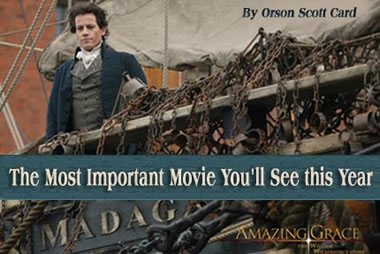
Amazing Grace is the story of William Wilberforce, the man who was most responsible (though he certainly did not work alone) for abolishing the slave trade and, ultimately, slavery itself, beginning with the British Empire, but ultimately around the world.
The trouble with a story like this is that while Wilberforce’s effort was heroic, fighting in what seemed to be a losing cause – yet one that could not, morally, be abandoned – the great moments consisted of speeches and votes, votes and speeches.
How much of this is a movie audience going to enjoy?
Writer Steven Knight (Dirty Pretty Things, Gypsy Woman, and, incredibly enough, various questions on Who Wants to Be a Millionaire) had a nearly impossible task. How do you take a man whose life was one long but deeply boring crusade and turn it into a thrilling, moving film?
Europeans with a Conscience
In the long run, it has to be a movie about slavery itself. Yet in another sense, the slaves were, by definition, nearly powerless to change their situation. The story is primarily about Europeans with a conscience – they are talking about the suffering of African slaves and trying to end it, but the slaves themselves are barely present.
The one African character who plays an important role in the struggle, Oloudaqh Equiano, is powerfully portrayed by Youssou N’Dour (best known as a composer). Otherwise, Africans are represented only by a few glimpses, in vision, of slave children.
This was absolutely the right choice. We needed to see only what most Englishmen of the time would have seen – the chains, the slave ships, and whatever they might imagine from the accounts they were given.
The relationships that mattered were among the influential people of London – people with money, people of faith, men in Parliament. The script jumps around a little in time, but does a good job of developing the key relationships in Wilberforce’s life.
First is his political friendship with William Pitt the Younger, played well by Benedict Cumberbatch (whose name is almost as silly as Wilberforce’s).
Second is the romance with his wife, Barbara, played with strength, wit, and grace by the remarkable Romola Garai , whom I remembered from her luminous performance as Kate Nickleby in the 2002 film of Nicholas Nickleby.
Third, but perhaps most moving, is Wilberforce’s friendship with his old teacher, John Newton. Albert Finney reminds us of his greatness as an actor, giving us a deeply convincing portrayal of the former slaveship captain who, stricken with remorse, lives a life of service to God, writing one of the greatest of all hymns, “Amazing Grace,” and then confessing his sins in a book that helped sway public opinion.
Powerful Performances
There are also powerful performances by the always-ambiguous and never-boring Rufus Sewell (Knight’s Tale, Tristan and Isolde) as abolitionist Thomas Clarkson, Toby Jones as the diminutive and slightly slimy Duke of Clarence, the bleakly powerful Ciaran Hinds (whom you may remember as Herod in The Nativity Story and Finn McGovern in Road to Perdition) as Lord Tarleton, and Michael Gambon (the replacement for Richard Harris as Dumbledore) as a great wreck of a man as Lord Charles Fox, and the enigmatic Georgie Glen as abolitionist Hannah More.
And don’t overlook the slightly goofy-faced Jeremy Swift, who was absolutely charming as Wilberforce’s butler. You may remember Swift from great small roles in Gosford Park (2001) and Oliver Twist (2005).
So strong are these performances that a lesser actor than Ioan Gruffudd (YO-un GRIFF-ith) would have been overwhelmed. Instead, Gruffudd proves once again that he has far more than his good looks to take with him into a role. His turns as Horatio Hornblower first caught the world’s attention, and it would be hard to imagine any other actor except, perhaps, a young Peter O’Toole, who embodies a similar mix of sensitivity and strength, vulnerability and force of will, along with a personal beauty that transcends mere attractiveness.
Please, let him never play James Bond. I only wait for him to get the role that is worthy of his talent – the role that will do for him what Lawrence of Arabia did for Peter O’Toole and Dr. Zhivago did for Omar Sharif.
This role is not it, alas – despite an excellent script, well directed by Michael Apted ( Firstborn [1984], Nell [1994], Enough [2002]), Amazing Grace tells a great story well, but it is not a great movie.
It doesn’t have to be. In an era when people so easily forget their own history, it is enough to have a merely good movie about a great life and a great achievement.
And when I compare Amazing Grace with Steven Spielberg’s wretched Amistad, this movie wins hands down. For Spielberg, as usual, could not tell the truth. He let political correctness deform the story: In Amistad, Spielberg relentlessly ridiculed and slandered the Christian abolitionists whose protests and vigilance were the only things keeping the mutinous slaves alive and free.
A Living Religion
Amazing Grace, on the other hand, does not hate Christians – this movie recognizes that it was Christianity alone that provided the foundation of virtue that ultimately allowed conscience to prevail over profit and long custom.
Not only that, but Knight and Apted realized that Christianity is still very much alive, and a people that actually tries to live up to its precepts will become the best of societies. When Ioann Gruffudd embarrasses a club full of worldly men by interrupting their drinking song to give a fervent rendition of “Amazing Grace,” the audience for the film is moved, as we are moved again by Wilberforce’s, Newton’s – indeed, everyone’s profession of faith.
It is worth keeping in mind that the abolition of slavery, worldwide, began with Christianity; sometimes we get our history so deeply screwed up that people blame Christians for slavery.
In fact, slavery was a nearly universal practice of human beings, taken for granted as the natural order of things, and while there were those, here and there, who tried to stanch the flow, it was only in Christian nations that people found the will to fight – by legislation where possible, by bloodshed where necessary – to end the ownership of one human being by another everywhere.
And it took the great “post-Christian” atheistic empires of Nazism and Communism to reinvent slavery. I don’t blame all atheists for that – but neither should we blame Christians for slavery when it was only Christians who succeeded in abolishing it.
You want your family to learn about the slave trade and how it really ended? Watch the first fifteen minutes of Amistad, until the slaves get to Boston, and then put it away and spend the rest of your time watching the far more honest, accurate, and fair Amazing Grace.
A Nation of Integrity
Not that Amazing Grace is perfect. While it is true to the life of Wilberforce, who was a pacifist, a communitarian, and a protector of animals, the movie does neglect to tell us what made England’s abolition of the slave trade so significant: Once it had stopped its own ships from trading in human flesh, England declared, unilaterally, that it would tolerate no slave ships upon the seas anywhere in the world.
Think about that. A nation dared to say that slavery was not only wrong for Christians, it was wrong for everybody, everywhere. And then, because it had the greatest navy in the world, the British declared war on all slave ships and then spent their own treasure and risked their own lives capturing any slave ship they found and bringing those who operated them to justice.
How could a British film tell that part of the story, in an age when the power elites are committed to hating America for behaving in exactly the same manner, and in a cause every bit as noble?
Despite the filmmakers’ best efforts, I could not help but think, as I watched this movie, that all those complacent people who argued against abolishing the slave trade were just as complacent, just as politically smart and morally dumb, as those today who abuse and ridicule President Bush and the American military for trying to offer the Muslim world the gift of democracy in place of suicide bombers, oppressive dictatorships, and endless poverty.
But you may be assured that you can watch this movie without having any contemporary message rammed down your throat. The filmmakers recognized that the story of William Wilberforce is one that should be vivid in everyone’s memory, no matter how you might personally apply the lessons of history to our present time.
Soundtrack Album
The producers of the soundtrack album for the movie Amazing Grace made a remarkable choice. While the music that plays under the scenes in this movie was excellent, and I really would like to have a recording of Ioann Gruffudd’s a capella performance of the title song, I think they made the right decision.
The album consists of modern renditions of the great Christian hymns of that period. Not just “Amazing Grace,” but such classic hymns as “All Creatures of Our God and King,” “Holy, Holy, Holy,” “Fairest Lord Jesus,” “I Need Thee Every Hour,” “Were You There?” “Rock of Ages,” “Nearer My God to Thee,” and “How Great Thou Art” – all of them rendered, not by church choirs, but by pop and folk singers who take the songs seriously.
Steven Curtis Chapman, Jars of Clay, David Crowder, Chris Tomlin, Natalie Grant, Martina McBride, and many others, bring strength and vigor to hymns that for some of us might be so familiar that we have stopped hearing them.
It’s good to remember that at one time these hymns were new, speaking from and to the hearts of living men and women. With this CD, they’re new again. I have listened to them over and over. Although not everyone will love every arrangement, I certainly did.


