





As there were ten generations from Adam to Noah, so likewise according to Jewish tradition, were there ten from Noah to Abraham [1](although some sources say eleven[2]). And “it was indeed high time that the friend of God’ should make his appearance upon the earth,”[3 for already there had arisen a pretender who audaciously claimed the patriarchal authority of Zion to rule over the human race and all living things: the proud and powerful King Nimrod.[4]
He is mentioned in both the Bible and the Book of Mormon as a mighty hunter, [5]and echoes of his name survive yet today in several ancient places, including in the region of Turkey that contains the city of Urfa. [6]
The name Nimrod appears to derive from the Hebrew word “to rebel,” [7]while tradition held him to be “a deceiver.” [8]
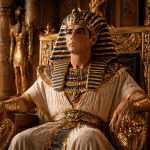
According to Jewish tradition, his claim of divine authority to rule the world was based on the patriarchal garment he had in his possession, the garment handed down from Adam through Noah and then stolen from him.[9] Donning the garment of Zion, he sought mightily to create a facade of Zion and the harmony by which it is known.
“Having gathered mankind in a monumental building project, Nimrod could turn the resulting sense of unity to his own ends.”[10] He would conveniently take all the glory – even as Satan had attempted in the Grand Council in heaven. Nimrod was indeed the very “antithesis of Zion.[11]
But despite the outward trappings of Zion, what Nimrod had established was not the peaceable earthly kingdom of God but the military earthly dominion of Satan. Nimrod had subdued nations and extended his kingdom far and wide, and is remembered in legend as one of the most ruthlessly effective conquerors ever. He “held sway over the entire world,” says a Turkish Islamic source.[12] The profile has an uncanny correspondence with that derived from historical sources about the ideal of kingship in the ancient Hittite empire, the likely location for the scene.[13]
According to such sources, “the Hittite king was the supreme military commander of his people,” while “the ideology of kingship demanded that he demonstrate his fitness to rule by doing great military deeds, comparable with and where possible surpassing the achievements of his predecessors. Military expansion became an ideology in its own right, a true sport of kings.'”
Indeed, one of the Hittite kings from this same era recorded his military exploits in terms of “a lion pouncing upon his prey and destroying it without mercy – an image of ruthless savagery” that “was to become a regular symbol of Hittite power.”[14]
Legend further remembers Nimrod as the most wicked of any man since the Flood, imposing idolatry and all manner of evil practices on his subjects, and forcing them to worship him as a god.[15] “Nimrod made men forget the love and worship of the true God, the Creator of the Universe, and led them on the path of sin and transgression.”[16]
Thus, Nimrod the hunter hunted not only great beasts but also the souls of men, seeking to turn them away from God.[17] We are reminded of the Book of Mormon’s exclamation that “how much iniquity doth one wicked king cause to be committed”! (Mosiah 29:17).
Among those led astray was the man who would be Abraham’s father, Terah, who is depicted in legend as extremely talented and successful, occupying a high position of power in Nimrod’s court. As “the prince of Nimrod’s host,” Terah was “very great in the sight of the king and his subjects, and the king and princes loved him, and they elevated him very high, … and dignified him above all his princes that were with him.”[18]
In that violent age of conflict and conquest, the world no doubt seemed to be determined by battles, not unlike a later age about which one writer observed: “Nobody thought of babies, everyone was thinking of battles. We fancy God can manage His world only with great battalions, when all the time he is doing it with beautiful babies. When a wrong wants righting, or a truth wants preaching … God sends a baby into the world to do it.”[19] And so it happened at that dark time of the world when, as Maimonides explained, the turning point came with the appearance of Abraham[20]
Despite Nimrod’s increasing power and arrogance, he lived in constant fear of losing his throne.[21] His concern heightened, says a Samaritan source, upon being advised by his wise men that “they had seen in the Book of Signs which had been handed down to them, that there would arise a man” destined to overthrow the idols and smite the idol worshipers. When his wise men pinpointed the projected date of birth, Nimrod imprisoned temporarily the men of his kingdom, to prevent the conception of this dangerous infant. But an unusual sign in the heavens created a panic that allowed Terah, in response to a vision that came to him, to escape unnoticed and be with his wife, and then slip back to the prison.
Meanwhile, when Nimrod’s wizards saw that the sign had been lifted, they exclaimed: “The child has reached the womb of his mother.” Nimrod released the prisoners, himself still a captive to an ever deepening anxiety.[22]
Portents of trouble continued to appear. According to a Turkish account from early Islamic tradition, Nimrod had a dream in which he saw his throne overturned by a charging ram. Nimrod’s soothsayers interpreted the dream to mean that a boy would be born who would ruin Nimrod’s empire.[23] In the Jewish version of the story differs, one night Nimrod’s astrologers witnessed an amazing phenomenon in the sky as a star rose in the east and seemed to swallow up the four stars in the four corners of the heavens. Hastening to their king, the astrologers reported the event as a sign that an infant was born that day who was destined to rule the world and overthrow Nimrod’s kingdom.
Various ancient sources report a heinous crime by the arrogant and cruel Nimrod as he ordered a terrible slaughter.
He had a proclamation published throughout his whole kingdom, summoning all the architects to build a great house for him … After it was completed, he issued a second proclamation, summoning all pregnant women thither, and there they were to remain until their confinement. Officers were appointed to take the women to the house, and guards were stationed in it and about it, to prevent the women from escaping thence. He furthermore sent midwives to the house, and commanded them to slay the men children at their mothers’ breasts.
But if a woman bore a girl, she was to be arrayed in [linen,] silk, and embroidered garments, and led forth from the house of detention amid great honors. No less than seventy thousand children were slaughtered thus.[24]
If such a thing sounds too evil to be real, one need only remember the tragic slaughter of the infants that would threaten the life of both Moses and Jesus as each of them entered mortality. Satan was waiting for these particular infants and determined to thwart their foreordained missions. Thus Abraham’s life, even at its inception, foreshadowed the destiny of his descendants.
The infant Abraham was saved only by being born in a cave and hidden away there for a time. “Let there be light” is how one modern Jewish writer describes Abraham’s entrance into history,[25] and the phrase is aptly descriptive of the signal birth that began to disperse the spiritual darkness of that age. At Abraham’s birth, in the cave to which his mother had fled, the place “was filled with the light of the child’s countenance as with the splendor of the sun.”[26]
Describing Abraham’s birth, an Ethiopic source adds that the bright light so astonished those present that they fell to the ground, whereupon there was heard “an outcry in a mighty voice, which said, Woe is me! Woe is me! There has just been born him that shall crush my kingdom to dust.’ And the voice wept.”[27] Thus were powers of both heaven and hell stirred when this infant, “trailing clouds of glory,” to borrow William Wordsworth’s poetic language, came from realms of light into the spiritually dark world of that day. Abraham was “a prince in the heavens,” noted John Taylor, “and by right came to the earth in his time to accomplish the things given him to do.”[28]
With Abraham’s birth, according to Jewish tradition, “desolation was over and a new light began to shine upon humanity.”[29] Even so, it was an extremely dangerous place to be born, a culture of death in which many infants did not survive.
The name he was given, “Abram” – meaning “the father is exalted” [30] or “the father is high” or “the father lifts himself on high” [31]– refers, says one legend, to Terah’s high status in Nimrod’s court: “Terah called the name of his son that was born to him Abram, because the king had raised him in those days, and dignified him above all his princes that were with him.” [32]
As would be the case with so much in the mortal life of Abraham, even his entrance into mortality echoed the past and foreshadowed the future. The brilliant light at his birth echoed that at Creation, when Christ the Creator, the Light of the world, had formed the great celestial luminary that would shine in the darkness and bring light to the earth. The light at Abraham’s birth also foreshadowed the time when the Creator would be born in the flesh as a light shining in a spiritually dark world (see John 1:1-5; D&C 93:8-11).
Early Christian sources further describe a “brilliant light” that surrounded the newborn infant Jesus.[33] As Abraham was prophesied to arise as a plant of righteousness in a corrupt world, so Isaiah prophesied that the Savior would grow up as a tender plant out of dry ground (Isa. 53:1-2). As a new star arose in the east when Abraham was born in a cave, so did it happen with the Savior (Matt. 2:1-11), whose birth, according to early Christian sources, was also in a cave.[34] The terrible slaughter of the infants at Abraham’s birth was repeated at the birth of Moses (Ex. 1:15-22; 2:1-10) and again at the birth of the Savior (Matt. 2:16-18).
In fact, according to rabbinic tradition, Abraham’s entire life “prefigured the future history of Israel”[35] in such a comprehensive way that “in his biography lives out the future history of Israel.”[36] “Everything that Abraham experienced,” maintained the Jewish sages, “has also been experienced by his descendants.”[37]
If Isaiah’s writings are valuable for prophesying all of Israel’s future (3 Ne. 23:1-3), so Abraham’s life is a rich portrait portending that same future, for “whatever happened to him would occur to his descendants.”[38] For example, his birth looks ahead also to his latter-day descendant Joseph Smith, whose own birth was also prophesied, anciently by the patriarch Joseph (2 Ne. 3:6-19), and later by Joseph Smith’s grandfather Asael Smith when he foretold that one of his descendants would “promulgate a work to revolutionize the world of religious faith.”[39] And as the powers of darkness seemed poised to persecute the infant Abraham, so it was with Joseph Smith who commented that “the adversary was aware, at a very early period of my life, that I was destined to prove a disturber and an annoyer of his kingdom; else why should the powers of darkness combine against me? Why the opposition and persecution that arose against me, almost in my infancy?”[40]
4. He “claimed to rule the world as God’s successor on earth.” Nibley, Teachings of the Pearl of Great Price, Lecture 23, 10.
6. Toorn, Becking, and Horst, Dictionaries of Deities and Demons, 629.
8. City of God, 16.4.
Ricks, “The Garment of Adam in Jewish, Muslim, and Christian Tradition,” both in Parry, Temples of the Ancient World, 649-739.
11. Research by Kerry Shirts, “Facsimile No. 1 and Opposition of Priesthoods: Nimrod’s Garment of Authority vs. Abraham’s Garment of Authority.
13 See below on probable location of Ur in what is now southeastern Turkey, in what was the ancient Hittite kingdom, as seen in Bryce, The Kingdom of the Hittites.
15. See Jasher 7:29-48, in Noah, Book of Yashar, 16-18; Ginzberg, Legends of the Jews, 1:177-78; Culi, Magriso, and Argueti, Torah Anthology, 1:429-30; Graves and Patai, Hebrew Myths, 125-29.
16. Rappaport, Ancient Israel, 1:235.
20. Davidson, Moses Maimonides, 237.
22. Pitron 5:16-26, in Gaster, Asatir, 223-25.
26. Ginzberg, Legends of the Jews, 1:188. quoting Maaseh Auraham Avinu 1:39-43.
28. Journal of Discourses,22:304.
30. Sarna, Genesis, 86; Speiser, Genesis, 124; Wenham, Genesis 1-15, 252; and Westermann, Genesis 12-36, 133.
32. Jasher 7:51, in Noah, Book of Yashar, 19. A different explanation is given in Jubilees: Abram was named after his mother’s father who had died earlier. Jubilees 11:15, in VanderKam, Book of Jubilees, 67. Obviously, these explanations are not necessarily mutually exclusive.
33. The Book of the Bee 36, in Budge, Book of the Bee, 80.
36. Neusner, Confronting Creation, 168.