





Teach ye diligently and my grace shall attend you, that you may instructed more perfectly in … things both in heaven and in the earth, and under the earth; things which have been, things which are, things which must shortly come to pass; things which are at home, things which are abroad; the wars and perplexities of the nations, and the judgments which are on the land; and a knowledge also of countries and of kingdoms – that ye may be prepared in all things when I shall send you again (Doctrine and Covenants 88:78-80).
A Mighty Cedar
Some three years [1] after Abraham and his followers arrived in the Promised Land, it was struck by famine. A modern writer has observed that for a person of Abraham’s day, “famine had the same resonance of terror as cancer or AIDS today. A modern American can find a twenty-four-hour supermarket packed with food within a ten-minute drive, so he has difficulty imagining the dread evoked in other times and places at the prospect of death by starvation.” [2]
What made matters worse for Abraham was the fact that the last time he had seen famine years earlier, it had come in the wake of the society’s failed attempt to execute him, and therefore appeared to be a vindication of his righteousness and God’s protection of him – that same God at whose command Abraham had now come to this land of promise. And in giving that command, God had announced himself to Abraham as the Controller of the world – at whose word the sea is calmed and mountains removed “in an instant suddenly” (Abr. 2:7).
Surely, then, it would be a small thing for God to simply reverse or remove this famine. One of the patterns of Abraham’s life was devout prayer for relief in the face of difficulty, and there is no reason to believe that he did otherwise in this instance. But the famine continued in all its severity, blighting crops and fruit, killing animals, and finally threatening the lives of Abraham and his community.
The heavens, from which God had spoken so often to his friend Abraham, now seemed bolted shut, allowing neither rain nor explanatory revelation. How could Abraham explain this to his followers, who had exercised faith in him as their inspired leader? Had God forgotten them after they had obediently come to this promised land? Why weren’t Abraham’s prayers answered? And what about God’s promise to bless Abraham and make his name great? The unfolding events seemed to be doing just the opposite.
But we read no words of complaint or questioning. The very purpose of the famine, according to Rashi, was “to test him whether he would have qualms about God’s promises.” [3] Other Jewish sources note that “after having unquestioningly complied with God’s command, Abraham should have been pelted with garlands, honored and revered … Instead, his journey to [the promised land appeared to be] a fiasco. Abraham should have protested. But no! Abraham did not question or complain.” [4] He “murmured not,” [5] and “neither protested nor assailed God’s justice.” [6]
For Abraham, it was yet another disappointment, another challenge in a life that seemed to be one trial after another. “The trials of Abraham” is how the learned Rabbi Eliezer wrote of the life of the Patriarch, [7] which is exactly how one might write of the life of Joseph Smith. And for both men, it seems that God was polishing his finest gemstones.
I am like a huge, rough stone rolling down from a high mountain,” said the Prophet Joseph, “and the only polishing I get is when some corner gets rubbed off by coming in contact with something else, striking with accelerated force … all hell knocking off a corner here and a corner there. Thus I will become a smooth and polished shaft in the quiver of the Almighty.” [8]
So it was with Abraham: rabbinic legend claims that among the stones that David used in his sling to slay Goliath, on the first stone was written the name of Abraham. [9]
In the polishing trials that Abraham faced, he met them with patience. “In every test to which the Lord subjected him,” says Jubilees, “he had been found faithful, and he was not impatient, nor was he slow to act, for he was faithful and loved the Lord.” [10] It was this love that sustained him; rabbinic sources tell that all of his many trials he “received with love” [11] and “stood firm in them all,” [12] thereby “demonstrating the extent of [his] love of God.” [13]
In fact, “Abraham showed his love for God by responding to his tests with deeds of loving-kindness,” thereby “utiliz[ing] each test as a tool for spiritual and personal growth.” [14] Abraham is the great example of the path to sainthood available to anyone who becomes “full of love” and, in a childlike manner, becomes “submissive, meek, humble, patient” and “willing to submit to all things which the Lord seeth fit to inflict upon him, even as a child doth submit to his father” (Mosiah 3:19).
And with that love came vision, as Nibley points out. “What keeps him going? He has a vision of something else. He knows something else besides the regular routines of this world.” [15] What did he know? John Taylor observed that although Abraham “was tried in almost every possible way,” yet he continued faithful, and, “inspired by the Spirit of the living God, in possession of the principles of revelation, holding the keys of the everlasting Priesthood, which unlocked the mysteries of the kingdom of God,” Abraham “looked forward and backward, and felt that” he was “part of the great program which God had designed to accomplish in regard to the earth.” [16]
His vision was shared by Sarah, who according to Jewish tradition possessed even greater prophetic powers than Abraham. [17] No murmuring word escaped her tongue when she could have easily complained of having left the goodly land of Haran for this famine-stricken place. Such silence in the record speaks loudly, as she above anyone else had cause – even the right – to protest, for if Abraham had been told to come here by the Lord, she had been told on ly by Abraham.
She might easily have complained also of the fact that, despite Abraham’s report of God’s promise of posterity, she yet continued childless. But her love for husband was too great, her commitment to her covenants too strong, her faith in the Almighty too unyielding, to allow her to criticize or complain. In the words of the learned Muslim scholar al-Tabari, Sarah “was one of the best human beings that ever existed.
She would not disobey Abraham in any way, for which God honored her.” [18]
In good times and bad, Sarah faithfully lived the law of Zion, faithfully maintaining that unity of heart that is always Zion’s crowning virtue. “From Sarah,” says a Jewish source, people “learn strength and constancy no matter what the odds.” [19] Together, Abraham and Sarah are, in the words of Erastus Snow, “models of noble character, purity of purpose,” and “superior integrity to God,” whom they “hesitated not to obey … at all hazards even to the sacrifice of that which was nearest and dearest unto them.” [20]
But having obeyed, they now faced the agonizing reality that there was simply not enough food in the famine-stricken land, making it impossible for them to remain. Nor could they return to Haran or Ur, which were also afflicted by famine and from out of which God had ordered them. Only one possibility loomed: Egypt, “the gift of the Nile,” where crops depended not on the vagaries of rainfall but on the annual flooding of the Nile. And so, Abraham tells in his autobiography, “I … concluded to go down into Egypt” (Abr. 2:21).
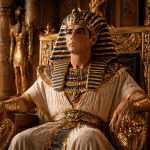
“Concluded,” he says, implying that this was a deliberate decision he alone had arrived at, and probably not without some difficulty. For this was the land of Pharaoh, whose evil priest had once raised the knife to sacrifice Abraham in a pagan rite (Abr. 1:7-20); Pharaoh, the powerful monarch who falsely claimed Abraham’s true patriarchal authority, and whose kingdom was but an idolatrous imitation of the true order of Zion on earth (Abr. 1:26-27). All this must have given Abraham pause as he contemplated journeying to Egypt; and, consistent with his practice, he must have made this a matter of fervent prayer.
Yet we read of no divine disclosure on this occasion. Apparently, Abraham was left to work this out on his own. The Zohar tells that “God purposely refrained from telling Abram to go down to Egypt, and allowed him to go of his own accord.” [21] But the experience was necessary and part of the Lord’s plan for Abraham, for if he “had not gone down into Egypt and been tested there, his portion would not have been in the Lord.” [22]
In fact, the Pirke de Rabbi Eliezer expressly reports that getting Abraham into Egypt was God’s purpose in sending the famine. [23] If the famine in Ur had been sent to vindicate Abraham, this one was sent to bless him, although such blessings are difficult to recognize at the moment. The famine became, in Abraham’s own description, “very grievous” (Abr. 2:21), making it impossible for Abraham and his people to remain. Sometimes even with His most faithful Saints, for their own good the Lord guides them by means of circumstances without disclosing His plan.
The trip to Egypt may have taken weeks, as they made their way slowly by the inland route through the Negev desert, probably via the Way of the Wells. Along the way, there were apparently settlements where some provisions might be bought. A group of Semites traveling to Egypt during this era was not unusual, as shown by the famous Beni Hasan mural showing just such a group around the time of Abraham. [24]
Arriving at the border, at the famed Wall of the Ruler, which consisted of a series of fortresses, Abraham’s group camped and prepared to pass through customs on the morrow. The border of Egypt, land of plenty, would have been a welcome sight for people fleeing from a famine-stricken land.
Only now did the Lord again spoke to his servant Abraham, but what was said must have seemed perplexing: “Behold, Sarai, thy wife, is a very fair woman to look upon; therefore it shall come to pass, when the Egyptians shall see her, they will say – She is his wife; and they will kill you, but they will save her alive; therefore see that ye do on this wise: Let her say unto the Egyptians, she is thy sister, and thy soul shall live” (Abr. 2:22-24).
In the Genesis Apocryphon version of the story, the divine warning comes in the form of a dream that Abraham has and recounts to Sarah on the very night of his entry into Egypt.
And I, Abram, had a dream in the night of my entering into the land of Egypt and I saw in my dream [that there wa]s a cedar, and a date-palm (which was) [very beautif]ul; and some men came intending to cut down and uproot the cedar, but leave the date-palm by itself.
Now the date-palm remonstrated and said, “Do not cut down the cedar, for we are both from one family” [or, “the two of us grow fr[om] but a [sin]gle root” [25] ]. So the cedar was spared with the help of the date-palm, and [it was] not [cut down]. (That) night I awoke from my sleep and said to Sarai my wife, “I have had a dream; [and I] am frightened by this dream.” She said to me, “Tell me your dream that I may know (it too).” So I began to tell her this dream; [and I made known] to [her the meaning of this] dream, [and] s[aid], “[ ] who will seek to kill me and to spare you. [N]ow this is all the favor [that you must do for me]; whe[rev]er [we shall be, say] about me, He is my brother.’ Then I shall live with your help and my life will be saved because of [ you. [ ] they will seek] to [ta]ke you away from me and to kill me.” And Sarai wept at my words that night. [ ], and Pharaoh Zo[an … so that] Sarai [no longer wished] to go toward [Egypt], lest any[one] should see her. [26]
It is yet another window into the soul of Sarah that although she wept, and even expressed her desire not to proceed to Egypt, yet we read not a word of contention or criticism that she ever uttered. Always she was Sarah the faithful, the loyal, the loving wife. And the comparison of these particular trees, the palm and the cedar, Sarah and Abraham is a powerful statement about their character, for according to the Psalms, “the righteous flourish like the palm tree, and grow like a cedar in Lebanon” (NRSV Ps. 92:12).
The Midrash, commenting on the story of Abraham in Egypt, explains how the righteous are like cedars and palms: “Just as a palm tree and a cedar produce neither crooked curves nor growths,” [27] so “the righteous have [no] crookedness” of character. Just “as the shadow of the palm and the cedar is cast afar, so is the reward of the righteous far away in the future world.” And just “as the heart of the palm and the cedar is directed upward, so are the hearts of the righteous directed toward the Holy One.” [28]
Abraham’s dream reflects the high demand for the precious cedar, the cedrus libani, or cedar of Lebanon, which was easily the most sought-after wood in the ancient Near East.
[29] Adorned with bluish-green needles, the branches grow straight out as the tree develops into its distinctive and majestic pyramidal shape, [30] attaining magnificent heights upwards of a hundred feet.
The finely-grained, reddish-colored wood is not only fragrant but strong, straight, and extremely durable, as well as resistant to rot and insects, making it anciently the coveted wood of choice for everything from furniture to coffins, and on a larger scale for ships and large and important buildings. With good reason does the modern flag of Lebanon bear the image of its famous tree, which from earliest times constituted an important trade item and figured prominently in the rise of the ancient Near East.
The original great cedar forests covering mountainous Lebanon and surrounding regions were extensively exploited by the successive dominant powers to float their imperial navies and erect their great edifices – everything from Solomon’s temple to Pharaoh’s palace.[31] But Pharaoh had to import the cedars, for while Egypt was nearly self-sufficient in natural resources, the major exception was timber from Lebanon and Syria. [32]
It is with some irony, then, that the Lord would later, speaking through Ezekiel, compare Pharaoh himself to “a cedar of Lebanon … of great height” and “beautiful in its greatness.” The tree described by Ezekiel is also a most unusual tree, whose roots penetrated down to the “abundant water” of “the deep” and whose top “towered high above the trees of the field” and ascended even “among the clouds,” and “in [whose] shade all great nations lived” (NRSV Ezek. 31:1-10).
According to one scholar, “while at first it seems to be a tree from Lebanon that is being depicted, the description soon broadens out beyond earthly proportions and sketches the picture of the great world tree,” that mythological cosmic tree offering shelter and protection for all life on earth. [33]
But as the Ezekiel passage and the Book of Abraham both show, Pharaoh’s claim to such grandeur was merely pretense, as Abraham well knew: “Abraham, possessed of the authentic records, knew Pharaoh’s secret – that his authority was stolen and his glory simulated.” [34] Nor did the other powerful monarchs of the ancient Near East possess the true patriarchal authority to preside over the human race, even though they would compare their rule to the qualities of a cedar, expressing the hope that their reign would be as benevolent and sheltering as the majestic tree. [35]
Such royal symbolism associated with the cedar was very ancient, [36] going back to the earliest traditions of ancient Near Eastern royalty in imitation of the deity, who as he sat on his throne was said to be holding a scepter of cedar, “a derivative of the Tree of Life [and] indicative of his royal status in heaven and on earth.”[37] Hence when the seventh antediluvian king in Mesopotamian tradition, Enoch, had been taken up and enthroned by the gods, he was handed a scepter of cedar. [38]
Enoch’s patriarchal authority was now held by Abraham, who was the mighty cosmic cedar that Pharaoh only pretended to be. Commenting on Abraham’s experience in Egypt, the Zohar expressly compares him to “a cedar [that] is pre-eminent and all sit under him. The world is supported upon one righteous one, as it is written, the righteous is the foundation of the world.'”[39] Abraham’s patriarchal authority was to establish what the Lord in latter-day scripture has called “Zion … a defense, and … a refuge from the storm” (D&C 115:6). Zion itself is the great cosmic cedar offering refuge and protection to all mankind.
Notes to Chapter 5
1. See Jubilees 12:28 through 13:11, in VanderKam, Book of Jubilees, 74-77 for chronology. The book of Abraham does not mention how long Abraham stayed in each place as he traveled through the promised land before entering
2. Egypt, although the Genesis Apocryphon apparently asserts that he lived in one location, at Hebron (not mentioned in Abraham’s pre-Egyptian itinerary in Genesis or the book of Abraham) for two years. 1QapGen 19.9-10, in Martinez and Tigchelaar, Dead Sea Scrolls Study Edition, 1:39.
3.Klinghoffer, Discovery of God, 62 (reading “imagining” for “imaging”).
4. Zornberg, Genesis, 93.
5. Scherman and Zlotowitz, Bereishis: Genesis, 1(a):391.
7. Kasher, Encyclopedia of Biblical Interpretation, 2:126.
8. Pirke de Rabbi Eliezer 26-32, in Friedlander, Pirke de Rabbi Eliezer, 187-238.
9. Galbraith and Smith, Scriptural Teachings of the Prophet Joseph Smith, 339.
10. Staalduine-Sulman, Targum of Samuel, 374.
11. Jubilees 17:18, in Sparks, Apocryphal Old Testament, 60. This statement in Jubilees directly precedes the account binding of Isaac.
12. Rabbi Joseph, Sha’are Orah, 342.
13. Pirke de Rabbi Eliezer 26, in Friedlander, Pirke de Rabbi Eliezer, 187.Soloveitchik, Man of Faith, 68, citing Av. 5:4.
14. Levy, A Faithful Heart, xiv, 13.
16. Journal of Discourses, 17:207. I have normalized the spelling of the word programme.
17.
See Encyclopaedia Judaica, 14:868; and Ginzberg, Legends of the Jews, 1:203.
18. Briinner, History of al-Tabari, 62.
19. Scherman and Zlotowitz, Bereishis: Genesis, 1(a):826.
20. Journal of Discourses, 23:228.
21. Zohar, Lech Lecha 82a, in Sperling and Simon, Zohar, 1:273.
22. Zohar, Lech Lecha 83a, in Sperling and Simon, Zohar, 1:276.
23. Pirke de Rabbi Eliezer 26, in Friedlander, Pirke de Rabbi Eliezer, 189.
24.See Klinghoffer, Discovery of God, 67.
25. Wise, Abegg, and Cook, Dead Sea Scrolls, 79.
1QapGen 19.14-23, in Fitzmeyer, Genesis Apocryphon, 60-61, omitting Zoan as anachronistic. Except for the brackets in bold, all others are in the original and indicate words or parts of workds that are difficult to read.
26.Genesis Rabbah 41:1:1, in Neusner, Genesis Rabbah 2:87.
28. Meiggs, Trees and Timber, 50.
29. Older trees gradually lose their pyramidal shape as the branches become widespread.
30.See, generally, Meiggs, Trees and Timber, 49-87, especially 55-56; Freedman, Anchor Bible Dictionary, 2:805; Buttrick, Interpreter’s Dictionary of the Bible, 1:545-46; Encyclopaedia Judaica, 5:268; Achtemeier, Harper’s Bible Dictionary, 159; Myers, Eerdmans Bible Dictionary, 197; New Encyclopdica Britannica 3:5; 20:453; 28:904, 907; Malek, In the Shadow of the Pyramids, 37; and Eisenberg, The Ecology of Eden, 116.
31.Malek, In the Shadow of the Pyramids, 84.
32. Zimmerli, Ezekiel 2, 147.
33. Nibley, Abraham in Egypt, 372.
34. Farbridge, Studies in Biblical and Semitic Symbolism, 33.
35. See E. Douglas Clark, “Cedars and Stars: Enduring Symbols of Cosmic Kingship in Abraham’s Encounter with Pharaoh,” in Gee and Hauglid, Astronomy, Papyri, and Covenant.
36. James, Tree of Life, 101.
37. Kvanig, Roots of Apocalyptic, 185. As discussed above, Enmeduranki is the Mesopotamian version of Enoch.
38. Zohar, Lech Lecha 82a, in Sperling and Simon, Zohar, 1:274. The quote is from Proverbs 10:25.