










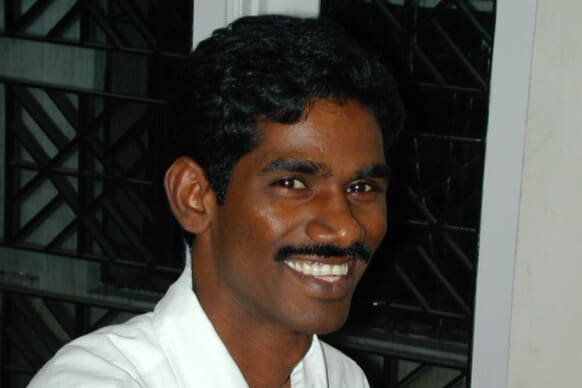


I had been invited to dinner at an exclusive country club in Chennai, India, by a group of wealthy men who had heard about our charity work with Rising Star Outreach. They wished to learn more to see if their service club (similar to Rotary Club) might become involved. The club was beautiful, bordering on opulent. I was frankly surprised to learn that Chennai had a golf club, but one of the men explained to me that it was established by the British in 1873. After the British left, it became a place for the wealthiest citizens of Chennai to socialize.
I asked if I could bring the Indian leader of our charity with me and they said it would be okay, so I asked Gopi to come with me. Gopi is one of the most wonderful people I know. He had been phenomenal in helping us to get Rising Star up and going and was running our pre-school at the time. He is, however, a darker-skinned Indian and from one of the lower castes. To me that made no difference, but when I showed up with Gopi, there was clear consternation among the group of men who were hosting me. One man took me aside and whispered that it was not appropriate to bring Gopi into the club. Taken aback, I informed him that I was very sorry for the inconvenience; however, if Gopi were not allowed in, I would not be joining them.
He excused himself for a few minutes and walked over to the group of men waiting to be seated with us. There was a hushed conversation. It was hard not to notice a real agitation in their demeanor, but finally one came back, cleared his throat, and explained to me that Gopi wasn’t dressed appropriately.
I meekly countered that at my country club back in America, if someone showed up for dinner without a jacket, one would be provided for him. With that, there was another quick conference, then a conferral with the maître d’ who apparently reluctantly agreed that given this unusual circumstance, Gopi could be provided with a jacket.
At the dinner, when Gopi addressed me, he called me “Becky.” Naturally! However, this was clearly not acceptable to others at my table. One man corrected him abruptly, insisting that, as his boss, I should be addressed as “Madam.” For the rest of the dinner, Gopi addressed me as Becky Madam. It was all I could do to keep from rolling my eyes.
By this point, I was convinced that these were not the people we would want to partner with. The dinner went on interminably, as they one by one explained to me what they did (and how important they were). Truth is, I could hardly wait to get out of there.
Finally, dessert was served and enjoyed. I thanked them for the lovely dinner and we moved to go home. The others motioned to the maître d’ that they were ready to have their drivers notified to come pick them up. The drivers were waiting in a parking lot up the hill. A person was dispatched to inform the drivers.
I took out my cellphone and called Mani, our driver, and told him we were ready to go. This caused another stir. “Your driver has a cellphone?” one man asked incredulously. (This was around 2004, when only the very wealthiest in Chennai had cellphones). There was obvious disapproval. After exchanging knowing looks between themselves, one man finally explained that Americans often seemed confused about the social order of things in Chennai. He would be happy to work with me and tutor me. “For one thing, you should never give a cellphone to an employee. They might become uppity. There should always be a clear difference between the classes.”
By now, I was convinced that this was not a probable partnership. They invited me to sit down on one of the beautiful sofas to wait for my driver, as it would take 15 minutes for the drivers to arrive. Glancing out the window, I saw our car pull up. I thanked them for the offer, but with a wink and a smile, added, “My car is already here. It seems that giving our driver a cellphone is quite convenient, timewise. Good evening, gentlemen.”
As we drove away, I couldn’t help but think of a quote by the Rev. Charles Milikin, a Methodist Episcopal minister from Chicago, “It is the way one treats his inferiors more than the way he treats his equals, which reveals one’s real character.”

Mani with his family, in front of his humble home.
Mani, our driver, is another one of my most treasured friends in India. I had met Mani when he was the driver at the orphanage I had originally come to visit in India. I had noticed how the children adored him. Every chance he got, he would play with them, laugh with them, encourage them, listen to them, and advocate for them. The children brightened visibly every time he came in the room. He was gentle and kind.
Later, when we decided to start our own charity to focus on leprosy-afflicted families, I heard through the grapevine that Mani had left the original orphanage. I jumped at the chance of bringing this kind man onto our team. We hired him as our driver, months before we ever even had a car or a van!
Amy Antonelli, our Executive Director, affectionately named Mani as “our protector.” This was not meant to be negate God’s protection; it was literal. On several occasions Mani had literally saved our lives.
One day as Amy and I stepped up into our large van, Mani smiled to greet Amy, but then his smile instantly morphed to alarm. “Oh, oh, oh!” Mani jumped out of his seat as Amy ascended the steps into the van, and with cupped hands swooped something off Amy’s hair. He was rapidly shaking his cupped hands back and forth as he frantically used his elbows to lower the driver’s window. As the window slid down a few inches, Mani quickly tossed whatever was in his hands out the window.
Amy and I were staring at him, cluelessly. He said breathlessly, “Bad spider. . . go hospital. . . many die.” That stopped me dead in my tracks as I realized that Mani had taken the deadly spider into his own hands to save Amy. I was speechless and completely humbled by his courage and love.
Another example: the volunteer home was very close to the Chennai beach. Every morning as the beach thronged with people, Amy would go running on the beach. But one day, we had to leave early for a meeting. We were engaged the entire day, splitting up to cover all the bases we needed to cover. When I arrived back at the volunteer home, it was late evening and beginning to get dark. I was surprised that Amy was not there. Her meeting was to have ended before mine. When I asked the housemother where Amy was, she replied that Amy had gone for a run on the beach. That worried me. Chennai could be a dangerous place for a single woman, especially in the gathering dark.
I tried to call Mani, who had dropped me off, but he didn’t answer. Now I was really panicked. I knelt and prayed, asking God to protect Amy. I called Gopi to see if he could come quickly and join me to search the beach.
Within a few short minutes Amy walked through the front door. She seemed a bit shaken. She explained that as she went running, she became uneasy as it got dark sooner than she had expected, so she didn’t run the full distance she normally did. Instead, she turned back to get home before it became completely dark. She became aware of some men that had fallen in, running behind her. Her adrenaline kicked in and she picked up her pace. The men behind her picked up their pace, as well. Panicked, her eyes swept the beach. There was no one else on the beach. As she now began a full sprint, she sent a prayer heavenward. She could hear the men gaining on her.
Suddenly Amy heard a van coming up behind her, on the beach, honking wildly. The men behind her scattered. Amy glanced back, her heart racing, but was overwhelmingly grateful to see that it was our van and Mani was driving. As he stopped and she climbed into the van, she gushed out, “Thank you! Thank you! Mani! You have saved me.” Mani gave her a stern lecture in his broken English about running alone in Chennai. Trying to catch her breath, Amy asked, “Mani, how did you know to come?” Mani responded simply, “God tell me.”
There were several other times when Mani literally saved us. He was always watching out for our safety. As our charity grew and we obtained more cars, vans, and drivers, everyone instinctively knew that when I came to India, Mani would be my driver.
Because my schedule in India was always hectic — it seemed I was forever trying to pack in more meetings before leaving to go back home — Mani often had to drive 12 to 16 hours a day when I was there. He never complained. I tried to honor the fact that he had Saturdays off, but one time I had a critical meeting with our financial team. They could only meet me on Saturday. I hesitated to ask Mani for his only day off that week, but I had no other choice, as one of our drivers was sick, and other two were out of town with our medical clinic.
When I asked Mani if he could take me to the Saturday meeting, his eyes clouded over. There was a pause before he answered. He finally said that if I could change the meeting to an hour later, he said he would be able to drive. He explained that on his day off every week he would go to a school for blind children. They funded their school by doing laundry for some hotels. Mani would pick up the laundry from the hotels and deliver it to the school. At the end of the day, when the laundry was finished, Mani would pick it up and deliver it back to the hotels. He did this without charging them. It was his own personal service project.
I was astounded that he was working many hours on his day off, without pay, but as a service to children who were extremely disadvantaged. It fit perfectly, though, into his remarkable character.
Mani served with us at Rising Star for over 20 years, before finally retiring. Two years ago he was diagnosed with terminal cancer and given 6 months to live. But miraculously, he is still alive and guiding his family with devotion. I try to make sure I see him every time I go to India. I always leave his humble home uplifted by his kindness and inspired to become more like him.
Another quote attributed to Samuel Johnson has a similar message to the Rev. Milikin’s quote: “The true measure of a man is how he treats someone who can do him absolutely no good.” I would add, or how he treats those whom others consider unimportant. That includes all kinds of people that we all meet in our everyday lives, such as waitresses, janitors, housekeepers, gardeners, the doorman at the hotel, our Uber drivers, those who care for the elderly — the list goes on and on. It would include those who live in less affluent neighborhoods, those who drive old beat-up cars, those who may be unattractive or dressed poorly. Each person is a cherished child of God, making them more important than earthly kings.
I love C.S. Lewis’s statement, “You have never met a mere mortal.” This intimates that those we meet have eternal, immortal souls. They are children of eternal, glorified parents, who in fact, rule the universe. They have inherited from their Heavenly Parents the ability to one day become glorified like them.
Nephi was definitely thinking along the same lines when he wrote, “And he [God] inviteth them all to come unto him and partake of his goodness; and he denieth none that come unto him, black and white, bond and free, male and female; and he remembereth the heathen; and all are alike unto God, both Jew and Gentile. 2 Nephi 25:33
Mani and Gopi both seem to naturally honor the importance of each human being. By that measure, it seems to me, that in God’s eyes they are far greater than those who disdained them at the ill-fated country club dinner!







NancyFebruary 19, 2026
Dear Becky I look forward to all of your articles! I aspire to be more like you in many ways. Bless you for all that you do! Is there anything you cannot accomplish? Much love, Nancy from Montana
JanetteFebruary 11, 2026
Beautiful article and such a great reminder!