







Cover image via Wikimedia Commons.
In 1 Nephi chapter 8 we read of the prophet Lehi’s vision of the Tree of Life. His account was written on golden plates centuries ago and came forth in the Book of Mormon in 1830.
Is it possible that some of the inhabitants of ancient Mesoamerica also recorded his vision graphically in stone, circa 300 BC?
In 1941, Mathew Stirling led a joint expedition of the National Geographic Society and the Smithsonian Institute to the Izapa archaeological site near the town of Tapachula in southwestern Mexico. They began excavating the first of over 80 monuments there, located within sight of the two tallest mountains in Central America. An 8-feet tall stone sculpture or “stela” designated number “five” at their dig was believed to be the most complex carving discovered in all of the Americas. It has been dated to approximately 300 B.C.[i]
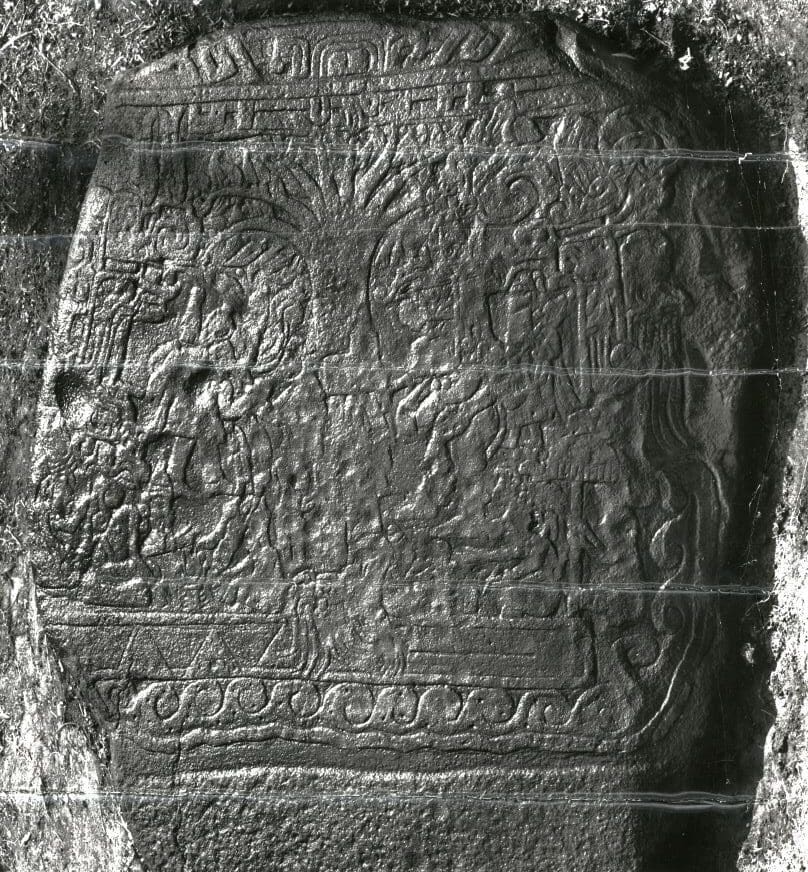 The carving contained a number of parallels to similar Assyrian and Babylonian depictions of the Tree of Life in the Old World. In each of the cases, a large fruit-bearing tree was flanked by two winged beings, who were shown caring for and protecting the tree. They held out purse-like objects toward the tree in one hand, and pine cone-like objects in the other. In her 1950 dissertation, Irene Briggs listed this and other parallels between Old World cultures and those found in the New World.[ii]

In 1958, Dr. Wells Jakeman, head of the Archaeology Department at Brigham Young University, published a booklet[iii] in which he asserted that other elements of the Stela 5 carving had possible connections to Lehi’s vision in the Book of Mormon. His drawings were made from Stirling’s original 1941 photograph, provided by the Smithsonian. There were six human figures seated around the foot of the tree on Stela 5 whom he identified as Sariah, Lehi, Laman, Lemuel, Nephi, and Sam. There was also a straight line at the base of the tree that Jakeman identified as the “rod of iron” in Lehi’s vision, and some wavy lines with dots inside that he felt depicted the “river of filthy waters” of the prophet’s dream.
The old bearded man figure that Jakeman designated as “Lehi” on the left side of the tree seems to be gesturing as if telling a story, and the figure of “large stature” Jakeman identified as Nephi sitting beneath a parasol on the right side (as befits royalty or a leader) holds a stylus-like object as if recording the account. In all, Dr. Jakeman found 25 elements in the carving that he believed were related to Lehi’s “Tree of Life” vision. 
Dr. Jakeman’s interpretation of Stela 5 Izapa was met with enthusiasm by many Latter-day Saints as an affirmation of their faith in the Book of Mormon as an historic document. BYU sent a team to Izapa in 1958 to make a rubber latex mold of Stela 5, which was then used to create a replica of the stone that was prominently displayed for many years in the archaeology exhibit in BYU’s Maeser Building. (It is now in storage at the Museum of Peoples and Cultures on campus.) Another replica made from the same mold is owned by a family in the town of Central, Arizona.
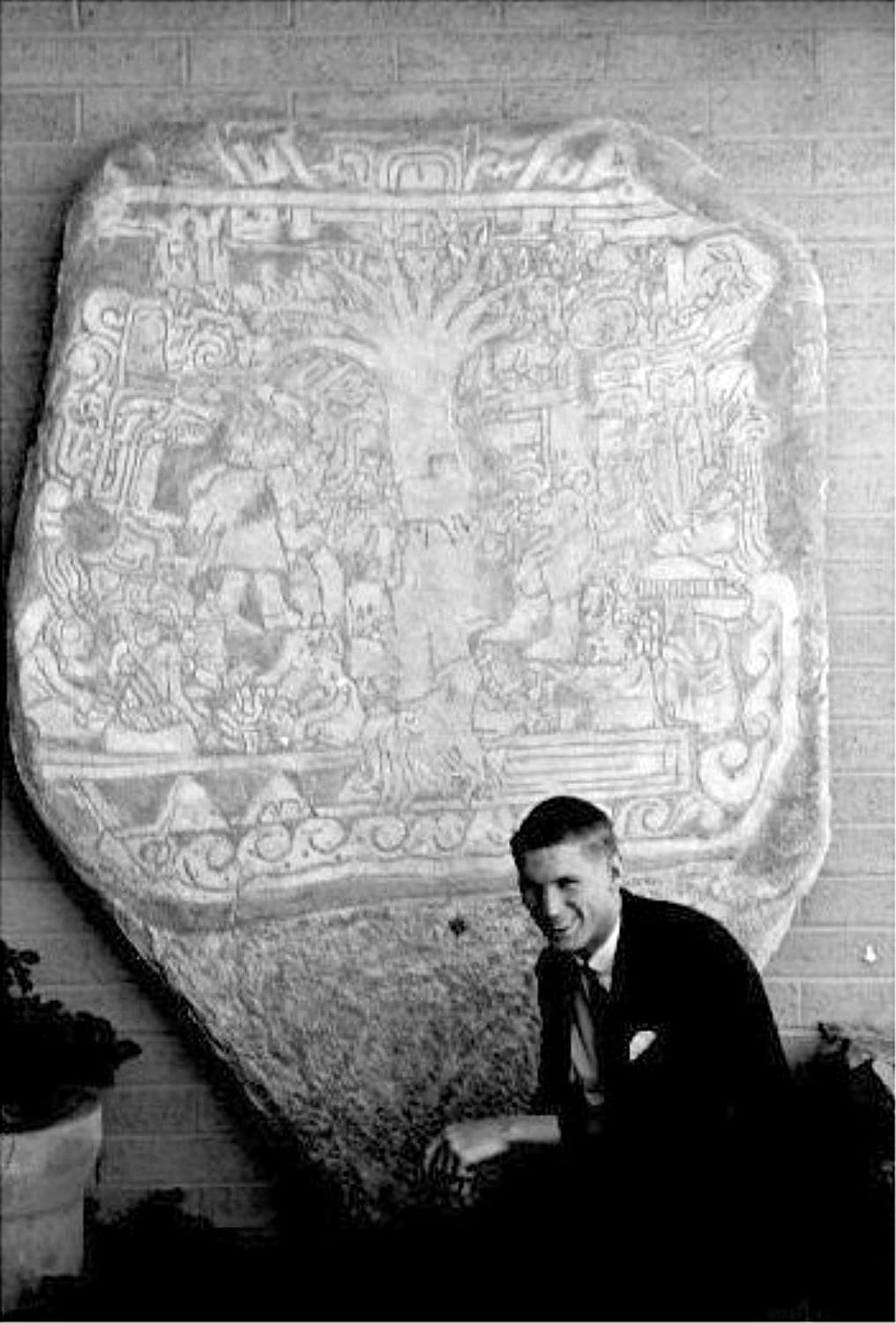
In 1962, a BYU student named V. Garth Norman became so interested in the Izapa monuments that he boarded a bus and traveled to Chiapas, Mexico to see them for himself. His efforts soon led to a position with the New World Archaeological Foundation, which performed extensive excavations and study at the Izapa site under the direction of Gareth Lowe from 1962-1982. Norman made the study of Izapa a life’s work, and he discovered many astronomical features of the complex, as well as a connection to the Egyptian and Babylonian cubits used in the Old World for measurements.
In 1973 Norman published a new drawing of Stela 5, based on a photographic analysis using artificial lights at night, placed at different angles. His conclusions agreed with Jakeman in some respects, but he differed in others. He also found at the Izapa complex a number of visual parallels to accounts recorded in the Popol Vuh, an ancient American indigenous text.[iv]
Other researchers of varying backgrounds and faiths have published differing interpretations of the scene depicted on Stela 5. In 1999, John Clark, head of the BYU Anthropology Department, published a new drawing based on the work of artist Ayax Moreno. His interpretation based on this drawing alleged no connection to the Book of Mormon.
In 2012, Garth Norman returned to Izapa with Jason B. Jones, an imaging specialist from the University of Warwick in the United Kingdom. Using a new technology called Reflectance Transformation Imaging (RTI), they produced computer-enhanced, ultra-high resolution images more detailed than any made previously. This advanced 3D imaging technique reveals details in stone carvings not visible to the naked eye.[v] Their findings were presented in 2014 at a conference of the Society for American Archaeology. Norman’s conclusions from these new images differed from the Clark-Moreno study and drawings. In many respects, they confirmed his own 1973 findings, which in turn agreed with at least some of Jakeman’s original opinions.
So, can Stela 5 Izapa reasonably be called the “Lehi Stone”? Does it depict Lehi’s vision of the Tree of Life? Differing opinions remain. Like the Book of Mormon itself, every person must decide for themselves where the truth lies. As Clark summarized in his 1999 Journal of Book of Mormon Studies article, although he feels it would be a “long shot”, a connection to Book of Mormon peoples “cannot be completely ruled out”.
He writes:
“The last Jaredite king, Coriantumr, carefully prepared a record on stone of his royal descent and status (see Omni 1:20–22). That is clearly a Mesoamerican-like thing for him to have done.” … “After all, Izapan art had its roots in the Olmec tradition” …
“[Stela 5] could fit within the general tradition of art and rulership that ended officially with Coriantumr’s demise, but which might have persisted among the later Mulekites in the form of myths, art elements, and other cultural patterns all the way down to Izapa’s heyday and beyond.”[vi]
(end)
Robert Starling has been a writer and producer for the NBC Television Network, and at Schick Sunn Classic Pictures, Osmond Productions, and the media production department of The Church of Jesus Christ of Latter-day Saints. His recent book “A Case for Latter-day Christianity” is available in many bookstores, on Barnes and Noble, and on Amazon.com in printed and e-book versions. He lives in Riverton, Utah with his wife Sharon. They have four adult children and eleven grandchildren.
[i] Archeological Investigations in Southern Mexico, 1938-1946
[ii] https://scholarsarchive.byu.edu/etd/4554/
[iii] Stela 5 Izapa, Chiapas, Mexico, BYU, University Archaeological Society, Special Publication 2, 1958
[iv] https://www.mesoweb.com/publications/Christenson/PopolVuh.pdf
[v] https://youtu.be/FBlrHf5zz_Q?si=3w5FumlUQEHCvVu_
[vi] https://scholarsarchive.byu.edu/jbms/vol8/iss1/6/?utm_source=scholarsarchive.byu.edu%2Fjbms%2Fvol8%2Fiss1%2F6&utm_medium=PDF&utm_campaign=PDFCoverPages