







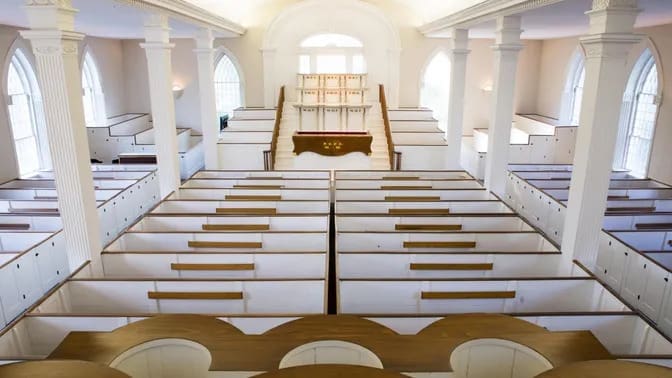


One hundred and ninety years ago, in a remarkable series of visions inside the newly dedicated Kirtland Temple, Joseph Smith and Oliver Cowdery received the keys of temple work. This series of three articles seeks to increase understanding of the priesthood keys restored on that occasion. It includes excerpts from The Heart of Our Covenants: Temple Principles that Draw Us unto Christ by Valiant K. Jones. Used by permission. See www.valiantjones.com or www.cedarfort.com.
This is part 3 of 3.
See the first part article in this series here.
See the second part article in this series here.
This series of articles has expounded on the remarkable series of visions that occurred in the Kirtland Temple on April 3, 1836. The reception of priesthood keys on this occasion was a culmination of a series of restoration experiences. The following table summarizes the most significant of the priesthood restoration events of this dispensation.
Priesthood Restoration Events for Joseph Smith and Oliver Cowdery
| Restorer | When | Where | Purpose and Keys Restored |
| John the Baptist | May 15, 1829 | On the banks of the Susquehanna River, near Harmony, Pennsylvania | Aaronic Priesthood: the keys of the ministering of angels and of repentance and baptism (see D&C 13) |
| Peter, James, and John | Most likely in late May 18291 | In the wilderness between Harmony and Colesville, Pennsylvania (see D&C 128:20) | Melchizedek Priesthood: the keys of spiritual blessings, including the Holy Ghost, and the keys of church administration (see D&C 27, 84, 107) |
| Moses | April 3, 1836 | Temple in Kirtland, Ohio | The keys of the gathering of Israel (see D&C 110) |
| Elias | April 3, 1836 | Temple in Kirtland, Ohio | The keys of the Abrahamic covenant including eternal marriage (see D&C 110) |
| Elijah | April 3, 1836 | Temple in Kirtland, Ohio | The keys of sealing for all ordinances for the living and the dead (see D&C 110) |
Let us review the succession of the receipt of these priesthood keys and see how they build on one another. John the Baptist first appeared to Joseph Smith and Oliver Cowdery to “confer the Priesthood of Aaron, which holds the keys of the ministering of angels, and of the gospel of repentance, and of baptism by immersion for the remission of sins” (D&C 13:1). Next, Peter, James, and John restored the Priesthood of Melchizedek, which holds the “keys of all the spiritual blessings of the church” (D&C 107: 18), including the gift of the Holy Ghost. They also “committed the keys of the kingdom, and a dispensation of the gospel for the last times” (D&C 27:13). Furthermore, “this greater priesthood administereth the gospel and holdeth the key of the mysteries of the kingdom, even the key of the knowledge of God” (D&C 84:19).
At this point, Joseph and Oliver possessed the keys and authority to perform all the ordinances of salvation, but they lacked the authority to spread this work of salvation globally. Moses came and filled this gap, providing “the keys of the gathering of Israel from the four parts of the earth” (D&C 110:11). Joseph and Oliver also lacked the keys and authority necessary to perform the exaltation ordinances of the endowment and eternal marriage. This was remedied with the bestowal of the keys of the Abrahamic covenant by Elias who “committed the dispensation of the gospel of Abraham” (D&C 110:12).
The keys and authority necessary to perform all ordinances had now been restored; however, this was still not enough. Up to this point, any ordinances were provisional and could only be performed for the living. Additional keys were needed to be able to seal the eternal validity of these ordinances in heaven and to make it possible to perform the same ordinances for the dead. These keys were restored by Elijah who restored keys “to turn the hearts of the fathers to the children, and the children to the fathers, lest the whole earth be smitten with a curse” (D&C 110:15).
We might ask why Jesus could not have conferred all these priesthood keys Himself. Certainly He held all priesthood keys, so surely, He could have. However, Christ respects and honors those He calls into stewardship under Him, and He provides opportunities for participation and personal growth as broadly as He can.
Similar to Joseph and Oliver, Christ’s apostles Peter, James, and John received priesthood keys from Moses and Elijah on the Mount of Transfiguration (see Mathew 17, Mark 9, and Luke 9). These two Old Testament prophets had gone to heaven without tasting death, allowing them to be able to return and corporally lay their hands on the heads of Peter, James, and John for the transmission of priesthood keys before Christ broke the bands of death and made resurrection possible. In addition, Joseph Smith has implied that John the Baptist was present.2 However, the Baptist could only have been there in spirit since he had recently died (see Matthew 14:1-12). Therefore, his presence could not have been for the transfer of his keys. That transfer of Aaronic Priesthood keys, although not recorded in the New Testament, had undoubtedly occurred while John the Baptist was living. Perhaps the Baptist came, in spirit, to the Mount of Transfiguration in order to be instructed by Jesus on the future transfer of the priesthood keys that everyone present would participate in 1800 years later: Jesus, John the Baptist, Peter, James, John, Moses, and Elijah.
We might wonder why the keys of Moses, Elias, and Elijah needed to be restored to Joseph Smith, since the work of the priesthood was already under way by the time they came. Their visits occurred in April of 1836, yet the Church had been organized in April of 1830. During the intervening six years, many members had been baptized and received the gift of the Holy Ghost, and many brethren had been ordained to the priesthood. Were these ordinances performed on earth without being sealed in heaven? Also, Samuel Smith had already been set apart in June of 1830 as the first official missionary of the Church, and he had already been sharing copies of the Book of Mormon throughout New England.3 Was this not the start of the gathering of Israel? Furthermore, Joseph Smith had received some degree of revelation regarding eternal marriage as early as 1831,4 and he performed anointings in the upper rooms of the incomplete temple in January of 1836.5
Clearly, the spirit of the restoration of the priesthood keys was already at work on the earth before Moses, Elias, and Elijah appeared. However, all of those early events were very limited in scope. Until the final restoration of the priesthood keys in the Kirtland temple, those actions and ordinances were only provisional. The Lord was laying the foundation of the restoration line upon line and precept upon precept. The work of gathering Israel and the work of forming eternal families could not expand beyond their early limited scopes until all priesthood keys were restored. In addition, the work of salvation for the dead could not and did not occur until after Elijah’s visit.
It appears that Joseph Smith was able to take those initial steps to begin the work of salvation under the authority of the Melchizedek priesthood and the mantle of his prophetic calling. This preliminary authority may have been what Joseph and Oliver received as a pronouncement from God when “the voice of God in the chamber of old Father Whitmer, in Fayette, Seneca county” (D&C 128:21) instructed them on steps to take to establish the Church. In his 1838 history, Joseph Smith placed this sacred, authorizing event shortly after the visit of John the Baptist.6 BYU professor Michael Hubbard MacKay has researched this event and suggested that it brought priesthood authority to Joseph before the bestowal of the keys of the Melchizedek Priesthood by Peter, James, and John.7
Clearly, the scope of Joseph’s early priesthood efforts was limited until he received the fulness of priesthood keys in the Kirtland temple. It is interesting to note that the quorum of the Twelve Apostles had only been established less than a year prior to the restoration of these priesthood keys, and their missionary endeavors had not yet extended beyond short, regional missions in North America. The foundation was being laid so that Joseph could share these keys with the new apostles. After these keys were restored, Joseph started sending missionaries to distant nations across the oceans.8 All of the priesthood keys necessary to direct the work of salvation for the living and the dead were once again upon the earth.
President Packer taught, “Elijah came . . . and bestowed the keys of the sealing power. Thereafter ordinances were not tentative, but permanent. The sealing power was with us. No authorization transcends it in value. That power gives substance and eternal permanence to all ordinances performed with proper authority for both the living and the dead.”9
Restored Keys Extend Christ’s Atonement to All
Because of the events at the Kirtland Temple on April 3, 1836, the restored keys of Moses, Elias, and Elijah are now carried out as a unified system of priesthood ordinances in hundreds of temples scattered throughout the world. The purpose of these keys is to expand the reach of the Atonement of Jesus Christ to everyone who has ever lived upon the earth.
The Prophet Joseph Smith explained why this work is so important: “The greatest responsibility in this world that God has laid upon us is to seek after our dead. The apostle says, ‘They without us cannot be made perfect;’ (Hebrews 11:40) for it is necessary that the sealing power should be in our hands to seal our children and our dead for the fulness of the dispensation of times . . . . It is necessary that those who are going before and those who come after us should have salvation in common with us; and thus hath God made it obligatory upon man. Hence, God said, ‘I will send you Elijah the prophet before the coming of the great and dreadful day of the Lord: he shall turn the heart of the fathers to the children, and the heart of the children to their fathers, lest I come and smite the earth with a curse.’ (Malachi 4:5.)”10
Without the keys restored by Moses, Elias, and Elijah, “the whole earth would be utterly wasted at [Christ’s] coming” (D&C 2:3). But now, through the great work of gathering Israel on both sides of the veil, and through temple work performed under the keys of Elias and Elijah for the living and the dead, the purpose of the creation of the earth is being fulfilled, and Christ will not need to smite it with a curse when He comes. Instead, He will be joyful knowing that the earth’s purpose has been fulfilled, facilitated by the restoration of priesthood keys.
These keys of the priesthood continue with us today. At the time of the death of Joseph Smith, most of the twelve apostles were away on missions. Apostle Wilford Woodruff and quorum president Brigham Young were in New England, and they met together in Boston shortly after learning of the martyrdom. Later, when President Woodruff was prophet himself, he recounted the following memory of that occasion:
“We were overwhelmed with grief and our faces were soon bathed in a flood of tears. … After we had done weeping we began to converse together concerning the death of the prophets [Joseph and Hyrum Smith]. In the course of the conversation, [Brigham] smote his hand upon his thigh and said, ‘Thank God, the keys of the kingdom are here.’ . . .
“President Young . . . referred to the last instructions at the last meeting we had with the Prophet Joseph before starting on our mission. . . . On that occasion the Prophet Joseph rose up and said to us: ‘Brethren, I have desired to live to see this temple built. I shall never live to see it, but you will. I have sealed upon your heads all the keys of the kingdom of God. I have sealed upon you every key, power, principle that the God of heaven has revealed to me. Now, no matter where I may go or what I may do, the kingdom rests upon you.’ . . .
“The keys of the kingdom of God are here, and they are going to stay here, too, until the coming of the Son of Man. Let all Israel understand that. They may not rest upon my head but a short time, but they will then rest on the head of another Apostle, and another after him, and so continue until the coming of the Lord Jesus Christ in the clouds of heaven.”11
We are blessed to have these keys with us today, held active and viable by a living prophet who is a modern apostle of Jesus Christ. It is under the direction of these keys that sacred priesthood ordinances are now performed in temples throughout the earth.
President Nelson said, “Consider how your life would be different if priesthood keys had not been restored to the earth. Without priesthood keys, you could not be endowed with the power of God. Without priesthood keys, the Church could serve only as a significant teaching and humanitarian organization but not much more. Without priesthood keys, none of us would have access to essential ordinances and covenants that bind us to our loved ones eternally and allow us eventually to live with God.
“Priesthood keys distinguish The Church of Jesus Christ of Latter-day Saints from any other organization on earth. Many other organizations can and do make your life better here in mortality. But no other organization can and will influence your life after death.
“Priesthood keys give us the authority to extend all of the blessings promised to Abraham to every covenant-keeping man and woman. Temple work makes these exquisite blessings available to all of God’s children, regardless of where or when they lived or now live. Let us rejoice that priesthood keys are once again on the earth!”12
We do rejoice! We are blessed to live in a time when these priesthood keys are active on the earth, allowing us to participate in the work of salvation and exaltation on both sides of the veil. Besides maintaining our own personal righteousness, there is no better way to show our love for Jesus Christ and to prepare for His Second Coming than to gather the children of Israel under the direction of these priesthood keys so that all have the opportunity to progress along the covenant path toward exaltation.
I Shall Love Thee Better after Death
Many poets have written about a romantic love that will last forever. Eternal love has been a topic of sonnets, songs, and poems throughout all literature. Such longings speak to one of the deepest and most profound emotions men and women experience. However, simply declaring one’s love for another person will not create a bond that will last throughout eternity. Only sealing ordinances administered through priesthood keys will do that.
In her sonnet, “How Do I Love Thee,” Elizabeth Barrett Browning wrote, “How do I love thee? Let me count the ways./ . . . I love thee with the breath,/ Smiles, tears, of all my life; and, if God choose,/ I shall but love thee better after death.13
Desires expressed in poems and songs cannot create bonds that will be sanctioned by God throughout eternity. A person may claim, “I shall but love thee better after death,” but this is only possible if two conditions are met. First, a couple must have an eternal marriage that is solemnized by an authorized temple sealer who has been set apart under the delegated authority of the living prophet of God. And second, that couple must embrace their temple covenants in such a way that those covenants start to change their natures. Only through living our temple covenants can we become sanctified in Christ and have our marriage “sealed by the holy spirit of promise” (D&C 132:7). That process may not be completed in this life, but if we will stay on the path—the covenant path—it will eventually be achieved with the help and grace of Jesus Christ.
This is why the keys of temple work matter. They create the foundation of sanctioned authority upon which eternal marriages can be established as well as the covenant environment in which eternal family relationships can flourish. In his own poetic prose, Elder Parley P. Pratt described the feelings he experienced when he first learned the doctrine of eternal families and the joy that came to him from knowing these eternal truths:
“It was Joseph Smith who taught me how to prize the endearing relationships of father and mother, husband and wife; of brother and sister, son and daughter. It was from him that I learned that the wife of my bosom might be secured to me for time and all eternity; and that the refined sympathies and affections which endeared us to each other emanated from the fountain of divine eternal love. It was from him that I learned that we might cultivate these affections and grow and increase in the same to all eternity . . . .
“I had loved before, but I knew not why. But now I loved—with a pureness—an intensity of elevated, exalted feeling, which would lift my soul from the transitory things of this groveling sphere and expand it as the ocean. I felt that God was my heavenly Father indeed; that Jesus was my brother, and that the wife of my bosom was an immortal, eternal companion . . . . I could now love with the spirit and with the understanding also.”14
This eternal love, so beautifully described by Elder Pratt, is possible because of the sacred temple keys that were restored in the Kirtland temple on April 3, 1836. What a blessing to have these keys effective today under the direction of a living prophet of God in hundreds of temples throughout the world. Like Elder Pratt, I, too, am grateful to be sealed to the wife and children of my bosom for eternity. Only in the Church of Jesus Christ of Latter-day Saints are these eternal blessings available because of the restoration of the sacred priesthood keys of temple work. This is the foundation for a love that truly will be “better after death.”
Valiant K. Jones is the author of The Heart of Our Covenants: Temple Principles that Draw Us unto Christ. For more information, see www.valiantjones.com
Footnotes
1 Larry C. Porter, “The Restoration of the Aaronic and Melchizedek Priesthoods,” Ensign, December 1996, churchofjesuschrist.org/study/ensign/1996/12/the-restoration-of-the-aaronic-and-melchizedek-priesthoods?lang=eng. In June 1829, Joseph Smith received D&C 18, which stated that Oliver Cowdery and David Whitmer were to be called as apostles (verse 9) and were to select additional members of that quorum. This implies that the Melchizedek Priesthood had already been restored by that time.
2 The Joseph Smith Translation of Mark 9:3 says, “And there appeared unto them Elias with Moses, or in other words, John the Baptist and Moses,” and under “Elias” in the Bible Dictionary says, “The curious wording of JST Mark 9:3 does not imply that the Elias at the Transfiguration was John the Baptist, but that in addition to Elijah the prophet, John the Baptist was present.”
3 Ryan Carr, “The First Latter-day Missionary,” New Era, Sept. 2004, lds.org/new-era/2004/09/the-first-latter-day-missionary?lang=eng.
4 The heading to D&C 132 says, “Evidence indicates that some of the principles involved in this revelation [on Eternal Marriage] were known by the Prophet as early as 1831.”
5 Richard O. Cowan, “The Unfolding Restoration of Temple Work,” Ensign, Dec. 2001, lds.org/ensign/2001/12/the-unfolding-restoration-of-temple-work?lang=eng.
6 Joseph Smith, History, 1838–1856, volume A-1 [23 December 1805–30 August 1834], p. 27, The Joseph Smith Papers, josephsmithpapers.org/paper-summary/history-1838-1856-volume-a-1-23-december-1805-30-august-1834/33.
7 Michael Hubbard MacKay, “Event or Process? How “the Chamber of Old Father Whitmer” Helps Us Understand Priesthood Restoration,” BYU Studies Quarterly, Vol. 60, No. 1, 2021, p. 73, byustudies.byu.edu/article/event-or-process-how-the-chamber-of-old-father-whitmer-helps-us-understand-priesthood-restoration/.
8 “Chapter 24 Truth Shall Prevail,” Saints Volume 1, site.churchofjesuschrist.org/study/history/saints-v1/24-truth-shall-prevail?lang=eng.
9 Boyd K. Packer, “Ordinances,” ibid.
10 Joseph Smith Jr., Teachings of the Prophet Joseph Smith, p. 356; see also Joseph Smith Jr., “Chapter 41: Becoming Saviors on Mount Zion,” ibid.
11 Wilford Woodruff, “The Keys of the Kingdom,” Ensign, April 2004, churchofjesuschrist.org/study/ensign/2004/04/the-keys-of-the-kingdom?lang=eng.
12 Russell M. Nelson, “Rejoice in the Gift of Priesthood Keys,” Liahona, May 2024, churchofjesuschrist.org/study/liahona/2024/05/57nelson?lang=eng.
13 Elizabeth Barrett Browning, “How Do I Love Thee? (Sonnet 43),” Academy of American Poets, accessed October 20, 2024, poets.org/poem/how-do-i-love-thee-sonnet-43.
14 Parley P. Pratt, “He Taught Me the Heavenly Order of Eternity,” Ensign, August 2015, churchofjesuschrist.org/study/ensign/2015/08/he-taught-me-the-heavenly-order-of-eternity?lang=eng; formatting modified.




Ann-Marie JensenApril 16, 2026
Thank you for clarifying the keys restored by Elias and Elijah — a question I’ve had for many years. Your research is thorough and helpful.