






Tender pork roast. Mashed potatoes and gravy. Sweet corn from the garden. I eagerly anticipated the leftovers from Sunday dinner as I filled my plate with Monday’s lunch. Sliding the food into the microwave oven and pressing START, I continued listening to a Come Follow Me podcast on my Bluetooth speaker. But the voices began to cut out until they disappeared altogether. I checked the speaker to see if it needed to recharge, but no, the power light was still on.
The microwave timer dinged and instantly my podcast resumed. As I retrieved my food, it occurred to me that the microwaves must have messed with the Bluetooth speaker. A quick Google search revealed that microwaves and Bluetooth devices interfere with each other because they both use ultra-high frequency radio waves.
While savoring my pork roast and potatoes, I pondered this idea. What voices do we allow into our heads? Do any of them interfere with the voice of God as found in the scriptures? With the voice of the prophet? Do we listen to voices that obscure the whispers of the still, small voice?
VOICES
Never has the world been so filled with voices as today. Never has it been so convenient for anyone who has an opinion to express it to a large audience. The internet is a digital megaphone for anyone who wishes to be heard. If ever there was a time we could relate to young Joseph Smith’s dilemma, it is now. He wrote that there was “…no small stir and division among the people, some crying, “Lo here! and others, “Lo, there!” … In the midst of this war of words and tumult of opinions, I often said to myself: What is to be done? Who of all these parties are right… and how shall I know it?” (JS History 1:5,10)
President Russell M. Nelson gave this warning: “The voices and pressures of the world are engaging and numerous. But too many voices are deceptive, seductive, and can pull us off the covenant path…If most of the information you get comes from social or other media, your ability to hear the whisperings of the Spirit will be diminished. If you are not also seeking the Lord through daily prayer and gospel study, you leave yourself vulnerable to philosophies that may be intriguing but are not true.” (1)
Some of the most seductive voices on social media come from Latter-day Saints who appear to be active members of the Church. They may be articulate and offer clever opinions, they may be completely sincere, but some of what they offer may not be in complete harmony with scripture, or the teachings of living prophets and apostles. The differences may be subtle, but dangerous.
“O the vainness, and the frailties, and the foolishness of men! When they are learned they think they are wise, and they hearken not unto the counsel of God, for they set it aside, supposing they know of themselves, wherefore, their wisdom is foolishness and it profiteth them not… But to be learned is good if they hearken unto the counsels of God.” (2 Nephi 9:28-9)
SOURCES
When we choose to listen to social media voices, we might ask ourselves: Is what we’re hearing doctrine or opinion? We must be wary of sources that contradict or undermine the teachings of the scriptures, living prophets, or established church doctrine. This includes unofficial websites, blogs, podcasts, other social media accounts, and publications that may not accurately represent Latter-day Saint beliefs.
We learn much from Joseph Smith’s example. After serious efforts to sort through the religious opinions of his day, he recognized that he could not find satisfying answers on his own. So, in faith, he turned to the scriptures, which led him to the ultimate authority on truth: God. He used pure sources of information. Proven voices.
In recent years, the term “influencer” has come into vogue. AI tells me that an influencer is someone who has the ability to affect the decisions of others because of their authority, knowledge, position, or relationship with their audience. They use their credibility and popularity to endorse products, promote brands, or advocate for certain causes.
Some people become influencers due to their fame as entertainers or professional athletes, and freely promote their opinions, even on spiritual topics. But just because they’re famous or popular doesn’t necessarily mean they’re right. “Trust no man be your teacher or minister save He be a man of God.” (Mosiah 23:14)
The Book of Mormon is full of spiritual influencers; some righteous, some dangerous. Nephi, Alma, Ammon, and Captain Moroni fearlessly raised their voices to persuade people to believe in Jesus Christ. Other influencers, such as Sherem, Nehor, and Korihor, used their voices to spread intriguing but false opinions. The anti-Christ Nehor was one of the biggest influencers of his day. People were still following the “order of Nehors” many years after he first spouted his comfortable doctrine that “all mankind should be saved at the last day.” (Alma 1:4)
It is prudent to ask ourselves who our primary influencers are, and if the influencers we’re listening to are trying to build the kingdom of God, or if they’re trying to build their own kingdom, and promote their own agendas instead of the doctrine of Christ. The Savior taught, “Hold up your light that it may shine unto the world. Behold, I am the light you should hold up.” (3 Nephi 18:24, emphasis added)
Samuel the Lamanite’s question is very appropriate for our day: “… how long will ye suffer yourselves to be led by foolish and blind guides? (Helaman 13:29)
CHOICES
Last year, my daughter and I set off for a Spring Break adventure in Kanab, Utah. We enjoyed the first few hours of our drive south on I-15, singing along to Becca’s playlist. About halfway through our journey, my phone rang. It was a family friend we hadn’t spoken to in years, and we chatted with him for twenty minutes or so, catching each other up on news of our families.
The call finally ended, and Becca and I spent the several minutes discussing our upcoming red rock adventure. Suddenly, I realized that I’d been so engrossed in conversations with my daughter and our friend that I hadn’t been paying attention to where we were on I-15, so I started looking for signs and mile markers to give me a clue as to our current location. By the time I figured out where we were, I was chagrined to find that we’d passed the obscure turnoff I should have taken nearly thirty-five miles earlier.
I pulled off at the nearest exit so we could plan our next move. As I studied our map, I was relieved to see that we wouldn’t have to backtrack thirty-five miles. We were just a mile or so from a road that cut across to the east and joined up with the little highway that would lead us south to our destination. Putting the car in gear, I pulled back onto the street. I had driven just a few miles on our new route when my phone rang again. This time, it was my husband who was calling to check on us.
I sheepishly admitted that I had missed our turnoff but had found an alternate route and we were back on track. When Brad realized which road were taking, he immediately cautioned us to turn around and backtrack to the original turnoff that I had missed. I questioned his advice. Backtracking would increase our drive time by a full hour, and it would soon be getting dark.
My daughter and I had chosen a new route based on our map, but Brad knew from personal experience what the map didn’t show: our alternate road would climb nearly 3000 feet, taking us to an altitude of 8400 feet, where there would still be snow the first week of April. The roads were winding and unimproved in some spots and we would be traveling the second half of it in the dark. Brad strongly encouraged us to turn around.
I had a choice to make. I did not want to follow my husband’s advice since it would add significant time to our journey. But decades of marriage had taught me to trust Brad’s judgment, his proven voice. I admit that I sighed heavily as I slowed the car and turned it around, but as night fell while Becca and I traversed the safer highway, I felt the Spirit confirm that following my husband’s counsel was the right choice.
Some voices tell us what we don’t want to hear, yet following their counsel may ensure our safety. Just as my husband had more information than my map showed, God sees the bigger picture. He sees what is not always apparent to us–the snow, the winding roads, the darkness that is about to engulf us, spiritually speaking. Faith is listening to His voice, even when we don’t see what He sees, because He has proven that He can be trusted.
“For my thoughts are not your thoughts,
neither are your ways my ways, saith the Lord.
For as the heavens are higher than the earth,
so are my ways higher than your ways,
and my thoughts than your thoughts.”
(Isaiah 55:8-9)
If we take time to examine the words of our prophets over the past few decades, we can recognize their inspired teachings and warnings. We can see that they prepare us for difficulties ahead—for world conditions and evils we could not have predicted on our own. We have seen and continue to see the fulfillment of their prophecies. The same applies to scriptural prophecies and warnings.
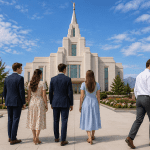
Our attitude about living prophets and apostles is so crucial that it is part of the temple recommend interview. (2) In the temple endowment, the Lord makes it clear that He sends messengers who will lead us back into His presence if we give strict heed to their voices. Do we understand who those messengers are?
Voices, sources, and choices. Who are we listening to? It is a question worth pondering today. I leave you with a hymn text, written for our time:
“When great swells of urgent voices
cry, “Lo here!” and cry, “Lo there!”
when the vast array of choices
leads to genuine despair,
Let no contest of opinions
sway me from the path of Christ.
Let me look to purest sources,
searching daily in the light.” (3)
Notes:
- President Russell M. Nelson, Make Time for the Lord, 2021 General Conference, emphasis added.
- “Do you sustain the President of The Church of Jesus Christ of Latter-day Saints as the prophet, seer, and revelator and as the only person on the earth authorized to exercise all priesthood keys? Do you sustain the members of the First Presidency and the Quorum of the Twelve Apostles as prophets, seers, and revelators?” (Temple recommend question #4.)
Lynne Perry Christofferson, When I Question, When I Wonder, hymn, 2019. FREE sheet music download at: https://www.christoffersonmusic.com/_files/ugd/e7467c_75f689ba714e47c5ba9e8b86625d709f.pdf