



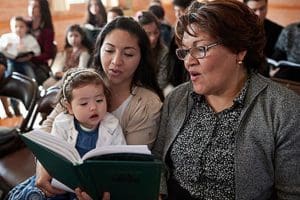








Hearing the voices of our ancestors often refers to the spiritual connection and guidance we feel through family history work and temple ordinances. Yet, literally hearing their voices through recordings can awaken memories, deepen our understanding of who we are, and strengthen our ties to our heritage. Considering this sacred gift, let us not forget future generations by preserving the voices of today as a legacy of faith for our descendants of tomorrow.
Amber did not know she was about to change something for all of us.
When my niece discovered an Audiobook recording of my father reading one of his books, Inside The NRA, it seemed almost incidental at first — an unexpected artifact tucked away, quietly waiting. Yet, the moment I pressed play, the room changed. His voice filled the space, unmistakable and alive. In an instant, memory awakened, emotion rose and love settled in.
It was not simply that I heard his words again. I heard him. The pauses he always took. The cadence shaped by conviction and kindness. The familiar steadiness that once guided our home. Time seemed to fold inward, and for a brief, sacred moment, distance dissolved. My father’s voice reached across time and gathered me in.
That experience lodged itself in my heart and refused to leave. It revealed something I had always known, but never fully named: a voice carries presence. Long after a life has ended, a voice can still testify, still teach, still love. It can speak peace into the present and belonging into the future.
Over the years, I have grown increasingly aware of a quiet urgency to capture voices — those of our ancestors and, perhaps more tenderly, our own. We are diligent about preserving records. We safeguard photographs, journals, certificates, and documents. All of these matter. They tell us who belonged to whom, where we came from, and when events occurred. Yet voices preserve something different. They preserve presence.
The Sound That Carries a Soul
I learned this lesson most powerfully while working with Ervin.
As we gathered his history, we collected what family history work often emphasizes: scanned documents, photographs carefully labeled, posters that told his story, videos of still images accompanied by captions, and genealogical files meant to endure. Everything was important. Everything had value.
Yet when his family heard the audio recording — the sound of Ervin’s voice — something entirely different happened. Even though he had been with them only months before, that gentle, distinctive accent moved them to tears. The room softened and hearts opened as his voice bypassed explanation and went straight to the soul.
What struck me then, and still does now, is that his voice carried what no document ever could: his humanity. His gentleness. His resilience. Hearing him speak made him present again, not as a name on a chart or a story summarized in paragraphs, but as a living soul.
Gratitude fills my heart when I think of the privilege it was to listen to Ervin as he told me his story. Learning about his life and the family he lost in the Holocaust was sacred ground. His voice became a testimony — not only of survival, but of dignity and faith carried quietly across decades. (see To Spark A Memory: A Forgotten Heritage Restored for Ervin’s story)
Why Voices Matter
“For those who shall be destroyed shall speak unto them out of the ground, . . . for the Lord God will give unto him power, that he may whisper concerning them, even as it were out of the ground . . .” (2 Nephi 26:16)
A voice carries truth differently than written words. It conveys joy and sorrow, certainty and searching, humor and humility. It holds the weight of lived experience. Its very sound invites the Spirit in a way that feels immediate and personal.
Instinctively I think of Elder Jeffrey R. Holland. His messages are powerful when read, but when heard in his own voice they become something more as emotion trembles, conviction steadies, and testimony breathes. The Spirit teaches not only through what is said, but through how it is said. Even though he has left his mortal estate, Jeffrey Holland’s voice bears witness.
Our family experienced that same awakening when Amber found my father’s recording. Hearing him speak his own words stirred memories of kitchens and living rooms, of conversations shaped by faith, conviction, and love. That discovery led to a simple yet profound idea: Amber thought that my siblings and I might record ourselves reading our father’s book, Peace, War, and Politics, preserving our own voices as we “tell” our father’s story.
As we talked about it, the idea felt less like a project and more like a continuation. His witness would not end with his passing. Familiar phrases, remembered convictions, and the steady influence of a father whose voice once filled our home would continue to be heard. In a quiet way, it felt like an invitation — to our family and to others — to consider what voices might yet be preserved, and what testimonies still need to be spoken.
Our Ancestors Still Speak
“I have written according to the best of my knowledge, by saying that the time passed away with us, and also our lives passed away like as it were unto us a dream . . .” (Jacob 7:26)
The voices of our parents, grandparents, and ancestors testify of who they were and how they lived. When we record them, we do more than preserve information — we preserve identity. A voice allows us to hear belief, perseverance, tenderness, and hope.
It is easy to assume it is too late. Sometimes it is. Yet, often living grandparents, aging parents, elderly neighbors, and extended family members whose stories remain unrecorded can be captured. Many believe their lives were ordinary. Ervin might have said the same. His voice is now a priceless inheritance.
Recording a voice does not require a studio or perfection. A simple device such as your phone; a quiet space such as a living room, and a willingness to listen are enough. What matters most is presence, patience, and love.
Leaving Our Own Voices for the Future
“Thy speech shall whisper out of the dust.” (Isa. 29:4)
Recording our own voices can feel uncomfortable. Many of us dislike how we sound or wonder whether anyone will care. Yet one day, someone will want to know not only our story or what we believed, but how we sounded when we said it.
They will want to hear laughter. They will want to hear emotion when a memory catches in the throat. They will want to hear testimony spoken plainly and imperfectly, wrapped in love. Your voice will anchor them. It will remind them who they come from.
If it helps, think of recording as a conversation with someone you love who is not yet born. Speak slowly. Pause when emotion comes. Let your voice be real. Authenticity carries its own authority.
Voices That Reach Beyond the Veil
“And now, my beloved brethren, all those who are of the house of Israel, and all ye ends of the earth, I speak unto you as the voice of one crying from the dust: Farewell until that great day shall come.” (2 Nephi 33:13)
Scripture teaches that voices can rise from the dust and speak again. Family history makes that truth tangible. When we hear recorded voices of those who have passed on, we are reminded that death does not silence influence. Voices continue to teach, comfort, warn, and testify.
Listening to Ervin’s voice felt like that—someone speaking from beyond the veil. His story ceased to be abstract. His voice made it personal. It made it live.
Covenant, Connection, and Continuance
“I will hear what God the Lord will speak: for he will speak peace unto his people . . .” (Psalms 85:8)
Every voice is unique. Even among siblings, no two are the same. A voice carries memory, authority, reassurance, and belonging. Hearing my father’s voice anchors me — reminding me who I am and where I come from.
Our covenant relationship with God gives deeper meaning to this work. As disciples of Jesus Christ, we covenant to stand as witnesses. When we preserve voices — those of our ancestors and our own — we honor both our family lines and our sacred promises. Testimony offered through a voice becomes living witness.
Let us not wait. Let us record the voices of those we love while we can. Let us leave our own voices behind for those who will one day listen and feel connected, strengthened, and known. In doing so, we allow generations yet unborn to hear not just our stories, but our hearts — and through them, our testimony of Jesus Christ.
Closing Testimony
“[Y]e are called to bring to pass the gathering of mine elect; for mine elect hear my voice and harden not their hearts . . .” (D&C 29:7)
I testify that voices matter deeply to God. He speaks, He listens, and He remembers. He invites us to listen — not only for one another, but for Him. “Listen to the voice of Jesus Christ, your Redeemer,” is both command and promise. When He speaks, He speaks peace.
I have felt that peace while hearing the voices of those who have gone before me — voices that seem to rise softly from the dust, whispering faith, courage, and love. I have felt it when my father’s voice filled the room again, and when Ervin’s voice reminded us that influence does not end with death.
I believe that as we preserve voices — our ancestors’ and our own — we participate in holy remembering. We bind generations and leave a witness. We allow our posterity to hear not only what we believed, but how belief sounded in our lives.
May we listen more carefully, and record more intentionally. May our voices, offered in love and testimony of Jesus Christ, continue to speak peace long after we are gone.






Kay Wiemer GerkeJanuary 15, 2026
I have not been this moved by reading an article in a very long time. Tanya Neider writes in a way that captures your heart, mind, and soul. Her descriptive style conveys spiritual depth that can only come from a lived dedication to the gospel and an understanding of the most tender human emotions. I agree with her sentiments in every way, and I plan to take her wise advice to record myself and others with purpose. I look forward to her column each month; she is a gifted writer with valuable insights.