





Photos by Philippe Kradolfer and Howard Collett
When you think of Audry Hepburn, Harrison Ford, or Tom Cruise, what comes to mind?
Perhaps it’s Audry’s elegance in a black dress, Harrison’s rugged fedora, or Tom’s iconic aviator sunglasses.
Costumes in film are never just clothes. They are visual storytelling. Done well, they tell us who the character is before a single word is spoken.
That is certainly true for The Ten Virgins.
Consider the challenge: Ten young women, each with her own story, background, responsibilities, and level of faith. A refugee. A fish vendor. A shepherdess. An olive grower. A weaver. Each requires clothing that feels authentic—not only for the first century but to her personal journey.
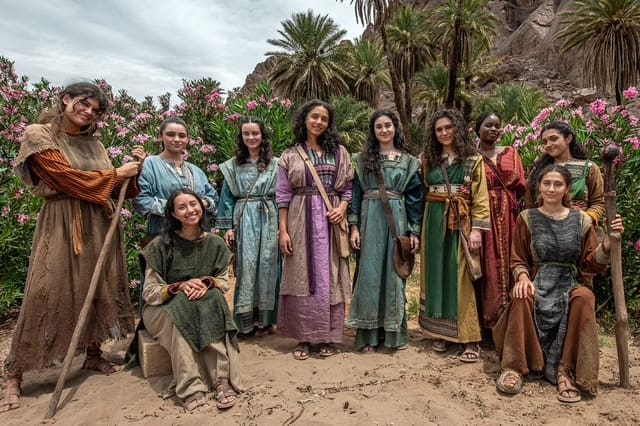
The ten virgins pose for a group photo near the ancient Fint Village in Morocco. Their costumes are as different as the girls who wear them.
To bring these women to life, costumers Sonya Harris and Abderahim Benkyayi and their team have searched across Morocco for fabrics, jewelry, and accessories that help tell each character’s story.
What they cannot find, they make.
“We are creating a story that is full of life,” said Harris. “We used color combinations to match the nature of the girls. Eliza wears purple, a color associated with wealth. Daniella and Lila wear the colors of the ocean [they sell fish], and rustic browns for Miriam, the shepherdess. The king is in indigo, another very expensive fabric.”

Ghizlane Jmile and Rachid Zine sew tirelessly, day after day, to create costumes for actors and extras.
Textures matter too.
Two girls, Chaya and Maya, are weavers,” Harris explained. “We wanted their clothing to look like something they might have made themselves. We also showcase them with props like a loom which they will use with some training.”
Behind the production office, long stretches of fabric hang drying after being washed and dyed by hand. Tunics, shawls, sashes, and head coverings are cut, sewn, and aged to look as though the stepped out of the first century.

Abderahim fits a costume to one of the actors.
Every costume begins with research. Historical references are studied. Fabrics are selected, dyed, cut, sewn, weathered, and finished with period-appropriate details.
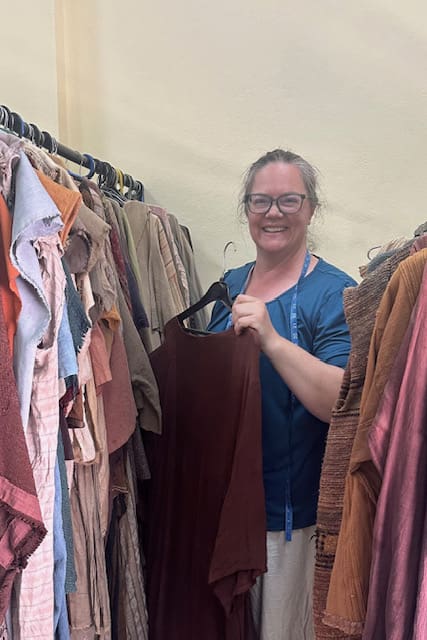
Sonja Harris pulls one of hundreds of costumes from the racks.
You can’t buy a first-century outfit for a young Jewish woman on Amazon.
By the time filming begins, the talented team will have created more than 80 costumes for principal actors—many with multiple wardrobe changes—along with costumes for more than 120 extras. And for the concluding wedding feast, there are 80 wedding garments.

Youssef Ait Hamd fits an accessory to the Bridegroom’s costume
The result is remarkable. When audiences watch The Ten Virgins, they will see much more than clothing. They will see faith, culture, and history woven together—one stitch at a time.