







 The revelations which profusely poured from the lips of the Prophet Joseph Smith have proven to be incalculable to most. Even his most bitter enemies, as well as enemies of the Church today, find nothing regarding the doctrine they can positively refute. The understanding of God, His son Jesus Christ, and the revelatory evolution of His Kingdom on Earth all began with Joseph’s ability to hear God’s word by direct revelatory experiences as well as through the Holy Ghost. Joseph’s experience translating The Book of Mormon had a direct impact on his subsequent ability to translate and create the New Translation of the Holy Bible, or as it is currently referred to, The Joseph Smith Translation (JST). Joseph’s translation experience with the Bible led him directly into many of his early revelations found in the Doctrine & Covenants (see D&C 45:60-62) and further prepared him to translate The Book of Abraham.
One interesting set of verses in the JST relates to the creation of man. In our efforts to teach people, some not of our faith, that God has a physical, immortal, and exalted body, Latter-Day Saints frequently refer to the creation story of man found in Genesis 1 and Moses 2. Genesis in the JST renders the pertinent verses in this manner:
Genesis Chapter 1
27
26And I, God, said, unto mine Only Begotten, which was with me from the beginning, Let us make man in our image, after our likeness; and it was so. And I, God, saidandlet them have dominion over the fishesfishof the sea, and over the fowl of the air, and over the cattle, and over all the Earth,earth,and over every creeping thing that creepeth upon the Earth.earth.28
27And I,SoGod, created man in minehisown image; in the image of mine Only BegottenGodcreated Ihehim; male and female created Ihethem.
In these two verses we see that God, Elohim of the Tanakh (the Hebrew Bible), taught Moses that He made man in “mine his own image” as well as the image of “mine Only Begotten, which was with me from the beginning,” His “Only Begotten” was of course none other than Jesus the Christ, the Messiah, Jehovah of the Old Testament. What we may not notice at this point in the creation story, was the fact that God the Father at the time had a physical, immortal, and exalted body while His son Jehovah, was still a spirit being; a God to be sure, but a spirit none-the-less. This is further substantiated in The Book of Mormon when the brother of Jared saw the spirit body of Christ prior to his coming to earth in a mortal form. (Ether 33:16) Thus, God’s words of making man “in our image” is apropos. (italics are mine) Later in JST Genesis 6, we get a further explanation of this creative event. Note that this is Genesis 5:1-2 in the KJV and Moses 6:8-9 in The Pearl of Great Price.
Genesis, Chapter 6
Genesis, Chapter 56
1And a genealogy was kept of the children of God. And this wasThis isthe book of the generationgenerationsof Adam, saying, In the day that God created man, (in the likeness of God made he him) in the image of his own body.7
2Male and female created he them and blessed them and called their namesnameAdam, in the day when they were created, and became living souls, in the land, upon the footstool of God.
Notice in verse 6 1 that Joseph further clarifies that Adam was created “in the image of his own body.” Whose body? God the Father’s. The body of Elohim. This makes perfect sense when we realize that Adam was provided with a physical body, in a spiritual state in the Garden of Eden, a body which became “natural” after the fall. At the time of Adam’s creation Jehovah was still in a spirit body and while Adam was created in the “image” of both the Father and the Son, his physical creation could only be in the image of the Father whose body was also spiritual, not just spirit. D&C 88:27 describes righteous resurrected beings as “spiritual”. Once again, a subtle yet insightful look at Adam’s creation story by Joseph Smith.
As a side note, another interesting feature of the JST creation story is Joseph’s consistent transformation of the text into a first-person singular account through the use of the term “I, God”. This brings into perspective an understanding of whose plan it was, and who was in charge of the creation, Elohim. Perhaps it also supports the Jewish translation in Genesis 1 of the Tanakh, where Elohim is translated as a first-person singular noun, when the ending “-im” is usually plural. Is it possible that the use of the singular verb in the Tanakh, which makes Elohim singular, is being reinforced by Joseph’s use of “I, God” in the JST? It almost appears as though Joseph is trying to make certain we understand that God the Father, Elohim, is the main God in the creation process. Jehovah executed Elohim’s plan, with the assistance of Michael who became Adam. Although the “Gods took counsel”, (Abraham 4:26) that counsel delt with the process of Elohim’s plan to create man, not an exploratory council to determine what the plan needed to be.
The JST creation story also helps reinforce LDS belief that the Father, the Son, and the Holy Ghost are three distinct beings having, in their perfection, separate physical or spirit bodies, a singular purpose, and like minds in all that they do. Therefore, while they each remain their own individual, they are frequently described as being one, or as is often stated, one in purpose.
These alterations to the KJV made by Joseph Smith once again bear witness to the faithful, that he was indeed a Prophet, Seer, Revelator, and Translator.
Footnotes
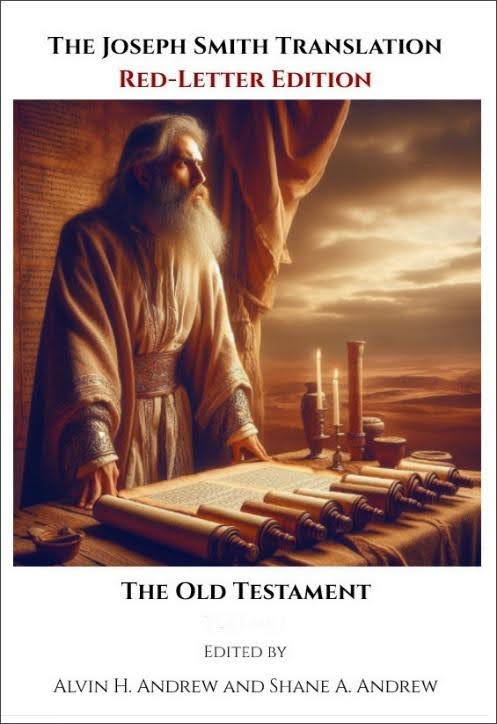
1 Those who may wish to more easily follow along in these Joseph Smith Translation series may obtain copies of
the Red-Letter Editions or an eBook at the website https://jstrle.com/. Red text are the alterations made by
Joseph Smith. Blue text with a strike-through are how the altered text read originally. Black text are the
unaltered words of the KJV.
2 Elohim, אֱלֹהִ֑ים, in the Hebrew Bible is made singular through the use of the singular masculine verb ‘bara’, בָּרָ֣א,
‘he created’.
3 See the previous article in this series “The Joseph Smith Translation: Three Creations”