






In Lehi’s magnificent speech near the end of his life in 2 Nephi 2, he makes a statement that has puzzled some Latter-day Saints such as my wife, Kendra Lindsay. If Adam had not fallen, “they would have had no children.” While this answers a long-standing debate about whether or not our first parents could have had children while in the Garden of Eden, the puzzle is how did Lehi know this? He does not state that he has received new revelation on this point, nor does he offer arguments to explain why this was so. He simply states it as a fact, as if it were something we should already know. But how?
Fortunately, Lehi gives us an important clue in this portion of his speech as he discusses the fall of Satan and the fall of man. Let’s begin with 2 Nephi 2:17:
And I, Lehi, according to the things which I have read, must needs suppose that an angel of God, according to that which is written, had fallen from heaven; wherefore, he became a devil, having sought that which was evil before God.
So he’s obviously referring to the scriptures. As we see in the verses that follow, it must be Genesis with its details about Satan through the serpent tempting Adam and Eve, leading to their fall and expulsion from the Garden. But the version of Genesis Lehi uses is obviously not the same version we have today. His version discusses the fall of Satan from heaven and calls him the serpent, as if he were the one tempting Adam and Eve, not a snake acting on his own.
Further, his version seems to add information about our free agency and contains a prophecy about the Messiah coming in the fullness of time to redeem us from the fall, for all these things are added in a continuous sequence as if he were still relaying written information he had recently read. Only in v. 28 does he signal a shift away from his midrash (as my wife calls it) on his version of Genesis to speak his thoughts to his sons.
For those who have been following some recent work on the connections between the Book of Moses and the Bookve of Mormon, it may come as no surprise to learn that a potentially plausible source for Lehi’s statement is found in Mother Eve’s words quoted in a text that may have been in a Brass Plates version of Genesis that is closely related to our Book of Moses. Her words are given in Moses 5:11, but let’s consider the context beginning with v. 9:
9 And in that day the Holy Ghost fell upon Adam, which beareth record of the Father and the Son, saying: I am the Only Begotten of the Father from the beginning, henceforth and forever, that as thou hast fallen thou mayest be redeemed, and all mankind, even as many as will.
10 And in that day Adam blessed God and was filled, and began to prophesy concerning all the families of the earth, saying: Blessed be the name of God, for because of my transgression my eyes are opened, and in this life I shall have joy, and again in the flesh I shall see God.
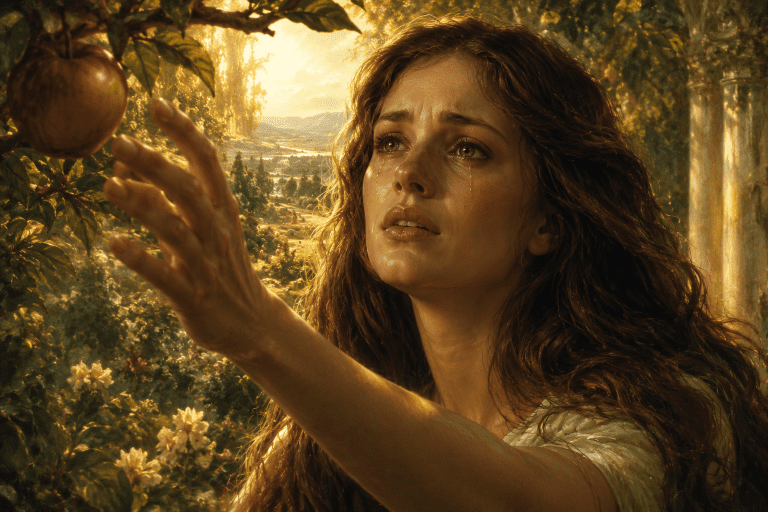
11 And Eve, his wife, heard all these things and was glad, saying: Were it not for our transgression we never should have had seed, and never should have known good and evil, and the joy of our redemption, and the eternal life which God giveth unto all the obedient.
Lehi did not know what factors made Eve certain of this, but she as a woman certainly knew.
Now let’s consider the context of Lehi’s statement, which shows extensive connections with the Book of Moses, as if something like it were on the Brass Plates.Here is 2 Nephi 2:17-28:
17 And I, Lehi, according to the things which I have read, must needs suppose that an angel of God, according to that which is written, had fallen from heaven; wherefore, he became a devil, having sought that which was evil before God.
18 And because he had fallen from heaven, and had become miserable forever, he sought also the misery of all mankind. Wherefore, he said unto Eve, yea, even that old serpent, who is the devil, who is the father of all lies, wherefore he said: Partake of the forbidden fruit, and ye shall not die, but ye shall be as God, knowing good and evil.
19 And after Adam and Eve had partaken of the forbidden fruit they were driven out of the garden of Eden, to till the earth.
20 And they have brought forth children; yea, even the family of all the earth.
21 And the days of the children of men were prolonged, according to the will of God, that they might repent while in the flesh; wherefore, their state became a state of probation, and their time was lengthened, according to the commandments which the Lord God gave unto the children of men. For he gave commandment that all men must repent; for he showed unto all men that they were lost, because of the transgression of their parents.
22 And now, behold, if Adam had not transgressed he would not have fallen, but he would have remained in the garden of Eden. And all things which were created must have remained in the same state in which they were after they were created; and they must have remained forever, and had no end.
23 And they would have had no children; wherefore they would have remained in a state of innocence, having no joy, for they knew no misery; doing no good, for they knew no sin.
24 But behold, all things have been done in the wisdom of him who knoweth all things.
25 Adam fell that men might be; and men are, that they might have joy.
26 And the Messiah cometh in the fulness of time, that he may redeem the children of men from the fall. And because that they are redeemed from the fall they have become free forever, knowing good from evil; to act for themselves and not to be acted upon, save it be by the punishment of the law at the great and last day, according to the commandments which God hath given.
27 Wherefore, men are free according to the flesh; and all things are given them which are expedient unto man. And they are free to choose liberty and eternal life, through the great Mediator of all men, or to choose captivity and death, according to the captivity and power of the devil; for he seeketh that all men might be miserable like unto himself.
28 And now, my sons, I would that ye should look to the great Mediator, and hearken unto his great commandments; and be faithful unto his words, and choose eternal life, according to the will of his Holy Spirit;
So what text is he working with in this midrash? It’s not our version of Genesis, but to use a term from Noel Reynolds, it could be a Brass Plates version of Genesis with remarkable similarities to our own Book of Moses, which was the first part of Joseph Smith’s translation of the Bible, related to Genesis 1 to 6:13. Noel Reynolds is the scholar who opened our eyes to the possibility of intricate connections between the Book of Moses and the Book of Mormon as if something like the Book of Moses were on the Brass Plates.
In his 1990 article, “The Brass Plates Version of Genesis,” he identified 33 parallels from a computer search linking the two texts, but sometimes with an evident “one-way direction of influence” from the Book of Moses to the Book of Mormon, as if the Book of Moses had concentrated passages of influence that affected multiple voices in the Book of Mormon, but with the Book of Moses serving as the logical source or backstory alluded to in the Book of Mormon.
Reynolds and I later collaborated in identifying many more parallels with added explanatory power and further evidence of one-way influence in a 2021 article, “‘Strong Like unto Moses’: The Case for Ancient Roots in the Book of Moses Based on Book of Mormon Usage of Related Content Apparently from the Brass Plates.” This was followed by “Further Evidence from the Book of Mormon for a Book of Moses-Like Text on the Brass Plates” in 2024 and a two-part article in 2025, “Parallels between the Book of Moses and the Book of Mormon,” with Part 1 examining the distribution of the parallels, the relationship to the rest of the JST, and other issues, while Part 2 offered more new and updated parallels in a list of 146 at the time. Since then the number of proposed parallels has grown to 186 in a regularly updated table provided at both AriseFromtheDust.com and JeffLindsay.com.
The quoted passage from 2 Nephi 2, where Lehi appears to be referring to a scriptural text that taught him about the fall of Satan and details of Adam and Eve, contains multiple parallels to the Book of Moses, including the following (parallels with the King James version of Genesis are excluded):
- Satan fell from heaven and became the devil (Moses 4:1-4)
- The devil is “the father of all lies” (Moses 4:4)
- The devil seeks our misery (Moses 7:37, 41; cf. Moses 4:3, 6)
- Without the Fall, Adam and Eve could have had no joy (Moses 5:10-11)
- Adam and Eve could not have had children prior to the Fall (Moses 5:11)
- We have free agency (cf. 2 Nephi 2:16) (Moses 4:3, 6:56)
- We can be redeemed from the Fall (Moses 5:9)
- Adam fell that men might be (Moses 6:48)
- The transgression of Adam and Eve brought the Fall and death (Moses 6:59)
- God calls on all men to repent (Moses 5:14, 6:23, cf. Moses 6:1, 50)
- Christ would come in the “meridian of time”/“fulness of time” (Moses 5:57, 6:57, 62, 7:46 — see the explanation in “Reflections on ‘the Meridian of Time’”)
- God’s knowledge of “all things” combined with wisdom (Moses 6:61, with respect to 2 Nephi 2:24)
- We can choose eternal life (Moses 1:39, 5:11, 6:59, 7:45)
In fact, Lehi, the student par excellence of the Brass Plates, seems to have the highest density of parallels to the Book of Moses in the Book of Mormon in 2 Nephi 2, many of which are found in the passage that begins with 2 Nephi 2:17, where he explicitly refers to what he has been learning from the scriptures (the Brass Plates). That passage resembles a midrash on the Book of Moses, and reflects the reality that something like the Book of Moses was a source of knowledge for Lehi that deeply mattered to him.
His midrash points us to a beautiful answer to an appropriate question for Mother’s Day: How did Lehi know that Adam and Eve could have no children before the Fall?
The answer is simple: marvelous Eve knew, and she said so in an ancient record similar to our Book of Moses that Lehi studied on the Brass Plates.