










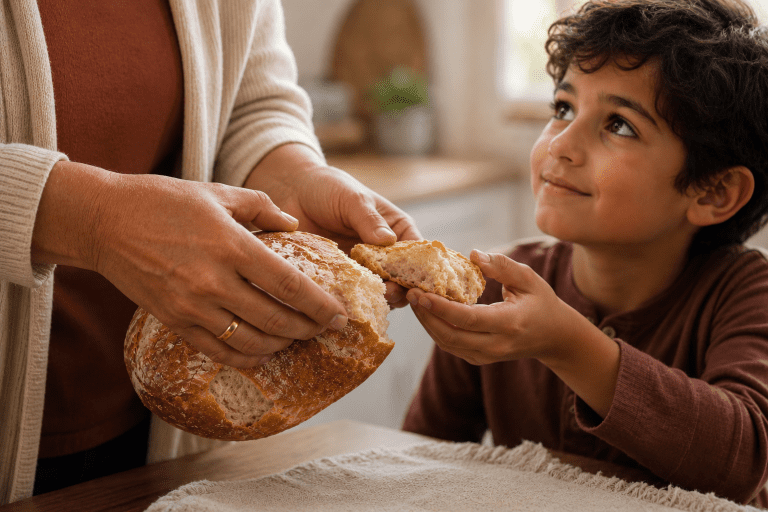


There is a piece of bread on a kitchen counter. A woman tore it from the loaf without pausing to think, because she has done it ten thousand times. Around her knees a child is making the noise that means hunger. She breaks the piece smaller. She hands it down. The child eats. Nothing has happened that a skeptic, an atheist, or an economist could not describe in the language of caloric intake and parental investment. They would not be wrong; they would merely be insufficient. And yet, if Latter-day theology is to be believed at all, something tremendous has happened. A sacrament has occurred under the kitchen lights. The Restoration has dropped one of its quietest secrets onto the linoleum floor: that heaven often enters by the back door.
Heaven often enters by the back door.
The Latter-day Saint takes the sacrament once a week. Bread and water travel down the pew on a tray, blessed by priests young enough to need acne cream, in the name of a Christ old enough to have made the wheat. The prayers are given by revelation, fixed and immovable.1 The bread is broken to recall a body broken. The water is poured to recall a blood poured out. We eat. We drink. We agree, again, to remember. It is the strangest sort of memory: one that makes the past present and the present accountable. The whole rite is over in fifteen minutes, and yet it is the still center around which every Sabbath turns.
The family circle is the unit of eternity itself.
The Restored church is no Sunday religion. It will not stay in the chapel. It is too domestic to be merely ecclesiastical. It persists, with a stubbornness that shocks its more refined neighbors, that the home is a temple, that the kitchen table is an altar, that the family circle is the unit of eternity itself. The sacrament itself ends at the meetinghouse door; the pattern does not. It was meant to be carried home in consecrated hands—in the daily labor of mothers and fathers who break, bless, and pass along life.
Consider what the priest does at the table on Sunday. He kneels. He breaks bread. He blesses it in prayer to the Father, in the name of the Son. He passes it to the congregation. His hands become instruments of a covenant older than himself.
Then consider what a mother does at every meal of every day. She kneels, for what is leaning down to a high chair if not a kneel. She breaks bread into pieces small enough for one particular, perilous little body. She blesses it, sometimes by offering prayer over it, sometimes only by smiling at it. She passes it to the child. Her hands, like his, are instruments of a covenant older than herself.
The ordinance and the echo are not the same thing. The sacrament is the sacrament: priesthood-administered, covenantal, commanded by Christ, centered entirely in His atoning flesh and blood. Yet ordinances do not empty the rest of life. They open it. The holy does not abolish the ordinary; it teaches the ordinary its real name. The sacrament unveils what God has been doing with matter all along.
Matter is not a disguise for spirit, but one of its chosen languages.
A word on that adjective. Latter-day Saints rightly reserve the sacrament for the ordinance itself — the bread and water blessed and passed in remembrance of Christ. No domestic act competes with it or substitutes for it. Yet the older Christian use of sacramental, which the Restoration deepens rather than discards, names something the gospel everywhere assumes: that an ordinary physical thing can become the visible carrier of an invisible grace. The outward sign does not replace the inward reality; it conveys it. Matter is not a disguise for spirit, but one of its chosen languages. The chapel sacrament is the highest instance of that pattern. The sacramental view of life simply notices that the same God who meets us at the sacrament table is also at work in the kitchen and on the doorstep, where matter rises to meet a heaven that leans down. Liturgy, its companion word, names any ordered, repeated act of devotion that shapes the soul. A mother’s work is a liturgy in slippers.
The scriptures have a quiet habit of placing holy things in ordinary settings. Not in the spectacular, where we would expect them, but in the places we pass through without noticing. A widow gathers sticks for a final meal and finds her handful of flour does not fail (1 Kings 17:12–16). A boy offers five loaves, and they are broken until a crowd is fed (John 6:9–13). In both cases, heaven does not replace the meal. It passes through it.
Again and again, the Lord works this way. He does not wait for ideal conditions. He takes what is already in the hand—oil in a jar, bread in a basket, water in a cup—and does something with it that leaves the thing unchanged in appearance and altered in meaning. The substance remains what it was. The use is lifted.
That pattern begins to teach the reader how to see. The dividing line between sacred and ordinary grows thin. Or perhaps it was never as thick as we supposed. A table is still a table. Bread is still bread. Yet once God has touched these things, they carry a kind of memory. They begin to suggest that the world is not closed, that something moves through it which cannot be reduced to weight or measure.
The action is small. The pattern is ancient.
So when bread is broken, even in a kitchen, it is not occurring in isolation. It belongs to a long history of hands receiving, dividing, giving. The action is small. The pattern is ancient.
This gives motherhood its theological weight. The modern world has a genius for making enormous things look small. It calls the woman at the high chair “just” a mother, forgetting that “just” is a small word by which we often commit quiet heresies. What is a mother doing when she feeds a child? She is not prolonging an organism. She is introducing a soul to a world.
Chesterton saw the absurdity with his usual sanity. He once asked why it should count as a grand career to teach other people’s children arithmetic, yet a small one to teach your own child what the world is for.2 The question still lands today. The mother at the table teaches the whole universe in installments: this is hot, this is sweet, this is enough, this is mine, this is thank you, this is share. Before a child can recite a creed, he has learned whether the world is hostile or hospitable. Before he can say “God is love,” he has had love cut into triangles and set before him on a plate.
The Family Proclamation calls each of us “a beloved spirit son or daughter of heavenly parents,” with “a divine nature and destiny.”3 The human family is no sentimental metaphor laid over a colder cosmos. It is the pattern beneath the cosmos. The hearth is not a metaphor borrowed from heaven; heaven is the hearth unveiled. We are not orphans who invented family to console ourselves. We are children who discovered family because reality is parental at its roots.
Here the doctrine of a Heavenly Mother begins to glow in the background of every earthly mother’s work. Latter-day Saints have never elaborated a full theology of Her, and reverence requires honesty about what has not been revealed.4 We do not pray to Her, because the Savior taught us to pray to the Father in His name. Silence, however, is not nonexistence. Eliza R. Snow’s hymn asks the question with devastating simplicity: “In the heav’ns are parents single?” and answers, “Truth is reason; truth eternal / Tells me I’ve a mother there.”5
Motherhood is no social accident.
If that is true, then motherhood is no social accident, no useful arrangement for keeping children alive until they become taxable citizens. It is an earthly participation in an eternal form. The mother bending over the crib is moving in an ancient pattern, one that precedes Eden. She translates it into milk and blankets and midnight vigilance, into the quiet work by which a life is kept.
The book of Moses tells us that God’s work and glory is “to bring to pass the immortality and eternal life of man” (Moses 1:39). No mortal mother can perform that work in its divine fullness. Christ alone redeems. She imitates the shape of it, however, every time she gives herself away so that another may live. She attends to him in mashed banana. The child is eternal in destiny. She teaches him not to bite. The scale seems absurd until one remembers that God Himself once entered the world as an infant who needed to be fed. Christianity has always hidden immensities in helplessness.
A mother’s hands are often the first theology a child receives. They lift, wash, wipe, steady, restrain, feed, bless, forgive. They are sometimes cracked, sometimes impatient, sometimes too tired to fold properly in prayer. They are the child’s first evidence that love is not a vapor. Love has fingers. Love has a temperature. Love leaves fingerprints on the glass. Love can be heard in the sink after dinner, when someone who would rather sit down keeps washing plates because bodies will need breakfast in the morning.
Modernity, which prefers its gods vague and its labor efficient, has little patience for repetition. It likes miracles best when they are novel, marketable, and safely discontinued by Thursday. Scripture moves in the opposite direction. Manna fell every morning, and no one called the miracle stale because it returned (Exodus 16:14–21). “Give us this day our daily bread” (Matthew 6:11) is a prayer for continuance—for God to keep giving what keeps us alive.
A mother is building a person by liturgy.
Motherhood runs on that same rhythm. The same socks, the same cup, the same bedtime, the same story, the same prayer. Repetition presses meaning deeper into the grain. A thing repeated in love is not a rut but a road. It shapes a soul by steady contact. The mother who pours the same milk, ties the same shoe, kisses the same cheek for the eighteen-thousandth time is not repeating herself into insignificance. She is storing something in the child that will hold. She is building a person by liturgy.
Mothers are also women with backs that hurt, tempers that fray, and souls that need the same Christ their children need. The cross is not diminished because it is carried in slippers. Consecration does not become less real because it smells faintly of peanut butter.
Honoring mothers does not diminish fathers, who stand in equal partnership in the Proclamation. Yet there is something particular in maternal nurture that deserves naming. President Russell M. Nelson called the work of a mother “the highest and noblest work in this life.”6 Elder Jeffrey R. Holland declared that “no love in mortality comes closer to approximating the pure love of Jesus Christ than the selfless love a devoted mother has for her child.”7 These are not sentimental compliments handed out with carnations. They are doctrinal clues wrapped, for one Sunday in May, in tissue paper.
The deepest of those clues is this. Motherhood, in this view, is not exhausted by biological status. It is an archetype, a pattern of self-spending love that any woman can be called to enact. Not every faithful sister has held an infant of her own. Some have waited for years and not been answered. Some have buried the child they once held. Some are single, some widowed, some still hoping. The gospel does not tell them that motherhood was a door that closed. It tells them that motherhood is as much something one does as something one is.
Sheri L. Dew put it with the bluntness the question deserves: “Are we not all mothers?”8 This is no flattening of the specific vocation of the woman who bears and raises her own — that calling remains singular, sacred, and irreplaceable. It is rather an enlargement of the pattern, a recognition that the love which mothers a child can mother a ward, a classroom, a neighborhood, a friend.
The aunt steadying a niece, the teacher learning every child’s name, the friend arriving with soup, the older sister keeping the porch light on. Each enacts the pattern. Each carries the daily echo of sacrament. Each makes love visible by the work of her hands.
For Christ gathers as a mother gathers. “How often would I have gathered thy children together,” He laments, “even as a hen gathereth her chickens under her wings” (Matthew 23:37; 3 Nephi 10:4-6). The image is deliberately domestic. Salvation is pictured not as an abstraction with wings, but as feathers over frightened chicks. The God who commands galaxies compares His saving work to a mother bird pulling the vulnerable under her body. There is a kind of love that protects by interposing itself. Mothers know this in their bones. The hen does not save her chicks by lecturing them on safety. She spreads herself over them.
A piece of bread on the kitchen counter, then. A child with his hand up. A woman who is, in the official language of the world, doing nothing in particular. The Latter-day Saint, lifting her eyes from the Doctrine and Covenants, knows better. She is participating, this minute, in the sacramental pattern that lasts all week. She is breaking, blessing, passing.
Sunday will come. The prayers will be spoken again.
But tonight the bread is already in her hands.







LaWrenMay 9, 2026
Beautifully expressed
Christian eMay 8, 2026
Thank you for this beautiful message! Such deep truths about love, motherhood, and Fhrist.