











In the high romances of the Middle Ages—those sprawling, wonder-filled accounts of Arthur and his knights—there appears a restless motif known as the Chapel Perilous. 1 It does not stay put. We mistake its movement for the flickering of a phantom, when in truth the Chapel moves because it is more real than the soil beneath it; holiness, like a wild fire, will not consent to be stapled to a plot of land. We often imagine a temple as a place where a man goes to be still; the Chapel Perilous suggests that a temple is a thing that goes to find a man who is lost.
A knight—Sir Percival, perhaps, or the pure-hearted Galahad—might be spurred through a “waste and howling wilderness,”2 a place of thorns and grey shadows where the maps of men fail. Suddenly, in a clearing where no surveyor’s line should run, the Chapel appears. It intrudes upon the wild. It is a place of terror and awe, of burning tapers and choirs heard through the blood—a traveling holiness that disrupts the mundane geography of the world.
We may smile at these legends today, dismissing them as the “fairytale magic” of an age that hadn’t yet learned to measure the world in square feet. If so, we are smiling in the wrong direction. These stories endure because they are True Myth3—the truth told “slant4,” so that it might slip past the sentries of our cynicism and strike the heart unannounced. They are echoes of a fiercer reality that our modern theology often tries to domesticate. We prefer a God who stays indoors; the old stories insist on a God who breaks camp.
The truth is, we are all wandering in the waste land, inhabiting a landscape of fluorescent hum and relentless data. Yet the Restoration offers a mystery far deeper than a mere escape into a distant sanctuary; it provides a Sanctuary that has been designed to walk. Zion ceases to be a spot on a map and becomes a geography you wear. By donning the holy symbols in remembrance, the soul begins to inhabit its own covenants, transforming the individual into a living outpost of the Kingdom. The Lord means to put His holy things nearer than your shoes—nearer than your shirt, nearer even than your own defenses. The wilderness does not need to be tamed by our hands; it needs to be answered by the Presence we carry, for the desert itself recognizes the signature of its Maker stitched upon the soul.
The Lord commands us to “stand in holy places, and be not moved5”—a curious order for a people He has turned into walking sanctuaries. Yet that is the secret: holiness travels only because its heart does not. The temple moves precisely because the disciple refuses to.
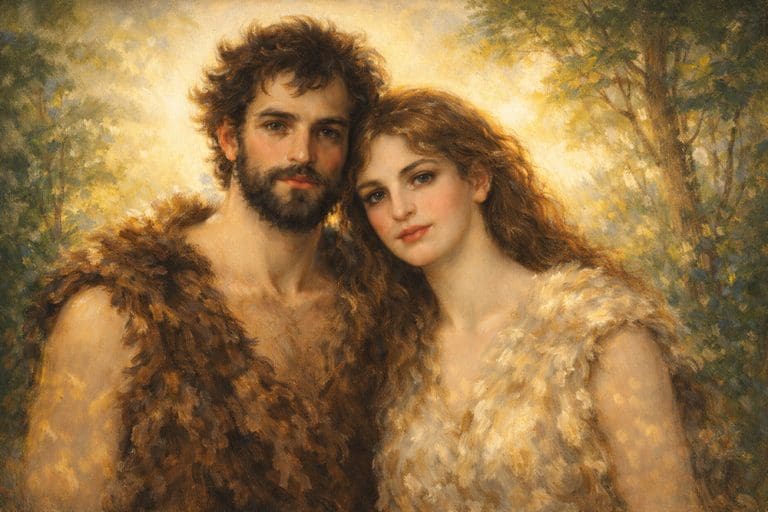
To understand the garment we wear, we must first look upon the glory we lost. Ancient Jewish tradition suggests that before the Fall, Adam and Eve were not “naked” in our modern, shivering sense. They were clothed in Kotnot Or—”Garments of Light.” In Hebrew, the word for “light” (or with an aleph) sounds identical to the word for “skin” (or with an ayin).6 The tradition holds that they lost their garments of light and received garments of skin. What a mercy—and what a terrifying weight—rests on that single letter.
In that first Garden, Adam and Eve required no stone walls to facilitate a meeting with the Almighty, for they walked in His presence. Their very being was a sanctuary—one without walls because it had no enemies. They were the Temple of God walking in the cool of the day. Then came the great transition. The fruit was taken, the eyes were opened, and the radiance of Eden gave way to the grit of the world. We often speak of the Fall in the dry language of a courtroom—a broken law, a penalty paid—but the Fall was a necessary change of state. Adam and Eve moved from a terrestrial radiance into a telestial density, stepping out of a static perfection into the dynamic struggle of becoming. They found themselves suddenly opaque, biological, and dangerously exposed—”naked” not merely for lack of cloth, but because they had traded the light of the Garden for the heavy, honest work of the wilderness.
The world outside the Garden was the “lone and dreary world,” a place of thorns, entropy, and a silence that felt like abandonment. Yet, the first act of the Lord in this new darkness was not to scold, nor to organize a committee. His first act was to become a Tailor. Redemption begins with a needle and thread.
“Unto Adam, and also unto his wife, did I, the Lord God, make coats of skins, and clothed them” (Moses 4:27).
We must pause over the startling intimacy of this. The God of the philosophers—the “Unmoved Mover” or the impassible Deity of the creeds 7—does not touch animal skins. An idea may explain the universe; it cannot clothe a child. He does not get blood on His hands. He deals in universals. But the God of the prophets is so great that He dares to be small. He is a God who weeps, a God who touches, and a God who sews.
He takes the chaotic materials of a fallen world and fashions a covering. This was the first Atonement—an old word we have polished until it shines, forgetting it once meant something as plain as a cloak. Before it was a doctrine, it was a garment.8 To clothe them, a sacrifice was required; life was given to cover nakedness. It was the first shadow of the Lamb slain from the foundation of the world.
We have often viewed these “coats of skins” as a badge of shame—a primitive bandage for a wound. But through the lens of temple theology, we see that the covering is not merely concealment; it is consecration. In those first rough layers of hide, the Lord was forging the livery of a royal house, a suit of celestial mail for the long war of the wilderness.
When the Lord later prescribed the vestments of the High Priest, they were “garments for glory and for beauty” (Exodus 28:2). These robes were a miniature replica of the Tabernacle itself. When the priest was fully vested, he was a walking pattern of the building. The sanctuary had learned to walk. So it is with the “coats of skins.” In draping the Holy of Holies over the shoulders of the exiles, the Lord provided a portable sanctuary. He was saying: You must go out into the chaos where the light is dim. You cannot stay in the Holy of Holies. So I will wrap the Holy of Holies around you.
Revelation 13:8; 1 Peter 1:19–20.
This re-enchants the morning ritual. When we put on the holy garment, we may think of comfort or modesty—explanations of a flat world—accurate, perhaps, but radically insufficient. To wear the garment is to engage in a revolutionary act of sacred architecture. It is to reconstruct the Temple upon your own body.
The “natural man”10 wrestles with God because the very air of mortality presses on the soul like a low and unyielding sky. We are sparks of divine fire living in a pressure-cooker of biology and trauma. The garment serves as the moving veil, the woven boundary that shields our divine nature11 while we navigate this hostile state. It is the “oilskin” that allows the soul to work in the rain of mortality.
In a world that seeks to reduce you to a consumer or a biological accident, the garment whispers that you are a priest or a priestess. It asserts that your body is a veil housing a God-in-embryo. Think of the Chapel Perilous again. When you sit in a minivan at a school pickup—engine idling, patience thinning—you are still an outpost. We carry the temple into places where temples are not supposed to be. In the classroom or the grocery aisle, you are the Tabernacle in the Wilderness, bearing the King’s insignia stitched nearest the heart.
There is a sacramental materialism here. The God of Joseph Smith does not save us from our bodies, but with them.12 The garment is physical; it is tactility as theology. Consider the deep-sea diver. To survive the crushing blackness of the ocean floor, he must bring his atmosphere with him. He wears a “second skin” that maintains the pressure of the world above while he works in the world below. We are that diver. This mortal sphere is a high-pressure environment for an eternal soul. It crushes us with grief and tempts us to forget our country. The garment is our diving bell. It preserves, right next to the skin, the atmosphere of Zion, reminding us with every movement that we do not belong to the deep.
The gates of Eden closed behind us to signal the start of a great deployment; we were sent into the thorns to find an education that the Garden could never provide. A wise Commander does not send His soldiers into a jagged wilderness in silk pajamas; He sends them in armor. The garment is the equipment of the ascent—the armor that allows us to endure the “Long Defeat”13 of this world without ever losing heart. It reminds us that the victory rests entirely upon the power of Him whose symbols we wear, a strength that far outstrips our own.
This reality consecrates Tuesday—the day modernity forgot to make holy. The divide between the sacred and the secular is a ghost of our own making. If you are wearing the garment, the laundry room is a precinct of the temple. The commute is a procession. This may be one fulfillment of the prophecy that “Holiness unto the Lord” shall be written even upon the bells of the horses.14 Even the barcode’s beep can be answered, somewhere deeper, by a hymn.
We are the Chapel Perilous. We are the mystery the world cannot explain—a people who walk through the fires of modernity without the smell of smoke, shielded by the covenants of a different country. Tomorrow morning, when you dress, step into the ritual of the Tabernacle. Construct the Holy of Holies upon your own shoulders. As you pull on the fabric, realize that the Great Tailor has fashioned for you a “Coat of Skins” to hold you until you are ready to be reclothed in the Garments of Light. Step boldly onto the kitchen tile or the rain-slicked street, for you carry the fire that makes the forest holy; you are the temple that has finally learned to walk.
Footnotes






Alece ReynoldsFebruary 20, 2026
Once when "clothing" a woman I was proxy for during an Iniatory ordinance in the Preston, England Temple, the woman said to me, from the other side of the Veil, "Oh, my shining garment"! AND -- she said it with complete awe! The garment, according this this angelic receiver of it, is definitely a garment of light!
Patrick D. DegnFebruary 15, 2026
To all who have shared such kind and encouraging reflections, my sincere thanks; it is a joy to see the core of this message resonate so clearly. To Gregg, however, I’d like to offer a brief word of clarification, as he has—with the best intentions—misread the way I am using the phrase "Chapel Perilous." You are quite right that in modern psychological and occult circles—especially following Robert Anton Wilson—the phrase has come to suggest a crisis of sanity or the collapse of a “reality tunnel.” If my article were claiming that the House of the Lord is a place of instability or spiritual paranoia, your concern would be more than fair. My use of the image, however, comes from its older literary and medieval background rather than its twentieth-century psychological afterlife. In Arthurian tradition (including Malory’s Le Morte d’Arthur, which I cited), the Chapel Perilous is a liminal place where the sacred presses into the “waste land”—a haunted frontier where grace insists on drawing near to ruin. The accent there is not on madness but on encounter: the danger lies in the soul’s unpreparedness for holiness, not in God’s unreliability. So I am not suggesting that the temple is a house of terror. I am suggesting that it is a traveling holiness that comes to find us when we will not move. That is what I meant in the line: “The temple moves precisely because the disciple refuses to.” The image of the Chapel Perilous, in this context, is meant to describe portable sanctity: the way the garment allows the disciple to carry the atmosphere of the temple into the “lone and dreary world,” much as a coal taken from the altar continues to burn even when it has left the altar. Your warning against any paranoid or occult reading of the temple experience is a needed caution, and I share it. My use of the word “perilous” is a poetic attempt to name the gravity of consecration, not a diagnosis of psychological peril. Here the “peril” is the peril of standing, as C. S. Lewis might say, under the “weight of glory”—the awe and seriousness that always attends the presence of the Divine in a fallen world. On this, I think we are very much agreed: the temple is the House of the Lord, a place of peace, order, and instruction. My article simply argues that, through covenant and garment, that peace is not meant to remain shut up in a single building. We are invited to carry it with us—into wastes and wildernesses where, left to ourselves, we would never dare go at all.