




Church Announces Worldwide Mission Leadership Assignments and Updates to Temple Square Service


Photo courtesy of the Church Newsroom. To visit their website, CLICK HERE.
The First Presidency of The Church of Jesus Christ of Latter-day Saints has called new mission presidents and their companions to lead 188 missions worldwide, including 55 newly created missions. Most couples are scheduled to begin their three-year service on or about July 1, 2026.
As part of preparations for the anticipated completion of the Salt Lake Temple renovation in 2027 and the planned Salt Lake Temple Open House Celebration, the Church will also introduce changes this year to enhance the visitor experience on Temple Square. Sister missionaries called to serve in Utah will now be assigned to Utah-based missions while also serving on Temple Square. Additional information is available through Church channels.
Mission Leadership Assignments
Tables below list the names of newly called mission leaders and their assignments. Five additional couples will be announced at a later date. Newly created missions are marked with an asterisk (*). In the months ahead, Church News will publish brief biographies and photos of each mission president and companion.
Africa Central
| Mission | Mission Leaders |
| Cameroon Yaoundé | Kelly L. and Maria Stotts |
| Democratic Republic of the Congo Kananga | Pierrot and Frida Kabunda |
| Democratic Republic of the Congo Kinshasa East | Tonga J. and Dorothee G. Sai |
| Democratic Republic of the Congo Kinshasa North* | Junior and Annie Banza |
| Democratic Republic of the Congo Mwene-Ditu* | Vally and Christine Tshimanga |
| Ethiopia Addis Ababa | Alexander and Phyllis Tandoh |
| Kenya Kisumu* | Hans and Annie Peterson |
| Republic of Congo Brazzaville | Victor and Edvige Mbengue |
| Tanzania Dar es Salaam | Philip R. and Alice O. Huber |
| Uganda Kampala East* | Lauriano P. Balilemwa and Happiness Kagemulo |
Africa South
| Mission | Mission Leaders |
| Angola Luanda North* | Odair and Edileude Lira |
| Madagascar Antananarivo South | Rob and Ruth Campbell |
| Malawi Lilongwe* | Nathan N. and Shannon W. Savage |
| Mozambique Maputo | Tyler C. and Karen E. Sorenson |
| Mozambique Nampula* | Solomon and Amalia Dickie Malidadi |
| South Africa Cape Town | Reginald and Vuyo Moyo |
| South Africa East London* | Glenn and Kathy Seninger |
| South Africa Johannesburg | Shawn K. and Beth M. Jones |
| South Africa Pretoria | Kuviwe and Thobeka Mahlangabeza |
| Zimbabwe Harare West* | To be announced |
Africa West
| Mission | Mission Leaders |
| Benin Cotonou | Matt and Kim Osborne |
| Cote d’Ivoire Abidjan East | Brandon L. and Jennifer M. Taylor |
| Cote d’Ivoire Abidjan North | Paul and Alison Brown |
| Cote d’Ivoire Abidjan South* | Michael A. and Corrie Call |
| Cote d’Ivoire Daloa* | Benjamin W. and Emily LeSueur |
| Ghana Accra East | Johnny and Terri-Dawn Ek |
| Ghana Accra South* | Nathan A. and Amy K. Craig |
| Ghana Sunyani* | James T. and Gina K. Anderson |
| Liberia Monrovia West* | Marc and Cammy Fuller |
| Nigeria Aba | Ikechukwu J. and Freda O. Ibe |
| Nigeria Abuja | Aoydele Orimisan and Olubukola Abiodun Ojulari |
| Nigeria Port Harcourt South | Gordon and Rose Ondiek |
| Senegal Dakar* | David James and Staccie Williams |
| Togo Lomé* | Kristopher A. and Amy Bailey |
Asia North
| Mission | Mission Leaders |
| Japan Kobe | Jason and Kristen Sybrowsky Kerr |
| Japan Sapporo | Jeffrey G. and April K. Bickel |
| Japan Tokyo North | Brett and Marcie Keller |
| Mongolia Ulaanbaatar West* | To be announced |
Brazil
| Mission | Mission Leaders |
| Brazil Brasília | Teciomar and Karen Abila |
| Brazil Campinas | Thomas L. and Kimberly C. Stone |
| Brazil Feira de Santana | Oriondes and Monica Martins |
| Brazil Florianopolis | James and Traci Welburn |
| Brazil Fortaleza | Carlos A. and Rozinete Santos |
| Brazil Guarulhos* | Joel and Claudia Fernandes |
| Brazil Maceió | Shane J. and Meri Ann Farnsworth |
| Brazil Manaus North | Antonio and Luciana Santana |
| Brazil Recife North | Stanton L. and Connie Marshall |
| Brazil Recife South | Lance R. and Robbi O. Bradford |
| Brazil Rio de Janeiro North | Neverson and Deborah Paes |
| Brazil São Bernardo* | Diego A. and Clézia S. Oliveira |
| Brazil São Paulo Interlagos | Larry and Rachel Cox |
| Brazil São Paulo North | To be announced |
| Brazil Sorocaba* | Adriano B. and Pamela P. Nogueira |
| Brazil Vitoria | David R. and Joanna C. Layton |
Canada
| Mission | Mission Leaders |
| Canada Halifax* | Steve and Deborah Montgomery |
| Canada Toronto East* | E. Boyd and Michelle D. Craig |
Caribbean
| Mission | Mission Leaders |
| Dominican Republic Santo Domingo East | Enrique and María Angélica Mayorga |
| Dominican Republic Santo Domingo West | Robert D. and Beverly J. Dow |
| Puerto Rico San Juan | Paul D. and Janelle F. Hernandez |
| Venezuela Caracas | To be announced |
| Venezuela Maracaibo | Ramón J. and Carmen Maria Martínez |
Central America
| Mission | Mission Leaders |
| El Salvador San Salvador East | Christian D. and Ella Walker |
| El Salvador Santa Ana | Todd and Tami Mickelsen |
| Guatemala Guatemala City | German and Alejandra de Laboriel |
| Guatemala Guatemala City Central | Nathan D. and Margaret W. Pace |
| Guatemala Guatemala City East | Eduardo J. and Solange Rex |
| Guatemala Quetzaltenango | José A. and Sonia Fernández |
| Honduras Tegucigalpa | McKay M. and Jodi K. Pearson |
| Nicaragua Managua South | Luis Fernando and Leticia Torres |
Europe Central
| Mission | Mission Leaders |
| Adriatic North | Jeff and Debbie Moore |
| Albania Tirana | Matthew and Mary Wirthlin |
| Alpine German-Speaking | Brett A. and Janice Greenhalgh |
| Bulgaria Sofia | David J. and Kara I. Ludlow |
| France Paris North | Louis-Marie and Cybèle Liebard |
| France Paris South* | Matthew R. and Rebecca S. Henriksen |
| Germany Frankfurt | Jared and Heather Theurer |
| Greece Athens* | Howard D. and Heather G. McKeon |
| Hungary Budapest | Case M. and Kerri L. Lawrence |
| Poland Warsaw | Jeffrey A. and Jennifer Barnes |
| Romania Bucharest | Matthew O. and Louise M. Leavitt |
| Spain Barcelona | Jayson and Allison Newitt |
| Spain Madrid East* | Jason M. and Karen B. Mattingley |
Europe North
| Mission | Mission Leaders |
| Baltic | Douglas C. and Carrie Derrick |
| Cape Verde Mindelo* | Chris and Tally Wright |
| Cape Verde Praia | Michael K. and Lori Coons Wood |
| Finland Helsinki | Bert T. and Gigi Dover |
| Sweden Stockholm | Robert and Karin Mayo |
México
| Mission | Mission Leaders |
| México Guadalajara East | J. Alejandro and Guadalupe De la Fuente |
| México México City Southeast | Sal and Araceli Zavala |
| México Oaxaca | Jorge W. and Graciela Agustina Pérez |
| México Puebla South | Scott E. and Robin Sears |
| México Tijuana | Randy and Jenny Richardson |
| México Torreón | Manuel and Genny Zapata |
| México Tula* | Dee W. and Kim Morse |
| México Tuxtla Gutiérrez | Manuel and Eva Gutiérrez |
| México Veracruz | Allen P. and Julie J. Hilton |
| México Xalapa | Carlos Gabriel and Dayalsi Prieto |
Pacific
| Mission | Mission Leaders |
| Australia Brisbane South* | Greg and Kristyn Trimble |
| Fiji Suva | Lote Kama and Venina Ucunibaravi Qoroya |
| New Zealand Auckland | James S. and Kylie A. Mackie |
| New Zealand Wellington | Paul W. and Haidee Roberts |
| Papua New Guinea Daru* | Sione and Mele Lavaka |
| Papua New Guinea Madang* | M. Dean and Christine A. Westerlund |
| Samoa Apia West | Gilbert and Ginger Tavita |
| Solomon Islands Honiara* | Matthew G. and Kimberli Court |
| Tahiti Papeete | Jay and Katauna Lucas |
Philippines
| Mission | Mission Leaders |
| Philippines Angeles | Thomas D. and Patricia C. Burton |
| Philippines Davao | Gerry C. and Charmaine Gaw Guerra |
| Philippines Lingayen* | Erwin and Reggie Brillantes |
| Philippines Lipa* | Federico and Sonia Francia |
| Philippines Manila | David and Jenna Roy |
| Philippines Olongapo | M. Todd and P. Michelle Jones |
| Philippines Ormoc* | Martiniano S. and Lourdes Beata C. Soquila |
| Philippines Ozamiz* | Bon C. and Imelda F. Escobar |
| Philippines Puerto Princesa* | Romeo A. and Olivia Salamanca Campos |
| Philippines Quezon City North | Jeffrey H. and Paige A. Winter |
| Philippines San Pablo | Eden R. and Tonya May Engen |
| Philippines Tacloban | Scott and Heidi McElhaney |
South America Northwest
| Mission | Mission Leaders |
| Colombia Cali | Jorge and Maria Teresa Portal |
| Ecuador Guayaquil East | Jim and Allyson E. Larkins |
| Ecuador Guayaquil North | J. Brian and Katie Abrams |
| Perú Chiclayo | Yan Carlos and Inocencia Vega |
| Perú Lima East | David and Juanita Bybee |
| Perú Lima Northwest* | John T. and Sharon G. Hutchinson |
| Perú Tacna* | Chris and Kristy Clason |
South America South
| Mission | Mission Leaders |
| Argentina Buenos Aires West | Josh and Katie Garner |
| Argentina Mendoza | Andres L. and Martha Dorado |
| Argentina Resistencia | Ranulfo and Irais Cervantes |
| Argentina Rosario | Lee D. and Jennifer Mackay |
| Argentina Salta | Juan Pablo and Florencia Sajtroch |
| Chile Santiago North | Brian W. and Kristi Baker |
| Paraguay Asunción East | R. Scott and Heidi Rushing |
| Uruguay Salto* | William A. and Alyson Freedman |
United States Central
| Mission | Mission Leaders |
| Colorado Colorado Springs | James N. and Kimberly Wadsworth |
| Colorado Denver East | Michael and Nichol Gallup |
| Missouri Independence | Blaine H. and Debbie Hill |
| Missouri Kansas City* | Markham D. and Melissa C. Tuttle |
| Wyoming Cheyenne* | Brett D. and Susan Christiansen |
United States Northeast
| Mission | Mission Leaders |
| Indiana Fort Wayne* | J. Kelly and Linda M. Flanagan |
| Maryland Baltimore | Douglas W. and Tiffany L. Hedger |
| Michigan Lansing | Larry R. and Dawn E. Larson |
| New Jersey Morristown | Chad R. and Sheree H. Argyle |
| Ohio Columbus | Robbie and Karen Bosco |
| Pennsylvania Pittsburgh | Daniel and Rebecca Greer |
| Virginia Norfolk* | Steven C. and Jeanne Merrell |
United States Southeast
| Mission | Mission Leaders |
| Arkansas Little Rock | Stan and Heidi Hanks |
| Florida Fort Lauderdale | Kevin E. and Brynda Lynn Dickson |
| Georgia Atlanta North | J. Andrew and Shannon Dent |
| Kentucky Louisville | To be announced |
| Louisiana Baton Rouge | Daniel and Allyson Chard |
| Mississippi Jackson* | Graden P. and Sommer Jackson |
| North Carolina Raleigh | Tod M. and Lindie Turley |
| South Carolina Columbia | Derek M. and Stephanie Miner |
| Tennessee Knoxville | Andrew and Vanessa Croshaw |
United States Southwest
| Mission | Mission Leaders |
| Arizona Flagstaff | Carl C. and Candace D. Cottrell |
| Arizona Phoenix East* | Marty R. and Michelle Page |
| Arizona Phoenix West | Bruce W. and Carolyn S. Ebmeyer |
| Arizona Tucson | Enrique M. and Yesenia Loo |
| Nevada Henderson | David A. and Sherice Lemperle |
| Nevada Reno | Kirk and April Feller |
| Oklahoma Tulsa* | Scott W. and Karla R. Wallentine |
| Texas Austin | Ed and Kari Jorden |
| Texas Dallas East | Travis J. and RaLynne Parry |
| Texas Dallas North* | Brian and Diane Fitzpatrick |
| Texas Fort Worth | Casey and Elizabeth Allman |
| Texas Houston East | Lehi and Melissa Rodriguez |
| Texas Houston North* | Dale A. and Kristen E. Curriden |
| Texas Houston West | Morgan and Jennie Fife |
| Texas Lubbock | Stuart R. and M. Lisa Schofield |
| Texas San Antonio South* | Martin C. and Veronica Pitarch Rios |
United States West
| Mission | Mission Leaders |
| California Anaheim | Curtis R. and Mollie Whetten |
| California Arcadia | David R. and Suzi Williams |
| California Carlsbad* | R. Tyler and Elizabeth Wallis |
| California Fresno | Will and Katie Fritcher |
| California Oakland/San Francisco | Tom and Lori Holmoe |
| California Ontario* | Kelly R. and Joan N. Norman |
| California Riverside | M. Sean and Diana Esplin |
| California Roseville | Scott A. and Amy B. Jensen |
| California Sacramento | Gregory and Hollie Peterson |
| California San Jose | Adam and Natalie Kessler |
| California Santa Rosa | Ben and Natalie Peterson |
| California Ventura | Raymond and Lucinda León Contreras |
| California Victorville* | Greg and Kaele Porter |
| Idaho Coeur d’Alene* | Scott H. and Laura Welch |
| Oregon Eugene | Dave and Shannon Morley |
| Oregon Portland | Stephen and Kim Daley |
Utah
| Mission | Mission Leaders |
| Utah Orem | Carl E. and Tammy Harris |
| Utah Salt Lake City Headquarters | Scott M. and Marcia A. Stanford |
New Temple Square Missionary Model
Beginning in 2026, sister missionaries will continue to serve on Temple Square, as they have for decades, but will be assigned to surrounding Utah missions. Under the new model, they will divide their time between teaching assignments and service on Temple Square.
Assignments to serve on Temple Square will continue to be made by a member of the Quorum of the Twelve Apostles.
Church leaders said the change reflects effective missionary service models already in place at other temple visitors’ centers around the world. The adjustment is intended to improve the guest experience and increase flexibility during peak visitor periods, while allowing missionaries to spend more time ministering in their assigned areas during slower seasons.
As part of the transition, a limited number of returned missionaries will be hired as part-time guides to assist sister missionaries in welcoming and orienting visitors.
In the coming months, sister missionaries currently assigned to the Utah Salt Lake City Temple Square Mission will be reassigned to surrounding Utah missions by a member of the Quorum of the Twelve. That process is expected to conclude by July 2026, at which time the Utah Salt Lake City Temple Square Mission will be discontinued.
A Century of Service on Temple Square
Volunteer and missionary service on Temple Square spans more than 100 years:
- 1922: Tours organized and conducted by part-time and full-time volunteer
- 1980s: Full-time missionaries, primarily senior couples, began assisting with tours, supported by younger missionaries for language need
- 1995: The Utah Salt Lake City Temple Square Mission was formally established
Ronald A. Rasband, now a member of the Quorum of the Twelve Apostles and chair of the Missionary Executive Council, served as a part-time guide on Temple Square from 1972 to 1976 while attending university.
“Missionaries at Temple Square play an important role in sharing the gospel of Jesus Christ as they welcome millions of visitors from around the world,” he said. He expressed appreciation for the many sister missionaries who have served there over the years, adding that their continued service will help ensure Temple Square remains a place of inspiration for people of all faiths and backgrounds.
Eat, Pray, Love to Preach, Pray, Learn: The Transforming Power of Young Missionaries

The following comes from Public Square Magazine. To visit their website, CLICK HERE.
On Friday, The Church of Jesus Christ of Latter-day Saints announced that young women would now be eligible for missionary service beginning at 18, rather than 19. This change will bless individual young women and strengthen families and congregations.
The Church Newsroom statement reiterated that, “While the Lord asks every worthy, able young man as part of his priesthood responsibility to prepare for and serve a mission … missionary service remains an optional opportunity for young women.” Sister Amy Wright, first counselor in the Primary General Presidency and a member of the Missionary Executive Council, further stated that after consulting with many young women throughout the world, the council decided to keep the length of missions for young women at 18 months, after “(reaching) out throughout the entire world to young women, inviting them to be a thoughtful part of this revelatory process.” The council found that the “overwhelming” preference was to keep the term of service as it currently stands.
On a weekend in early August 2012, I took a spontaneous drive to Salt Lake City to see some friends. At the time, I was 22 years old, living with my parents, working a retail job, and attending what was then Dixie State College (now Utah Tech University) part-time. I had previously paused my university studies and was “taking some time” to “travel,” and “find myself.” It was, after all, the decade of Eat, Pray Love. But the truth was, I was listless, lonely, without direction or a deep sense of spirituality or purpose.
On Sunday morning, before my drive back to St. George, I had a passing thought to stop by the Salt Lake City Temple. I hadn’t been very active in the Church in many years—I had mostly attended friends’ mission farewells and homecomings. I believed that The Church of Jesus Christ of Latter-day Saints was probably mostly true, except for the teachings on coffee, priesthood ordination, and marriage. I assumed that eventually, I would return to church activity, perhaps when I was older or when the changes I desired in the Church came, which I was sure was just around the corner.
As I sat quietly on the temple grounds, I thought it might be appropriate to pray. I don’t remember what I said in my prayer, but as I opened my eyes, I looked toward the smiling sister missionaries greeting visitors and thought I should serve a mission.
It was preposterous. And yet that thought didn’t go away. It grew louder and louder in my mind as I drove home. I couldn’t put it out. After hours of this very clear and direct impression, I called my mother while driving and told her I needed to prepare to serve a mission. And I did.
I needed to prepare to serve a mission.
I returned home from my mission in Toronto, Canada, two years later, a completely different person. Yes, I had many more bumps and bruises ahead of me in my spiritual and temporal growth, but within a year I had returned to university studies and become a 4.0 student, had met and married my now-husband in the temple, had developed some goals in my life, was active in my ward, and within two years my husband and I welcomed our first child.
This past Friday evening, I volunteered backstage for that same daughter’s (now 9) ballet recital. I was overjoyed to hear the oldest girls chatting about how they would now be eligible for missionary service. These precious daughters of God are already so far ahead of where I was at their age, with accomplishments and goals and a devotion to the Savior.
In 1979, President Spencer W. Kimball prophesied, “Much of the major growth that is coming to the Church in the last days will come because many of the good women of the world … will be drawn to the Church in large numbers. This will happen to the degree that the women of the Church reflect righteousness and articulateness in their lives and to the degree that the women of the Church are seen as distinct and different—in happy ways—from the women of the world.”
President Russell M. Nelson echoed his words many years later, saying, “My dear sisters, you who are our vital associates during this winding-up scene, the day that President Kimball foresaw is today. You are the women he foresaw! Your virtue, light, love, knowledge, courage, character, faith, and righteous lives will draw good women of the world, along with their families, to the Church in unprecedented numbers!”
These were the young women I served with on my mission, the young women I see in my ward, the young women from the dance recital, my nieces, and my children’s wonderful nanny. Young women and men coming out of our youth programs are extraordinary. Emergent adulthood, the stage from about age 18 to 25 years old, is so crucial for identity formation. As young adults become immersed in the gospel during the beginning of these years, they will be better equipped to engage with the prevailing university party culture and worldly philosophies they may later be exposed to. I wasted years of my young adulthood trying to find myself, but I was only successful when I forgot myself, as is the case with so many.
Those outcomes don’t just bless the sisters.
Sister missionaries return home with leadership and public speaking skills, and a deeper knowledge of the gospel. They also return having lived independently, budgeted wisely, and cooked, cleaned, and served those in need often. Many have learned foreign languages. Research shows their GPAs are higher, and they take more university credits when they return.
Those outcomes don’t just bless the sisters themselves; they ripple out into the families and wards they eventually help build. A woman who has spent a year and a half testifying of Christ, studying scripture daily, and learning to work shoulder to shoulder with a partner is better prepared to teach the gospel in her own home, to counsel with a spouse, and to nurture children in a bewildering cultural moment. Even for those who never marry or have children, that spiritual maturity and practical experience fortify Relief Societies, Young Women classes, Primary presidencies, and every corner of the church family.
Lowering the missionary age for young women is, in that sense, a profoundly pro-family policy. It opens a window for more daughters of God to be deeply rooted in the gospel during the very years when so many peers are drifting, and it does so without pressuring every young woman into one path or timeline. By keeping missionary service optional and the length of service at 18 months, the senior leadership of the Church of Jesus Christ has made more room for young women to seek revelation about education, work, and family in a way that fits their circumstances and callings.
The road to adulthood is never easy, and it provides many opportunities for young men and women to lose their way. What a blessing the missionary program is for not only those who are taught by missionaries, but also those who are blessed to serve. My hope is that with this policy change, many more young women will choose to serve, to lose themselves for a season in the work of the Lord, and in doing so find a surer sense of who they are.
To visit Public Square Magazine’s website, CLICK HERE.
Sisters Shall Not Fear: Leaving for a Mission at Age Eighteen

Changes in missionary work happen so fast that it might feel like every time we blink our eyes open to a surprise. We may resist sudden change because it is unfamiliar and frightening. Sending a daughter out to serve a mission at age eighteen is a change that can make some people uneasy.
Bret and I served as mission leaders during a time of unprecedented change. During our mission, the missionaries who had been accustomed to calling home twice a year were suddenly allowed to call home every week. This change concerned us. We worried our missionaries might get homesick and lose focus on the mission. It turned out our worries were unfounded, and the change blessed the missionaries and their families. In addition, during our tenure of service, the tried-and-true “white bible” was replaced with Missionary Standards for Disciples of Jesus Christ. As much as we celebrated the switch to principle-centered learning, we wondered if our missionaries would lower their standards and start wearing their hair in ponytails. That didn’t happen. What did happen is the missionaries chose high standards, rather than feeling compelled to live the standards. COVID came during our mission, and our missionaries suddenly began teaching with smartphones. Again, we were concerned the missionaries might lose their focus and abuse the technology. Instead, the technology allowed our missionaries to teach remotely, and the missionary work not only continued but flourished.
As we navigated these and other changes, we learned that although change can rock our world, when we embrace the change with faith rather than fear, we can realize the tremendous blessings the change was intended to produce.
Protection for the Sisters
As parents, we often worry more when we launch our daughters out into the world than when we launch our sons. This may be because we are concerned for their safety, and we assume (perhaps erroneously) that boys can take care of themselves. If this is the case, I can assure you, a mission is one of the safest places possible to send an 18-year-old girl after high school. It’s safer than going away to college, and it’s safer than backpacking around Europe. It’s safer than taking an overseas job as a nanny, or an internship, or any other option available to a young lady right out of high school. Evil influences can be found in any of these places, even if you send your daughter to a church school. Although a mission is not the Celestial Kingdom, a mission is more likely to provide a safe environment spiritually, physically, and emotionally than any other destination.
Watched Over by a Companion
Missionaries have all kinds of people to watch over them and protect them. From the moment they arrive in the mission, they are met by a responsible party—not by a stranger holding a sign that says their name, but by someone with a tag that says, “The Church of Jesus Christ of Latter-day Saints.” They will step into good hands as soon as they walk off the plane.
Even when things do not go as planned, the Lord will protect them. Days after we arrived in the Dominican Republic, we went to the airport at the appointed time to pick up a sister missionary arriving from Honduras. She didn’t come off the plane, and we could find no information as to why she wasn’t on the flight. At two o’clock in the morning, we received a phone call saying she had missed her flight and was now at the airport in Santo Domingo waiting for a ride. We quickly dressed and headed back to the airport. Halfway there, we received another phone call. It was from a member of the area presidency who had arrived on a late flight and saw our sister missionary waiting for her ride. He picked her up and brought her to our doorstep.
Missionaries are assigned a companion as soon as they arrive in the mission. The companion already knows everything that is necessary to keep her companion safe. She knows the bus schedule, she knows how to exchange money, she knows what areas are off-limits to missionaries, and she knows what kind of backpacks/fanny packs are safe to wear in the mission. She knows the language, she knows customs regarding eye contact, conversation, etc. And the new missionary gets to be with that experienced companion 24-7. They are always within sight or sound of one another.
Cared for by Mission Leaders
Not only does an 18-year-old sister have a full-time companion, she has mission leaders who will love her like their own daughter. The mission leaders will teach, counsel, and listen just like a loving parent. They receive inspiration as to the needs of the new missionary, both temporal and spiritual. We had a sister in our mission from El Salvador who arrived in very poor health. As sick as she was, she had received a blessing before she came that she would complete her entire mission. Throughout her mission, she called me with various aches and pains that usually required a “take two aspirin and call me in the morning” response. However, once she called complaining of pain in her lower abdomen. The spirit told me that this time it was serious. We took her to the hospital and discovered her appendix was about to burst. Doctors removed her appendix, and she completed her mission without any more health issues.
Not only do mission leaders care for missionaries physically and spiritually, but they care for them emotionally, too. Once, I was sitting in a chapel with a sister from the Philippines, and I could tell that she was really sad. As we began talking, she shared that she had lost her mother as a young girl, and she was feeling an unusual longing for her mother. I listened to her for some time. We wept together, and I hugged her and held her like a daughter. I felt the Lord was allowing me to share her mother’s love when she needed it the most.
Guarded by Angels
The greatest protection of all comes from the heavens, where angels guard over missionaries. When my husband, Bret, was serving as a young missionary in Buenos Aires, Argentina, they rode bicycles everywhere they went. Their bicycles weren’t fancy mountain bikes or bicycles with many gears. They rode old-fashioned bicycles that had a single gear and stopped with coaster brakes. Buenos Aires is a busy city, and trains run all throughout the city. Once Bret and his companion were approaching a series of train tracks, and Bret rose up on his bike, ready to push down hard on the pedal to get some momentum as he crossed 12 rows of train tracks. However, the front tire locked. The back tire popped up in the air, and the bicycle didn’t move an inch. Just then, an express train sped by only a few feet in front of his front tire. A bit shaken, Bret checked the pedals, and once again the bicycle worked fine.
Many may wonder why the church made this change regarding the age when young women can leave on their missions. Why were sisters always older than elders to begin with? and why is the eligible age for service now the same? Like when we experienced so many radical changes on our mission, the church often announces what will change in missionary work, but does not always announce why. In a future article, I will share from the perspective of a former mission leader, as well as the mother of both sons and a daughter who have served missions, the blessings I foresee coming from this change.
JeaNette Goates Smith is a Licensed Marriage and Family Therapist and the author of four books about family relationships that can be found at www.smithfamilytherapy.org. She and her husband, Bret, served as mission leaders in the Dominican Republic from 2017-2000. They are the parents of three boys and one girl.
Heretic Movie: All Your Questions Answered

The following first appeared on Public Square Magazine.
What is Heretic?
Heretic is a horror film distributed by A24. It arrives in theaters this fall. It stars Hugh Grant, as well as relative newcomers Sophie Thatcher and Chloe East.
What is Heretic About?
Heretic is about two sister missionaries from The Church of Jesus Christ of Latter-day Saints, Sister Paxton and Sister Barnes. Hugh Grant plays Mr. Reed, who requests a visit from the missionaries. Reed kidnaps the sister missionaries.
Who is involved in creating Heretic?
The film was written, directed, and produced by childhood friends Scott Beck and Bryan Woods. They are known for writing the script for the popular film series A Quiet Place. This is the largest production Beck and Woods have directed themselves. In a Q&A at the film’s world premiere, they described themselves as lapsed evangelicals.
Sophie Thatcher and Chloe East, both former Latter-day Saints, portray the sister missionaries. Hugh Grant describes himself as not a believer.
Heretic hasn’t come out yet. How do you have details about it?
While the film has not been released nationwide, it has had its premiere. The Q&A below is spoiler-heavy based on previous screenings of the film. While most Latter-day Saints will not want to watch the film, we felt that it was important to discuss the portrayal of sister missionaries in an open and honest way so members can participate in and be aware of the dialogue surrounding the film.
How does the film begin?
The film opens with the two sister missionaries sitting on a bus bench with a condom advertisement. They discuss condom sizes and which sizes Sister Barnes’ ex-brother-in-law wears, which leads Sister Paxton to describe watching pornography. She describes watching a video where the performers were interrupted by the person in the next room. One performer looked aghast “like her spirit left her.” Paxton says that this helped her testimony.
We learn that the senior companion, Sister Barnes, has taught many people who have been baptized, while Sister Paxton hasn’t taught anyone who was then baptized. Sister Barnes commits that they are going to get Paxton a baptism.
We are then shown a montage of them doing unsuccessful street contacting.
They then approach a group of teenage girls because Paxton says she has “a good feeling about them.” Those girls then ask Paxton about her “magic underwear” and then pull her skirt down, revealing her temple garments before she can answer. Paxton is very embarrassed.
How do the missionaries meet Mr. Reed?
The missionaries had received a referral for Mr. Reed, but someone in their ward warned them not to go. They go anyway because Barnes wants to get Paxton a convert. Mr. Reed is very friendly and invites the missionaries in.
They inform him that they cannot come in if there is not another woman present. Reed says his wife is in the kitchen cooking a blueberry pie.
The missionaries walk in and start a conversation. Reed says he thinks people should have some belief and the conversation begins on a friendly basis. Sister Barnes shares a story of her father’s illness, and Mr. Reed uses this as a reason to question her faith. Barnes says when she dies she wants to come back as a butterfly. He then begins to lecture them about what he sees as the weaknesses of their religion.
When his wife does not appear within a few minutes, the missionaries press that she needs to come out or they need to leave. Mr. Reed goes into the kitchen to get her, and the sister missionaries realize that the blueberry pie they smell is actually from a candle.
While Mr. Reed says he’s getting his wife, he’s actually stealing the missionaries’ bikes from the front so no one will know they’re there.
They decide to leave, but the door is locked. The windows are too small to escape from, and their cell phone doesn’t have reception.
How does Reed begin to mistreat the missionaries?
The missionaries ask him to let them go, but he tells them that his locks are automatic and cannot be unlocked until the morning.
Mr. Reed is obsessed with the idea of control, so at this point, he never physically hurts the missionaries but rather tells them they can make their own decisions. He tells them they must go into the back room if they want to get their coats and that the house exit is out the back. When they get their coats, they realize that the key to their bike lock has changed pockets.
Reed continues to insist they can leave at any time they’d like through two doors from that backroom.
Worried about being harmed, Barnes convinces Paxton to stay and listen to a lecture Mr. Reed wants to give them about religion.
What is Reed’s Theory of Religion?
Reed begins to tell the missionaries that religion is about iterations. He claims that the story of Jesus Christ is merely a reworked myth of previous cultures like the Persian Mithras or the Egyptian Ra.
He compares Judaism to “The Landlord’s Game ” and Christianity to “Monopoly,” which is substantially similar but better marketed. He compares Islam to “Monopoly: Ultimate Banking Edition” and the Church of Jesus Christ to “Monopoly: Bob Ross Edition.”
He also plays the songs “The Air I Breathe” and “Creep” by Radiohead, which share similar melodies and chord progressions.
While in this room, Sister Barnes sees a letter opener which she gives to Paxton to put in her pocket. Barnes tells Paxton that if she says the phrase “magic underwear,” that means to stab Mr. Reed with the letter opener.

Is there any way for the missionaries to get out?
Mr. Reed insists throughout that the missionaries are not locked in the house but that there is an exit through the back, and they just need to go that way.
There are two doors out the back, and when he finishes his lecture, he tells them to leave either through a door representing belief or disbelief. Sister Barnes convinces Paxton that they should go through the belief door, and they proceed even though it clearly leads to a basement. Reed immediately locks the door behind them.
When they get into the basement Barnes notices a loose floorboard with nails in it. Soon, they see a woman walking across the room with a blueberry pie. They hear Reed through a speaker. He lectures them about miracles and says that he brought them here to witness a miracle. The woman is going to eat the pie, which has been poisoned, and she will then come back to life. Reed calls her “the prophet.” She is elderly and in rags. Her eyes have thick cataracts, and she doesn’t speak. She scoops the pie with her hand, eats it, begins to spasm, and then dies in front of the missionaries. Reed forces them to check for a pulse, which she does not have.
Does anyone come to check on Sisters Barnes and Paxton?
Yes, there are occasional scenes with Elder Kennedy. He is a single, middle-aged man played by Topher Grace. He wears a missionary tag, and we see him cleaning the local chapel. When he notices that the missionaries aren’t back at the chapel by the usual time, he goes out into the snowstorm to find them.
He stops by several homes, including Mr. Reed’s. Reed insists that the missionaries have never come, and Elder Kennedy leaves before returning for a brief second to pass along a pamphlet to Mr. Reed.
While Mr. Reed is at the door, the missionaries are screaming and getting a set of matches. They use them to try to create smoke that Elder Kennedy might see, but it doesn’t work.
Has Mr. Reed planned this encounter?
Yes. We see Reed in a study where he has created a model of his house and has planned in detail how he expected the sister missionaries to act throughout his plan. The entire architecture of his house, including metal roofs to block cell phone signals, has been built with this abduction in mind.
What happens to the woman who ate the pie?
When Sister Barnes and Paxton go back down, Paxton notes that it appears like the woman has moved. Eventually, she sits up and, in bursts of words, describes a vision of a train in the clouds, ending with the words, “It’s Not Real.”
Mr. Reed then comes into the basement. He lectures the missionaries, insisting they call what happened a miracle. Barnes argues with him, saying that it’s an illusion. She calls it “magic—” and in suspense, we see Paxton is ready to stab Reed if Barnes says “underwear,” but instead, Reed stabs Barnes, killing her.
He then insists that when the prophet said, “It is not real,” she meant that life is actually a simulation. To illustrate this, Reed recounts a Daoist thought experiment where a man had a dream of being a butterfly but wondered if he was really a butterfly having a dream of being a man. Reed says Barnes was not a real person but part of the simulation. He then cuts open her upper arm and pulls out what is clearly subcutaneous birth control, claiming it is actually evidence of the simulation.
Paxton then says it’s birth control and (inaccurately) says Barnes would have faced church discipline if anyone knew she had it.
How does the movie end?
Reed then tries to convince Sister Paxton of the miracle, but Paxton says that what happened is that the old woman actually died, and a second woman was brought into the room to replace her. Paxton tells Reed that she doesn’t believe his trick went according to plan. She believes that when the second woman said, “It’s not real,” it was a warning to the missionaries.
Reed is skeptical, saying if that is true, there must be a door underneath the basement.
Paxton immediately finds the door and discovers the dead body of the woman she saw before and cages filled with women dressed exactly the same as the one who had died eating the poison pie.
Paxton then says Mr. Reed actually believes “the one true church is control” and that he had been controlling them the entire time. Reed then lectures Paxton about how much she is controlled, cutting off a finger of one of the women to demonstrate. He then uses the example that Paxton has even been told she has to wear “magic underwear.” At this, Paxton stabs Reed with the letter opener and runs back up into the cellar, but she’s still locked in.
Reed follows and then stabs Paxton. She then admits that she doesn’t believe that prayer works, but she thinks it’s nice anyway.
Sister Barnes, who had been presumed dead, stands up and impales Reed with the loose floorboard, and he dies. Barnes immediately collapses again. Paxton then goes back into the sub-basement, finds the bicycle lock, which she unlocks, and then goes outside. She briefly hallucinates a butterfly landing on her finger before passing out in the snow, presumably dead.
Is the movie good?
It is suspenseful. The set design is above average. There are some moments of great cinematography and other moments where it’s poor. The dialogue is not written very well. Hugh Grant is a strong actor, but both Sophie Thatcher and Chloe East, who play the sister missionaries, feel like amateurs who can’t communicate with much nuance or carry the weight of the narrative.
Because of its heavy emphasis on lecturing about atheism, the plot often feels weighed down and dull. In that way, it’s kind of like overly preachy religious cinema like “Saturday’s Warrior,” but for atheists.
In terms of its artistic merit, it’s average, certainly not great or even good. It also doesn’t have the makings of a cult horror movie, nor is it good enough to be an award contender. It’s unlikely to be remembered in a year by anyone except academics who study Latter-day Saint depictions in movies or horror movie buffs.
Who is the Heretic?
A heretic is someone who believes the wrong thing. The title is likely intended to make its audience wonder if the missionaries are heretics because Reed “proves them wrong” or whether he, as the non-believer predator, is the heretic.
Does Heretic have an agenda?
The creators say they want the movie to spark conversations about religion. Mr. Reed is portrayed far and away as the most intelligent character in the movie. Paxton’s vision of the butterfly at the end is portrayed as a hallucination. Barnes briefly coming back to life to kill Mr. Reed could be seen as a miracle.
In the Q&A, the directors said that they were influenced by the “new atheist” movement’s writers, such as Christopher Hitchens and Richard Dawkins.
Could this result in missionaries getting hurt?
A copycat attempt is one of the worst possible outcomes here. The creators don’t seem to be trying to create them, though. It is shown that Reed has spent years planning this, including building the very architecture of the home to enable it. It also requires strong manipulation from Reed to work around the missionaries’ safety standards.
What criticisms could Latter-day Saints face as a result of the film?
While Mr. Reed mocks Latter-day Saints generally throughout the film, there are only three cogent criticisms that he makes:
1. Joseph Smith instituted polygamy for his own sexual satisfaction. This is an old criticism, and recent research into the timeline of Smith’s polygamous marriages is making this claim feel more out of touch with reality.
2. The story of Jesus Christ is a reworked myth from other ancient cultures. Interestingly, the screenwriters have Reed, who otherwise seems well-read, repeat easily debunked claims about mythological Gods to make this point.
3. Religion is all about control. This is Reed’s main conclusion in the film, so it may be picked up on by others as well.
How does Heretic make Latter-day Saints and the Church of Jesus Christ look?
Different viewers will have different takeaways, but a group of those who have seen the film reported having, on average, more positive feelings about missionaries but worse feelings about the Church of Jesus Christ as a result of the movie.
Is Heretic Insulting to Latter-day Saints?
Those who feel insulted will likely notice that the film spends a lot of time implying that all faith is unintelligent. In the end, Sister Paxton reveals the reality of her lack of faith. The missionaries are sexualized in ways most missionaries would be uncomfortable with. The film also seems to revel in embarrassing the sister missionaries, such as pulling down their pants, comparing their religion to Bob Ross Monopoly, and repeating “magic underwear” ad nauseam.
One person who watched the film said, “Whoever wrote that was really angry that a sister missionary said no when he tried to hit on her.”
Those who feel the film respects Latter-day Saints will likely focus on the fact that the missionaries are the protagonists and that, in the end, Sister Paxton outwits Mr. Reed.
In our assessment, however, the creators of the film wanted audiences to take the message that religion is obviously wrong but might make you a better person anyway. Different viewers will certainly make their own interpretations.
Cartoon: Easter Eggrolls

Sign up for Meridian’s Free Newsletter, please CLICK HERE

6 Things Returned Sister Missionaries Should NEVER Forget
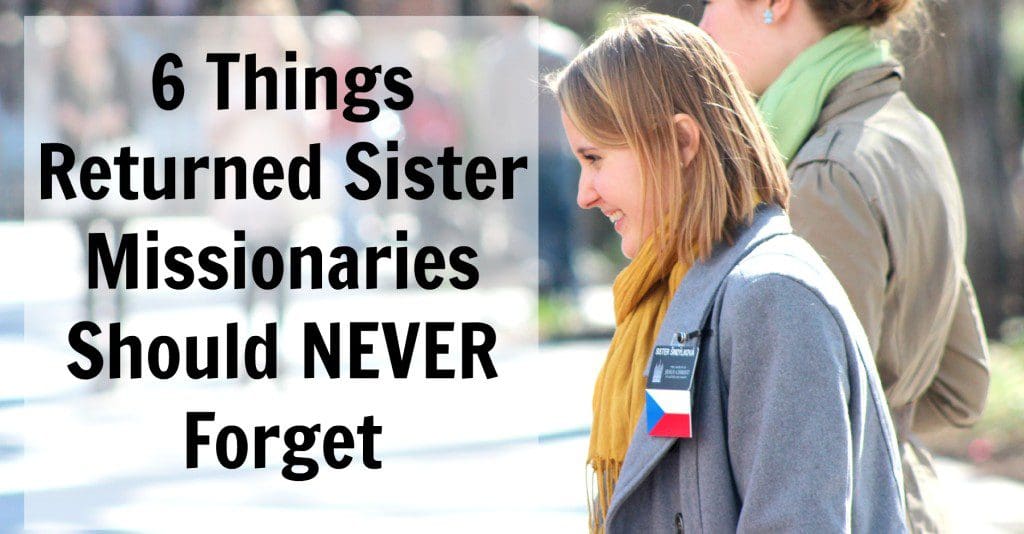
This article was originally published on TheReturnedMissionary.com.
Being a sister missionary is great and being a returned sister missionary is even better! Some sisters may not think so, but I want to give you six reminders to help you see that life after the mission is as great as you make it, just like the mission. Six things that you should NEVER forget.
1. You are STILL Needed.

During the mission, you probably feel more needed than you ever have in your life. Your ward and stake leaders need you, your investigators need you, less active members look to you, your companion needs you and most importantly, the Lord needs you. It is pretty validating to feel like you are needed and a great part of the Lord’s work. Then you come home. But I promise you sister, you still matter just as much as you did in the mission! The world needs you. It needs your voice for good. This is a world where your voice is needed more than it hasever been needed. Elder Ballard’s words (above) are true: “Sisters your sphere of influence is a unique sphere – one that cannot be duplicated by men. No one can defend our Savior with any more persuasion or power than you, the daughters of God, can — you who have such inner strength and conviction. The power of a converted woman’s voice is immeasurable, and the Church needs your voices now more than ever.” 1
You are needed now more than ever. Just because you have no name tag, doesn’t mean you are not needed. Never forget this.
2. Your Life Mission Awaits

Every missionary (sister or elder) feels the power that comes from voluntarily applying and responding to a mission call from God. It is a magical thing to receive a mission call from a prophet that assigns you to a specific place, for a specific time, to serve specific people. All who have served a mission know that missions include days where you get smashed by a powerful spiritual, emotional, or even physical storms. Despite the storms, you move forward, you keep knocking, talking and teaching. Why? Because you know your purpose and you knowyou are called by God to do this. So you move forward through the storm. What about the post mission storms? When you no longer have that specific calling from a prophet of God whispering to you that “this is going to be worth it.” What can we do then? Do we have a personal life mission? I believe we all do.
Every person on earth has a unique purpose and mission to accomplish. That includes you. Until you discover it, each storm will be increasingly difficult to walk through. When you do find it, you are strengthened to push through the storms of RM life. And when you are actively engaged in fulfilling your life mission, everything changes and the world is a better place because you exist.
Elder Russell M. Nelson has said that his mission in life was to learn how to become the best heart surgeon so that he could save the life of the prophet. Anyone who knows about his background knows that he fulfilled that mission. I believe we all have a specific mission to accomplish just like Elder Nelson. What is your mission? Find it and live it and you will be happier.
3. God Will Bless You, if You Let Him

You have a document signed by a prophet that ensures this. Your mission call. You were called by a prophet of God and with that call comes some powerful promises, especially after the mission. Just above where the prophet signed your mission call, it says:
“The Lord will reward you for the goodness of your life. Greater blessings and more happiness than you have yet experienced await you as you humbly and prayerfully serve the Lord in this labor of love among His children.” 2
It doesn’t say that the Lord will reward you for the goodness of your mission only. It says that he will reward you for the goodness of your life. And greater blessings and more happiness than you have yet experienced await you. That is a huge promise! And that promise doesn’t just end the last day of your mission. You can collect these blessings and this happiness the rest of your life if you desire.
God has not forgotten the returned missionary. Don’t forget His promises to bless you. Let God bless you and He will.
4. You Have Greater Influence than You Know.

Even if you don’t believe it, people will look to you the rest of your life. Just think of Helen of Troy, you know, the “face that launched a thousand ships.” 3 I don’t think it was just Helen’s beauty that launched those ships and it wasn’t Queen Esther’s beauty that changed the course of an entire city. The world will say that what gives you influence is your looks, but I disagree. Think of Abigail Adams. She was an amazingly powerful woman with great influence. Americans always speak of the founding fathers of this country. Well, I would be so bold as to say that Abigail Adams was a founding mother of the United States and that without her intimate and intelligent communication with John Adams, this country may have taken a different path. Her influence was pivotal in John Adams’ influence on the founding of the nation. She was an anchor to John and an anchor to the nation. No matter how strong men appear, they need an anchor. Your brothers, friends and boyfriends, husband, father, and every man in your life, will be strengthened by you. Do not underestimate your influence.
If you have the blessing of bearing children, you are the first experience of love that we have when we enter into this life. You are a crucial bearer of love and a creator of life. You are a co-creator with God.
This is a huge deal. I believe that though the names of women are sparse in scripture and in historical literature, you have had the greatest impact on humanity. Consider this quote about Napoleon and the battles of 1809:
“. . . men were following, with bated breath, the march of Napoleon, and waiting with feverish impatience for the latest news of the wars. And all the while, in their own homes, babies were being born. But who could think about babies? Everybody was thinking about battles. . . .
“. . . in one year. . . between Trafalgar and Waterloo, there stole into the world a host of heroes! . . . in 1809. . . Gladstone was born at Liverpool; Alfred Tennyson was born at the Somersby rectory . . . Oliver Wendell Holmes made his first appearance at Massachusetts . . . and Abraham Lincoln drew his first breath at Old Kentucky. Music was enriched by the advent of Frederic Chopin at Warsaw, and of Felix Mendelssohn at Hamburg. . . Elizabeth Barrett Browning [was born] at Durham. . . . But nobody thought of babies. Everybody was thinking of battles. Yet. . .which of the battles of 1809 mattered more than the babies of 1809? . . .
“We fancy that God can only manage His world by big battalions . . . when all the while He is doing it by beautiful babies. . . . When a wrong wants righting, or a work wants doing, or a truth wants preaching, or a continent wants opening, God sends a baby into the world to do it. That is why, long, long ago, a babe was born at Bethlehem.” 4
We all know Napoleon’s name. We also know the name of Abraham Lincoln, Alfred Tennyson, and Oliver Wendell Holmes. Maybe the history books don’t mention the names of their mothers, but these great influencers exist because of these great women who raised up incredible children.
Don’t underestimate your influence.
5. It’s Okay to Have Doubts and Questions After Your Mission.

If you have ever had a question about something in the Church as a returned missionary, you’re normal. We all have questions, especially the returned missionaries. When doubts arise, don’t just ignore them and pretend they aren’t there (fearing that you may go down the wrong path if you acknowledge their existence). Face the doubt, but make sure to remember a few things as you do:
1. Keep the commandments while you figure out the thing you are questioning and do all you can to bring the Spirit into your life. I know too many people who as soon as they start to have doubts, they somehow feel that it justifies doing whatever they want until God shows them the answer. The fastest way to get an answer from God is by doing things that will bring the Spirit, not the other way around. God is the Father of our spirits and that is how He will communicate with us, especially if we have doubts. Don’t forget this.
2. Read and ponder The Crucible of Doubt, by Terryl and Fiona Givens. This is probably the best resource for facing real doubts as Latter-day Saints. It not only helped me to resolve some concerns I had with specific issues, but it also helped give me a new way of seeing. They say in the book: “Questioning is not the problem…After all, the Restoration unfolded because a young man asked questions. The difficulty arises when questions are based on flawed assumptions or incorrect perceptions, which can point us in the wrong direction, misdirect our attention, or constrain the answers we are capable of hearing.”
3. Even in the moments where you feel like you don’t believe in God, remember that, even if you don’t believe in Him, He still believes in you. You’ll figure it out, and He will be patiently waiting for you whenever you are ready to reach up to Him again.
Read more about why doubt doesn’t have to be dangerous on Meridian Magazine here and here.
6. Marriage is NOT a Prerequisite of Happiness

How many of you had an interview with your mission president before leaving the mission? (Everyone) How many of those interviews mentioned something like this: “You have completed your mission. Your next mission is to find a spouse and be married.” Most mission presidents say something similar. This is great! Marriage really is an incredibly important thing and an institution that is ordained of God. However, I would like to dispel a myth herethat I have talked about before on this blog. Some think “to be happy as a returned missionary, I have to be married.” Not so. Happiness is not dependent upon your relationship status. Research does show that people who have close relationships are happier, but that could be a relationship with your brother, sister, friend, mentor, aunt, or anyone. [ Murali Krishna, MD, DLFAPA and David Myers, PhD – Pursuit of Happiness, Characteristics of Happy People, May 2013.] Please don’t get me wrong. I’m married and super happy! I love marriage! And the greatest potential for joy exists when you share it with another. But I was a happy person before I was married, and so was my wife. We both chose to be happy people before we even knew each other. And now we are happy people, who are married. Consider the words of Elder Marvin J. Ashton:
I have yet to see marriage, by itself, turn an unhappy person into a happy person. A really happy married person is almost always one who was or could have been happy as a single person…While we are striving for quality conduct in our lives, we must ever realize that being single will never be as painful as being married to the wrong person. Avoid getting married just to be married.5
I would caution returned missionaries who believe that just being married by itself (and the status of officially having a ring on your finger) will make you happier than not being married. Being a quality person (read the talk by Elder Ashton below) and living a happy life will make you happy. Being married, just to be married, will not make you happy. Living a happy lifestyle and choosing to be happy will make you happy. In Mormon culture, it is often difficult to feel accepted if you are a single person above the age of 22. I know because I was one. Just remember that there is a huge difference between culture and truth. Don’t get sucked into the culture. Remember the truth and choose to be a happy person and live a life of purpose. Then, if you find another person who is choosing to be happy and also living a life of purpose, you may consider marriage with that person. If you are a happy person living a fulfilling life, I can almost guarantee that you are going to attract (and be attracted to), another happy person who is living a fulfilling life. Once you are married, your fulfillment and happiness just increases with someone who is living in the same way. Be happy now. Don’t wait for marriage to be happy or you may end up being more of a “menace to society” than you would have been as an unmarried RM over the age of 25. Though the greatest potential for joy is experienced in married life, happiness is not dependent upon being married.
So please don’t forget to be happy now, whether you are married or not.
***Like this article? Subscribe to our Free Newsletter and like us on facebook and Google+ and check out my book Live Your Mission: 21 Powerful Principles to Discover Your Life Mission, After Your Mission.
When Your Heart Matches Your Shoes

Editor’s Note: Sister Michaela Proctor is on a mission, currently serving in Blantyre, Malawi in Africa. Water and electricity are unpredictable, sometimes going out for as much as a week. Recent flooding collapsed the walls of several hand built mud homes. Clothes are hand washed. Hiking up and down the mountainous paths is her daily routine.
 When I arrived at my little flat in Lilongwe, Malawi as a new missionary with new shoes and a fresh-out-of-the-MTC-let’s-get-to-work attitude, I curiously peered down at the rugged, hole-strewn shoes of the more experienced sisters and thought my shoes would never get to that point. I thought perhaps I was impervious to wear or I came a bit more prepared with the sturdiest shoes available.
As I got to know some of the missionaries in my district and zone I found that though many older missionaries were still zealous about the work after 15-23 months of service, some missionaries’ excitement level was directly connected to the wear of their shoes. Along with their rubber soles wearing thinner and thinner it seemed their souls were also getting tired. But in my bright-eyed, fresh missionary outlook, I thought it would never happen to me. I came a bit more prepared.
Many months have passed since I hugged my trainer that first night in Lilongwe and just recently I began to find holes and tears and wear in all of my shoes. Even my socks have turned to rags. My current area of Blantyre, Malawi is a rather mountainous city and with the combination of elapsed time and hiking miles a day to investigators’ houses, I find myself wondering if my shoes will last me the duration of my mission.
It has gotten to the point that even the cobbler who brings his stool and sits on a corner in our area every day knows me by name. To be candid, there’s something satisfying about working a pair of shoes right off your feet, but it’s disconcerting to find that along with faded shoes walking out the gate in the morning is a faded excitement about the work.

One day, I was determined to turn my attitude around. When the alarm went off, I woke up with a smile and said out loud, “Today is going to be the best day of my mission.” Our planning session the night before was especially good and we had planned what I decided was the perfect day. We thoughtfully called specific members to come help us teach each investigator and each hour had an appointment. Though we passed the same primary school and crossed the same rickety bridge and walked through the same maize field, that day felt different.
Hope added a spring in my worn out shoes. Potential hung in the very air we breathed. At the first house, they invited us in and told us they had a few things to do so just to wait a minute. Five minutes turned into 45 and when they finally sat down we had another appointment to get to. We rushed to the market to meet up with a member who agreed to come teach with us and he never showed up. At this point my heart was undeterred–it was still morning and we still had an afternoon of perfect plans. Without the member, we forged ahead to teach the lesson anyway only to find a man without his wife at home. Slightly disappointed, we turned down the appointment because without a woman we couldn’t teach.
After lunch and a long hike to our next lesson we found an empty house and each subsequent lesson got cancelled over text or phone call. The only “perfect” plan of ours that actually happened was to see who we call our “eternal investigator”. But not even a lively discussion on tithing could refresh my downtrodden soul. By far the worst cancellation came through a text ten minutes before the appointment was supposed to start. We ashamedly called the member who was coming to teach with us for the first time to find he had already made the long hike from his house to our meeting place.

With every cancelled appointment, my heart sunk a little lower and the sting of perfect plans shattered made my feet heavy as we made our trek home. I felt that Heavenly Father’s sense of humor that day was a bit dry and the blazing sun was a bit too diligent at its job. As we accounted for the day I felt like a failure–to my mortal eyes I hadn’t helped to save anyone.
How do we trudge on when our hearts are about as weary as our shoes? Where can we find validation when our hard work and our perfect plans result in empty houses and long walks? The Lord says to each of us, no matter what is weighing our hearts down, “Be not weary in well-doing, for ye are laying the foundation of a great work. And out of small things proceedeth that which is great,” (D&C 64:33).
This is not just some cheap encouragement to persuade us to keep laboring in His kingdom. This is an invitation to look forward with a perfect brightness of hope, for we are not only doing His work but He is working on us. His “great work” is to “bring to pass [our] immortality and eternal life,” (Moses 1:39). If your perfect plans don’t work out then you can know for a surety that God is working on you. His plans are infinitely grander than our mortal minds can fabricate.
With my minute comprehension of missionary work and life, I cannot possibly measure success in the expanse of eternity. Maybe, for today, the greater success in Heavenly Father’s eyes is not that I accomplished all of my plans but that despite every cancellation I kept walking and my patience grew the tiniest bit. He rejoices every time we smile when it would be easier to cry, every time we walk out the gate, though we are exhausted and unsure what the day holds, and every time one of our weaknesses becomes a little less weak through the Atonement of His Son.
The enemy of our souls tries to convince us that God is only pleased when we are perfect and all weaknesses have been turned to strengths. The truth is when our natural man would get frustrated and lose patience but we choose faith and long suffering instead, that is a miracle to our Father in Heaven.

I often think of Nephi and his diligence and faith in the midst of great setbacks. He may not have left family behind for 18 months but he did leave his home behind with no knowledge of the journey ahead. He and his murmuring brothers took the same path, facing the same Laban, the same hunger, the same storms, and they all reached the Promised Land but which of these sons of Lehi do we honor and desire to emulate?
Nephi, of course. Nephi maintained inexhaustible hope in the promises of the Lord and went on his wilderness journey with gladness in his heart. Laman and Lemuel also go to the land of promise, like Nephi, but what was their journey like? I would say their figurative shoes were worn out within their first steps out of Jerusalem.
I don’t want to be Laman or Lemuel. I don’t want my heart or attitude to match my shoes. I don’t want to wish any moment away.
Nephi’s unfailing faith rested on his testimony that God has the ability to fulfill all of His promises. “Yea, and how is it that ye have forgotten that the Lord is able to do all things according to his will, for the children of men, if it so be that they exercise faith in him? Wherefore, let us be faithful to him. And if it so be that we are faithful to him, we shall obtain the land of promise,” (1 Nephi 7:12-13).
He had faith that God’s wisdom far surpassed his own. He maintained an eternal perspective even when the journey seemed long. In mortal years, maybe his journey was long but great light accompanied him and the Liahona guided them “in the most fertile parts of the wilderness” (1 Nephi 16:14). He rejoiced in Christ and lived in thanksgiving in all things. His voice “forever ascend[ed] up unto [God]” (2 Nephi 4:35).

On April 1st, we got a call from the assistants to the president informing us that our quarterly mission leadership council in Zambia had been cancelled. After weeks and weeks of no success, this seemed like the one thing I had to look forward to. I wanted to believe it was some cruel April Fools joke but this three-day trip to Lusaka became yet another 2-hour monthly council over Skype.
That was hardly the spiritual and emotional refreshment I had been waiting for. But with yet another perfect plan shattered and many minutes off my worn out feet down on my weary knees the Spirit called me to awake, shake the dust from my soul, and open my eyes. The Savior brushed me off and reminded me that this may be a wilderness journey but He is leading me through the most fertile parts. With arms outstretched He says, “Let your heart be not faint now the journey’s begun; There is One who still beckons to you. So look upward in joy And take hold of his hand; He will lead you to heights that are new,” (Does The Journey Seem Long, 127).
Oh the heights I have reached on my mission. With every moment of grief my appreciation for the Atonement deepens. The greatest, effulgent joy comes from seemingly inconsequential things–the change of the seasons, having running water when dry taps are the norm, kneeling in prayers with an investigator, seeing someone open the Book of Mormon for the first time, a less active coming to church for the first time in years, a member who willingly teaches with us.
 My eyes see life a little clearer and the Spirit has expanded my perspective. Though I am so intricately within this experience I am also without. When missionary work gets difficult I feel my future self calling out to me saying, “Don’t give up, my dear. Don’t you quit. You keep trudging. You keep knocking. There is far greater light ahead.” “Ye cannot behold with your natural eyes, for the present time, the design of your God concerning those things which shall come here after, and the glory which shall follow after much tribulation. For after much tribulation come the blessings. Wherefore the day cometh that ye shall be crowned with much glory; the hour is not yet, but is nigh at hand,” (D&C 58:3-4).
Storms may rage and the natural man may hunker down and hide but a wiser voice calls from future years to say, “You will be forever grateful for this storm. Pull those shoes on and keep walking. Be not weary. You are His work.”

FEATURES