




Meridian Authors Richard and Linda Eyre Featured on Cover of National Magazine
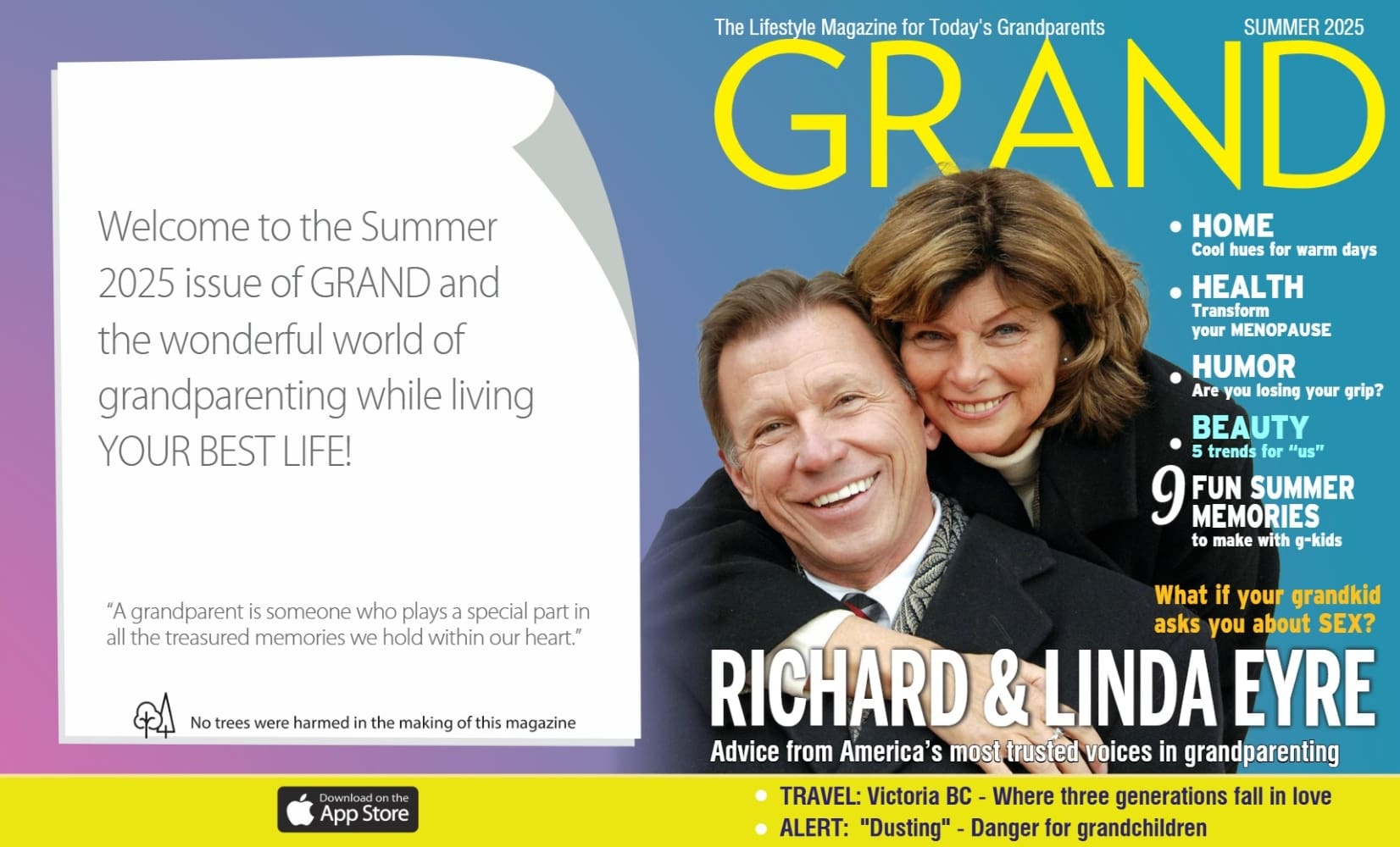
Frequent Meridian contributors Richard and Linda Eyre are currently featured in the cover article of the Summer edition of GRAND magazine, the only national magazine devoted to grandparenting and three-generation family management.
Because so many Meridian readers know the Eyres, and because the article contains tips and pointers that can be helpful to all of us in our families, we are excerpting parts of it here and providing a link to the full article which can be found at https://www.nxtbook.com/nxtbooks/grand/2025summer/index.php#/p/17.
Here are some excerpts from the current issue of GRAND:
From Politics to Parenting: The Remarkable Journey of Richard and Linda Eyre
BY CHRISTINE CROSBY
How a power couple traded campaign trails for family values—and became America’s most trusted voices on parenting and grandparenting
Before Richard and Linda Eyre became household names in the world of family life, their paths seemed destined for very different trajectories. Linda was pursuing her passion as a music major and accomplished violinist, while Richard was cutting his teeth in the high-stakes world of politics, working on the presidential campaigns of George Romney and Nelson Rockefeller in 1968.
Their love story began with a honeymoon that doubled as a cross-country adventure—a four-day drive to Boston, where Richard would pursue his MBA at Harvard Business School and Linda would share her musical gifts teaching at a local junior high. But even then, their ambitions extended beyond the traditional. Richard and a classmate from France pioneered an innovative course called “Power,” reflecting their belief that business education should serve larger purposes, particularly in the political arena. During their second year at Harvard, their first daughter arrived, adding a new dimension to their already dynamic lives.
Building Political Careers
After graduation, the Eyres co-founded Bailey, Deardourff and Eyre, a political consulting firm in Washington D.C. that would go on to orchestrate numerous successful gubernatorial and U.S. Senate campaigns throughout the 1970s, primarily for moderate Republicans. Their expertise in campaign strategy and management quickly established them as rising stars in political circles.
Seeking a new challenge, they took a leave of absence to manage Jake Garn’s first Senate campaign in Utah—a race that seemed impossible when Garn trailed by 30 percentage points. Their strategic brilliance paid off when Garn not only won but did so decisively, setting the stage for Richard’s own anticipated run for Congress against the incumbent Democrat in Utah’s second district.
Just as they were preparing to announce Richard’s candidacy, life took an unexpected turn.
A Paradigm Shift in London
The Eyres were called to serve as mission presidents for their church in London, putting their political ambitions on indefinite hold. They moved their family of four children across the Atlantic, where they would spend three transformative years working with more than 600 missionaries.
“The experience changed our perspective and our paradigm, as well as our priorities,” Linda would later reflect. Working closely with young people from diverse backgrounds, they began to notice a pattern: the problems and strengths of each missionary could almost invariably be traced back to their home environment and parental influence. This revelation sparked a profound question that would reshape their entire career trajectory—should their contribution to society center on strengthening families rather than pursuing political power?
From Politics to Parenting
Returning to Salt Lake City with a renewed sense of purpose, the Eyres channeled their analytical skills into a new domain. They wrote their first parenting book, applying management principles to child-rearing in what they called “Parenting by Objective.” The result was Teaching Children Joy, which became a bestseller and inspired a revolutionary preschool curriculum called “Joy Schools”—an innovative, do-it-yourself program that spread rapidly across the country and internationally.
Their publisher, Simon and Schuster, recognized their unique voice in the parenting space and commissioned Teaching Your Children Values. The book struck a cultural nerve, becoming a #1 New York Times bestseller—the only parenting book to reach that pinnacle in more than fifty years. High-profile media appearances on shows like Oprah, Donahue, and the Today Show catapulted both the book and the Eyres into national prominence.
Global Impact and Recognition
What followed was an extraordinary period of influence that spanned four decades. Book contracts, speaking tours, and media appearances took them around the world five times, reaching two generations of parents across more than 50 countries. They discovered something remarkable in their travels: regardless of economic, religious, geographic, or cultural differences, parents everywhere shared similar hopes, dreams, and concerns for their children.
The Eyres have authored more than 50 books focusing on work-family balance and parenting. They’ve been featured on major network shows including 60 Minutes, Prime Time Live, and Good Morning America, and once hosted regular segments on CBS Early Show. Their website, ValuesParenting.com, continues to provide guidance and creative programs for families worldwide.
Their philosophy for grandparenting mirrors their approach to parenting: if you want to be a better grandparent, start by improving yourself. They advocate for becoming better listeners, empathizers, supporters, and leaders of three-generation families, working on oneself physically, mentally, emotionally, socially, and spiritually.
A Lasting Legacy
From their early days in political consulting to their current status as America’s most trusted voices on family life, Richard and Linda Eyre have demonstrated that the most powerful changes often come not from the halls of government, but from the living rooms and kitchens where families gather. Their journey from campaign strategists to parenting experts illustrates a profound truth they discovered in London decades ago: the strength of our society ultimately depends on the strength of our families.
Editor’s note: The article also refers to the Eyres new, online course called How to Live the Second Half of Life in which Meridian and the Proctors are participating (see https://valuesparenting.com/how-to-live/)
For more by Richard and Linda Eyre, click here.
How To Live The Second Half of Life (part III)
Editor’s note: Meridian is pleased to partner with the Eyres in presenting their new online course called HOW TO LIVE The Second Half of Life. The pre-course began last Spring and was announced by two Meridian articles on March 28 and April 11 (read them here and here) and has been unfolding on Instagram @richardeyrehtl and on the Eyres on the Road podcast. Meridian readers can still join the pre-course for free at https://valuesparenting.com/how-to-live/ until August 11.
Starting on August 15, on the same website, registration will open for the official course. The Eyres will lead the teaching, but several “adjunct faculty,” including the Proctors, will also contribute. Meridian is pleased today to present the third part of the three-part overview from the Eyres.
Why it is Beneficial to Mentally Separate the “Two Halves of our Lives”?
Most people live their entire life on one continuous spectrum, essentially living and thinking the same way for all of their 50 or more adult years, and approaching life and its goals and challenges pretty much the same way when they are 70 as they did when they were 40. The problem is that they have changed, and their circumstances have changed, and their mental and physical capacities have changed—and they have not re-invented their approach to life or altered their paradigm of life to match who and what they are now.
The thesis of the How to Live the Second Half of Life online course is that there are new ways of approaching our lives physically, mentally, socially, emotionally, spiritually, familially, and financially that we are better suited for now, and that can increase our abilities to contribute and to enjoy in remarkable new ways.
As the years pass, we lose some of our physical capacity but compensate for it with new effort and regimens; and in the words of Arthur Brooks, our “fluid intelligence” declines a bit even as our “crystalized intelligence” incorporates our experience and wisdom to form a whole new level of mental ability.
And while ageing suggests the need to “manage” and minimize our hopefully very gradual physical and mental decline, we continue to grow and expand and “ascend” in our social, emotional, and spiritual lives.
If we fail to make important adjustments in the second half, we will just keep on doing the same old things in the same old ways—but we will do them less and less well and will find decreasing satisfaction in them.
But if we consciously and deliberately shift our paradigm and redesign how we live all seven facets of our lives, the second half can be incredible! And the second half of the second half (the all-important “fourth quarter” when all games are decided) can be the best part of all.
Why an online Course on How to Live the Second Half?
First of all, in today’s world, our “second halves” and “fourth quarters” are getting longer.
Some young grandparents can expect to be grandparents for 30 or 40 years, and people who are in reasonably good health in their 60s have an excellent chance to live into their 90s.
If we put in the effort to make it so, 70 can be the new 50, and 80 really can be the new 60.
Do we want to live long? In many of our seminars, we ask our audience (usually in their 40s or 50s) how long they want to live. Interestingly, the two biggest groups of respondents are the ones who say they want to live forever—or as long as humanly possible, and the ones who say they think they want to pass on before they are a burden on anyone—perhaps checking out in their 70s. (We have a strong feeling that they will change this view once they are 70!)
Linda and I find ourselves in the first group. We are curious about what will happen in this world (and in this Church) in the next 20 years, and most of all, we want to see our grandchildren marry and have kids of their own.
And we are open to the idea (naïve?) that there is at least a feasible chance that if we work at it, we can stay reasonably able and healthy for quite a few more years and continue to be a blessing rather than a burden to those we love most.
Fortunately, a lot of our speaking and writing of late has been to like-minded (and like-age) people—many of them business and community leaders and CEOs who want not only to live long but to make their fourth quarter a time of recalibrated broadening and contributing.
So, we have been working, for decades now, on the kind of physical, mental, social, emotional, spiritual, familial, and financial approaches that can really work in life’s second half, and we find that they are very different than the way most of us lived our first half. We are putting those approaches into this How to Live the Second Half of Life online course. Take a look at https://valuesparenting.com/how-to-live/ for more details.
We all need a balanced approach in this business of deliberate, managed ageing. Some of us get very good at physical fitness, but don’t pay much attention to the mental or the spiritual. Some really focus on the financial, but let the social and familial facets of their lives slide. The best results come when we develop a plan for how to live our best in all seven life-facets—physical, mental, social, emotional, spiritual, familial, and financial. Doing our best at each one of these benefits the other 6!
Not a Bed of Roses
I remember my ageing grandmother saying something like “getting old is not a bed of roses.”
We imagine that many of you are saying (or thinking) “The Eyres are trying to make ageing sound happy and exciting, but he doesn’t know what I’m facing.”
You might identify more with what one old crotchety uncle said, “Getting old is the Pits!”
We just want to reassure you that we do empathize with what so many of you (and us) are feeling. Some have lost their health in ways that are impossible to recover from. Some are frightened that their cognitive ability is in decline. Some have recently lost parents or spouses, or children. Some have had financial reverses and lost their self-sufficiency. Some are just in new phases of life where they don’t feel needed or appreciated, or relevant anymore. Some are pretty depressed by the directions the world is going—the world their grandchildren will live in. Some have experienced a faith crisis and begun to doubt the very beliefs they have based their lives on. Some wonder what is really left for them and feel underused, underserved, and underappreciated.
No…that certainly doesn’t sound like a bed of roses.
But there is one principle that we will be basing this course on, which can mitigate (not eliminate but mitigate) a lot of the woes that we face.
We began learning it a long time ago from a book called Man’s Search for Meaning by Viktor Frankl. As a prisoner in a Nazi concentration camp, Frankl suffered in unimaginable ways, including having medical experiments done on him. But he essentially decided that the ONE freedom he still had was the freedom to decide how he would respond internally to the abuse and the abusers. He could choose whether to hate or forgive, whether to look for doom or for hope.
It is not our circumstances or situation that determine our joy or our motivation. It is how we perceive and respond to what happens to us.
Frankl observed that among the fellow inmates in the concentration camp, those who survived were able to connect with a purpose in life to feel positive about and who then immersed themselves in imagining that purpose in their own way, such as conversing with an (imagined) loved one. According to Frankl, the way a prisoner imagined the future affected his longevity.
That is what we are trying to do in HOW TO LIVE—to imagine our future at its best—to live well-examined lives. We will each try (and help each other to try) to magnify the joy and the good in our lives, to make the most of what we have, to improve wherever we can, to serve those we love a little better, and to find new ways to view our lives and our abilities to broaden and contribute and to make the second half or fourth quarter the most consequential and blessed season of our lives.
How does all this relate to Meridian Readers?
Nearly 600 people (perhaps around 1,000 if we count husbands and wives separately) have already registered and have been participating in a pre-course on WHY to live the Second Half differently…which leads up to the official course on HOW to Live the Second Half of Life, which begins on September 1.
A significant number of those who have registered as members are Meridian readers, and you can still sign up for free for the remainder of the pre-course (until August 10) at https://valuesparenting.com/how-to-live/. Doing so and becoming an HTL (How to Live) member will give you access to all of the posts and podcasts that have led up to this point.
You will then have two or three weeks to review those WHY-TO materials and decide if you want to commit to the 7-month course, which starts September 1.
In teaching the course, we will continue to be assisted by the Proctors and two dozen additional “Adjunct Faculty” who we admire and who we believe can teach us all a lot about living the second half of life artfully, creatively, and fully. Thanks to these additional teachers, all of whom we respect and want to learn from. Together, we think we can offer second-half-ers a balanced and proven pattern for a truly awesome “Autumn” of life!
Richard and Linda Eyre have been called “America’s most trusted voices on Families and Grandparenting.” Read the recent national cover story on them at https://www.nxtbook.com/nxtbooks/grand/2025summer/
HOW TO LIVE The Second Half of Life (part II)

Editor’s note: Meridian is pleased to partner with the Eyres in presenting their new online course called HOW TO LIVE The Second Half of Life. The course is in its final stages of development and is built around short posts and emails so that members can listen and participate with five minutes here and five minutes there, whenever they have the time. The pre-course is now underway, and Meridian readers can join for free at https://valuesparenting.com/how-to-live/. The Eyres will lead the course, but several “adjunct faculty” including the Proctors, will also contribute. We are pleased to present this second part of a two-part overview from the Eyres (part one was two weeks ago and can be read here.)
Who and What is “OLD”?
We were watching a BBC special the other evening on the topic of AI, and one issue discussed was how the workforce is divided between the “young” who learn and use and thrive with AI and the “old” who resist it and want to keep doing everything the “old school” way.
The troubling part was that the reporters defined “old” as everyone over 50. To those of us who have children over 50, that is a bit of a blow. Putting the “old” label on people only half way through their lives is not only incorrect, it damages society as the senior half of the population along with their huge asset of experience and wisdom is disregarded and undervalued.
It is easy to blame the culture or the system or “younger people” in general when we seniors begin to feel marginalized or irrelevant or disrespected. But we sometimes bring it on ourselves. If we disengage, if we “retire” from much of life and just seek to entertain or amuse ourselves, if we pull away from life to the point that when people ask what we are doing we say “Oh, I’m keeping busy,” or when asked how we are doing we say “Oh, not too bad”…if we do or say things like this, then maybe it is ourselves that need some examination and adjustment.
We live in a world that is already so polarized and divided politically and economically and culturally, and if we also divide it generationally—the young and the old, the first-half-ers vs. the second-half-ers, everyone loses. Age diversity and age compatibility and age synergy are what makes a society strong. The mentoring and mutual learning and communicating connections between the old and the young make our culture and our individual lives richer and deeper.
And that is nowhere more true than in our families!
Irrelevant?
We have a wonderful study group that has been meeting since it was formed 50 years ago in graduate school (that will make it pretty easy to figure out the average age of the group) and while most of its members are robust and proactive, it did come up in a recent discussion that feelings of “irrelevance” are one of our biggest concerns.
Do those feelings come because we really believe that we are “losing it”, or that we have no more ambition or goals; or are the feelings inflicted on us by a “youth culture” that shuts out and disrespects our abilities and our experience?
The simple fact is that any culture—that of a business, that of politics, that of the Church, works best when young and old and everything in between values each other and respects each other and the fact that each of the “others” are better at some things than we are. Every level and part of society works better and operates in sync and cooperation when young and old respect and learns from one another.
We may not have much control over whether a company, or a government, or the Church operates in that age-synergistic way, but we have a great deal of influence over whether our families work that way—each of us do. If we are grandparents, we can find effective ways to gather and support and help manage our three generation families. If we are parents, we can consciously link our children to our parents in countless ways. If we are younger, we can show deep respect to our grandparents and complement them by asking for their advice.
We know that there are ideas and discussions going on in the Church at every level about how to foster this powerful blending of ages and stages of life, and how to support and value all parts of the family. It happens so beautifully in missionary work and temple work and within well connected wards and stakes. And if there are world-wide broadcasts for the youth, should there not also be Face-to-Face global broadcasts to seniors and grandparents? And if all the other elements of families are represented by a Church Auxiliary, perhaps something akin to a Senior Auxiliary should also be considered. Every age and every part of families has its own set of worries and needs and issues, and we trust the Church above all other institutions to help and support us with these concerns.
HOW TO LIVE The Second Half of Life
All that we have written so far in this article has factored into the online course HOW TO LIVE The Second Half of Life that we are doing in connection with Meridian and the Proctors and other supporting “Adjunct Faculty.” The course will explore and examine how those of us who are well into our “Second Half” can make this Autumn Season the best part of our lives and continue to be relevant and contributing within our families and communities as well as in the Church. (And by the way, the reason we call it the “Second Half” is that even if we are numerically three fourths through, we likely have as much to give in what remains of our lives as we have given in the part that is past. So, think of it as the second half of our lives in terms of our contributions to the people and institutions we love.)
The course will be unique and flexible in that there will not be a set schedule for classes or meetings. It will all be presented in short posts on Instagram or in podcasts or brief email notes that you can watch or listen to or read at whatever time suits you best—and you will be able to respond with comments or questions whenever either one occurs to you.
Join Us, Have some Autumn Goals, Become a “Soc”
What we find as we talk to other Seniors (actually we like the term “Masters” better—that is what the upper-age divisions are called in the tennis tournaments I (Richard) play in.
In our Master years, what we need for motivation in our lives is what we have always needed—clear GOALS. But we need a different kind of goals than in the first half when most of our objectives were about getting and accumulating and achieving. We now need more family goals, more relationship goals, and more character-creating and spiritual goals. These are essentially “becoming” goals. What kind of person—or grandparent—or empty-nest parent—or mentor—or supporter—or gatherer do we want to become? What sort of goals do we have that can help manage or slow our inevitable decline in the physical and mental aspects of our lives? And what social or emotional or spiritual or familial goals do we have that will aid and increase our ascent in these other four aspects? And what plans do we have to make these goals happen?
If you draw a blank on some of those questions—you are in the majority! Most of us have not thought enough about the potential power and joy of this phase of life. In these HOW TO LIVE classes we will help each other become what we like to call “Socs” or people who are Socratic in how we think—who agree with Socrates who was himself was an old guy when he said, “The unexamined life is not worth living.” In the online course, we will examine ourselves as Seniors, as Masters, as Grandparents, as 3-generation family leaders, as physical, mental, emotional, social, and spiritual beings who can make the determining fourth quarter of a game or the final crescendo movement of a symphony become the best part.
Join us! Get signed up now for free at https://valuesparenting.com/how-to-live/ as a member of the pre-course that will further examine the changes and adjustments of the second half and give you a spread of ideas and inputs to think about as you decide if you want to stay on board when the main course on the Fall and Winter of life unfolds in the Fall and Winter of this year.
As New York Times #1 Bestselling Authors and Global Speakers on Family and Life Balance, the Eyres have now turned their writing and speaking to where they are—The Second Half, The Fourth Quarter, The Fifth Set, The Crescendo.
HOW TO LIVE the Second Half of Life

Editor’s note: Meridian is pleased to partner with the Eyres in presenting their new online course called HOW TO LIVE The Second Half of Life. The course is in its final stages of development and is built around short posts and articles so that members can listen and participate with five minutes here and five minutes there whenever they have the time. The pre-course is now underway, and Meridian readers can JOIN FOR FREE. The Eyres will lead the course, but several “adjunct faculty” including the Proctors, will also contribute. We are pleased to present this two-part overview from the Eyres (part two will be here in this space two weeks from today on April 11.)
Spiritual and Familial Maturity
One thing we love about writing for Meridian Magazine is that it has a mature audience—not that there are no young readers, but whether young or old, Meridian readers are generally mature in their outlooks, in their beliefs, in their families and in their testimonies. And perhaps some, like us, are in the second half of our lives and striving to live and grow in a different and more spiritually mature way than we did in our first half. Many of us are grandparents, or approaching grandparenthood, and we are more aware than ever that our families, our relationships, and our grandchildren are our true legacies. Thus, we are open to new ideas on how to be more effective leaders of three-generation families, how to be more proactive and sensitive in our grandparenting, and just generally HOW TO LIVE the second half of our live with maximum joy and fulfillment.
And as simple and obvious as it sounds—that we are all getting older and have new opportunities and new challenges in how we live—it deserves some deep and serious thought—because the second half of life is very different than the first; and coming to recognize that, and deliberately making the changes that it allows, can make all the difference.
And may we let you in on a little secret that most of you have already figured out: The second half can be better than the first! And how do we know that? Because we all have Grandkids!
The Big HOW Question
But how do we LIVE the second half? How do we make the most of it? How do we re-prioritize and re-calibrate? Should it be more about relationships and less about achievements now? More about broadening and contributing and less about aspiring and competing? More about being a consultant than a manager to our kids and grandkids? These are questions the two of us have been thinking about and writing about for a long time now, and we think we have some ideas, if not solutions—and we want to share them with all of you who read Meridian Magazine. And as mentioned in the editor’s note above, we are doing that through a new online course called HOW TO LIVE The Second Half of Life, and you can sign up for free right HERE.
Of course, we all want to be better grandparents and better parents of adult children—but here is the interesting thing: Our tendency is to think “OK, I want to be a better grandma (or grandpa) so I better start changing and improving my grandkids!”
In fact, if we want to be better parents and grandparents, we need to start changing and improving ourselves! We need to become better listeners, better empathizers, better supporters and cheerleaders, and better leaders and unifiers of our 3-generation families. We need to work on ourselves physically, mentally, emotionally, socially and spiritually—to try to become the kind of people who our grown children and grandkids can look up to and respect (and ask for advice) as well as love.
Where is the Owner’s Manual, and where are the Mentors?
So, who helps us to become all that? Where is the owner’s manual for the second half of life? When we were younger, most of us had mentors and teachers and role models who could guide us, but who guides us now?
Well, here is a unique idea: We can and should be mentoring each other. Hats off to Maurine and Scot Proctor and a little hand-picked cadre of outstanding grandparents and “second-half-ers” who are helping us figure out the best ways and the best ideas for doing that, because the finest grandparenting ideas and senior-living ideas will always come from other grandparents and other seniors. The best advice on preserving our physical and mental abilities will come from others in our same life-phase. The best motivation to make ourselves better emotionally and socially and spiritually will result from being in contact with other second-half folks who have figured out certain parts of it better than we have.
What we want to do through the HOW TO LIVE course is to make that peer-to-peer learning more deliberate and more powerful—an ongoing discussion group among second-half-ers who want this to be the best phase of all. The course is set up in a way that allows you to listen in or join in on your own schedule, whenever you want, on apps that allow you to comment and ask questions.
I (Richard) will lead the course, but of course Linda will be highly involved as she always is, as will a half-dozen or so “Adjunct Professors” mentioned above who will offer their response to what I say and bring in their own insights on the artful and joyful living of the second half of our lives.
Let us be candid enough to say that I am in the second half of the second half of our lives—and in a way, we are a little embarrassed that it took us this long to figure out some of the things we want to pass on to you. We want you figure it out a little sooner, and live it for a little longer!
Call to Action
Take a minute, right now if you can, and click here where there are more details, and where Meridian readers can sign up for free and participate as much as they like in the early, general stages of the course which have already begun this Spring. By the time summer rolls around, if you are finding the pre-course interesting and helpful, you can enroll in the full course where, over the next six months, we will be exploring and examining the “Autumn and Winter” of life during the Autumn and Winter of the year
And remember, the point is to learn from each other, so feel free to pass this link on to any other second-half-ers who you would like to see in the course with you.
A Quick Summary
Here are a few “teasers” on the things we all ought to be thinking about in our Second Halves:
How to Live Physically
New approaches to how to eat, how to sleep, how to exercise. The free gifts and proper use of Air and Water. How to relax instantly, at will. How to reduce your psychological age by 10 years. The two productive body-sets of Lightning and Waves. Easy monitoring–becoming your own physician and knowing enough to avoid health surprises.
How to live Mentally
Fresh perspectives on how to think, how to imagine, how to read, how to transition from “work and plan” to “watch and pray.” Artificial Intelligence vs Authentic Intelligence. Viewing Nature as an Inspirational Mother. Reading and listening differently. The art of Anti-planning. Relationship Goals. Enlightened Observing. The visual magic of foam-core boards. Thinking freely. Noticing what others miss.
How to live Socially
Reinvented Awareness on how to listen and how to ask the right question at the right moment. “Crystal-ball heads.” Forming a Trust Group. Discovering compound-questions. Making vertical relationships horizontal. The joy of being inconvenienced. Making friends with your own adult children. Disagreeing agreeably.
How to live Emotionally
Surprising alternative paradigms on how to chill, how to make the hard easy, how to find deliberate calm. Answers to whence cometh peace. Feeling deeply. Enjoying simple. Trading control for serendipity. Discovering more of the aesthetic and becoming a true creator. Trading Ownership for Stewardship. Trading Control for Serendipity, Loving More. Seeing the beauty of truth and the truth of beauty.
How to live Spiritually
Enlightened insights on how to meditate, how to receive. The real Spirit You. The counterintuitive power of under-preparing. A powerful can’t-do attitude. The secular and spiritual meaning of Grace. Taping into the Divine. Seeing yourself from above. The three things you can take with you: People, Places, and Purpose. The His-Agenda pattern of Releasing, Requesting, Receiving, and Responding. Self-correcting prayer.
How to live Communally or Familially
Shared secrets on how to be vulnerable, how to trust, how to sail the relationship. Three-generation family management. Grandparenting and empty-nest parenting. The eight myths of marriage. The Emerson/Thoreau bounce. Oneness partnerships. Discovering how to influence grandkids without stepping on parent’s toes.
Remember, Socrates himself was a “senior” when he said “The unexamined life is not worth living.” Expand and Examine your Second Half within the stimulation of this course. There is nothing to lose and lots to gain. Get signed up for free and join us in the quest.
Linda and Richard Eyre are New York Times #1 bestselling authors who lecture throughout the world on matters of family, parenting, and life-balance. Recently they have turned their attention to where they are in their own lives—Grandparenting and the Second Half.
Making Sense of the Gospel through a Family Lens

Editor’s Note: We are pleased to present this once-a-week, all-summer-long series of articles from Linda and Richard Eyre. As most Meridian readers know, the Eyres, for five decades, have focused their professional lives on strengthening families. This focus has ranged from writing New York Times #1 bestselling books to speaking to parents in more than 60 countries around the globe. But their true passion is for an Inclusive, Eternal Family Paradigm that can’t be fully shared or grasped without the insights of the Restored Gospel. And they feel that the reverse of that is also true: The Restored Gospel can’t be fully grasped or shared until it is seen through an Inclusive, Eternal Family Lens. The goal of this series of essays is to more fully integrate Family and Gospel, helping us each to better understand both., “Family” is broadly defined so that each article speaks to us all, whether we are single or married, parents or siblings, aunts and uncles or grandparents.
Writer’s Note: We love and trust Meridian Readers, and are pleased to share, in bite-sized chunks, what will later become a book of essays attempting to synergistically connect Church and Family and share a fresh perspective on mortality’s purpose relative to our exaltation. Since you will be the first to see these essays, we invite you to share your feedback and insights—because by doing so you will be helping us edit the book. Reach us directly and confidentially by writing to our pseudonym email [email protected] where only the two of us will read or respond.
Now one more note, specifically from Richard: I am the voice for these essays, but you need to know that every concept I will try to express in this series was co-created with Linda. Her summer plate is a bit fuller than mine, so I’m the scribe, but these articles come from both of our minds and both of our hearts. Let us invite you to join us here each weekend this Summer to focus on a new facet of how Church connects to Family and how Family connects to Church. Develop with us the Summer-habit of Family-Focused Fridays.
What is “the Church”?
A friend of mine asked a group of young Church members, some in the midst of personal faith crises, what they meant when they said “the Church.” Most of them said they meant the Brethren, the Salt Lake Headquarters, the Institutional Church with is organization of wards and stakes, the hierarchy that tells us what to do and how to live.
Not enough of them, in my friend’s view, said that the Church was them, that they were the Church, that the Church was the community of Christ, made up of imperfect people trying to help each other negotiate this beautiful but messy mortality, with the divine help of the Spirit and the Priesthood and the insights and covenants of the Restoration.
Perhaps we all need to think longer and harder about who we are and what the Church is and how it can help and guide us on the course that our Heavenly Parents have set for us which returns us to Them and makes us more like Them. This kind of longer and harder thinking is the purpose and goal of this series of essays which will suggest a fresh perspective or paradigm…
- in which God is our Heavenly Parents who never stop offering to us all that they have;
- in which relationships, particularly family ones, are what is eternal, not the Church;
- in which “family” is broadly defined and inclusive of all;
- in which the Church is the scaffolding with which we build forever families;
- in which temples and covenant paths lead to the joy of extended, connected ancestors and descendants;
- in which the earth escapes being “cursed” or “wasted” because “the hearts of the parents turn to their children,” and the “hearts of the children turn to their parents;”
- and in which Exaltation is the end and Christ, His Church, and His atonement are the means.
Thinking Familycentric, Inclusive, and Long-term
Our beloved President Nelson has said, and frequently reiterates, that the Restored Gospel is “Home centered, Church supported.” Thus, to fully understand the Gospel, we need to think in familycentric terms.
Or, said another way, to grasp the essence of the Restoration, we need to think from the perspective of Eternal Family—both Theirs, and ours. Come to think of it, our Prophet frequently says that too, in the simplest, most direct way, “Think Celestial.”
WAIT, HOLD IT, please don’t anyone stop reading right now because “I’m not a parent” or “I don’t have a family.” Let’s not define “family” that narrowly. We all have families, we are all part of families, we are all children in God’s family. We are cousins and/or aunts and/or uncles and/or siblings and/or children and grandchildren.
This is not to say that single members of the Church do not have some needs and challenges that are different from those of married members, and sometimes the “support” singles need can be a ward or church group that is their family for the time being. But that does not change the overriding understanding that we are all connected, all part of families, all part of God’s family.
It has always been so, (with “always” meaning everything since God begat us spiritually) and organized us from the intelligences we have always been (with “always” really meaning always.)
President Oaks said it profoundly and beautifully: “Our theology begins with Heavenly Parents.”
And he could have said that our theology also ends with Heavenly Parents, or with our hoped-for return to live as linked, connected families that are part of Their family.
So, for the purposes of this series, may we define “family” in the broadest, most completely inclusive terms. Family is all of us, all of God’s children.
Believing in and thinking of God as Parental rather than a Sovereign can change everything. It changes how deeply we feel His love, it helps us understand that we are not His creations but His children, and that we are not Christ’s subjects, but His siblings.
God doesn’t separate us by what family roles we have played and what roles we have left to play, so why should we separate ourselves in that way. What a disservice we do when we divide “Families and Singles.” Instead, we should try to perceive all the roles and relationships that exist in families and understand that, in the course of mortality, spirit world, millennium and resurrection, we will all have the chance to play all of those family roles which can connect us in the ways that all parents want their children to be connected.
The theology of the Restoration, the one President Oaks says begins with Heavenly Parents, is infinitely more family-centric than any other theology, doctrine or church. It truly begins and ends with family, and is perhaps best understood in terms of individual-loving Heavenly Parents who want to give us all They allow and encourage us to become progressively more like Them. They knew (somewhat like mortal parents sending children away to college in recognition that many kinds of progression are facilitated by independence, choice, agency, and the absence of parental control) that the option-rich adventure of earth would facilitate Their gift of ever-growing similarity with Them.
On the future end of eternity, the Restoration’s perception of heaven—an eternal, family-within-family progression, both individual and collective, of relationships and connection—differs dramatically from the traditional Christian heaven of eternal rest (although that “rest” part sounds particularly desirable to most young parents.)
The overarching point of this series is that it benefits us to see both our earthly and eternal lives through an inclusive family lens.
Again, we all have families, we are all part of families, and we all have the chance and the capacity, here or there, to create new families wherein we are sealed in a Oneness bond and have the chance to bring children into that sealed relationship. Thus, dividing the Church by Marrieds and Singles is a false dichotomy. Even worse is “those with family and those without.”
Exaltation and the Three-scene Middle Act of Eternity’s Three-Act Play
President Nelson also teaches that “Salvation is an individual matter, but Exaltation is a family matter.” It could not be otherwise, since we know that the part of the Celestial Kingdom where our Heavenly Parents dwell will be populated by families and couples living in the restored New and Everlasting Covenant.
The beautiful sweep of perspective that the Restoration gives us allows us to see forward to that time, and to see back to when that plan was first presented to us all.
We know few details of that premortal counsel, but we do know that our eldest Brother presented our Heavenly Parents’ plan of agency and progression and offered Himself to atone for our inevitable mistakes. Thus, Christ and later His Church and Restoration became the means by which we can reach the end of Exaltation.
Another intriguing thing we know about that great counsel is that at some point we “shouted for joy.” Perhaps we might even speculate that this may have happened twice: First when we learned of the plan to create an adventure/agency earth where we would have all the ingredients necessary to become, in important ways, more like our Heavenly Parents.
But I wonder, after the initial jubilation of the idea, if we may have realized how perilous the round-trip journey would be—knowing that no unclean thing could dwell with God and knowing that all of us would fall short. Then Christ made His supremely magnanimous offer to atone, to intervene, to make it possible for us to return. Perhaps that was when, for the second time, we shouted for joy.
President Boyd K Packer, nearly 30 years ago, used the metaphor of eternity as a three-act play. Here, now, on this mortal earth, we exist in the short, pivotal middle act of this play—with the first act of the premortal world stretching out forever behind us and the third act of celestial glory rolling out forever in front of us. Here in this second act, we have the Restoration-given opportunity to make and live the covenants that will bring us back to where we started, once again living in the presence of our Heavenly Parents, only this time being more like Them, with our families as part of Their family.
This middle act has three scenes: this Mortality, the Spirit World, and the Millennium. Before the act ends, we will all have opportunity to complete the covenant path—to do and to become what we must in order to return to and dwell with Them.
It can be well-argued that this returning, this exalting, and the covenant path that gets us there, was and is the substance and the purpose of the Restoration. The Holy Bible that survived the Apostacy gives us most of what we need to know about Salvation, but so much was lost about Exaltation, and the Priesthood and Keys that could bring it to pass. How blessed we are to be the recipients of this ongoing Restoration and to have both the knowledge and the family-connecting ordinances that can bring us home.
And may we think of these gifts not as exclusive but as inclusive, being made available to all at some point in this three-scene, middle act of God’s drama.
The Lord tells us the goal or the end—“the immortality and eternal life of man”—the connected, sealed families and “eternal lives” of the Celestial Kingdom. And He gives us, eternally and through the Restoration, the means of His Church, His Covenants, His Priesthood, His Temples, and most importantly His Atonement.
A Perspective that Prevents or Mitigates Faith Crisis
Just as this Church-perspective helps and supports us in connecting our families, a clear Family- perspective and priority can help us to understand and stay committed to the Church. The means-and-end paradigm can take some of the angst out of our personal doubts and fears.
When we think of the Church not as the end that measures us but as the means that supports us and our families, we start to become more inclined to accept and receive, and less inclined to criticize and judge. We understand that it is not the Church but our families that are eternal, and we look for and welcome the support and help and back-up that we can receive from our wards, from the Temple, and from the insights of the Restoration.
In this context, finding something in Church History that bothers us or that we don’t understand, or having a Bishop that makes mistakes, or not liking a statement about children of gay parents, or Joseph’s interpretation of hieroglyphics, or apparent inconsistencies between scriptural history and DNA testing—each become less disturbing or threatening. We understand the humanness of Church administration and leaders and the imperfection of the lay ministry that we are all a part of. And we understand that what matters is how much the Church and its covenants, doctrines, programs and perspectives can help us believe in and understand Christ, and how much they can help and support and supplement our families, and guide us on our return journey to our Heavenly Parents.
Bottom line: The Church (and the Restoration) helps us understand the eternal-nature of Family and the goal of Exaltation; and the Family Paradigm that results helps us understand the invaluable but temporary support-nature of the Church. Taken together—blended and connected, they make both Church and Family less stressful and more enjoyable.
The 12 essays of this series will expand these themes, and try to add both the nuances of perspective and the specifics of implementation. Join us here every summer weekend between now and September.
_______________
When Richard was 31 and Linda was 28 the Eyres were called as Mission Leaders to London. That mission presidency changed their career course from business and politics to what became their life-long focus on marriage, parenting, and work/family balance. Now, nearly 50 years and 50 books later, they focus their writing and speaking on grandparenting and 3-generation families and on the eternal family connections that they believe are the essence and the purpose of the Restoration.
A Scriptural Diet that Works (Meridian readers proved it!)
To sign up for Meridian’s Free Newsletter, please CLICK HERE.
Editor’s note: This is Article 4 in the new Meridian series, “The Half-Diet” wherein Richard Eyre lays out the basics of the most simple and logical method of losing weight and keeping it off. New installments in the series run every Wednesday. Most of the concepts are taken from Richard’s latest book THE HALF DIET DIET. Meridian readers who comment on all articles in this series will be put into a drawing for free copies of the book when the series concludes. Readers may still comment on articles 1, 2, and 3.
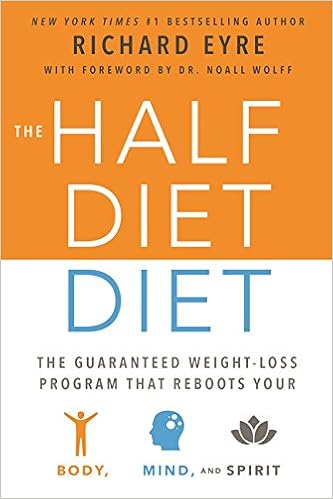
From the first three articles in this series, you know:
- That I am Dr. Bridell (The first version of the Half Diet Diet was originally printed here in Meridian Magazine some years ago under the pen name Dr. Bridell and hundreds of Meridian readers lost a total of over two tons of weight.)
- That the pseudonym of “Bridell” was taken from Alma’s letter to his son when he advised Shiblon to bridle all of his passions that he might be filled with love. I like the metaphor because it suggests that an appetite or a passion, like a horse, can be a thing of beauty and joy or a thing of danger and destruction depending on whether we can bridle and control it.
- That the diet revolves around bridling the appetite by adopting the habit of eating only half of each meal and only snacking on fruits and vegetables.
- That by eating half as much and eating it twice as slow, intake is halved while enjoyment is doubled (as we learn to smell, sip and savor rather than gulp, guzzle and gorge.)
- That drinking a full glass of water before each meal or snack lessens your hunger and hydrates your body.
- That the “water habit” and the “slow habit” make the “half habit” possible.
- That the diet even works on a cruise ship. (I lost 8 pounds on a two-week cruise in January while the average passenger gained 10-14 pounds—about a pound a day.)
What has not been mentioned yet in this series is perhaps the most important thing: That the half-diet is consistent with and complementary not only to Alma’s advice and metaphor but also to the Word of Wisdom. It is, therefore, a “scriptural diet.” Let me elaborate by sharing my favorite words and phrases from the 89th section:
From verse 10: Wholesome herbs God hath ordained…
From verse 11: Every fruit in the season thereof..
To be used with prudence and thanksgiving…
From verse 12: Flesh of beasts and of the fowls of the air….to be used sparingly…
From verse 14: Grain is ordained for the use of man….to be the staff of life…
Herbs (vegetables) and fruits are not only acclaimed as wholesome, they are actually ordained of God, as is grain. Our Creator, who made this physical earth and our physical bodies, tells us simply and straightforwardly that our diets should center on grains and fruits and vegetables.
Meat, also made for man, is approached in a very different way. The Word of Wisdom treats fruits and vegetables and grains positively, largely, expansively, telling us to eat every fruit all the time. With meat the language is just the opposite—negative, small, restrictive, telling us to eat “sparingly.”
Overlaying all of this with Alma’s bridle metaphor we might say that in the level, even field of natural fruits and vegetables you can give the horse his head and let him run, eating as much as we want; but in the rocky gullies of meat, we keep a tight hand on the bridle, eating carefully and sparingly.
Best of all are the words “prudence” and “thanksgiving” suggesting that we eat modestly and selectively and that we eat slowly enough to truly enjoy and be grateful.
Next week we will go deeper into the thesis of the Half Diet which is, essentially, that a horse which is bridled and controlled over a period of time becomes more manageable and easier to handle, safer, and more interested in serving the rider. Likewise, an appetite that is bridled by feeding it only half gradually stops asking for more quantity of food and starts asking instead for more quality in the lesser amount of food it gets. Greasy, fast food begins to lose its appeal; and healthy, natural food looks better and more desirable.
See you here next Wednesday for more on that thesis; and more on implementation.
Why the 55 to 75 is the new Prime of Life

To sign up for Meridian’s Free Newsletter, please CLICK HERE.
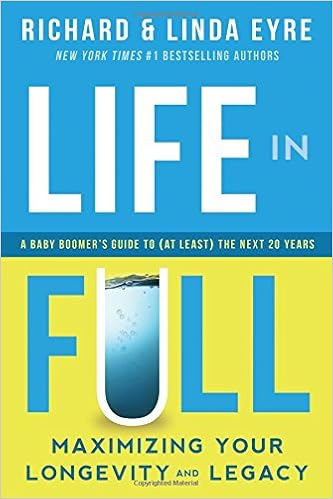
In this ongoing series, LIFE IN FULL, we are writing to Baby Boomers (those of us in our 50s, 60s, and 70s) about how to maximize our Longevity and our Legacy. Find new episodes here every Tuesday and Thursday, and read the overview and catch up on earlier articles in this series by clicking here.
Do not go gentle into that good night,
Old age should burn and rave at close of day;
Rage, rage against the dying of the light.
–Dylan Thomas
Surrendering to aging has no appeal. And the best way to rage against it is simply to push it back—way back. With a little higher handicap here and a health enhancement there, we can do everything now that we could do 20 years ago….and we can now do so much that we couldn’t do then!
But think specifically for a moment why 65 is the new 45: 45 year olds used to think “we have another 20 good years ahead of us—so what should we do with it?” This is exactly the question 65 year olds are asking themselves today.
If you think about it hard enough and rationalize long enough, you can convince yourself that there are actually no drawbacks at all to a little aging! I (Richard) do it all the time with sports…..
I was a 5.0 level tennis player in college and maintained that level for a few more years. But when everyone started beating me in the 5.0 divisions, I just dropped down to 4.5 and for a while I could win or hold my own again. A few years later I opted down again to the 4.0 and was competitive again. It all works out!
I used to think water skiing meant the sharpest cuts and the highest spray, and snow skiing meant the double black diamonds; now I have the more enlightened view that smooth, aesthetic skiing where you see and appreciate the world around you is the best way to go on water or on snow.
Golf’s an easy one; you just increase your handicap to where you are as competitive as ever.
Scuba diving used to be about how deep and how dangerous; now it’s about longer dives in shallower, warmer, more sunlit and reef fish-filled water. I enjoy it more!
Maybe biking is the best example or metaphor of all. I used to think of mountain biking as a combination of joy and torture. I loved the trails it took me to, but I was so busy thinking about my muscle burn and getting enough air into my oxygen-starved lungs that I missed a lot of the scenery that was going by.
I still go on all the very same trails now, but I have this wonderful electrical assist bike where all I have to do is turn a handle-switch to have a little help on the hills.
That’s a lot like aging in general—keep on your same trails but provide yourself with a little assist now and then. You know how to do that, and you’ve earned it.
The way life works now, early in this 21st century, there is virtually nothing you could do in your 30s or 40s that you can’t still do now—with a little assist from an electrical switch, or a scoring or handicapping system, or a fresh attitude. Maybe getting out of the car takes a bit longer and you can never find even one of the scores of reading glasses that you know are somewhere in the house.
But all in all, you, at 65 today have at least as many and perhaps more possibilities than a 45 year old had a couple of generations ago.
And chances are that you have far fewer constraints and far more resources than that 45 year old had.
But we can learn from that 45 year old—because he probably didn’t just drift into his next 20 years. He probably set goals and made plans and deliberately worked at figuring out what he wanted to do with the rest of his life. That is what we 65 year olds need to do today—set goals, develop plans, and figure it out! The worst thing we can do is just drift into retirement or into some kind of a wait-and-see attitude. Socrates said “The unexamined life is not worth living,” and it could be modified for us to say “The unexamined autumn of life is not worth living, while the examined-and-planned autumn of life can be the greatest season of all!”
Grandparenting II: Individual Grandkid focus and Social Media

To sign up for Meridian’s Free Newsletter, please CLICK HERE.
In this ongoing series, LIFE IN FULL, we are writing to Baby Boomers (those of us in our 50s, 60s, and 70s) about how to maximize our Longevity and our Legacy. Find new episodes here every Tuesday and Thursday, and read the overview and catch up on earlier articles in this series by clicking here. Today’s article is part of a “series within a series” as we focus on grandparenting. The previous grandparenting article can be read here.
No matter how we look at it, the emotional core of Life In Full has a lot to do with grandchildren. In fact, in one poll indicated that 82% of 65 year old grandparents called their grandchildren “the best part of my life.”
Another way to say it would be:
The idea that no one is perfect is a view most commonly held by people with no grandchildren—Doug Larson
Earlier in this series, we did an article on being a “champion for our grandkids” which you can read here. Today, we want to mention two things that are absolutely essential to a good relationship with a grandchild today. One is individual time, perhaps in the form of one on one “dates”, and two is social media and technology:
Grammie or Grandfather Dates…
We have had so much fun taking our grandkids out on little private, individual dates. For the pre-schoolers, individual time might be just reading a book together or playing with toys or going to a nearby playground together.
Once a year I (Linda) take our grandchildren who live close (who happen to be nine and older) to a special concert they want to see or to a symphony to introduce them to the finer things of life. I don’t mind leaving at half time for younger kids whose attention span lacks the ability to sit still for long periods.
And it is highly entertaining and enlightening to take a grandchild to dinner…one on one. Take a notebook and ask questions and record the answers. Sometimes it is so interesting to ask them the same questions each year as they grown older and see how their answers change.
We usually start with asking what is the happiest and the saddest thing that has happened since we saw them last. We get fascinating answers!
Here are a few ideas for other questions:
What is your favorite food?
What is your favorite song?
What is your favorite movie and why?
What do you love?
What do you fear?
How happy are you on a scale from 1-10?
What do you worry about most?
What is an example of something kind you did for someone?
Social Media:
The best way we have found to communicate with our grandkids that live far away is through social media! Several of our children have incredible blogs so we can keep track of what is happening to their families whether they live in Arizona or England but the one-on-one contact directly with the kids is so much more important.
We used to use email but we have found that our older grandchildren and teenagers never look at their email account even if they have one. But they do text and they do use Facebook and Twitter and many have Instagram and Flickr accounts. Especially fun with the little pre-schoolers is FaceTime and Skype. It’s such a dreamy way to keep up with what is going on with your long-distance grandchildren! If you don’t have a clue how to use those sites on your computer or phone, its time to figure it out—or ask a grandkid!
We have had some particularly interesting interchanges with our grandchildren through Instagram. Just commenting on their posts lets them know that you are aware of what they are doing. And it may also make them a little more cautious about what they post.
Bottom line: make it a conscious goal to have a special, personal relationship with each grandchild. And use individual time together and the power of technology to achieve it!
9 Simple Folders that will help you Plan the Rest of your Life

To sign up for Meridian’s Free Newsletter, please CLICK HERE.
In this ongoing series, LIFE IN FULL, we are writing to Baby Boomers (those of us in our 50s, 60s, and 70s) about how to maximize our Longevity and our Legacy. Find new episodes here every Tuesday and Thursday, and read the overview and catch up on earlier articles in this series by clicking here.
We are writing this week from Australia and lets face it, change is hard. Time change, jet lag, different customs, different stars in the sky. It reminds us that change is the hardest thing. Even changing our ideas about what and who we want to be is hard. Our brain and our body resist change. But giving in to either of them is like giving them license to slow down and atrophy and weaken. Real change takes time and deliberate concentration.
We will change; we do change in the autumn of our lives. It is inevitable, but if we make no effort to orchestrate the change, it will all fall within the category of decay.
Things like change and growth and progress are only scary if we try to do them too fast or too abruptly. The best way to transition into autumn is to do it naturally and gradually, the way a leaf changes color.
In our personal experience, and with all the Boomers we have worked with, we find that the easiest, simplest, least scary and best place to start is simply to set up some folders. Folders are just places you keep track of things that matter to you or that you think will someday matter. You might think of these as the traditional manila old-school file folders. Or you might think of them as new folders in the email or document section of your computer. Others may want to simply create some separate sections in a “creation” book of blank paper where they can jot down ideas or inputs for each of the things you think will matter. In any case, setting up some files is quick and easy. You don’t have to have anything at all in them for now. Just establish them up and label them.
The idea is to have a folder for each of the things that are going to matter most to you over the next 20 years—so that they become a place to collect ideas and to keep track of where you are going and how you are getting there.
Here are the nine folders we think each of us needs as we start to shape the next 20 years of our lives:
- “Possibilities Folder”
- “Character Folder”
- “Health Folder”
- “Wealth Folder”
- “Faith Folder”
- “Family and Relationships Folder”
- “Grandkids Folder”
- “Service and Legacy Folder”
- “Autobiography Folder”
The first step is just to set up the ten folders. Empty folders are better than no folders at all. For now, just let them sit there as potential attractors of ideas.
As you live your day to day life, you will find things you want to put in each folder. And as each of the folders becomes “active” and has a few contents, it will surprise you how it grows. Ideas begat ideas, and the tenth idea is always much easier to come by than the first.
There is no deadline and no criteria or set of requirements. Just put into each folder thoughts that appeal to you. Review them once in a while and let them grow out of their own momentum. It may be ten or twenty years before you implement some of the ideas or options, and that is just fine because you are spiritually or conceptually creating them as you collect them.
Good luck with those folders! And tune in again Thursday as we go deeper into one of the folders—the Grandkids one!
Will Baby Boomers Save the World?

To sign up for Meridian’s Free Newsletter, please CLICK HERE.
In this ongoing series, LIFE IN FULL, we are writing to Baby Boomers (those of us in our 50s, 60s, and 70s) about how to maximize our Longevity and our Legacy. Find new episodes here every Tuesday and Thursday, and read the overview and catch up on earlier articles in this series by clicking here.
As we mentioned a couple of weeks ago in this column, the Baby Boomer generation numbers over 80 million Americans who are all now in their 50s and 60s. What responsibility does this generation have to the rest of the world? It’s a question all of us in that generation should ask ourselves.
Our parents and grandparents were called “The Greatest Generation” because they fought and won World War II and then built the industrialized world. They were the builders and the givers while we, their children—the baby boomers—are often thought of as the inheritors and the takers.
And there is no question about it, we Baby Boomers were the recipients of the post-war prosperity and were raised with more privilege, possibility, and potential than any previous generation.
The question is, after being the 50 and 60-year beneficiaries of the opportunities and options we inherited, what will we give back to the world? And what will we do with the 20 or 30 extra years that no previous generation has had?
One way to think about it is this: The greatest generation gave up their youth to a war and the re-forming of the American dream and then reaped its rewards for the second half of their lives. We Boomers may do just the reverse—accepting the best that our parent’s generation gave us during our first 50 or 60 years and then using out last 20 or 30 to save our slumping world once again.
Because our world is slumping! Our grandchildren are the first American generation in history threatened with less prosperity than their parents, and our children’s generation—the “Millennials” who are now 18 to 33 years old—may be collectively the most self-oriented and self-worried and least family-oriented group ever to come along.
Millennials are the first generation in history to not believe that they will make more money, have more opportunities and live a better life than their parents. They are worried financially and personally and often inclined to think more about their own needs than about families and relationships. 46% say the most important thing to them is “having a good job” compared to only 14% who say “getting married” and 11% who say “having children.” (USA Today, Nov. 5, 2014) 74% of Millennials are single (compared with only 25% of the same age range a couple of generations ago) and two thirds of Millennials say they have met someone they could marry, yet didn’t.
Who is going to change this? As our grandchildren move into this Millennial age range, who is going to rescue and guide them? It is not always going to be their parents, who have had to struggle through the great recession and may never know the freedom that many of the grandparents (us) now know. Our children, Most of our children, whether they are single parents or two-parent couples, work full time. Most have neither the time nor the resources that we Baby Boomers had as young parents, or that we have now.
When some kind of generational overview of history is written decades from now, perhaps what it will show is that the Boomer Generation saved the Millennial Generation. We can save them directly when they are our children and grandchildren and we can save them indirectly when we use the last third of our lives to positively impact some aspect of their world.
At the point of life where earlier generations retired, finished their parenting, and became less involved with family and career, our generation can do just the opposite—becoming more involved—rescuing, supplementing, consulting children and grandchildren, starting altruistic second careers, and making the last movement of our symphony one of crescendo rather than diminuendo.
It has been said that the reason grandparents often connect so well with grandchildren is because they have a common enemy. Without subscribing to that ridiculous notion, we can say that grandparents often have a type of non-threatening affinity and a certain social distance that allows them to help grandchildren in ways that their parents often can’t.
Perhaps our principal legacy will be what we do with the last third of our lives. We are the first generation ever to have the opportunity to deliberately and purposefully use the extra 20 years that no other generation has had to save and build and strengthen our own families and to contribute to the health and welfare of the larger world. Perhaps we will become the most involved and in-touch grandparents the world has ever known. Perhaps the last movement of our life’s symphony will be devoted to getting our grandchildren on-pitch and in-tune.
FEATURES