






Currents: Tabernacle Choir Launches Broadcast into Africa; New Names for Young Women Age Groups; Secret Life of Mormon Husband

One
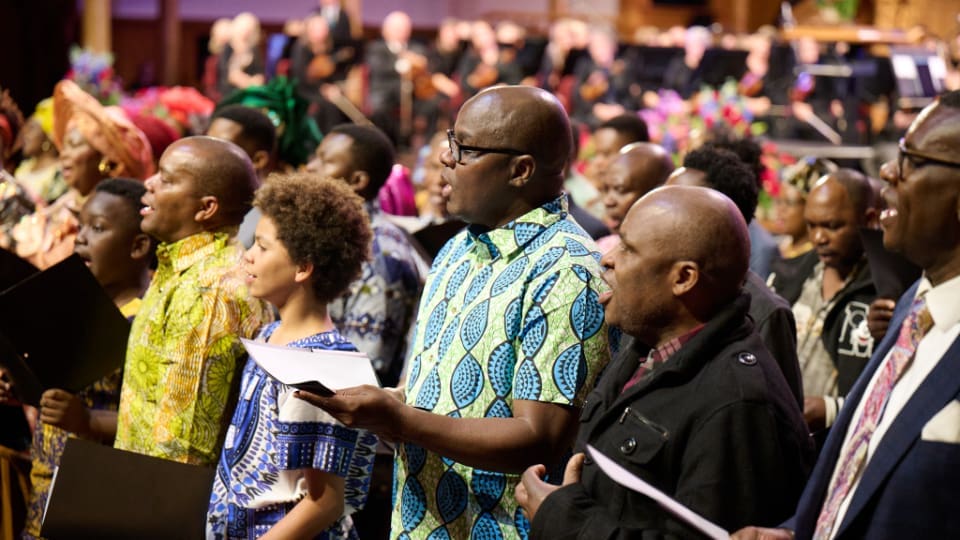
Tabernacle Choir’s ‘Music and the Spoken Word’ Reaches Millions in 25 African Countries
It was a historic day as the Tabernacle Choir and Orchestra at Temple Square expanded the reach of their weekly broadcast, “Music and the Spoken Word,” to millions across the African continent.
“For nearly 100 years, this program has aired weekly from here in the Tabernacle to the world,” said Choir President Michael O. Leavitt prior to the broadcast. “Today’s broadcast will be seen live in prime time in 25 countries in Africa.”
See the entire program here:
Two

New Names for Young Women Age Groups
The First Presidency of The Church of Jesus Christ of Latter-day Saints has announced new age-group names for the Young Women.
- Builders of Faith (young women turning 12 or 13)
A Builder of Faith helps build God’s kingdom through her faith in Christ, steadfast witness, and actions that uplift and encourage others (see Ephesians 2:20).
- Messengers of Hope (young women turning 14 or 15)
A Messenger of Hope carries Christ’s message of hope to the weary, speaking peace, sharing comfort, and lifting hearts through the power of the Spirit (see Mosiah 18:8–9).
- Gatherers of Light (young women turning 16 or older)
A Gatherer of Light trusts divine guidance and draws strength from covenants as she seeks, gathers, and reflects God’s light (see Doctrine and Covenants 50:24).
These names were spiritually confirmed for Sister Emily Belle Freeman as she visited a “For Strength of Youth” (FSY) conference in Tahiti where the young women sang “As Sisters in Zion.”
She said, “As the girls sang, I was inspired to think of these covenant-keeping young women whose purpose and mission would be to build faith, share hope, and gather and reflect light around the world,” President Freeman said. “My eyes teared up as I realized the Spirit had been leading this process all along, inspiring names of faith, hope, and light that would help God’s daughters live as disciples of Christ and prepare them to enter a lifelong sisterhood of charity — the Relief Society.”
Three
Have You Seen This? A Parody of “Secret Lives of Mormon Wives” by a Latter-day Saint Father.
With a stop at the doughnut shop on his way to help a widow move, Patrick Tafua created a parody of “Secret Lives…,” showing in a light-hearted way what real activities Latter-day Saints are actually about.
View this post on Instagram
The trend spread online as other Latter-day Saint men shared posts of themselves participating in such “Secret Life” behavior as helping people move and doing dishes at home.
Parked on the Covenant Path

When I was a teenager, I used to collect motivational sayings. One of my favorites said, “It’s all right to be on the right track, but you’ll get run over if you just sit there.” This motivated me to strive to improve at whatever I pursued. If I got a B in a class one semester I worked for an A the next semester. If I ran the 50-yard dash in seven seconds one year, I would try to run it in 6.5 seconds the next year. My improvement wasn’t galactic, but I always tried to improve.
This motivational saying holds an entirely different meaning for me now. I think of the “right track” as the covenant path, and consider what happens when one chooses to “just sit there.”
Being on the “covenant path” implies two things: 1) we have made covenants with the Savior. We have been baptized and taken his name upon us and we obey his commandments. 2) We are on a path, not sitting in a park. Our objective is to go somewhere, not to stay where we are.
Parked on the Path
In our efforts to be compassionate, loving, disciples of Christ we welcome new members into the church. We welcome repenting members, wherever they are spiritually.
“You are enough,” taught Sister Kearon. “[God] loves you just the way you are, right here, right now, in all your beautiful messiness.” (Worldwide Devotional for Young Adults May 6, 2018). Sister Kearon delivered the same message when she came to visit our mission and the missionaries embraced it. We all need to feel like we are “enough,” like we are worthwhile, like we can be loveable even if we are far from perfect.
However, in our efforts to be loving and welcoming of new and returning members sometimes we focus only on the first half of Sister Kearon’s message. We celebrate the messiness, inviting the messy to give firesides or appear on podcasts and we follow their social media sites, or television shows.
Caution is required when returning members are more interested in changing the church to accommodate the way they live their lives rather than changing their lives to accommodate the teachings of the prophets. Returning members claim they want to be members of the church, but not be “all in.” Or they decide to return to the gospel, but “on their own terms,” not necessarily the terms the of the modern-day prophets. One returning member claimed she couldn’t stand listening to General Conference because the talks were always about repentance.
While we must love people wherever they are, we cannot edit out the second part of Sister Kearon’s message: [God] also loves you enough not to let you stay the way you are right here, right now. We do our new and returning members a disservice when we focus so much on loving them the way they are that we forget that the covenant path is a path not a park. President Nelson said, “Returning to the covenant path does not mean that life will be easy. This path is rigorous and at times will feel like a steep climb.” We are not being loving disciples of Christ if we let our brothers and sisters stagnate where they are. We all must give up the sins of the past and develop new Christ-like habits. When we wink at sin, or justify sin, or celebrate sin, we enable one another to stay stuck.
Years ago, a young woman in our congregation became pregnant out of wedlock. She chose to keep the baby and planned to live with her mother. She was poor and needed lots of things: diapers, clothes, a stroller, etc. Loving Relief Society sisters wanted to throw her a baby shower complete with a cake, a crown on her head, and a boa thrown around her shoulders. They wanted to invite the young women in the ward who were her peers. The bishop was concerned about the message this would send to the other young women: this girl broke the law of chastity and she is being celebrated. He did not want to see others of the young women bringing home babies to live with their mothers and expect the Relief Society to throw them a party. In the end the bishop convinced the Relief Society President to quietly gather the baby’s necessities and to take them over to the mother’s house. The young mother received her Pampers and her Onesies, her Similac and a stroller, all from loving Relief Society Sisters—but at the same time nobody glorified her choices.
Misplaced compassion can mislead new and returning members of the church. They may misinterpret the love members show for them as acceptance of their choices, enabling them to stay parked on the covenant path.
A “Buffet Mormon”
New members may not understand the concept of the covenant path. They may believe that once they are baptized, that’s all they need to do to be saved. Returning members may not understand the covenant path is designed to get them somewhere.
Some social media sites have encouraged returning members to return to church “on their own terms.” Some sights suggest that it’s okay to go to church, but not accept a calling, or to attend some of the Sundays, but not all the Sundays, or wear temple garments when it is convenient, but not at all times.
Accepting and fulfilling a calling is one of the things that helps us progress along the covenant path. Attending church every Sunday and partaking of the sacrament is one of the things that helps us progress along the covenant path. The very things those who attend church “on their own terms” refuse to do, are the very things that enable people to progress along the covenant path. Their “own terms” may keep them stuck. Refusing to change halts our progress. It’s like sitting on a park bench on the covenant path and refusing to get up and start walking.
This is not to imply that new and returning members need to sprint along the covenant path. Their progress may be slow. Upon first returning they may not feel comfortable being “all in.” However, their goal should be to progress, not to stagnate.
Stay in Your Lane
The counsel to be loving and welcoming to everybody on the covenant path is refreshing and sorely needed, therefore what’s a saint to do? First of all, we have no business trying to correct those who are not within our stewardship. If we notice truly alarming behavior, we need to seek out the person in charge, perhaps a parent or perhaps a priesthood leader, and let them handle the situation. Not long ago a new sister missionary bore her testimony her first Sunday in my home ward. The sweater she wore didn’t fit well and exposed her entire cleavage. I feared she would lose credibility as a missionary, so I called the mission president’s wife who addressed the issue with the missionary. The missionary humbly accepted the correction and was grateful to her mission president’s wife for her loving counsel.
Correct Collectively/Love Individually
Taking correction requires a lot of humility, and it is rare for one to respond when singled out, even by someone with stewardship over them. This sister missionary was exceptional. Usually, it’s safer to correct behavior that is not in line with the prophets in a group setting. For example, if a young woman is not dressed modestly, it’s not going to be productive for her leader to look her in the eyes and tell her skirt is too short. The young lady might become offended. However, the leader could plan a lesson for a subsequent Sunday that teaches correct principles. Then the young woman doesn’t feel singled out or picked on. In a like manner, the bishop could assign someone to give a talk in Sacrament meeting about a topic that concerns him. This way the leader shows his love by helping the person move along the covenant path.
When we correct collectively, we can be effective without being specific. We don’t have to talk about specific behaviors that keep people stuck. We can teach general principles that help those we love progress along the covenant path. As mission leaders we had the opportunity to review the new handbook for disciples of Jesus Christ before it was published. The Missionary Standards for Disciples of Jesus Christ replaced the old missionary manual or the “White Bible” that missionaries wore in their breast pocket. We were ecstatic with the new handbook. No longer was there a long list of “do’s” and “don’ts.” Instead, the handbook contained principles of the gospel. When we taught those principles well, our missionaries didn’t need a list of “do’s and don’ts”. They chose for themselves to dress modestly, wear their hair neatly, not distract from their appearance with facial jewelry, etc.
Some of the principles we taught included:
-Obedience to our Heavenly is a sign of our love for Him
-Commandments keep us safe from sin and harm
-Flirting with sin makes it much harder to resist sin
-Personal Revelation comes through worthiness
-Do unto others as you would have them do unto you
One of our missionaries was teaching a woman who wanted to get baptized. She believed the Book of Mormon was the word of God but didn’t want to give up drinking coffee. The missionaries had been telling her she needed to give up coffee, but she wasn’t willing to make that sacrifice. Finally, our missionary was inspired to ask her the key question: “Do you believe Joseph Smith was a prophet of God?” The woman paused before she responded. She didn’t respond, “yes.” She responded, “Oh. I understand.” She gave up coffee and was baptized, and the decision had nothing to do with a specific correction. The decision had everything to do with the principle of prophetic revelation.
When people are corrected individually, they may feel that because we disapprove of a particular choice it means we don’t love them. They confuse love for acceptance and if we don’t accept everything about them, they conclude that we don’t love them. In reality, it is entirely possible to deeply love someone without condoning all their choices. No one makes everybody happy all of time. We all have habits/behaviors that need correction.
One of our sons was a champion tease when he was growing up. Someone in the family was constantly crying because this child knew exactly how to get under their skin. My husband and I adored this son. He was funny, creative, smart as a whip, and very entertaining. Just because we didn’t love his teasing, didn’t mean we didn’t love him. However, if we had focused solely on the character trait that drove us nuts, he might have felt unloved. Instead, we worked very hard to communicate our love for him as a whole person. When he felt truly loved he was less defensive when being corrected for his misbehavior.
We can love our new and returning members and still help them progress along the covenant path. In fact, if we truly love our new and returning members we will not allow them to sit complacently on a bench, parked on the covenant path. We will invite them to get up and walk with us because we will never reach our destination if we are complacent with where we are.
JeaNette Goates Smith is a Licensed Marriage and Family Therapist and the author of four books on family relationships. She and her husband, Bret, served as mission leaders in the Dominican Republic from 2017-2020. For more information go to www.smithfamilytherapy.org.
Big Change in Sunday School Meeting Schedule

The goal is the same—to help members become lifelong disciples of Jesus Christ, but how to do that has changed according to the First Presidency of The Church of Jesus Christ of Latter-day Saints. They have made adjustments to the Sunday class meeting schedule which will begin the first Sunday in September, 2026.
According to the letter the First Presidency issued:
“In the new schedule, sacrament meeting will continue to be no longer than 60 minutes. After a 5-minute transition, youth and adults will attend a 25-minute Sunday School class each week. Following another 5-minute transition, they will attend a 25-minute priesthood quorum, Relief Society, or Young Women meeting. Primary will continue to meet weekly and will now last 55 minutes.
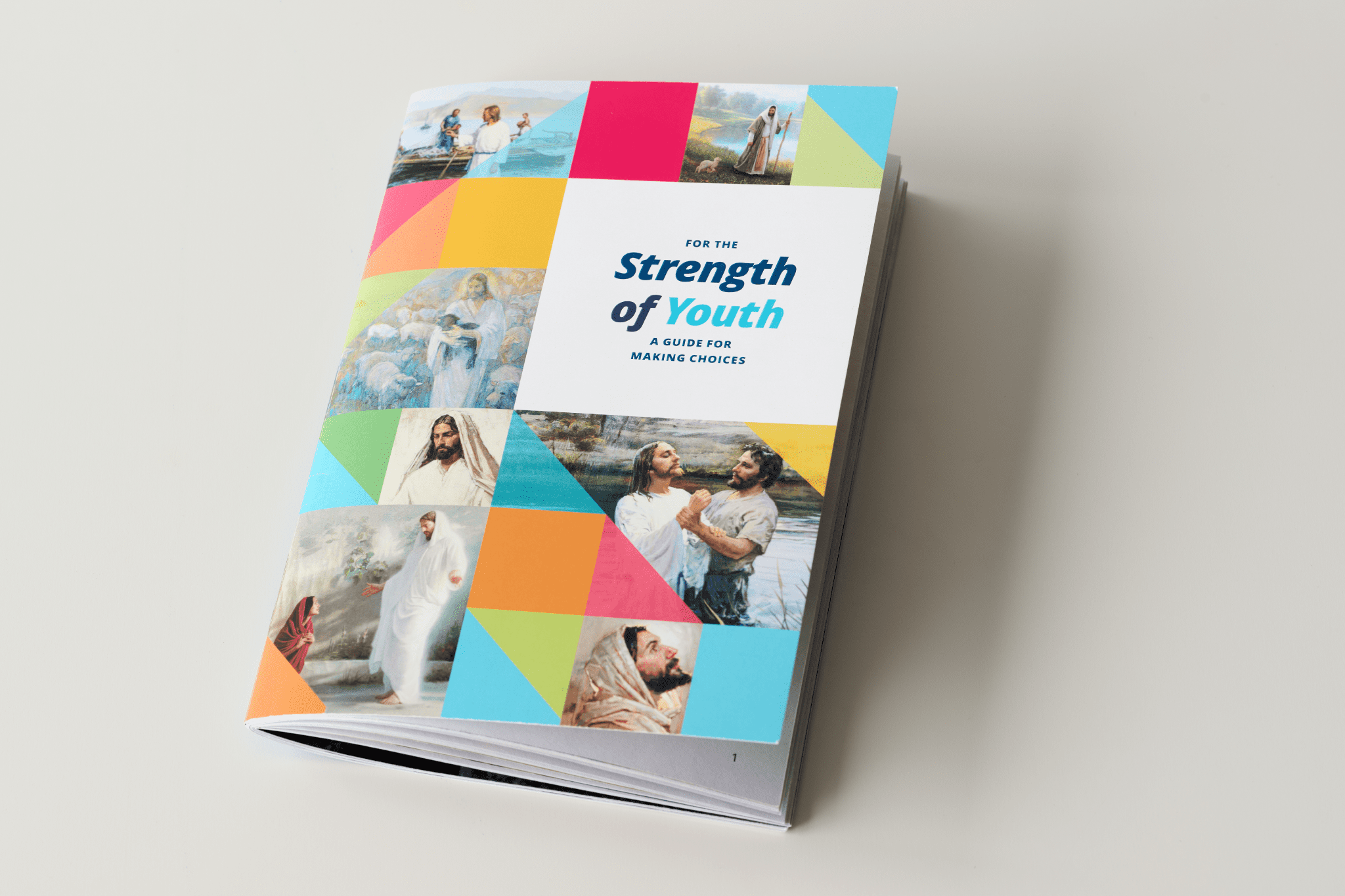
“Sunday School and Primary classes will study the scriptures using Come, Follow Me—For Home and Church. Elders quorums and Relief Societies will continue to study messages from the most recent general conference. Youth will use a new and expanded edition of For the Strength of Youth: A Guide for Making Choices, supported by material available in Church magazines. Quorums and classes will no longer counsel together about a specific topic prior to these lessons.”
In January 2019, the Church implemented a two-hour Sunday schedule to provide individuals and families with increased opportunities for home-centered gospel study. Members across the world have embraced these changes with faith and enthusiasm. Additional adjustments will be introduced to further enhance learning, fellowship, and worship.
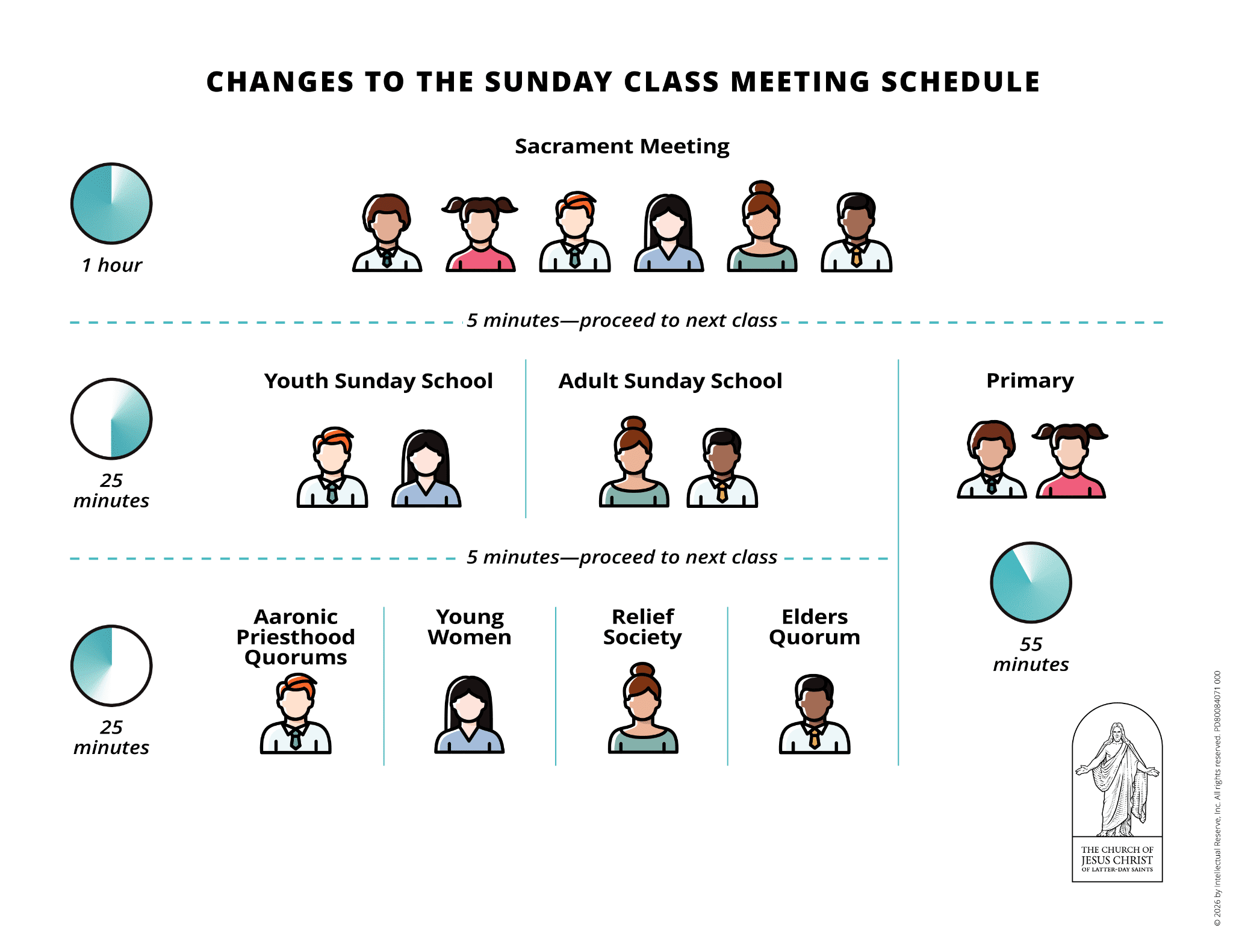
“Gathering weekly in every class helps deepen gospel learning by connecting it more closely to personal and family study,” said President Paul V. Johnson, Sunday School General President. “It also enhances the spiritual support that members get. Though the schedule looks different, the amount of time spent learning together remains the same.”
“Come, Follow Me” Alignment
Every age-group will continue participating in “Come, Follow Me” lessons that directly support home study.
Sunday School classes will continue using “Come, Follow Me—For Home and Church.”
Youth Curriculum: “For the Strength of Youth”
An updated “For the Strength of Youth: A Guide for Making Choices”—now available in the Gospel Library—features 12 chapters that align with monthly study. Physical copies are being shipped to units and do not need to be ordered by local leadership.
Beginning September 6, 2026, this guide will become the curriculum for Young Women classes and Aaronic Priesthood quorums. Additional supporting content will be provided through the “For the Strength of Youth” magazine, starting with the September 2026 issue.
“Living prophets have given us the FSY guide. It’s simple but powerful. It will help young men and young women focus on Christ, know His doctrine, and listen to the Spirit,” said President Timothy L. Farnes, Young Men General President. “This guide will help youth walk in confidence, rely on His power, and move forward with hope in a challenging world. I find it helpful as a daily part of my scripture study.”
The desired outcomes for youth who study this guide are that they will:
- Become lifelong disciples of Jesus Christ with a firm understanding of His gospel.
- Be prepared for the endowment with a deeper understanding of priesthood ordinances and covenant promises.
- Be prepared for a mission with a desire to serve the Lord.
- Be focused on their future family with an understanding that marriage between a man and a woman is ordained of God and that the family is central to the Father’s plan.
- Know Jesus Christ is their strength.
Young women, young men, their parents, and leaders are encouraged to subscribe their household to the “For the Strength of Youth” magazine at no cost. Those who would like to receive additional copies can purchase current issues at store.ChurchofJesusChrist.org or at retail stores. Current and past issues can be accessed digitally on ChurchofJesusChrist.org or the Gospel Library app. If members need help with subscriptions, they may contact their local magazine representative or ward clerk.
Relief Society and Elders Quorum
Weekly Relief Society and elders quorum meetings will continue to focus on messages from the most recent general conference. These discussions emphasize understanding prophetic teachings and applying them in daily life.
“There is additive strength that comes when we meet each week to counsel, learn, and support one another,” said President Camille N. Johnson, Relief Society General President. “When we gather in His name, the Spirit is there to teach us, testimonies are strengthened, and we lift each other in discipleship. This weekly time for connection will help us draw closer to the Savior and each other. We find joy in walking the covenant path together.”
Strengthening Worship in Sacrament Meeting
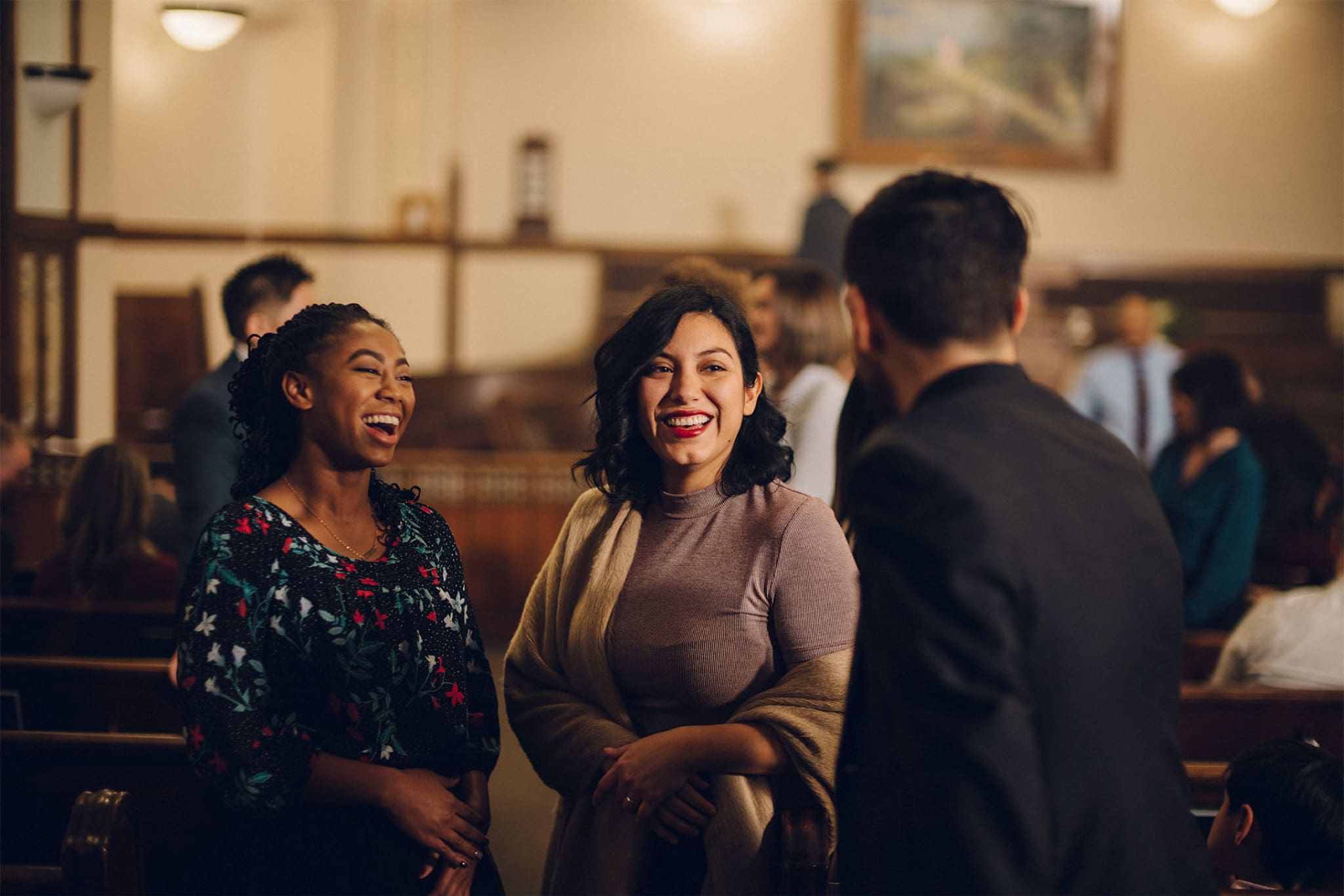
While the length of sacrament meeting remains unchanged, leaders are encouraged to deliberately consider ways to strengthen the quality of worship and help sacrament meeting become more central in the lives of Latter-day Saints. Members are invited to seek meaningful ways to enrich their own worship experience. Sacrament meeting is a time of joy, reverence, and welcoming fellowship centered on the Savior Jesus Christ.
The fifth Sunday in August 2026 will be dedicated for preparation and discussion by youth, their parents, and their leaders. Additional preparation and discussion for members will take place during the second hour on September 6, 2026. Resources, training materials, and answers to common questions will be made available in the coming weeks.
Relief Society Worldwide Devotional Emphasizes Covenantal Relationship with Heavenly Father and Jesus Christ

This article originally appeared in the Deseret News. To read the full article, click HERE.
All over the world, more than 8 million women belong to the Relief Society of The Church of Jesus Christ of Latter-day Saints.
“By providing and receiving relief, both temporal and spiritual, we draw closer to Jesus Christ and become more like Him,” Relief Society General President Camille N. Johnson said in her opening remarks to the Relief Society worldwide devotional, which became available for viewing Sunday.
Elder Quentin L. Cook of the Quorum of the Twelve Apostles called it a great responsibility to speak to Latter-day Saint women.
“You have my love and admiration for who you are and your commitment to the Lord and his Church in this difficult world,” Elder Cook said. “Dear sisters, please do not underestimate the power and impact of your capable, loving and sensitive influence on those with whom you associate. You bless many as you strive to live Christlike lives.”
As part of celebrating the 184th anniversary this month of the organization of the Relief Society, women are invited to gather with their wards and stakes to view the devotional, which also features remarks and testimonies from President Johnson’s counselors, Sister J. Anette Dennis and Sister Kristin M. Yee.
A series of discussion videos was also released on Sunday from the Relief Society general advisory council. The discussion videos can be used at the same time as the broadcast or any time throughout the year.
All of the messages were prepared with the women of the church in mind, President Johnson said.
To read the rest of the article, click HERE.
When a Reality Show Becomes a Distorted Mirror: What “Mormon Wives” Reveals About Fame, Faith, and Misunderstanding

Pop culture often grabs a faith tradition by its most distorted edges and then holds it up as if it were a mirror. The problem is that the reflection is rarely accurate, and often the mirror itself is cracked. That is the case once again with The Secret Lives of Mormon Wives, Hulu’s reality-show juggernaut that has now secured a fourth season. Its reach extends far beyond the streaming screen: its stars are dancing on national television, headlining The Bachelorette, writing best-selling memoirs, and taking their turns on Broadway. This weekend, two major news outlets ran stories trying to make sense of this sudden boom of “Mormon women” in entertainment.
But the question that hovers over all of it is this: What happens when a highly misunderstood faith becomes a convenient backdrop for scandal—and what responsibility do those raised in that faith have?
When Fame Leans on a Label
In a feature titled “Mormon Women Are Taking Over Our Screens,” The New York Times framed this moment as a new cultural visibility for Latter-day Saint women. And yet, even the article acknowledged the dilemma. As Rebbie Brassfield, the host of the podcast Mormons in Media, put it:
“Even though you see them in ‘Secret Lives’ as being catty and dramatic and things that I think a lot of people in the church don’t want to associate with… you also see them as, like, savvy and enterprising.”
The trouble is that the “catty and dramatic” part is what millions of viewers will remember—and for many, it becomes the assumed portrait of Latter-day Saint womanhood. A faith that is already widely misunderstood now finds itself associated with soft-swinging scandals, domestic violence arrests, bitter personal feuds, and the weaponizing of the word Mormon as a branding prop.
These cast members know exactly what they are doing. “Mormon” creates intrigue. It gives their storyline a built-in contrast: Look how far I’ve come from the rigid religion of my youth. Their rebellion reads more boldly when the rules they once lived are framed as strange or strict.
But what is the cost of building a platform by burning down the house behind you?
A Faith Tradition Thrown Under the Bus
The Fox News analysis did not mince words. Media strategist Doug Eldridge said:
“The construct of the show is antithetical to our macro-understanding of Mormon culture. Strict adherence to LDS teachings couldn’t be further from what is being portrayed.”
He then added what may be the more devastating point:
“Viewers have been flocking to the show because it represents rebelling against an establishment.”
In other words, the show’s appeal hinges not on the women themselves, but on how flamboyantly they can reject the faith they once knew.
When someone sells out their own reputation, we usually call that tragic.
When someone sells out their people, their faith, and a community that nurtured them—especially one that is already a religious minority—what do we call that?
This is not merely a case of “a mess of pottage” for personal gain. Something deeper is happening here: a global entertainment machine is rewarding former or fringe Latter-day Saints for dragging their own tradition through the mud.
And the public, not knowing the difference between this stylized chaos and real discipleship, walks away more confused than ever.
What Most Latter-day Saint Women Actually Are
In 2024, when Season 2 debuted, the Church issued a simple, clear statement:
“A number of recent productions depict lifestyles and practices blatantly inconsistent with the teachings of the Church.”
That remains true.
The vast majority of Latter-day Saint women do not live curated lives of indulgence, conflict, and exhibitionism. They serve, they teach, they nurture, they create. They run Relief Societies, comfort the grieving, lead humanitarian efforts, and hold together families and congregations. Their lives are not perfect; they are devoted. They are not scandal-driven; they are covenant-driven.
And none of that fits the formula for reality television.
The irony is that the “best export of the Church,” as one source in the Times piece noted, really is its women—but not for the reasons these shows imply. The strength of Latter-day Saint women has always been found in their discipleship, their steadiness, their faith in Christ, and their willingness to lift others.
Those qualities rarely go viral—but they change the world far more than a reunion special on Hulu.
The Questions We Must Ask
This moment raises uncomfortable but necessary questions:
- What happens when people build careers by misrepresenting a faith they no longer practice?
- Why does popular culture reward a storyline only when it shows someone rejecting belief?
- How do we protect the public’s understanding of a faith whose image is shaped more by entertainment than by lived reality?
- And who pays the price when a minority religious community is portrayed as frivolous, unstable, or morally unmoored?
The answer, unfortunately, is that the faith itself pays the price.
And so do the millions of sincere, devoted women whose daily lives bear no resemblance to the caricature.
Seeing Through the Noise
This latest cultural moment says less about Latter-day Saint women and more about the appetite of modern audiences. Conflict sells. Scandal trends. Self-exposure masquerades as empowerment. In such a landscape, quiet faithfulness simply does not generate headlines.
But it still generates light.
And that is why, despite the noise on our screens, Latter-day Saint women will continue to do what they have always done. They will serve, create, love, teach, and rise. They will continue to shape their communities not through spectacle, but through discipleship. They will continue to follow the Savior who never needed a spotlight to change the world.
If there is a story worth telling, it is that one.
A Better Way to Ask “How are you REALLY doing?”

To sign up for Meridian’s free newsletter, CLICK HERE.
That awkward moment. An acquaintance is going through something wrenching, like depression, or unemployment, or a messy divorce, and you want to reach out supportively. You know the need goes deeper than a casual “How are you doing?”
With siblings or close personal friends, you can sometimes insist, “C’mon, how are you REALLY doing?” But that’s too personal for many situations. You want to respect your friends’ privacy and emotional boundaries. You’re not trying to imply that their nonchalant responses are somehow dishonest, or that it’s your job to be their counselor. You’re also not trying to amplify the implication that they might be weak or struggling. So how can you allow them to open up without prying?
My friend Anne is perky, funny, artistic, generous, and uplifting, despite enduring the slow degeneration of multiple sclerosis since 2001. She has probably heard the question, “How are you doing?” more than 10,000 times from kind folks around her, and here’s what she told me:
“I’m grateful that people ask me because it means they love me. I know they don’t mean it condescendingly. But there’s a downside to the question, “How are you doing?” It forces me to judge my performance, and that can be depressing. It’s almost like people are asking: How well are you handling life? Are you holding strong? Are you taking it on the chin? Or, are you doing poorly? Are you really falling apart? Sometimes I’m not doing so hot, but I want to sound like I’m coping well, so I answer cheerfully or vaguely.”
About ten years into her illness, Anne was startled when, for the first time, a friend instead asked her a different question she had never heard before.
“What’s it like to have multiple sclerosis?”
Anne related, “I was amazed at how different this question felt to me. I was free to talk about MS in a third-person perspective, without self-evaluation. Distancing myself from my trial allowed me to honestly describe how awful IT is—that disease out there that challenges a lot of people—without worrying about how well (or poorly) I was dealing with the challenge myself. I was free to be honest about tough parts of the trial—because they didn’t necessarily reflect on my own personal coping ability.”
The questions “How are you doing?” or “How are you REALLY doing?” implied that Anne might be in a needy, struggling place—that she needed compassion for her potential weakness. To answer honestly, Anne had to judge herself and her performance.
The question “What’s it like?” empowered Anne to share her hard-won expertise on a difficult subject. Because the inquiry focused on the external environment, instead of Anne’s individual coping, it felt more supportive and less judgmental. It also conveyed intellectual humility, desire to learn, and the assumption that the listening friend would benefit and be enriched by Anne’s perspective.
Consider how rephrasing these commonly asked questions makes them easier to answer:
How are you doing on the job search?
What’s it like to search for a job these days?
How are you doing in your new school?
What’s it like to be the new kid? What’s your new school like?
How did your divorce court go?
What’s divorce court like, anyway?
How are you getting along with your new family?
What’s it like to adjust to a blended family?
How are you doing? Recovering well?
What’s it like to recover from this type of surgery?
Leaders can prayerfully use this question to deepen conversations and friendships in church classrooms too. Some subjects (sins, family disputes, etc.) would be too personal for public discussion. But many topics could likely benefit the whole group. Would ward members benefit from a spotlight about certain types of challenges faced by those in their midst? Would a specific member be comfortable and grateful for the chance to publicly explain the complex nature of a specific trial? Whether for 3 minutes or 30 minutes, this kind of exchange has the potential to take ward chit-chat beyond the surface into more compassionate support networks.
–what it’s like to place a parent in hospice?
–what’s it like to parent with peanut allergies?
–what’s it like to have family in the military?
–what’s it like to go through Christmas for the first time without your spouse?
I asked my friend Anne what she would tell the whole Relief Society if asked to give a 5-minute spotlight about the challenges of MS. She told me that many ward members have seen her totally depleted with muscle weakness, so they no longer invite her to any activities that might tax her strength. They don’t know that MS often goes into remission for days, during which Anne can hula-hoop in the parade, dive into the surf, and walk the dog as well as anybody. She wishes that, rather than politely excluding her, ward members would always continue to invite her, and then allow her to make her own decision about whether to participate.
I’m not suggesting that the phrase “what’s it like?” is a silver bullet that always cuts straight to the heart of any situation. Building trusting, open relationships still takes lots of time and love. Even then, not everyone wants to opens up for a big heart-to-heart, and that’s totally okay. Many still answer casually, or positively, or impersonally like before: “It’s great!” or “It’s no big deal!” But in some conversations, I have seen that people now feel freer to say, “It has been really, really hard…” And many times, this starts not just one meaningful exchange, but a whole series of real conversations.
I wonder: how much more sensitive and compassionate I would be if I had asked these questions carefully and consistently over the last 40 years? How many more close friendships might I have made if I had started the conversation simply,
Help me understand. What’s it like…?
Eat, Pray, Love to Preach, Pray, Learn: The Transforming Power of Young Missionaries

The following comes from Public Square Magazine. To visit their website, CLICK HERE.
On Friday, The Church of Jesus Christ of Latter-day Saints announced that young women would now be eligible for missionary service beginning at 18, rather than 19. This change will bless individual young women and strengthen families and congregations.
The Church Newsroom statement reiterated that, “While the Lord asks every worthy, able young man as part of his priesthood responsibility to prepare for and serve a mission … missionary service remains an optional opportunity for young women.” Sister Amy Wright, first counselor in the Primary General Presidency and a member of the Missionary Executive Council, further stated that after consulting with many young women throughout the world, the council decided to keep the length of missions for young women at 18 months, after “(reaching) out throughout the entire world to young women, inviting them to be a thoughtful part of this revelatory process.” The council found that the “overwhelming” preference was to keep the term of service as it currently stands.
On a weekend in early August 2012, I took a spontaneous drive to Salt Lake City to see some friends. At the time, I was 22 years old, living with my parents, working a retail job, and attending what was then Dixie State College (now Utah Tech University) part-time. I had previously paused my university studies and was “taking some time” to “travel,” and “find myself.” It was, after all, the decade of Eat, Pray Love. But the truth was, I was listless, lonely, without direction or a deep sense of spirituality or purpose.
On Sunday morning, before my drive back to St. George, I had a passing thought to stop by the Salt Lake City Temple. I hadn’t been very active in the Church in many years—I had mostly attended friends’ mission farewells and homecomings. I believed that The Church of Jesus Christ of Latter-day Saints was probably mostly true, except for the teachings on coffee, priesthood ordination, and marriage. I assumed that eventually, I would return to church activity, perhaps when I was older or when the changes I desired in the Church came, which I was sure was just around the corner.
As I sat quietly on the temple grounds, I thought it might be appropriate to pray. I don’t remember what I said in my prayer, but as I opened my eyes, I looked toward the smiling sister missionaries greeting visitors and thought I should serve a mission.
It was preposterous. And yet that thought didn’t go away. It grew louder and louder in my mind as I drove home. I couldn’t put it out. After hours of this very clear and direct impression, I called my mother while driving and told her I needed to prepare to serve a mission. And I did.
I needed to prepare to serve a mission.
I returned home from my mission in Toronto, Canada, two years later, a completely different person. Yes, I had many more bumps and bruises ahead of me in my spiritual and temporal growth, but within a year I had returned to university studies and become a 4.0 student, had met and married my now-husband in the temple, had developed some goals in my life, was active in my ward, and within two years my husband and I welcomed our first child.
This past Friday evening, I volunteered backstage for that same daughter’s (now 9) ballet recital. I was overjoyed to hear the oldest girls chatting about how they would now be eligible for missionary service. These precious daughters of God are already so far ahead of where I was at their age, with accomplishments and goals and a devotion to the Savior.
In 1979, President Spencer W. Kimball prophesied, “Much of the major growth that is coming to the Church in the last days will come because many of the good women of the world … will be drawn to the Church in large numbers. This will happen to the degree that the women of the Church reflect righteousness and articulateness in their lives and to the degree that the women of the Church are seen as distinct and different—in happy ways—from the women of the world.”
President Russell M. Nelson echoed his words many years later, saying, “My dear sisters, you who are our vital associates during this winding-up scene, the day that President Kimball foresaw is today. You are the women he foresaw! Your virtue, light, love, knowledge, courage, character, faith, and righteous lives will draw good women of the world, along with their families, to the Church in unprecedented numbers!”
These were the young women I served with on my mission, the young women I see in my ward, the young women from the dance recital, my nieces, and my children’s wonderful nanny. Young women and men coming out of our youth programs are extraordinary. Emergent adulthood, the stage from about age 18 to 25 years old, is so crucial for identity formation. As young adults become immersed in the gospel during the beginning of these years, they will be better equipped to engage with the prevailing university party culture and worldly philosophies they may later be exposed to. I wasted years of my young adulthood trying to find myself, but I was only successful when I forgot myself, as is the case with so many.
Those outcomes don’t just bless the sisters.
Sister missionaries return home with leadership and public speaking skills, and a deeper knowledge of the gospel. They also return having lived independently, budgeted wisely, and cooked, cleaned, and served those in need often. Many have learned foreign languages. Research shows their GPAs are higher, and they take more university credits when they return.
Those outcomes don’t just bless the sisters themselves; they ripple out into the families and wards they eventually help build. A woman who has spent a year and a half testifying of Christ, studying scripture daily, and learning to work shoulder to shoulder with a partner is better prepared to teach the gospel in her own home, to counsel with a spouse, and to nurture children in a bewildering cultural moment. Even for those who never marry or have children, that spiritual maturity and practical experience fortify Relief Societies, Young Women classes, Primary presidencies, and every corner of the church family.
Lowering the missionary age for young women is, in that sense, a profoundly pro-family policy. It opens a window for more daughters of God to be deeply rooted in the gospel during the very years when so many peers are drifting, and it does so without pressuring every young woman into one path or timeline. By keeping missionary service optional and the length of service at 18 months, the senior leadership of the Church of Jesus Christ has made more room for young women to seek revelation about education, work, and family in a way that fits their circumstances and callings.
The road to adulthood is never easy, and it provides many opportunities for young men and women to lose their way. What a blessing the missionary program is for not only those who are taught by missionaries, but also those who are blessed to serve. My hope is that with this policy change, many more young women will choose to serve, to lose themselves for a season in the work of the Lord, and in doing so find a surer sense of who they are.
To visit Public Square Magazine’s website, CLICK HERE.
Face to Face: How Hebrew Reveals Women’s Priesthood Power

The following was originally published on Public Square Magazine. To visit their website, CLICK HERE.
In English, idioms appear only occasionally as colorful expressions, but in biblical Hebrew, idioms are constant, shaping the way meaning is conveyed.
Think of the phrase “kick the bucket.” To an English speaker, it is perfectly clear that no one is literally striking a pail with their foot. To someone learning English, however, the image is more than confusing. They would have to be told that it is an idiom, a soft turn of phrase that carries a meaning larger than the literal words.
The Hebrew Bible is filled with phrases like this: to “harden the heart,” to “lift up the face,” to “walk in the way,” to “know” someone, to “cover the feet,” to “gird up the loins,” to “set the face,” or to “eat bread.” These are simple examples, yet in a conceptual language, most phrases carry layers of idiom that remain difficult for us to perceive.
Now, you can imagine how this creates a problem for our modern understanding. For those of us who speak in hard languages like English, that creates a particular challenge. Hard languages train us to expect precision, one-to-one meanings, and fixed categories. Our minds are shaped by that rigidity, so the polysemy of this biblical Hebrew can feel foreign or even flattened when we encounter it. Ancient hearers lived in the flow of those multiple meanings and felt at home in them. We, as hard-language speakers, have to work against our instincts to even begin to comprehend the depth that biblical Hebrew carried so naturally.
Soft vs. Hard Language
Soft languages like Hebrew are capacious. A single word can hold multiple meanings at once. Take the word shema. In English translations, it appears as the command “hear,” as in Shema Yisrael—“Hear, O Israel.” To the ancient ear, shema held so much more depth than the flattened translation we hear today. It carried the sense of listening with understanding and responding in obedience. The Israelites, when specifically using the word shema, could not separate hearing from doing, so when they heard the call to shema, they understood it as a summons to act.
Soft languages like Hebrew are capacious. A single word can hold multiple meanings at once.
Hard languages, like modern English, are driven by categorization. They crave exactness: this word means this and not that. This is why idioms tend to puzzle us. If we insist that shema must be only “hear,” then the depth of the word is lost. For ancient Israel, shema joined hearing, understanding, and obedience into one living act. To flatten it into a single definition cuts away the conceptual depth that gave the word its power.
English and other modern hard languages perform well when clarity and efficiency matter. But they struggle with conveying layers of meaning that soft languages carry naturally. God speaks to us according to our understanding. Isn’t it interesting that even today, He draws on the conceptual depth in these soft languages when communicating with us? Could it be that modern English is too rigid to hold the mysteries in the language of God? Perhaps God is still speaking in soft, polysemic, and conceptual terms. If so, we would want to invest effort to learn the conceptual depth by which God has always communicated. As Joseph Smith, the first prophet of The Church of Jesus Christ of Latter-day Saints, wrote to an early church editor W. W. Phelps on November 27, 1832, he offered a heartfelt plea to God: “Oh Lord God, deliver us from this prison, almost as it were, of paper, pen, and ink, and of a crooked, broken, scattered and imperfect language.” That prayer is more true for us today than it was for them then.
The Puzzle of Kenegdo
The story of Adam and Eve has been told and retold for centuries. But what many of us receive today is a story shaped by layers of tradition. Generations of interpreters passed it down through debate, dogma, and politics. Artists gave it form in iconography, each picture coloring how Eve was seen. Over time, the narrative hardened into a familiar version in which Eve was created as subordinate to Adam and both were commanded to avoid the fruit.
Linguistics tells another story. When the Hebrew text is examined diachronically, tracing the earliest layers and the way meanings shifted over time, a very different picture appears. The text itself only records Adam being directly commanded concerning the fruit (see also Moses 3:16, which is even clearer on this point). This sets the stage for a problem. Adam alone could not fulfill the divine command. The ancient oral tradition left a clue in the ṭipḥa (¶)—a cantillation mark that signals a pause in the verse. Readers in antiquity would have recognized this as a deliberate stopping point. This is the moment where Adam stands in stasis. Something more was required to move the story forward.
The very next verse introduces that solution: “It is not good that man should be alone.” The Hebrew word ṭov, usually rendered “good,” can also mean “sufficient.” In other words, Adam by himself lacked sufficiency. Ancient oral tradition and semantic studies show that ṭov often implied functionality or adequacy rather than strictly moral value.
Into this insufficiency steps the figure we too quickly name Eve. The text first introduces her as ezer. Most translations reduce this word to “help,” but that translation obscures the deeper meaning. Hebrew has other words for ordinary “help.” Ezer is different. It appears only 21 times in the Hebrew Bible, and in nearly every case, it is bound to salvation or deliverance (Exodus 18:4; Deuteronomy 33:7; Psalm 33:20). Eve enters the story as ezer, the one who brings salvation to the problem Adam could not solve.
Her title is extended with the word kenegdo. Translations often render it as “meet” or “fit,” as in “an help meet for him.” This choice at least hints at equality, which was remarkable in the world of the translators at the time. But it still falls short of what the Hebrew conveys. Kenegdo literally means “standing opposite of” or “face-to-face with.” It’s an idiom that, taken at face value, describes one who stands across from another as an equal counterpart. Yet, as with all idioms, its real meaning lies in the depth of the concept it conveys.
Each time God entrusts a servant, the language is “face to face.” Jacob names the place Peniel because he saw God “face to face” and his life was preserved. Moses speaks with the Lord “face to face, as a man speaketh unto his friend” at the moment of his prophetic calling. The Levites stand before the Lord face to face to minister, signifying presence and commission. In each of these earliest instances and many more, the idiom marks the moment of authorization. Understanding the nature of soft language, to stand face to face is to receive priesthood.
Adam was not authorized to move forward in the story. Eve enters as the one who bears authorization. She stands face to face, fulfilling the very definition of priesthood. This idiom is difficult for hard-language speakers to grasp, yet in the Hebrew Bible it is unmistakably tied to authority.
Adam was not authorized to move forward in the story. Eve enters as the one who bears authorization. She stands face to face, fulfilling the very definition of priesthood.
The garden scene follows the same pattern. Eve is introduced not as subordinate but as salvation, as a priestly partner, as the one authorized to open the way forward. Let’s reiterate that one more time. Priesthood, at its core, is the authority of God given to act where others cannot. The narrative of Genesis sets up Adam in a position where he cannot move forward, bound by the command he received. Into that insufficiency enters Eve. She is introduced as ezer, the one who brings salvation, and as kenegdo, the one who stands face to face. The language ties her directly to the priesthood idiom that will echo throughout the Old Testament. This is not a derivative gift but the very solution God placed at the heart of the temple narrative.
Standing Face to Face in Nauvoo
The idiom of priesthood begins in Eden, but it does not end there. Eve as ezer kenegdo, standing face to face and embodying salvation and priesthood, is reborn in that same language when Joseph Smith restored the Relief Society, a women’s group of Latter-day Saints, in Nauvoo, Illinois. The archetype did not just disappear. Joseph Smith reestablished the Eden pattern when he invited women into the temple ritual.
In the Kirtland Temple, the first temple of the Church of Jesus Christ, women had no organized ritual role. They witnessed, sang, and rejoiced at visions, but the temple order remained incomplete. By the time the Latter-day Saints had moved to Nauvoo, three years after the Kirtland Temple, questions about women’s authority had come to the forefront of Joseph Smith’s mind. In March 1842, he organized women into the Relief Society. Emma Smith was sustained as president, fulfilling the earlier revelation that she was to be an “Elect Lady.” To the women gathered, Joseph Smith declared, “I now turn the key to you in the name of God.”
Week after week, Joseph Smith expanded their charge. He taught that women could heal, prophesy, and bless with divine sanction. He even described their role as “to save,” echoing the ancient role of ezer in Eden. Eliza R. Snow recorded that Joseph Smith promised the sisters they would form “a kingdom of priests as in Enoch’s day.” The culmination of this vision came in the Nauvoo Temple, where women participated alongside men in the ordinance they called “the endowment.” They clothed themselves in the same garments, entered the same covenants, and received the same blessings.
This was the difference between Kirtland and Nauvoo. In Kirtland, women stood as witnesses. In Nauvoo, they stood face to face with men in ritual, equal counterparts in the order of the priesthood, clothed in the same robes, speaking the same covenants. That balance echoes all the way back to Eden. Eve was the one who moved creation forward, standing as salvation, ezer kenegdo, face to face with Adam when he could go no further. In Nauvoo, women once again stood in that role. They moved salvation forward, clothed in priesthood, equal in covenant, bearing authority in the same idiom restored. The archetype of Eve was never a symbol frozen in the past. It was restored as living practice, carried into the temple, where women and men stood together as counterparts in the image of God.
Equal counterparts in the order of the priesthood, clothed in the same robes, speaking the same covenants. That balance echoes all the way back to Eden. Eve was the one who moved creation forward.
The temple is not finished. Its forms unfold in time, line upon line, precept upon precept. What Eden revealed in Eve as ezer kenegdo—salvation standing face to face—was restored again in Nauvoo, where women received what Joseph Smith called “keys.” There they receive the same endowment of priesthood power, and the same promises of future blessing and authority from God beside their brethren. Yet that restoration itself remains incomplete. The archetype of Eve continues to rise. Revelation never arrives in a single moment. Joseph Smith taught that light comes in increments, the way morning breaks upon the horizon. In the same way, the role of women as priestly partners was glimpsed in Eden, renewed in Nauvoo, and will be revealed with greater clarity as time moves forward. The archetype of Eve is not locked in the past. It is the pattern of the Elohim themselves, the image of God, male and female, and it continues to unfold.
If the garden was the beginning, and Nauvoo was a renewal, then the future still holds further unveiling. The temple is the vessel of that unveiling, carrying us deeper into the truths that were spoken from the beginning. We can trust that revelation will not stop. It will grow, it will deepen, and it will carry us into the fullness of what it means to stand face to face with God, as Adam and Eve once did.
To visit the Public Square Magazine website, CLICK HERE.
President Nelson’s Last Talk Still Lives in Me
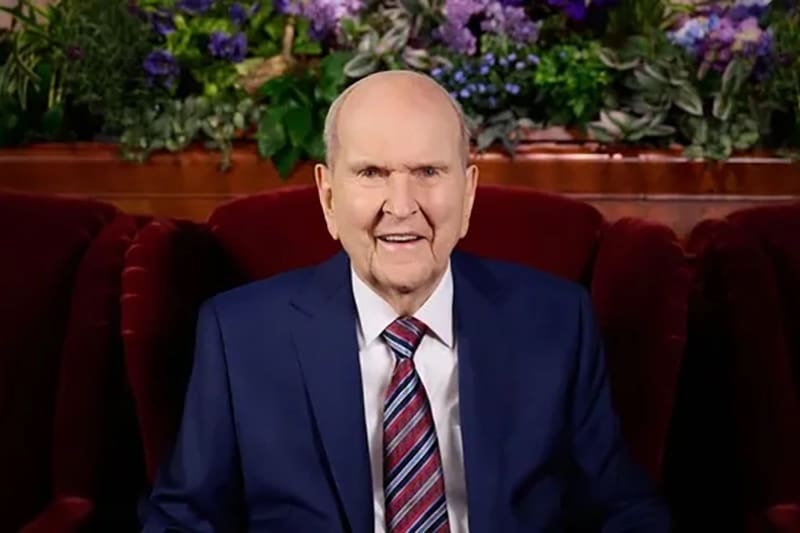
President Nelson’s last conference talk, “Confidence in the Presence of God,” prompted some self-reflection I didn’t expect. At first, I was unsure of his meaning. Was President Nelson encouraging me to prepare to come into God’s presence with confidence when I die? No. He clarified: “When I speak of having confidence before God, I am referring to having confidence in approaching God right now! I am referring to praying with confidence that Heavenly Father hears us, that He understands our needs better than we do.”
How do we obtain this level of confidence to come into the presence of God, right now? Joseph Smith made the foundational statement: “The first principle of the Gospel [is] to know for a certainty the character of God…. I want you all to know Him, and to be familiar with Him, [to have} a correct idea of his … perfections, and attributes’ and an admiration for ‘the excellency of [His] character”.
When we know more about who God is, we learn to approach Him with greater love, respect, fidelity, honor, and humility. The prophet Alma said: “All things denote there is a God… and do witness that there is a Supreme Creator” (Alma 30:44). We know He is omniscient, all-knowing; He is omnipresent, always aware, and omnipotent, all-powerful. He is more intelligent, more merciful, more talented than all of us put together (Abraham 3:19). In the temple, we watch Him as the Presiding Officer, the Planner, the Organizer, the Sovereign. This is the God President Nelson wants us to have confidence in and to connect with.
Approaching God in prayer begins with His name. “Dear Father in Heaven,” or simply: “Heavenly Father.” We can feel the holiness of His name weekly in the first words of the sacrament prayers, “O God, the Eternal Father.”
After sacredly addressing the heavenly throne, Satan can disrupt and confuse. You know he did this to Joseph Smith. After kneeling and calling upon God, Satan interrupted and put dark, fearful, doubting, evil thoughts into Joseph’s mind, so he could not speak. As thick darkness gathered around him, he felt “doomed to sudden destruction.” Then, at the very moment he was ready to sink into despair and abandon himself to destruction, he exerted all his powers to call upon God (Joseph Smith-History 1:16). That is how fourteen-year-old Joseph Smith overcame evil. He increased the intensity of his prayer—fervently, earnestly, and desperately. Joseph did exactly what the Apostle Paul admonished: “Cast not away therefore your confidence,” (Hebrews 10:35).
If that were the extent of President Nelson’s final message, I could work on knowing God and improving my connection with Him for the rest of my live. But there is more. President Nelson said that when we pray with that understanding and that confidence, God will send angels to be with us and those we love. Are you wondering who these angels could be? He could be referring to pre-mortal or post-mortal spirits or resurrected beings. But I think it is more probable that these angels are living among us who are prompted to help us.
And there is still more. President Nelson gives the reason God sends angels. Angels are sent to help us reach our potential. This is astounding.
I, like most of you, have received a patriarchal blessing, personal revelation to help me reach my potential. Like you, I hold my patriarchal blessing close to my heart. But to understand what I am about to share, you need to know that my blessing emphasizes two concepts: words and teaching.
Because of President Nelson’s talk, I thought about how I have been blessed by earthly angels to reach the potential spoken of in my patriarchal blessing.
Richard and I were living in San Jose, California, in 1969. We had three children under three. I was in the kitchen, cleaning up dinner dishes. Suddenly, in my mind I saw a children’s book. I saw a couple of pages turn. It was an illustrated alphabet book with definitions of gospel words. I walked into Richard’s office where he was preparing his lesson for the next day. I told him what I had seen in my mind. He immediately pushed his lesson aside, got out a notebook, and said: “You are going to write that book. Let’s start making a list of the words.” He could have said, “Well, you just had a baby. You have three little children. Write about that experience in your journal, and in a few years, when things calm down, you can think about writing that book.” But he didn’t. A little over a year later, that book was in print.
One day in 1999, a good friend who was serving as a docent, a museum teacher, in the Church History Museum, said to me, “Why don’t you apply to be a docent in the museum. They are taking applications. So, I did and stayed for twenty years. One of my frequent assignments in the museum was to tell about the translation of the Book of Mormon. Specifically, I liked explaining how Oliver Cowdery handwrote the Book of Mormon two times. The first time as Joseph dictated the words, and a second time so Joseph would have a backup copy to take to E. B. Grandin, the printer.
One day in 2013, I said to Richard, “I want to have an Oliver Cowdery experience and handwrite the Book of Mormon. He could have said, “Why would you want to do that? It seems like a waste of time.” But he encouraged me. And two more books came out of that experience.
In 2022, because of severe osteoporosis, I began breaking vertebrae. I had three surgeries. I was still on painkillers and oxygen when my Relief Society president came to visit. I knew, because my recovery time would be at least a year, that I would be released as a Relief Society teacher. The Relief Society president said, “I talked to the bishop about an impression I had while I was mowing my lawn. The thought was, ‘Ask Marilynne to teach a Book of Mormon class on Zoom.’ The bishop thinks it’s a good idea. I looked at her dazed. How could I ever do it? For over two years, I taught a weekly Book of Mormon class on Zoom.
In 2024, our new Relief Society president said, “I’m sending you an application to be an Institute teacher with BYU-Pathway. You will be teaching on Zoom. Long story short, I am now teaching my fourth term on Zoom. I have taught the gospel to students in Brazil, Venezuela, Nigeria, Haiti, the Dominican Republic, Barbados, and Jamaica.
You can see the connections. But this is what I haven’t told you. In every one of these situations in which earthly angels were helping me reach my potential, I had to pray not to cast away my confidence.
When I had three little children under three, writing a book took time I didn’t have. I had never written a book. The learning curve was steep. I wanted to give up. The only thing that kept my confidence was that I had seen the finished book in my mind.
When I was in the three-month training to become a docent in the museum, I found out that I could not use notes to help me tell visitors about the art and history of the Church. I didn’t have the talent to talk without notes. I wanted to give up. It took study, practice, and prayer to continue.
When I started to handwrite the Book of Mormon, I found out that I had carpal tunnel and could not write it, but I could type it. When I started typing, I was slow and made many errors. I corrected them. I wanted it to be accurate, even though no one would ever see it but me. It took me exactly 565 days, which is 500 days longer than it took Joseph Smith to dictate it to Oliver Cowdery. I persevered with confidence because earthly angels were encouraging me.
When my Relief Society president asked me to teach on Zoom, I knew almost nothing about Zoom, let alone how to host a meeting. I didn’t know how to make a PowerPoint presentation. Because of the pain, I prepared my lessons lying down with my laptop on my bent knees. Many, many times I wanted to quit. But prayer sustained me. It also helped immensely that my kind friends and family joined the class each week.
When my new Relief Society president made me aware of the BYU-Pathway opportunity, I had to attend seven weeks of training. I had to learn another computer program, Canvas. It was difficult. And a weekly preparation is demanding and draining. I wanted to quit. But again, confidence in my Father in Heaven is making it possible. It also helps that I was set apart by my stake president with priesthood authority.
President Nelson, in his so-to-speak last lecture, promised that Heavenly Father loves you more than you can comprehend, that He yearns to help you reach your potential, and that he will send angels to help you. With that promise, you and I can approach God’s presence right now and cast not away therefore our confidence.
Wilford Woodruff Discourse: “Whatsoever Leadeth to Good Is of God”
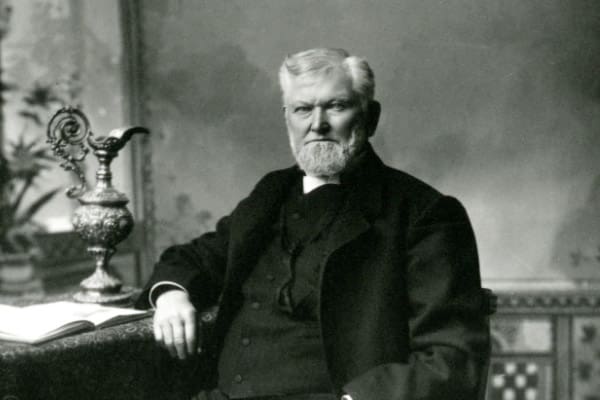
The following is a discourse delivered by Wilford Woodruff in 1894, which was recorded by Arthur Winter. This transcript, its images, and others can be found at https://wilfordwoodruffpapers.org/
The angel Moroni said to the Prophet Joseph Smith, “Whatsoever enticeth and leadeth to good and to do good is of God, and whatsoever doth not is of that wicked one.” That is a true principle. I wish to make some remarks upon this, but before doing so I desire to refer to our meeting this forenoon. There was probably not one half present this morning of those who are here this afternoon, and therefore many may not fully understand what I allude to. This is a Stake Conference, and there was a report made this morning of the fast offerings received from the various wards in the Stake and the amounts disbursed for the support of the poor. I think that the report showed that during the last six months this Stake alone received from the general tithing office $14,000 for the support of the poor. I believe I am sa[f]e in saying that fifty per cent of all the tithing collected throughout the mountains of Israel is returned to the various Stakes for local expenses, among which is the
support of the poor. I think myself that this is wrong. As Latter-day Saints, we should observe our fast meetings and our fast offerings. We should at least make a donation of that which we save by fasting, and give it to the Bishop for the support of the poor. It was remarked this morning that some people said they could not fast because it made their head ache. Well, I can fast, and so can any other man; and if
it makes my head ache by keeping the commandments of God, let it ache. If we did our duty with regard to the poor among us the tithing would not be withheld from the Presiding Bishopric for the support of the poor. In this, brethren and sisters, I certainly think we should improve. There is nothing gained by our attempting to shirk any duty that God requires of us. We should be more diligent in attending our fast meetings. We should fast as the Lord requires. The Lord does not ask anything of any man that he cannot perform. Whenever the Lord
gives a commandment to the children of men, He provides a way for the fulfilment of that commandment. Tithing is a commandment of God to the people, and should be observed. The report of what the Relief Society has done is certainly a great credit to them. The amount of means which they have donated for the support of the poor in this Stake is a large amount, considering the labors that there are upon that Society. I hope we will all reflect upon these things and not forget our duty with regard to the fast offerings and the fast meetings, as well as all other meetings that we are required to attend.
President Angus M. Cannon referred to the officers of the Stake not being present at this Conference. I think if we all felt as we should, if we understood the signs of the times, we would take pleasure in attending meetings as far as possible. The Presidency of the Church and the Twelve Apostles have the conferences of the whole Church to attend, and when they are not here they are performing other duties.
Now, with regard to the statement I made in the beginning, “Whatsoever enticeth and leadeth to good and to do good is of God, and whatsoever doth not is of that wicked one.” While we as a people accord to every denomination the right to enjoy their religion, we claim the same privilege ourselves. I have often referred to this, because perhaps it has appeared sometimes as though we were encroaching upon
others. This, however, is not the case. Let us compare the good with the evil today. Where is there a man, no matter what sect he belongs to, who cannot see a great change in the world today? I remember very well over eighty years of my life, and I certainly have never
seen such a time in my life in the United States as I have during the last year. The spirit of murder, of whoredom, of blasphemy that is going like a flood over the land, and the increase of crime on every hand, is certainly alarming. Is it from God? Does it lead to
good? It does not. There is no God in it. When we look at these things we can see that there is a power manifest in our land and among the nations of the earth that is leading men to do evil. There is one thing very prominently before my mind, and that is the unpopularity of God himself, and of Jesus Christ, and of the Gospel of the Son of God. In the days of the Savior there were a good many religious sects, and they were all at war with the Savior and His Apostles. They fought against everything they did, and labored for their destruction until the Savior and His Apostles were put to death. Were they led by the Spirit of God? They were not. They were not inspired to do right; they were seeking to do wrong. In this dispensation the Prophet Joseph was an unpopular man. He was opposed by the world, and by a great many men who professed to be ministers of the Gospel. They labored against him and to overthrow his doctrines. Now, if Joseph Smith was right, his persecutors were not right. Of course, every man must be his own judge with regard to that. If Jesus Christ and the Apostles were right, then those men who fought against them were not right.
We are informed by the revelation of St. John that in the last days there would be something like six hundred three score and six different religious sects and parties in the earth. Of course, there could be but one of them right; for there is but one right way. There is but one Gospel;
there never was but one and never will be. That Gospel never deviates from one generation to another. So with the Holy Priesthood. The Priesthood is the same in every generation. Whenever God has had a people on the face of the earth, He has had the Priesthood among them. In fact, no man has the right to administer in one of the ordinances of the Gospel of the Son of God only by and through the power of the Holy Priesthood. The ancient apostles and prophets who administered in the ordinances of the Gospel held that Priesthood. Without that authority they would have had no right to administer in these ordinances. So in this day, this principle is the same.
Now, my friends, it does not pay any man to preach false doctrine or ot practice false principles, because there is no salvation in it. It is for salvation that we labor. For that the Lord called Joseph Smith to organize the Church of Jesus Christ once more for the last time on the earth, so that a body of people would be prepared for the coming of the Son of Man. The Gospel of Christ was with Joseph Smith. The Priesthood was given to Joseph Smith by those who held that Priesthood in the days of Jesus. He never pretended to administer in one ordinance until he received the commandment of God to do it. Those of you who have embraced the Gospel and have lived your religion know for yourselves that the power of God has followed this work from the commencement until today. I know it has, and I know it will if we do our duty. All the ancient patriarchs and prophets labored for salvation, for the glory where God and Christ dwell, that after death, in their immortal bodies, they might occupy that position forever. It paid them to do it, and it will pay all men to do the same. We cannot spend our time foolishly in safety. We have a mission to fulfil. Some portion of the Holy Priesthood has been given to almost every man in the land of Zion, and to many of them at a very early age. It has been given to us that we may administer in the ordinances of the Gospel and in the things of the kingdom of God. Then let us try to magnify our callings and to do our duty. We know the principles we are practicing are true. The Lord has given us power to rear these temples unto His holy name, that we may enter in as saviors on mount Zion and redeem our dead, that they who have never heard the Gospel may partake of eternal life. Jesus himself went to preach to the spirits in prison, that they might be judged according to men in the flesh. [1 Peter 4:6]So do the apostles and elders of Israel as they pass away. We labor this side of the veil, and they labor the other side of the veil. These things are true. God has established this Church. He has raised up prophets and apostles, and has planted a work in these mountains of Israel, where this congregation have been gathered by the power of God. We have a labor to perform, and if we do not do it we will be under condemnation. I know this is the work of God. I know the Priesthood is here, and I know the power of God has followed this Priesthood since the Church was organized. Our Elders have traveled at home and abroad. They have been taken from the various
occupations of life and thrust into the vineyard. They have traveled thousands of miles, and that, too, without purse and scrip, preaching without price. I never thought of taking any money with me on my missions. I have traveled in a good many countries, and I always traveled without purse and scrip, and I preached without money and without price. The Lord always raised up friends for me in time of need. I was fed and clothed and had all the necessities of life. That is the way the ancient Apostles preached. It was the way the Elders of Israel have had to preach in the day and generation in which we live.
Brethren and sisters, I hope we will look at the position we occupy here and the work that lies before us, and as far as we can go into these temples. I thank God we have a temple upon this block, where the Latter-day Saints in this region can enter and redeem their
dead—their fathers and mothers and their progenitors who have gone into the spirit world without the Gospel. They never heard the Gospel,
and no man, in time or in eternity, will ever be saved in the celestial kingdom of God without the Gospel of Christ. Therefore, let us look upon these things as they are. Let us try to live our religion, that when we get through we may be satisfied with life. I prayed many an hour when a boy that the Lord would let me live to see a prophet or an apostle, or some man who could teach me that Gospel which I read of in the New Testament. I have lived to see that day, and I thank God for it. I have tried to do what good I could in my weak way. I have tried to go into
these temples and redeem my father’s house. With the assistance of my friends I have been able to do this. When I go to the other side of the veil and meet with them, I think I shall be satisfied, and I think they will. They will find that these principles are true, and so will all denominations when they come in the presence of God. They will learn then, if not before, that this is the work of God. I pray God to bless all who are connected with the Church of Jesus Christ of Latter-day Saints. May we magnify our calling and do our duty, that when we get
through and go into the presence of God and read our history in that great library in heaven, where the acts of all men are recorded, we may be satisfied. God give us wisdom, and lead and guide us in our duty, that we may overcome the world, the flesh and the devil, and inherit eternal life, for Jesus’ sake. Amen.
FEATURES