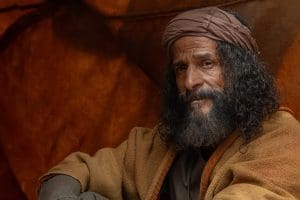






The last chapter of the last book of the Pentateuch, the “Five Books” of Moses, tells of the departure of that titanic Old Testament figure from the midst of the wandering Camp of Israel that, under God, he had both created and led. (Of course, the account of his death raises the question of his authorship of the chapter. But that isn’t the topic of this current column.) Deuteronomy 34 begins as follows:
“And Moses went up from the plains of Moab unto the mountain of Nebo, to the top of Pisgah, that is over against Jericho. And the Lord shewed him all the land of Gilead, unto Dan, and all Naphtali, and the land of Ephraim, and Manasseh, and all the land of Judah, unto the utmost sea, and the south, and the plain of the valley of Jericho, the city of palm trees, unto Zoar. And the Lord said unto him, This is the land which I sware unto Abraham, unto Isaac, and unto Jacob, saying, I will give it unto thy seed: I have caused thee to see it with thine eyes, but thou shalt not go over thither.” (Deuteronomy 34:1-4)
Those who have stood on a clear day atop Mount Nebo (aka Mount Pisgah) in the ancient land of Moab—a mountainous region in what is today southwestern Jordan—can testify to the enormous panorama that it offers of modern-day Israel to the west, the north, and the south. It’s possible, looking across the Jordan Valley below, to see Jericho, the Dead Sea, and sometimes even Jerusalem.
But there is a curious detail to the biblical account of the “death” of Moses, found in the following verses:
“So Moses the servant of the Lord died there in the land of Moab, according to the word of the Lord. And he buried him in a valley in the land of Moab, over against Bethpeor: but no man knoweth of his sepulchre unto this day. And Moses was an hundred and twenty years old when he died: his eye was not dim, nor his natural force abated.” (Deuteronomy 34:5-7)
According to the biblical author, God himself buried Moses. But, since the narrator doesn’t know where this happened, how can he know that God was the undertaker? And, anyway, burying people seems a fairly curious activity for the Lord.
It’s interesting to observe that the Book of Mormon may know a slightly different tradition about Moses’s departure than that available to the writer of Deuteronomy 34:
“And when Alma had done this he departed out of the land of Zarahemla, as if to go into the land of Melek. And it came to pass that he was never heard of more; as to his death or burial we know not of. Behold, this we know, that he was a righteous man; and the saying went abroad in the church that he was taken up by the Spirit, or buried by the hand of the Lord, even as Moses. But behold, the scriptures saith the Lord took Moses unto himself; and we suppose that he has also received Alma in the spirit, unto himself; therefore, for this cause we know nothing concerning his death and burial.” (Alma 45:18-19)
Doctrine and Covenants 84:25 says that the Lord “took Moses out of their midst, and the Holy Priesthood also.” But the Latter-day Saint Bible Dictionary (under “Moses”) takes a very clear stand on the matter, explaining that
“As was the case with many of the ancient prophets, Moses’ ministry extended beyond the limits of his own mortal lifetime. In company with Elijah, he came to the Mount of Transfiguration and bestowed keys of the priesthood upon Peter, James, and John (Matt. 17:3–4; Mark 9:4–9; Luke 9:30; D&C 63:21; HC 3:387). From this event, which occurred before the Resurrection of Jesus, we understand that Moses was a translated being and had not died as reported in Deut. 34 (Alma 45:19). It was necessary that he be translated, in order to have a body of flesh and bones at the time of the Transfiguration, since the Resurrection had not yet taken place. Had he been a spirit only, he could not have performed the work on the mount of giving the keys to the mortal Peter, James, and John (see D&C 129).”
And, of course, Latter-day Saints understand from Doctrine and Covenants 110 that Moses came again to the earth on 3 April 1836, to the temple in Kirtland, Ohio, where he conferred the keys of the gathering of Israel upon Joseph Smith and Oliver Cowdery (D&C 110).
The ancient Hebrews, though, refugees for decades from their homes in Egypt and not yet arrived in the Promised Land, had lost one of the giants of the Bible, one of the greatest figures in all of the history of world religions. They were, no doubt, both devastated and lost: “And the children of Israel wept for Moses in the plains of Moab thirty days.” And they must have wondered: Who, if anybody, would arise to lead them? And how would he react to the assignment? How would he feel about the world-historical shoes that he would be called to fill?
My late brother told me once, and (I think) not entirely in jest, that the lowest ebb of his faith came immediately after his call to serve as a bishop. Why? Because, he said, he had always looked up to bishops and admired them. And now he himself needed to rise to the responsibility, and he wasn’t sure that he would be able to do it. Had somebody made a mistake?
I’ve wondered how Brigham Young felt about stepping into the shoes of Joseph Smith, a prophet whom he profoundly respected and of whom he considered himself a disciple. And try to imagine the feelings of the Galilean fisherman Simon bar Jonah, appointed to feed the Lord’s sheep and lead the Church after the death, resurrection, and ascension of Jesus himself. It would be perfectly astonishing, indeed superhuman, if they never felt inadequate to the responsibility. For us mortals, in fact, I suspect that, if we ever feel entirely ready for a calling in the Church, that may be excellent evidence that, in fact, we’re not.
Listen carefully to the account of the calling of Joshua to assume leadership of the Israelites in the absence of Moses:
“Now after the death of Moses the servant of the Lord it came to pass, that the Lord spake unto Joshua the son of Nun, Moses’ minister, saying, Moses my servant is dead; now therefore arise, go over this Jordan, thou, and all this people, unto the land which I do give to them, even to the children of Israel.
“Every place that the sole of your foot shall tread upon, that have I given unto you, as I said unto Moses. From the wilderness and this Lebanon even unto the great river, the river Euphrates, all the land of the Hittites, and unto the great sea toward the going down of the sun, shall be your coast.
“There shall not any man be able to stand before thee all the days of thy life: as I was with Moses, so I will be with thee: I will not fail thee, nor forsake thee.
“Be strong and of a good courage: for unto this people shalt thou divide for an inheritance the land, which I sware unto their fathers to give them. Only be thou strong and very courageous, that thou mayest observe to do according to all the law, which Moses my servant commanded thee: turn not from it to the right hand or to the left, that thou mayest prosper withersoever thou goest.
“This book of the law shall not depart out of thy mouth; but thou shalt meditate therein day and night, that thou mayest observe to do according to all that is written therein: for then thou shalt make thy way prosperous, and then thou shalt have good success.
“Have not I commanded thee? Be strong and of a good courage; be not afraid, neither be thou dismayed: for the Lord thy God is with thee whithersoever thou goest.” (Joshua 1:1-9)
In his instructions to Joshua, the Lord assures the new leader of success if he remains faithful to the teachings that he has been given, promising that he will be with him. He is bolstering Joshua’s confidence. Even so, not just once but three times, the Lord counsels him to be strong and courageous.
And, as if that weren’t enough—which, given the magnitude of the task before him, it may not have been—the people of Israel echo the Lord’s words to their new leader, promising him their faithful obedience if he is faithful to the Lord, and advising him to be both strong and brave:
“And they answered Joshua, saying, All that thou commandest us we will do, and whithersoever thou sendest us, we will go. According as we hearkened unto Moses in all things, so will we hearken unto thee: only the Lord thy God be with thee, as he was with Moses. Whosoever he be that doth rebel against thy commandment, and will not hearken unto thy words in all that thou commandest him, he shall be put to death: only be strong and of a good courage.” (Joshua 1:16-18)
The name Joshua (Yehoshua) changed over the centuries but is essentially identical to Jesus (Yeshua). Both mean something like “Yahweh (or Yehowah, i.e. Jehovah) saves.” It’s in Joshua 3 that, led by Joshua, the Israelites actually cross over the Jordan. And it’s here that I see some typological significance in their path and in the lay of the (holy) land. Consider this:
The Jordan River Valley is the lowest place on the face of the earth. The surface of the Dead Sea, into which the Jordan flows but from which it doesn’t exit, currently rests at nearly fifteen hundred feet below sea level. And in passing through the River Jordan from their homeless wanderings in the wilderness into their new divinely appointed home in the Promised Land, the Israelites can be viewed as symbolically undergoing a kind of baptism. Centuries later, John the Baptist will perform actual baptisms in the Jordan, not terribly far from the Israelites’ place of crossing.
Keeping that in mind, please recall Doctrine and Covenants 128:12-13 and the layout of our modern chapels and temples, which very commonly feature a baptismal font at their lowest points and, in temples, a symbolic (or even actual physical ascent, however slight) through the ordinances:
“To be immersed in the water and come forth out of the water is in the likeness of the resurrection of the dead in coming forth out of their graves; hence, this ordinance was instituted to form a relationship with the ordinance of baptism for the dead, being in likeness of the dead. Consequently, the baptismal font was instituted as a similitude of the grave, and was commanded to be in a place underneath where the living are wont to assemble, to show forth the living and the dead, and that all things may have their likeness, and that they may accord one with another.”
The ultimate Israelite goal, though, which will not be achieved for several centuries after the conquest of most of Canaan, is the construction and dedication of a temple in Jerusalem. And where will that temple stand? Although it is only slightly more than twenty miles from the River Jordan as the crow flies, the platform of Jerusalem’s Temple Mount sits at an altitude of nearly 2,500 feet above sea level. Thus, Isaiah’s prophetic vision of future temples in an era of millennial peace also describes the historical reality of the temple that he actually knew in his day:
“And it shall come to pass in the last days, that the mountain of the Lord’s house shall be established in the top of the mountains, and shall be exalted above the hills; and all nations shall flow unto it. And many people shall go and say, Come ye, and let us go up to the mountain of the Lord, to the house of the God of Jacob; and he will teach us of his ways, and we will walk in his paths: for out of Zion shall go forth the law, and the word of the Lord from Jerusalem.” (Isaiah 2:2-3; compare Micah 4:1-2)
It’s possible, with such facts in mind, to view the overall direction of the Israelite conquest of Canaan as suggestive of the covenant path, of entering the Kingdom of God by a symbolic baptism under the leadership of a man whose name, equivalent to “Jesus,” meant “Jehovah saves” and culminating in an ascent of the mountain of the Lord, to the temple.