









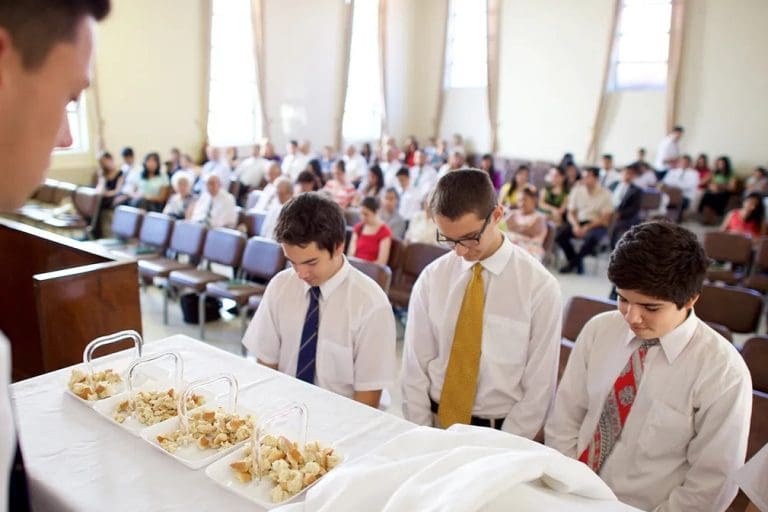


As I walked into the chapel for ward conference, I noticed there were no priests, teachers, or deacons seated in their normal places at the sacrament table. I heard the adult men seated behind me, asking each other if the Aaronic Priesthood young men could all be out of town. I wondered if it were possible that we were not having the sacrament today. Then my mind jumped to worst-case scenario: what if we never had the sacrament again.
Without the ordinance of the sacrament, our meetings would be just meetings, not sacrament meetings. There would be prayers, hymns, and talks but no opportunity to make afresh the covenants of baptism or the temple. Weekly reminders to repent and come before the Savior in humility would be gone.
No sacrament would mean breaking the commandment to “meet together oft” to partake of the bread and wine which the Lord established in Doctrine and Covenant 20:75. It would not follow the pattern Moroni described about the saints in his day: “And the church did meet together oft, to fast and to pray, and to speak one with another concerning the welfare of their souls. And they did meet together oft to partake of bread and wine, in remembrance of the Lord Jesus” (Moroni 6:5-6).
The emphasis on Jesus Christ would be greatly reduced. The unparalleled blessing of the Spirit to be with us would not be spoken regularly. When I looked again at the sacrament table, I noticed the sacrament trays under the cloth. The sacrament had been prepared.
Soon a counselor in the bishopric welcomed us and gave the order of the meeting: opening song, opening prayer, talks by the bishop and stake president, sacrament song, sacrament, closing prayer. The bishop spoke on the importance and power of the word remember, and the stake president spoke about the importance and power of the sacrament. He taught that in addition to the promises of the covenant, the ordinance of the sacrament is to celebrate the life of Jesus Christ. He reminded the congregation that although the sacrament service is done as a ward, partaking of the sacrament is individual, private, and personal, a solo experience that no one can do for you.
As he finished his talk, he invited the Aaronic Priesthood young men to come to the sacrament table. We sang a sacrament song, and the sacrament was administered as usual. There was no closing song, just a closing prayer.
Because the sacrament concluded the meeting and because the stake president had just illuminated the gifts and powers associated with the sacrament, I stayed more attentive. But too many times, I do not stay focused. Somewhere after the first few words of the prayer on the bread, my mind goes AWOL until I realize the deacons are returning the water trays to the priests. Chagrined before the Lord, I ask, did I renew my covenants? For sure I did not renew them with real intent.
I have tried to overcome this personal deficiency and partake intentionally by remembering and visualizing Jesus Christ in America. I think of Him saying the sacrament prayers and passing the bread and wine to His disciples. When I do, like dew, the import of the sacrament distills upon me.
“And it came to pass that Jesus commanded his disciples that they should bring forth some bread and wine unto him. And while they were gone for bread and wine, he commanded the multitude that they should sit themselves down upon the earth. And when the disciples had come with bread and wine, he took of the bread and brake and blessed it; and he gave unto the disciples and commanded that they should eat. And when they had eaten and were filled, he commanded that they should give unto the multitude” (3 Nephi 18:1-4).
The next day, Jesus performed a miracle as He administered the sacrament again: “Now, there had been no bread, neither wine, brought by the disciples, neither by the multitude; but he truly gave unto them bread to eat, and also wine to drink” (3 Nephi 20:6-7). He explained: “He that eateth this bread eateth of my body to his soul; and he that drinketh of this wine drinketh of my blood to his soul; and his soul shall never hunger nor thirst, but shall be filled” (3 Nephi 20:8). At this time, Jesus gave authority to His disciples to administer the sacrament.
The Nephites then taught us how we should feel about partaking of the sacrament. “Now, when the multitude had all eaten and drunk, behold, they were filled with the Spirit; and they did cry out with one voice, and gave glory to Jesus, whom they both saw and heard” (3 Nephi 20:9).
The words in The Living Christ succinctly state the reason for the sacrament: “He instituted the sacrament as a reminder of His great atoning sacrifice.” The words in the sacrament prayers remind us to partake in remembrance of His body and blood.
One Sabbath when I was listening to the sacrament prayers, the idea came to make the prayers more personal by repeating the words in my mind and by changing the plural pronouns from we, us, they and them to I, me, and my:
O God, the Eternal Father, I ask thee in the name of thy Son, Jesus Christ, to bless and sanctify this bread to my soul as I partake of it, that I may eat in remembrance of the body of thy Son, and witness unto thee, O God, the Eternal Father, that I am willing to take upon me the name of thy Son, and always remember him and keep his commandments which he has given me; that I may always have his Spirit to be with me. Amen.
O God, the Eternal Father, I ask thee in the name of thy Son, Jesus Christ, to bless and sanctify this water to my soul as I drink of it, that I may do it in remembrance of the blood of thy Son, which was shed for me; that I may witness unto thee, O God, the Eternal Father, that I do always remember him, that I may have his Spirit to be with me. Amen.
Another time, as I was looking through the hymn book at the list of sacrament hymns, the idea came again to change any group pronouns to personal pronouns.
As Now We Take the Sacrament
As now I take the sacrament,
My thoughts are turned to thee,
Thou Son of God, who lived for me,
Then died on Calvary.
I contemplate thy lasting grace,
Thy boundless charity;
To me the gift of life was given
For all eternity.
While of These Emblems We Partake
While of these emblems Ipartake
In Jesus’ name and for his sake,
Let me remember and be sure
My heart and hands are clean and pure.
Jesus of Nazareth, Savior and King
While of this broken bread
Humbly I eat,
My thoughts to thee are led
In reverence sweet.
Bruised, broken, torn for me
On Calvary’s hill—
Thy suff’ring borne for me
Lives with me still.
We’ll Sing all Hail to Jesus’ Name
I’ll sing all hail to Jesus’ name,
And praise and honor give
To him who bled on Calvary’s hill
And died that I might live.
Behold the Wounds in Jesus’ Hands
Behold His wounded hands and feet!
Come touch, and see, and feel
The wounds and marks [so] I may know
His love for me is real.
Then as I fall to worship Him
And wash His feet with tears,
The Savior takes me in His arms
And quiets all my fears.
I thank my stake president for the unique sacrament meeting. I am thankful for the purpose and power of “meet[ing] together oft to partake of bread and wine, in remembrance of the Lord Jesus” (Moroni 6:5-6). How blessed we are individually and collectively for this time of sacred reflection and rededication.






MaryannMarch 30, 2026
I often read the words of the Sacrament hymns while the Sacrament is passed. It helps me to stay focused, and to really think about the deeper meanings of the lyrics. It has been a wonderful tool to draw me closer to the Savior and to remember Him.
Rochelle HaleMarch 25, 2026
I forgot to mention that "As Now We Take the Sacrament" is my favorite hymn. With a few minor word changes, it is an excellent song for a funeral to share a final testimony of Jesus Christ, His teachings, and the way [we] tried to live our lives.