

A Special 35th Year Anniversary Church History Tour

Scot & Maurine Proctor have been leading Church History Tours for the past 35 years. They know and love these places and know and love the Prophet Joseph Smith. This year’s tour will be Monday, September 14, 2026, to Monday, September 28, 2026. Below is a day-by-day illustrated itinerary of this very spiritual and wonderful journey. Come and enjoy reading about and seeing these places!
We know you have always wanted to see ALL the significant early Church History sites and now is the time! Many of you have been to Nauvoo or just to Palmyra, or perhaps to Kirtland—but now you will have the opportunity to see all these sacred sites in one sweeping, panoramic view. It makes ALL the difference in understanding the early history of the Restoration and the life of the Prophet Joseph.
We have been leading this ultimate Church History tour for the past thirty-five years! We know these places and the stories that bring them alive and we love to teach and share this amazing part of our sacred heritage. If you have ever thought about going on a Church History tour, this may very well be your year, and we would love to take you with us! One year a tour participant exclaimed: “This is not the ULTIMATE Church History Tour…It is the ONLY Church History Tour!”
We will be leading this year’s tour from September 14-28, 2026. It’s the perfect time of year for this incredible tour. You will return home the Monday before October General Conference.
WARNING: This is a life-changing experience!
Below is a thorough look at what we do. Read through the daily itinerary and then consider joining us. There are available spaces at this time, but the remaining spots will sell out, so please decide right away. Pricing and contact information are located at the end of the article or you can call right now for information or booking with our agent:
Sarah, at Morris Murdock Travel: 801-483-6473.
Please note: If you would feel more comfortable, you can book the Ultimate Church History Tour with the Proctors immediately online yourself: PLEASE CLICK HERE. When you get to that page, scroll down to where it says BOOK NOW and then set up your account and get it done. As of today, there are 18 places left so please call immediately to make sure you can secure your place on this never-to-be-forgotten experience. This is one time we have room for parents who would like to bring all their adult children and spouses (this happens often)—as long as you don’t have more than eight married children!
Please read and enjoy the following detailed itinerary below.
Day 1- Monday, September 14, 2026


We all fly in from our various homes to Boston today and gather at the Embassy Suites, Boston Logan Airport. (Evening snacks included at the hotel). Tonight we will have a brief meeting where we get to meet each other for the first time. You will look around and, at first, think these are all new faces and strangers to you. That feeling won’t last for long as we quickly become like a traveling family.
Day 2 – Tuesday, September 15, 2026
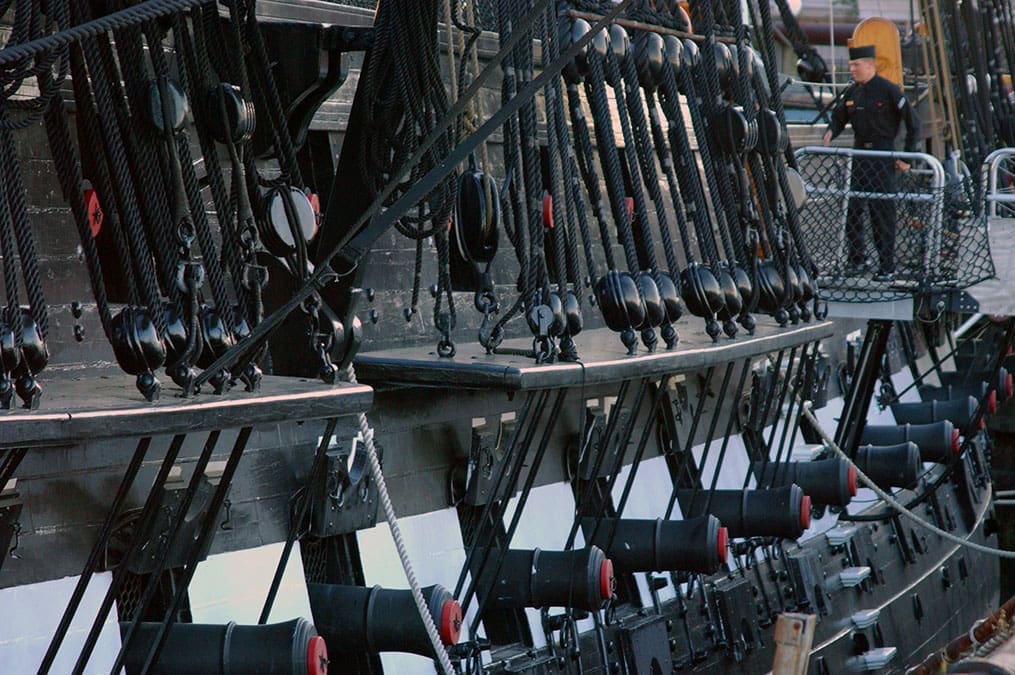 You’ll love our visit to Old Ironsides. You may even want to buy an American Flag that you get to fly over this historic ship! The Proctors have one in their family!
After breakfast, we’ll enjoy Boston, walk part of the Freedom Trail including seeing the Old North Church, and see “Old Ironsides,” the oldest commissioned warship in the world still afloat (229 years old). A memorable lecture given at Harvard Square in Cambridge will ring in your ears throughout the trip and give you new perspectives on the founding of our country and the beginnings of the Restoration. We’ll get a feeling for the American Revolution and then let you have an enjoyable hour at Quincy Market for dinner where you’ll see the famous Faneuil Hall. Built in 1742, this building hosted pre-Revolutionary protests against the Sugar and Stamp Acts and boasted speakers George Washington, Samuel Adams and later abolitionist Frederick Douglass.
Tonight we stay at the charming Colonial Inn in Concord, which dates to 1716 and weas used during the Revolutionary period by Concord Minutemen for storing arms and ammunition. It was once owned by Henry David Thoreau. (Meals: B,D)
Day 3 – Wednesday, September 16, 2026
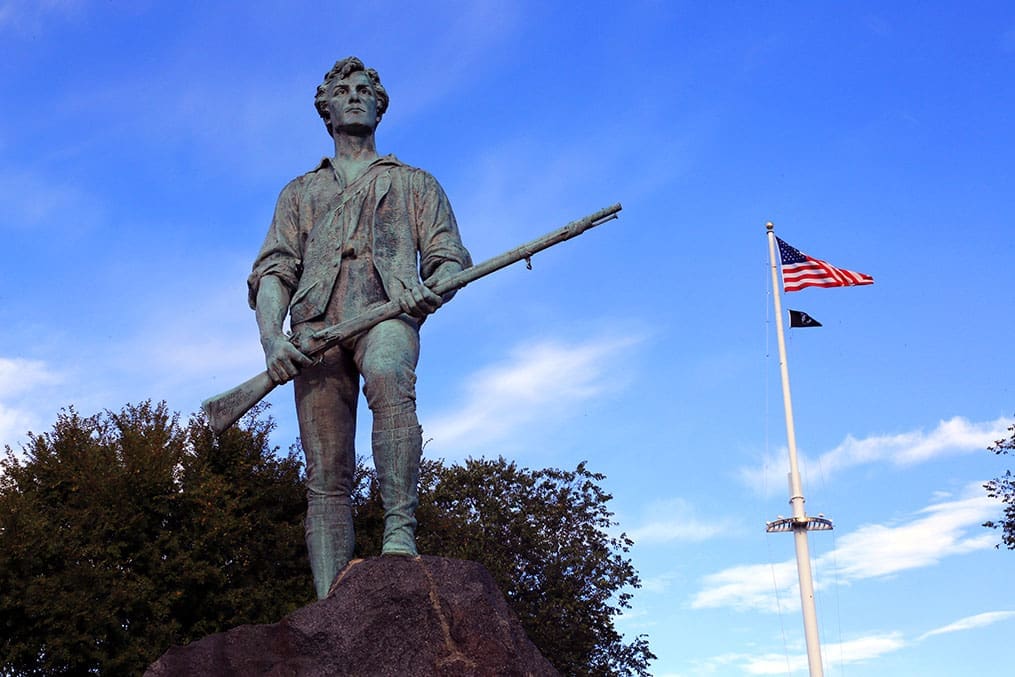 You’ll feel the spirit of the Revolution as you gaze upon the Minute Man statue here in Lexington on the Green.
This morning we will relive the first moments of the Revolutionary War and see the place where the shot was fired that was “heard around the world”. We will travel along Battle Road, stopping at various points, and even see where Paul Revere was captured by the British.

There are few places where you will feel a deeper connection to the Revolutionary War than here at the Old North Bridge in Concord.
You will come to know Lexington and Concord including hearing a moving lecture at the Old North Bridge that will help you understand those events which brought about the Independence of this great nation and set the stage for the birthplace of the Gospel of Jesus Christ in the latter days. In the afternoon we will visit Louisa May Alcott’s home and see the Sleepy Hollow Cemetery where Ralph Waldo Emerson, Nathaniel Hawthorne, Henry David Thoreau and the Alcott’s are buried. Tonight we will have a meal together at Longfellow’s Wayside Inn in Sudbury—the oldest Inn in America—established in 1716! Here we will see one of New England’s most picturesque sites and perhaps her most famous mill.
We will stay again tonight at our beautiful and historic Colonial Inn. (Meals: B, D)
Day 4 – Thursday, September 17, 2026
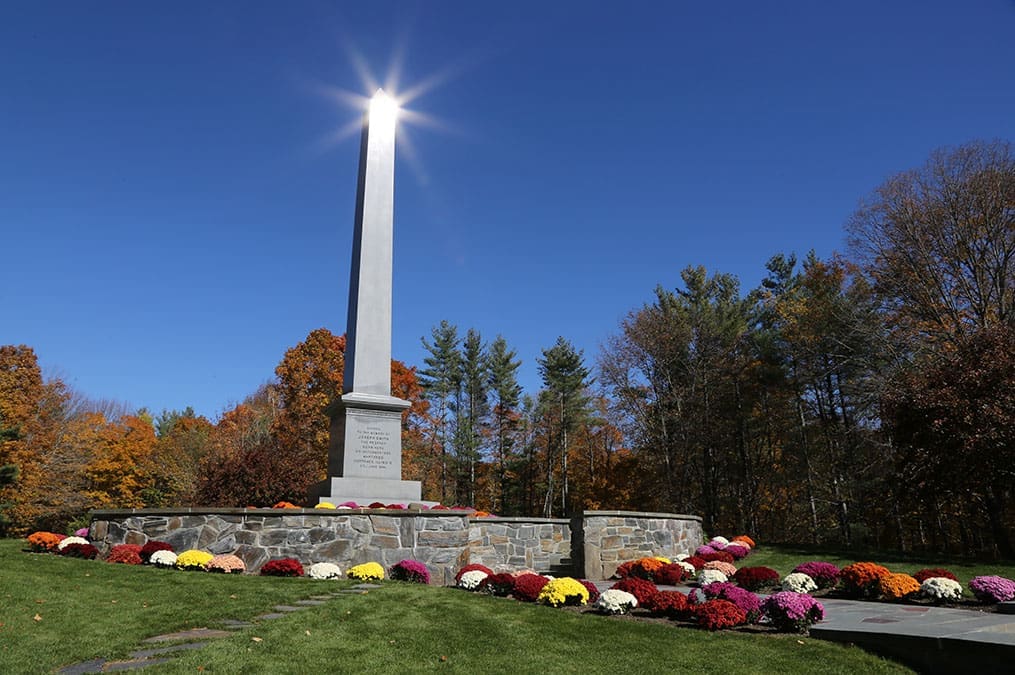 This 38 1/2 foot monument commemorates the birthplace of Joseph Smith, the Prophet.
Very early this morning we head northward on our journey into beautiful New England and for our first major Church History stop in Sharon, Vermont. Fortunately, you will experience the journey up Dairy Hill in a bus (we don’t have to hike) where we will experience strong feelings of the Spirit at the birthplace of the prophet Joseph. We will eat our lunch together on the original property where the Smiths were living. We will visit the towns of Sharon, Turnbridge, and drive past the Smith stomping grounds of Norwich and West Lebanon. Here we will get a feel for the first twenty years of marriage of Lucy Mack and Joseph Smith, Sr.
This evening we will have dinner and stay in the quaint ski resort lodging of the Best Western Inn & Suites in Rutland, VT. Rutland is only 24 miles from where Oliver Cowdery was born! (Meals B, D)
Day 5 – Friday, September 18, 2026
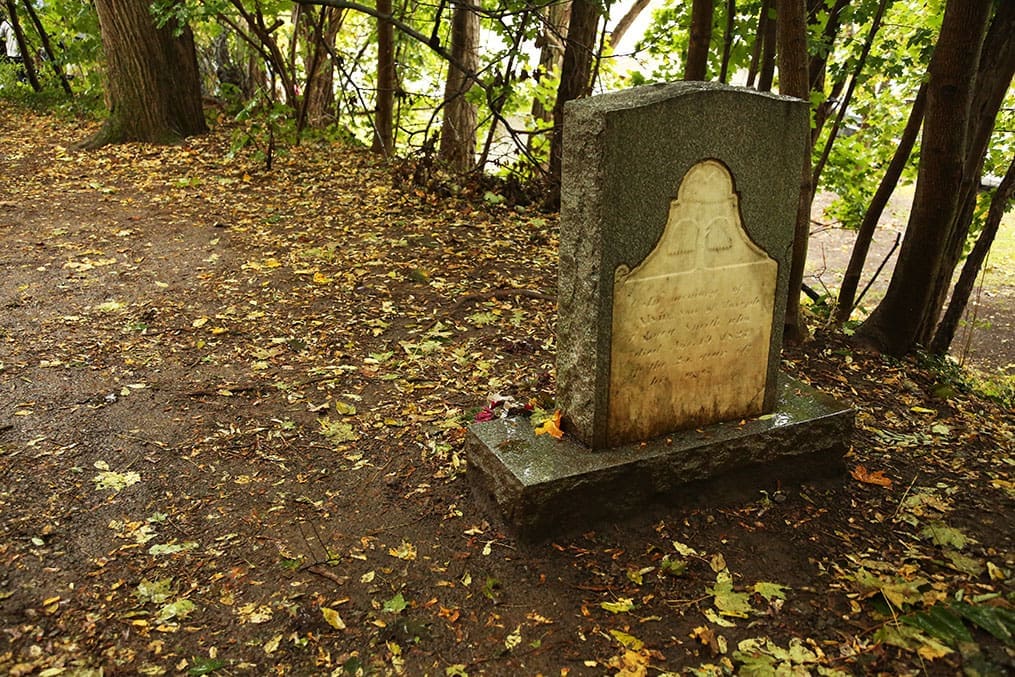 Here we walk on sacred ground at the grave of Alvin Smith.
Leaving New England the scenery changes as we wind our way south and west to fertile fields and lovely lands in Western New York. We will enjoy stories of early church leaders of the church, where they came from and how they came to know the Gospel of Jesus Christ. We will talk about what it was like for Lucy Mack Smith to make the arduous journey with eight young children more than 300 miles (without her husband) to Palmyra.
Tonight we will stay in the Woodcliff Hotel and Spa in Fairport (near Rochester), New York (right near the old Erie Canal and not too far from Palmyra) and ready ourselves for a spiritual feast tomorrow. Dinner will be at your discretion at the amazing Wegmans Food Store & Deli (you will love Wegmans—we guarantee it). (Meals: B, D)
Day 6 – Saturday, September 19, 2026
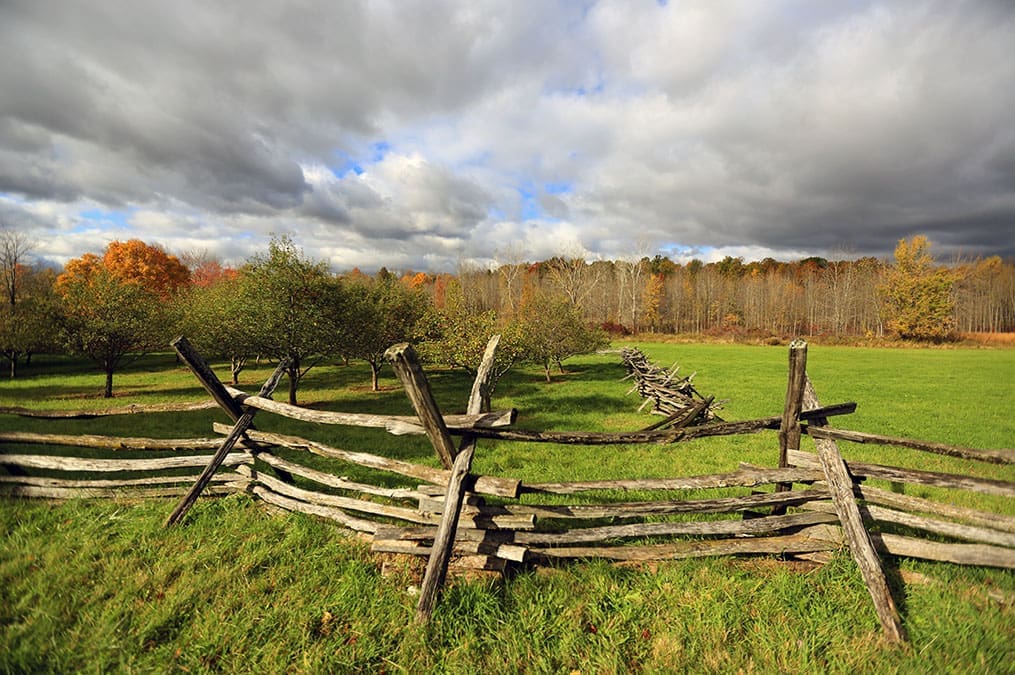 You’ll feel the Spirit here at the farm of Joseph and Lucy Smith.
We will arise early to be at the Sacred Grove and experience this, one of the most significant holy places on the earth. For many this experience is the highlight of the whole trip. We will have our own, individual quiet time in the Grove. Afterwards, we will enjoy the Smith farm, tour the Smith frame House and the Smith Log Cabin (where the Angel Moroni visited the prophet). We will also visit the Hill Cumorah, Martin Harris Farm, the E.B. Grandin Printing Complex and the downtown village of Palmyra. Our little walk up the hill to the Smith Cemetery will touch you as we gather at the grave of Alvin Smith. This afternoon we may have the opportunity of attending a session at the Palmyra Temple (be sure you bring your own temple clothes—Sarah will let us know if the scheduling works).
Dinner will be at a local restaurant before we stay again at the Woodcliff Hotel tonight.
(Meals: B, D)
Day 7 – Sunday, September 20, 2026
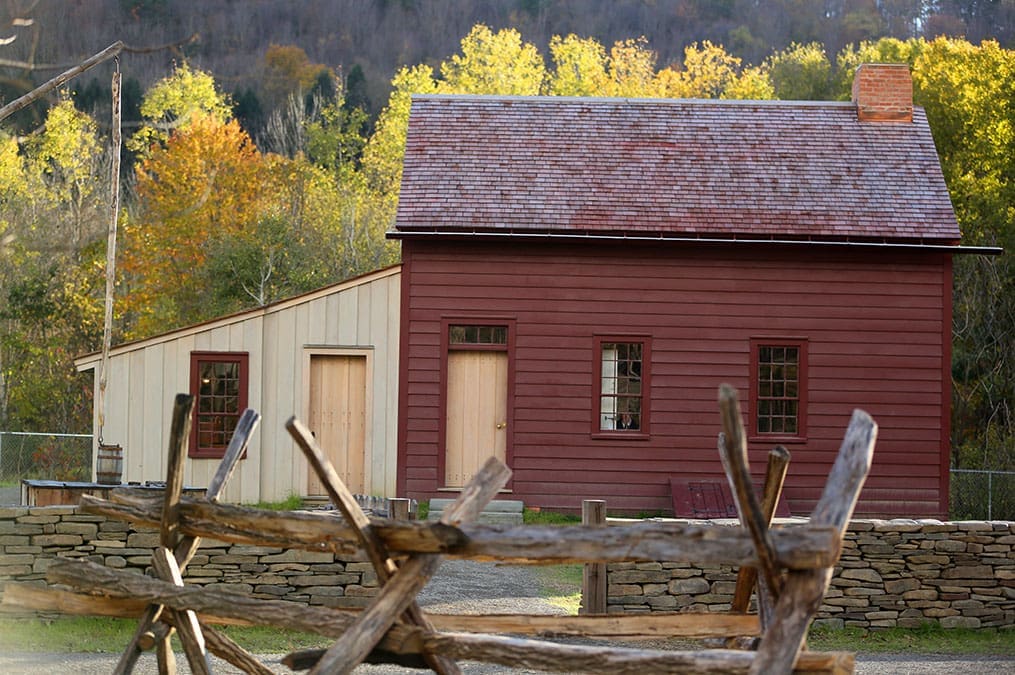
You truly have to experience this newly restored (2015) Priesthood Restoration site. It is stunning.
Today is a VERY BIG day! This morning we head to Fayette where the Whitmers lived and the Church was legally organized on Tuesday, April 6, 1830. Twenty revelations for the Doctrine and Covenants were received here or near here. This is also the place where Martin Harris, Oliver Cowdery and David Whitmer received their special witnesses of the plates. We will attend sacrament meeting at the beautiful Fayette Ward then head south to Harmony, Pennsylvania to visit the beautiful Priesthood Restoration site. For some, this is considered the most beautiful of all the Church Historical sites. Here we will see the reconstructed homes of Joseph and Emma Smith, Isaac and Elizabeth Hale, and the section of woods where John the Baptist restored the priesthood. A good part of the Book of Mormon was translated here in Joseph and Emma’s Cabin (about 70%). We will walk along the banks of the Susquehanna River where the first baptisms were performed in this dispensation. This is such a memorable afternoon and early evening!
Later this evening we check into the Double Tree Inn in Binghamton for dinner and our overnight stay. Do not miss getting your free, freshly baked famous DoubleTree 2-ounce chocolate chip cookie as we arrive. These feature 30 chocolate chips (per cookie!), a hint of lemon juice, cinnamon and coconut and are absolutely delicious. DoubleTree has distributed more than 483 million of these to date and we want to do our part to keep that number high! (Meals: B, D)
Day 8 – Monday, September 21, 2026
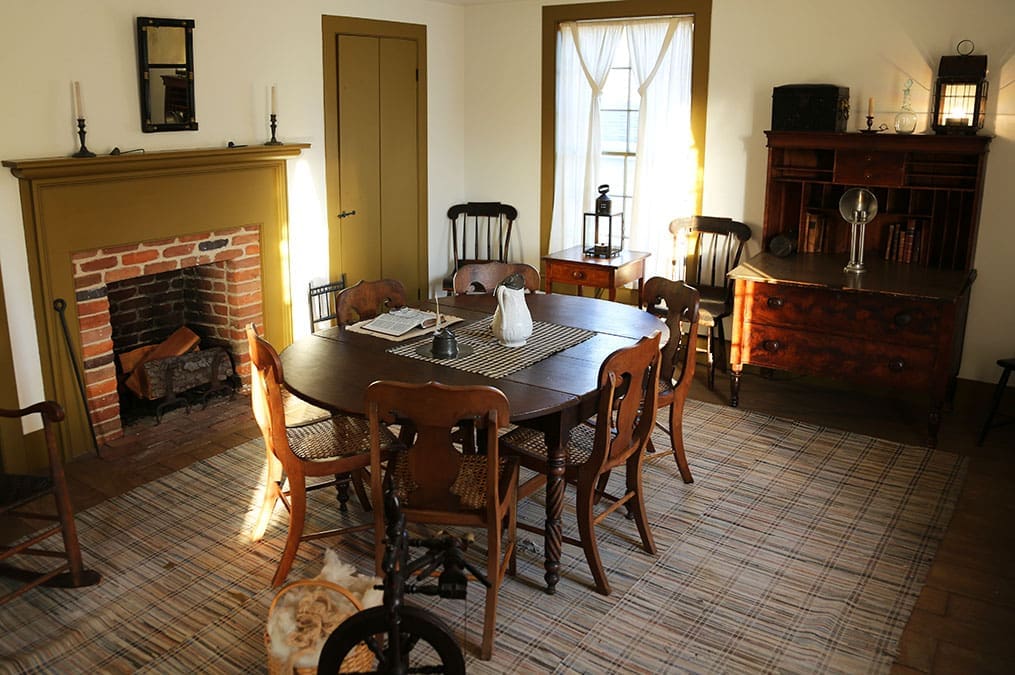 Seventeen revelations were given in this upper room of the Newel K. Whitney Store here in Kirtland.
Today we travel through some of the western regions of New York and review the missionary labors of Samuel Harrison Smith (the Prophet’s little brother) and Parley P. Pratt. The latter headed for Ohio where their labors would change the history of the Church because of the conversion of his very good friend, Sidney Rigdon. About midmorning we will make a stop in Corning, New York at the glass factory in route to Kirkland, Ohio. We reach Kirtland in the late afternoon and tour the Newell K. Whitney home and Store as well as see some of the other Kirtland sites. Be prepared for a spiritual feast at the Whitney Store.
Dinner will be at the “Olive Garden” before checking into our Hotel in Mentor (the natives do not say the “t”—it’s Menor!). (Meals: B, D)
Day 9 – Tuesday, September 22, 2026
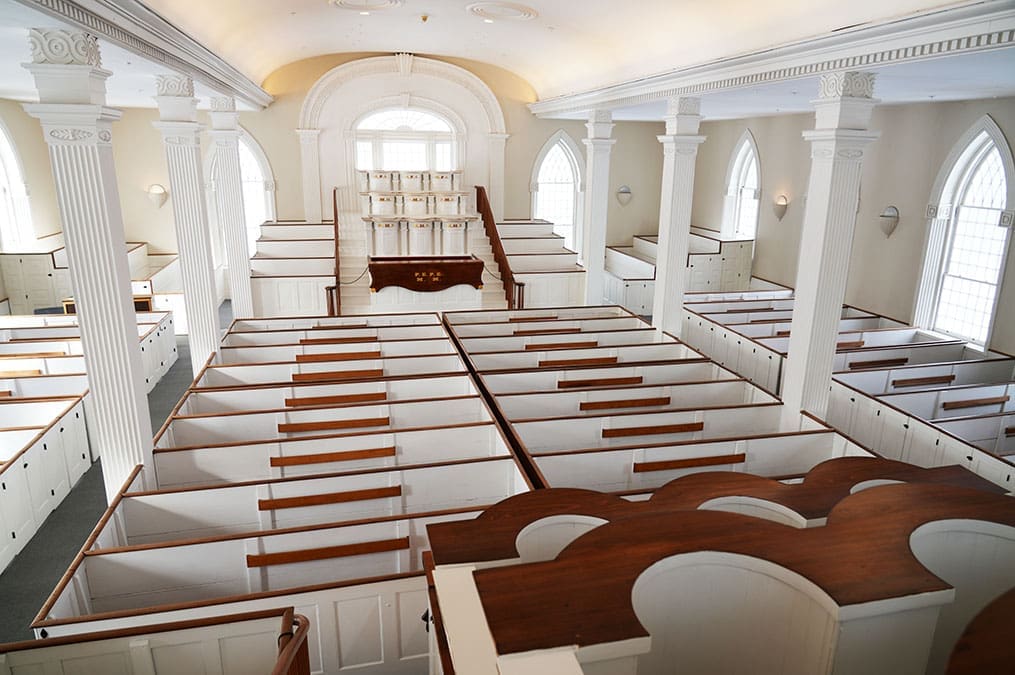 During that glorious week of the Kirtland Temple dedication in 1836 the Lord visited this room as well as numerous angels, including Moses, Elias and Elijah.
This morning Breakfast is provided at the hotel before we visit the Isaac and Lucy Morley Farm then tour the Kirtland Temple where The Lord Himself appeared as did Moses, Elias, Elijah, and numerous other angels. The script has changed a great deal since the Church purchased this historic temple March 5, 2024. You will love every minute of your time inside this sacred and holy place. We even get to go up into the third floor at the west end of the temple where Joseph had his office and saw a glorious vision of the celestial kingdom. After lunch we will travel on to the John and Elsa Johnson Farm in Hiram, Ohio where the vision of the three degrees of glory was received and at least 14 other revelations. Here the Prophet and Sidney Rigdon were mobbed, beaten and the Prophet tarred and feathered.
We travel to the heart of the Ohio Amish Country for an old-fashioned home style meal at the Dutch Valley Restaurant (eat light today because tonight, well, you can’t eat light). We stay tonight at the charming Carlisle Inn in Sugar Creek, a place where everyone begs us to stay longer! (Meals: B, D)
Day 10 – Wednesday, September 23, 2026
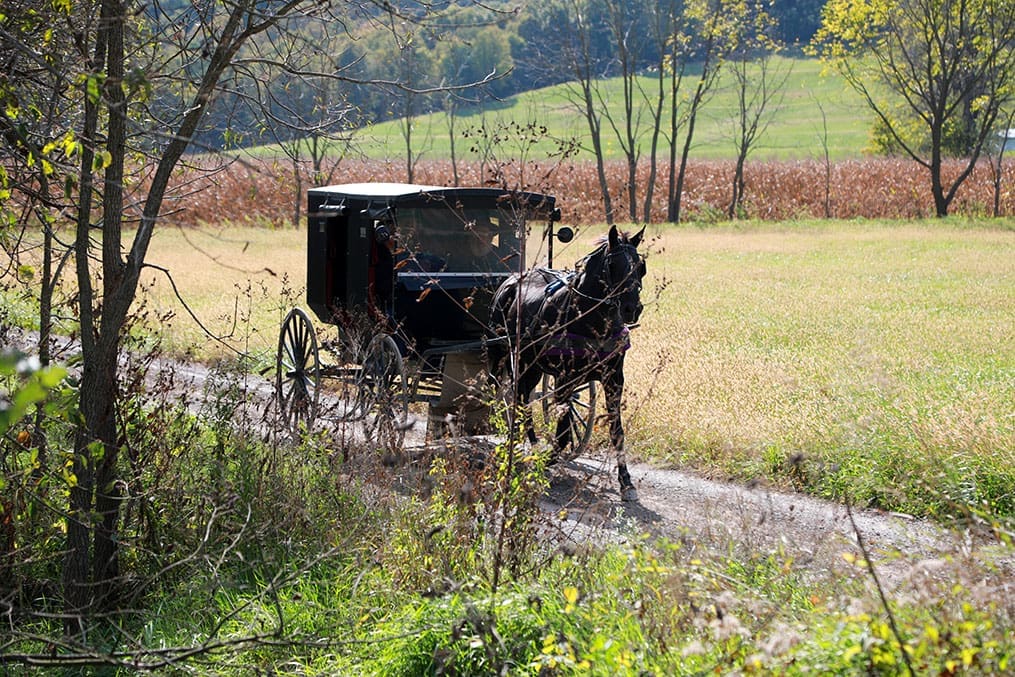 You will enjoy a buggy ride with the Amish. Holmes County Ohio boasts the largest population of Amish in the country.
This morning we will have the rare opportunity to spend more time with the Amish, touring their charming villages, seeing some of their local markets and talking to the people. You will love this experience and even have a chance to do some shopping! We will eat with one of our favorite Amish families in their home (don’t worry, they are all ready for large groups) and have another sumptuous meal together. We learn so much from the Amish.
Later this afternoon we will depart for the Cleveland airport for our flight to Kansas City. Our hotel for the next two nights is the Embassy Suites in Kansas City, Missouri. (Meals: B, D)
Day 11 – Thursday, September 24, 2026
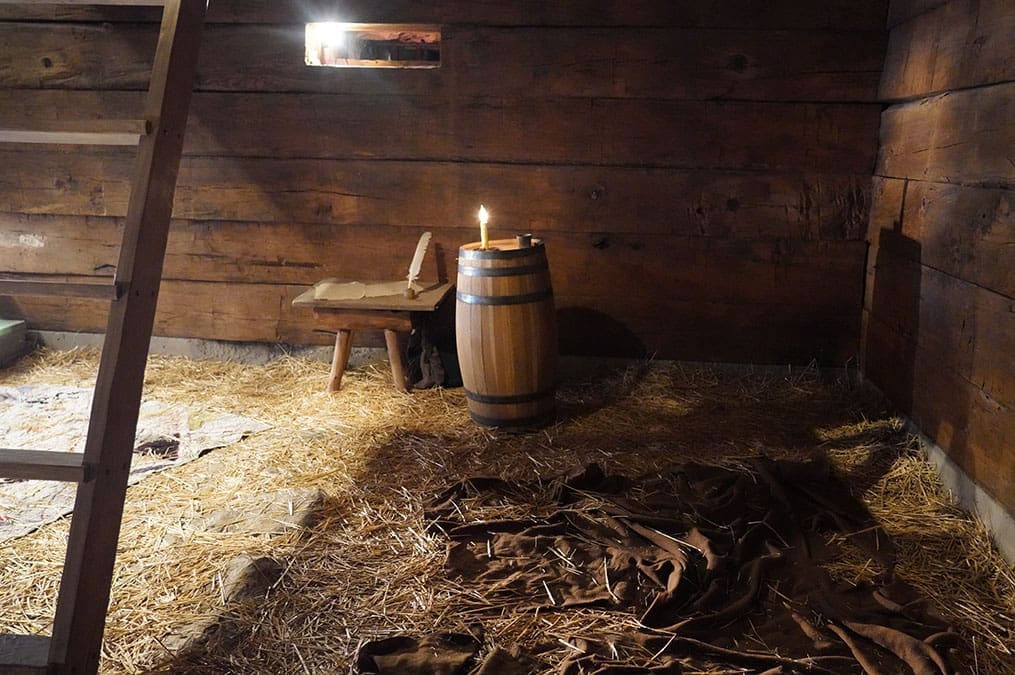
The Liberty Jail beccame a temple-prison for the Prophet Joseph.
This morning we will visit Independence, Missouri. Here we will see the original temple lot, enjoy our own Latter-day Saint Visitors’ Center and see the original Jackson County Courthouse. We then head east to visit Richmond, Missouri where two of the Three Witnesses of the Book of Mormon are buried. We then end our touring today in the Liberty Jail where the Prophet Joseph and his companions were imprisoned through the cold winter months of 1838/1839. Here we will feel the Spirit as we read the revelations and hear the voices of the past. We will also watch for the Kansas City Missouri Temple as we pass by it and see its beautiful setting in Clay County.
This evening we will have a wonderful meal either at the Cracker Barrel or a restaurant near our hotel. (Meals: B, D)
Day 12 – Friday, September 25, 2026
 For many our visit to Adam-ondi-Ahman is the highlight of our tour.
We head for our morning teaching and meditational time at a very, very special place: Adam-ondi-Ahman! Here you will learn things you’ve never known and perhaps even feel things you have never felt. This is a very sacred place that dates to the beginning of recorded time. After a wonderful lunch on your own at a local Mexican Restaurant in Gallatin, we then visit the temple site at Far West and hear some powerful stories of faith and super faith here. We then make our way east along the approximate path the Saints were driven out of Missouri.
This evening we eat dinner in Hannibal at a local Chinese Restaurant where we have taken groups for many years. We then head the last hour and 25 minutes to Nauvoo! We will be staying at the Nauvoo Family Inn and Suites for the remaining three nights of our journey. (Meals: B, D)
Day 13 – Saturday, September 26, 2026
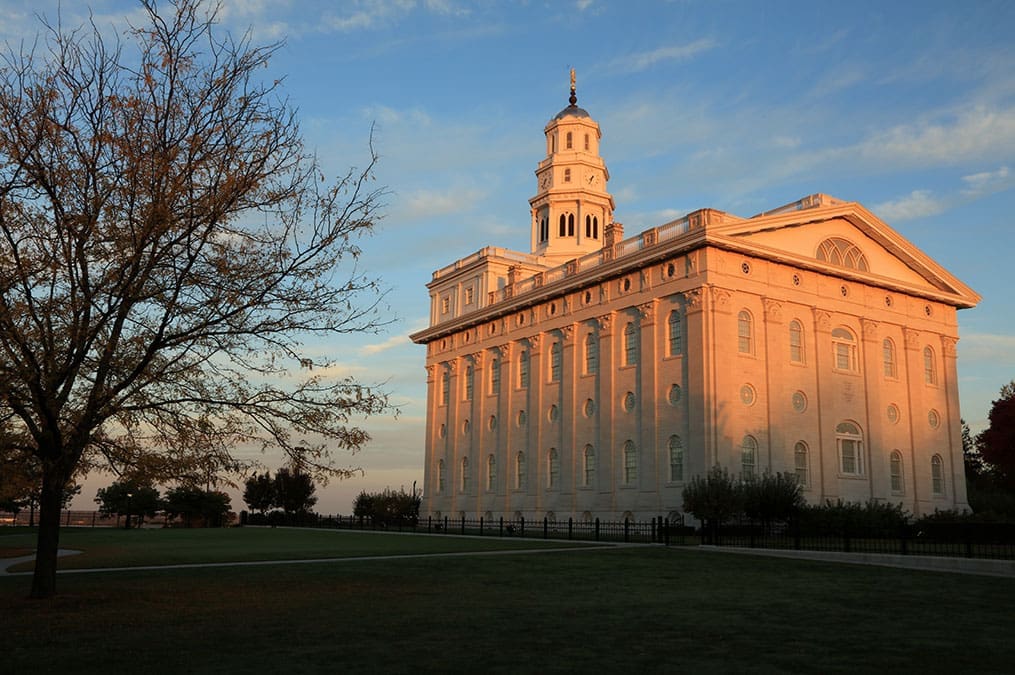 How can we ever forget that breathtaking announcement on April 4, 1999 that the Nauvoo Temple would be rebuilt?
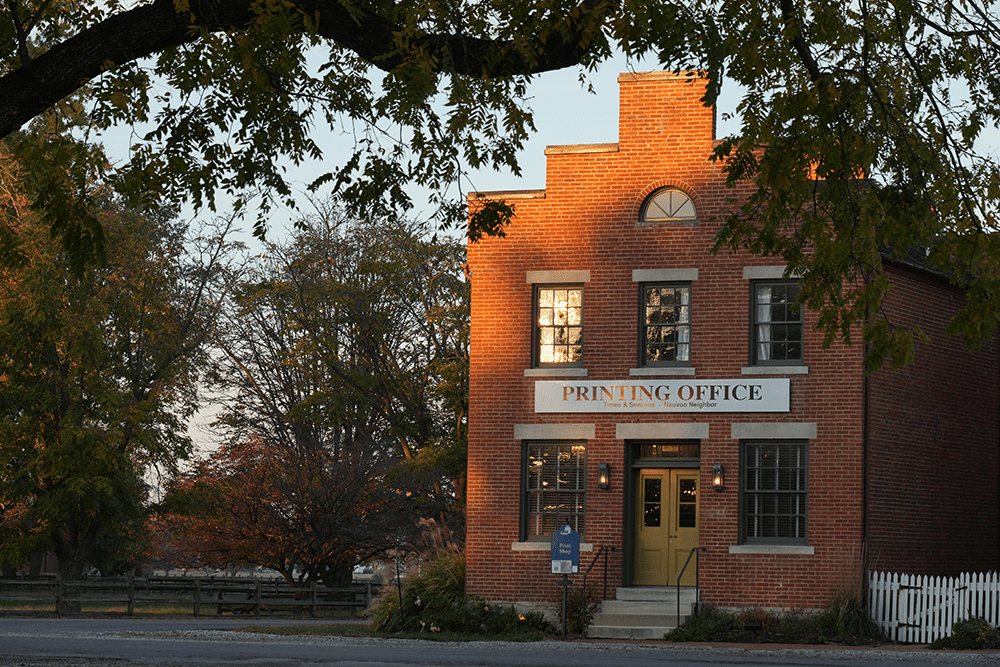
This morning we step back in time and spend a glorious day touring the sites of Old Nauvoo—beginning with a session (either initiatory, sealing or endowment depending on availability and scheduling) in the stunning Nauvoo Temple. Today we’ll hear stories of the past and get a feel for “the City of Joseph”. We will see the moving Relief Society Gardens where thirteen monuments to women will touch your soul. We will tour Brigham Young’s home (recently renovated and redone), the Printing Complex, the Blacksmith Shop, the Seventies Hall, the Browning Gunsmith Shop and Home and as many other places as we can squeeze in—including the brand new Nauvoo Temple Visitors’ Center. You may receive a Nauvoo brick today as a souvenir from Nauvoo.
Tonight we will dine at the old Nauvoo Hotel (depending on their business situation–or some other nearby dining experience) with their wonderful all-you-can eat dinner buffet. Don’t miss their amazing cinnamon buns! (Meals: B, D)
Day 14 – Sunday, September 27, 2026
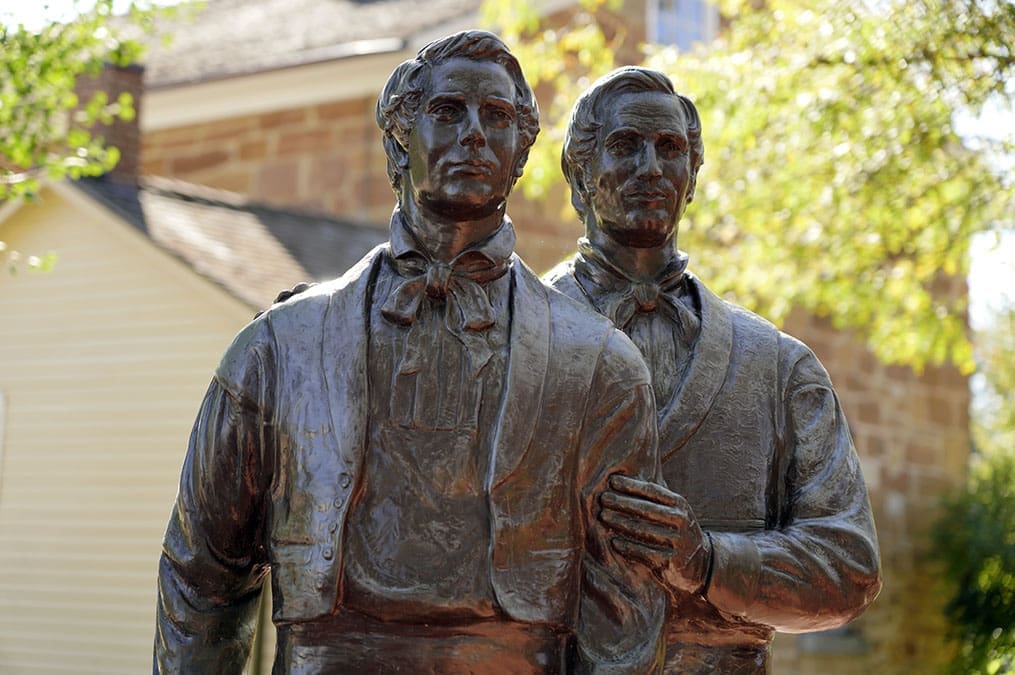
By the end of two weeks you will feel a deep love for Joseph and Hyrum.
We will attend the earliest Sacrament Meeting in the Nauvoo Ward and then tour more of Nauvoo. This afternoon we travel south and east to our final stop: The Carthage Jail. Here you will have one of the highlight experiences of the trip as we review the events of the Carthage Jail and talk about our feelings for Joseph and Hyrum. We end the tour with a group testimony meeting in Nauvoo at our hotel. (Meals: B, L)
Day 15 – Monday, September 28, 2026
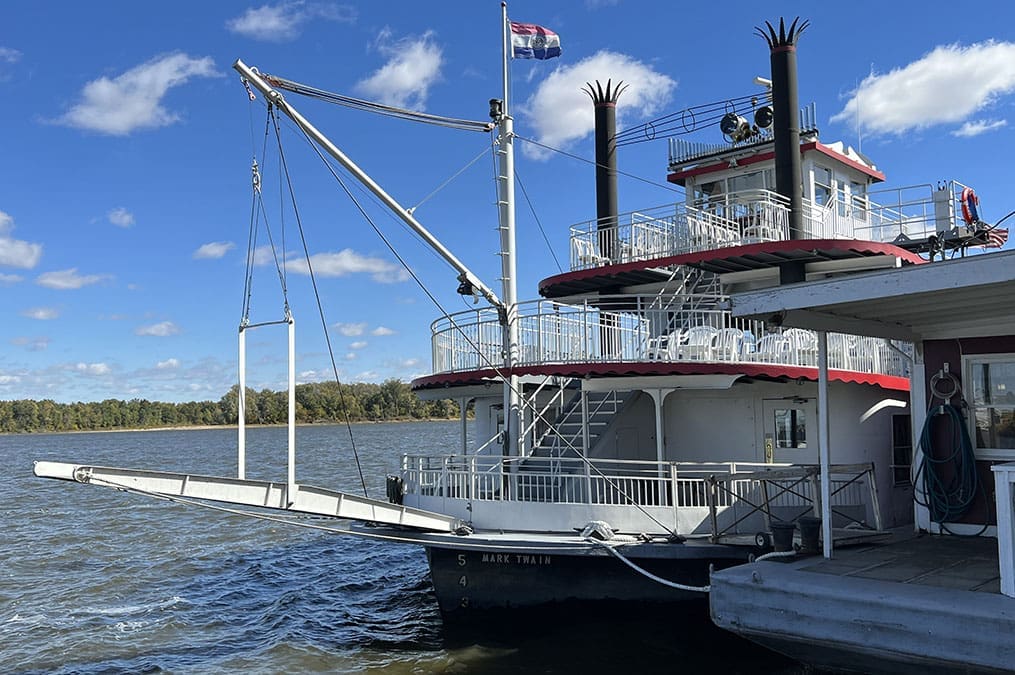
We will have a wonderful Mississippi River boat ride/lunch cruise at Hannibal, Missour–Mark Twain’s home town.
As we say our farewells to Nauvoo this morning, we continue on to Mark Twain’s Hannibal on the Mississippi River where we’ll take a special luncheon cruise on a riverboat hosted by a charming family who really take pride in this experience and make you feel so welcome. You’ll delight in hearing the stories and folklore of this mighty river. Following this special lunch, we’ll immediately head to St. Louis with a brief stopover in Historic St. Charles, Missouri, the beginning of the Lewis and Clark Expedition, May 14, 1804. It’s only a tease but you will love your approximately one hour of walking these 18th and 19th century streets and maybe get an ice cream cone (only homemade) at Kilwin’s.
Now we sadly head to our evening flights home (only about 15 minutes from St. Charles). Farewell dear friends! (B, L)
Tour Cost Per Person includes hotels, deluxe motor coach, flight from Cleveland, Ohio to Kansas City, Missouri, entrance fees, taxes & gratuities, luggage handling, daily breakfast and dinner, and a Mississippi Riverboat cruise.
Credit Card price:
- Double Occupancy $4,479 per person.
- Ask Sarah about Single or Triple occupancy pricing.
Round trip airfare from home cities is not included, but may be booked with the group or secured on an individual basis (you are welcome to use frequent flyer miles).
Please call our agent, Sarah Wangsgard, at Morris Murdock Travel direct to her office at: 801-483-6473.
Please note again: This tour will sell out; if you would like to go right online and book it yourself, PLEASE CLICK HERE. When you get to that page, scroll down to where it says BOOK NOW and then set up your account and take care of it.
A deposit of $250.00 per person is necessary to hold space. Payment arrangements can be made with final payment due 60 days prior to the tour. Cancellation insurance is available and is always recommended.
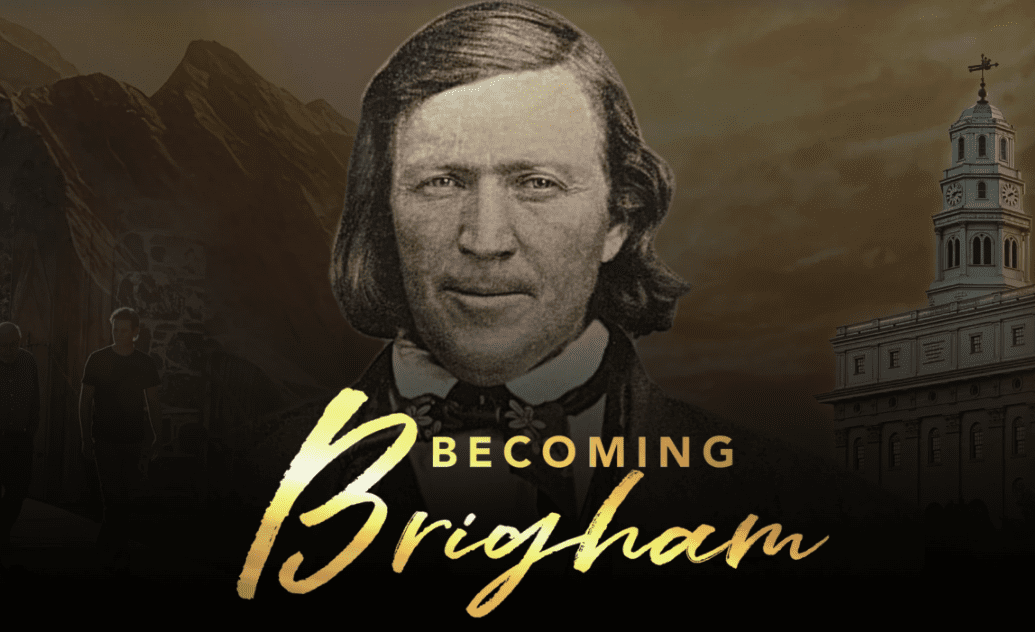
Becoming Brigham, Episode 13 — In spite of differences, what did Brigham Young and Emma Smith have in common deep in their souls?
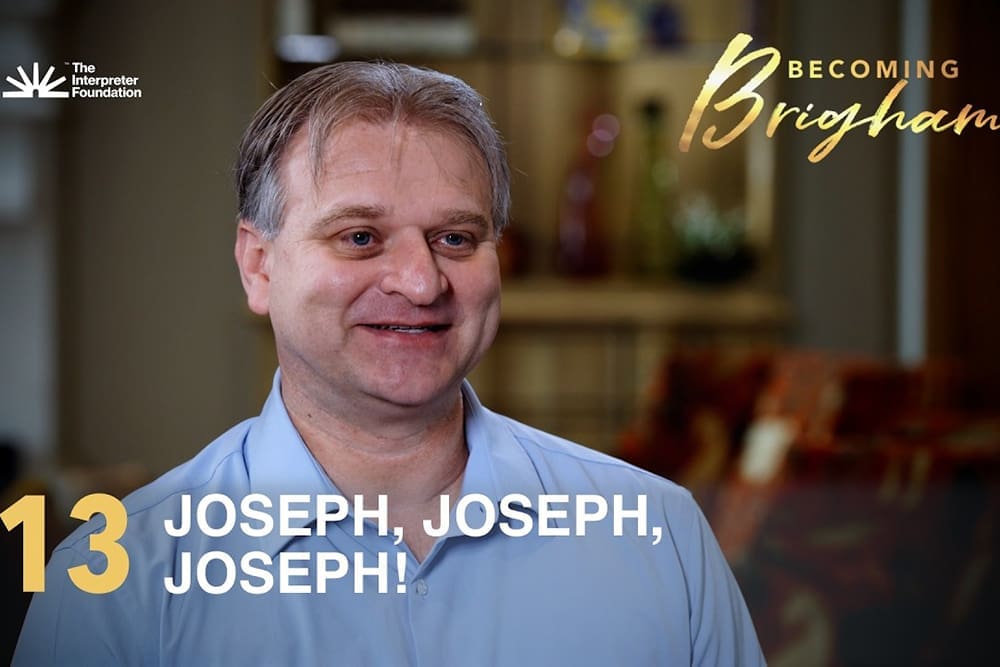
In this episode the hosts explore the final days of Joseph Smith’s life and how those events shaped both Emma Smith and Brigham Young. The episode also examines the decisions Brigham Young and the Twelve made after the martyrdom. With mobs threatening Nauvoo, the brethren chose to focus on finishing the temple while preparing to go west. John Wilson interviews Church historian Dr. Gerrit Dirkmaat who contrasts Joseph Smith’s passionate, dramatic personality and conversion experiences with Brigham Young’s more gradual, deliberate path to faith, and points out that once Brigham was converted, he never looked back.
The Tragedy of Nauvoo: Remembering the Lost City of the Latter-day Saints
Because of my involvement with the Interpreter Foundation’s new series of mini-documentaries, “Becoming Brigham,” which launched on Monday, 26 January, and which will continue releasing weekly episodes into 2027 (see becomingbrigham.com), I’ve spent several days in and around Nauvoo, Illinois, on each of perhaps five different occasions within roughly the past year. That’s more times than I had visited the town in all of my previous life.
I’ve seen Nauvoo in various seasons, from various angles, spending time in many of its original and reconstructed buildings. I’ve spoken on camera and I’ve reflected silently in Carthage Jail. I’ve stood at the graves of Joseph and Emma and Hyrum Smith.

Perhaps because of this, I’ve come to appreciate more deeply than ever before the tragedy of Nauvoo. I find myself thinking of the lament of the biblical Psalmist, carried away from Jerusalem and its temple into Babylonian captivity:
“By the rivers of Babylon, there we sat down, yea, we wept, when we remembered Zion.
“We hanged our harps upon the willows in the midst thereof.
“For there they that carried us away captive required of us a song; and they that wasted us required of us mirth, saying, Sing us one of the songs of Zion.
“How shall we sing the Lord’s song in a strange land?
“If I forget thee, O Jerusalem, let my right hand forget her cunning.
“If I do not remember thee, let my tongue cleave to the roof of my mouth; if I prefer not Jerusalem above my chief joy.” (Psalm 137:1-6)
Colonel Thomas Kane, a friendly and well-positioned outsider who would become a lifelong friend of the Latter-day Saints, visited the city after the pioneer companies had left. He arrived in September 1846 just after the “Battle of Nauvoo” (10-12 September 1846), when the last remaining sick and destitute members had been driven out. (For many, this wasn’t their first exile.) Later, he wrote an evocative description of what he saw:
“Half encircled by a bend of the river, a beautiful city lay glittering in the fresh morning sun; its bright new dwellings, set in cool green gardens, ranging up around a stately dome-shaped hill, which was crowned by a noble edifice, whose high tapering spire was radiant with white and gold. The city appeared to cover several miles, and beyond it, in the background, there rolled off a fair country, chequered by the careful lines of fruitful husbandry. The un-mistakeable marks of industry, enterprise, and educated wealth everywhere, made the scene one of singular and most striking beauty. It was a natural impulse to visit this inviting region. I procured a skiff, and rowing across the river, landed at the chief wharf of the city. No one met me there. I looked, and saw no one. I could hear no one move, though the quiet everywhere was such that I heard the flies buzz, and the water-ripples break against the shallow of the beach. I walked through the solitary street. The town lay as in a dream, under some deadening spell of loneliness, from which I almost feared to wake it, for plainly it had not slept long. There was no grass growing up in the paved ways; rains had not entirely washed away the prints of dusty footsteps.

“Yet I went about unchecked. I went into empty workshops, rope-walks and smithies. The spinner’s wheel was idle; the carpenter had gone from his work-bench and shavings, his unfinished sash and casing. Fresh bark was in the tanner’s vat, and the fresh-chopped lightwood stood piled against the baker’s oven. The blacksmith’s shop was cold; but his coal heap and lading pool, and crooked water horn were all there, as if he had just gone off for a holiday. No work-people anywhere looked to know my errand.
“If I went into the gardens, clinking the wicket-latch loudly after me, to pull the marigolds, heartsease, and lady-slippers, and draw a drink with the water-sodden well-bucket and its noisy chain; or, knocking off with my stick the tall, heavy-headed dahlias and sunflowers, hunted over the beds for cucumbers and love-apples—no one called out to me from any opened window, or dog sprang forward to bark an alarm.
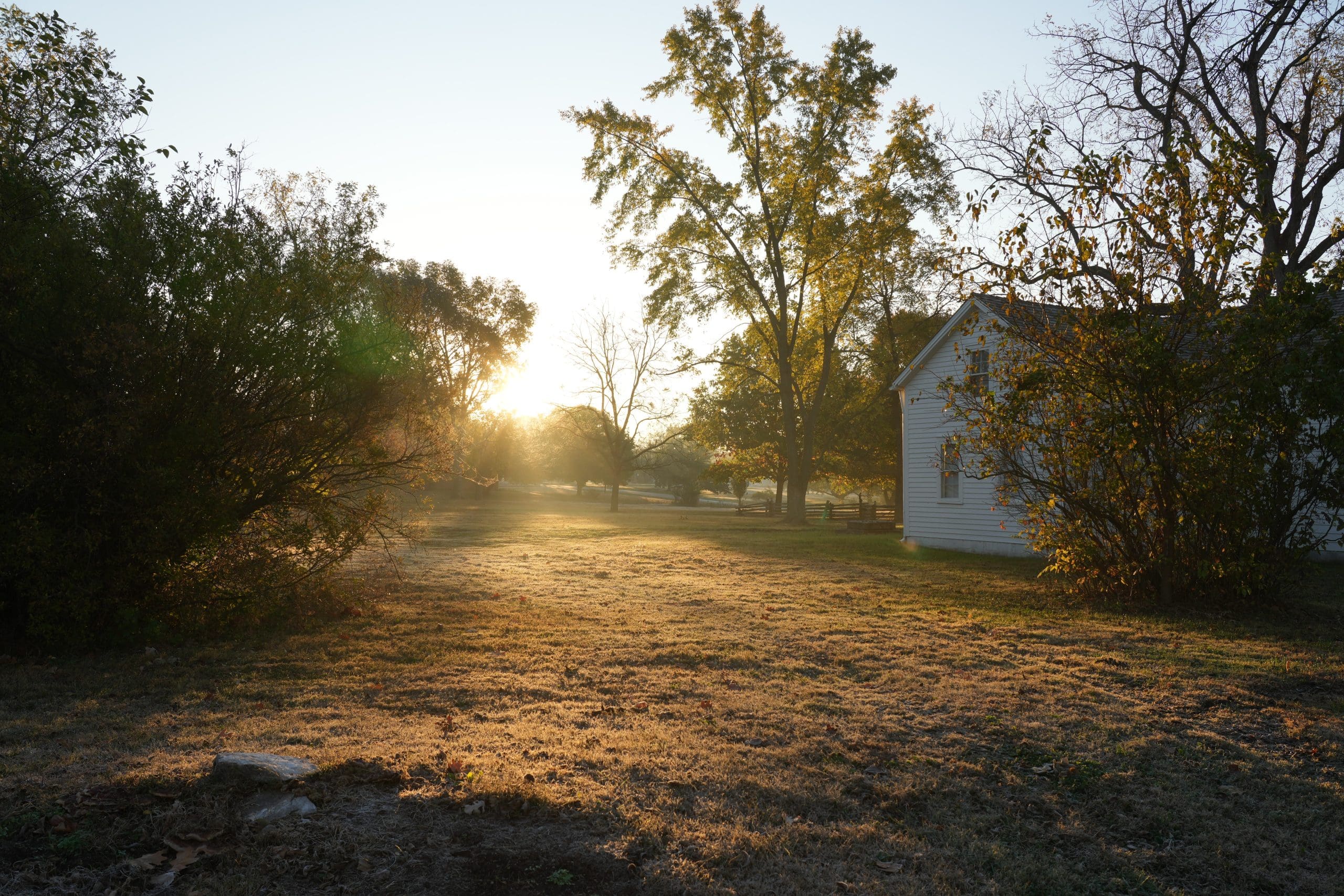
“I could have supposed the people hidden in the houses, but the doors were unfastened; and when at last I timidly entered them, I found dead ashes white upon the hearths, and had to tread a tip-toe, as if walking down the aisle of a country church, to avoid rousing irreverent echoes from the naked floors. On the outskirts of the town was the city graveyard; but there was no record of plague there, nor did it in anywise differ much from other Protestant American cemeteries. Some of the mounds were not long sodded; some of the stones were newly set, their dates recent, and their black inscriptions glossy in the mason’s hardly dried lettering ink. Beyond the graveyard, out in the fields, I saw, in one spot hard by where the fruited boughs of a young orchard had been roughly torn down, the still smouldering remains of a barbecue fire, that had been constructed of rails from the fencing around it. It was the latest sign of life there. Fields upon fields of heavy-headed yellow grain lay rotting un-gathered upon the ground. No one was there to take in their rich harvest.

“As far as the eye could reach they stretched away—they sleeping, too, in the hazy air of autumn. Only two portions of the city seemed to suggest the import of this mysterious solitude. On the southern suburb, the houses looking out upon the country showed, by their splintered wood-work and walls battered to the foundation, that they had lately been the mark of a destructive cannonade. And in and around the splendid Temple, which had been the chief object of my admiration, armed men were barracked, surrounded by their stacks of musketry and pieces of heavy ordnance. These challenged me to render an account of myself, and why I had had the temerity to cross the water without written permit from a leader of their band. . . . Though these men were generally more or less under the influence of ardent spirits.”
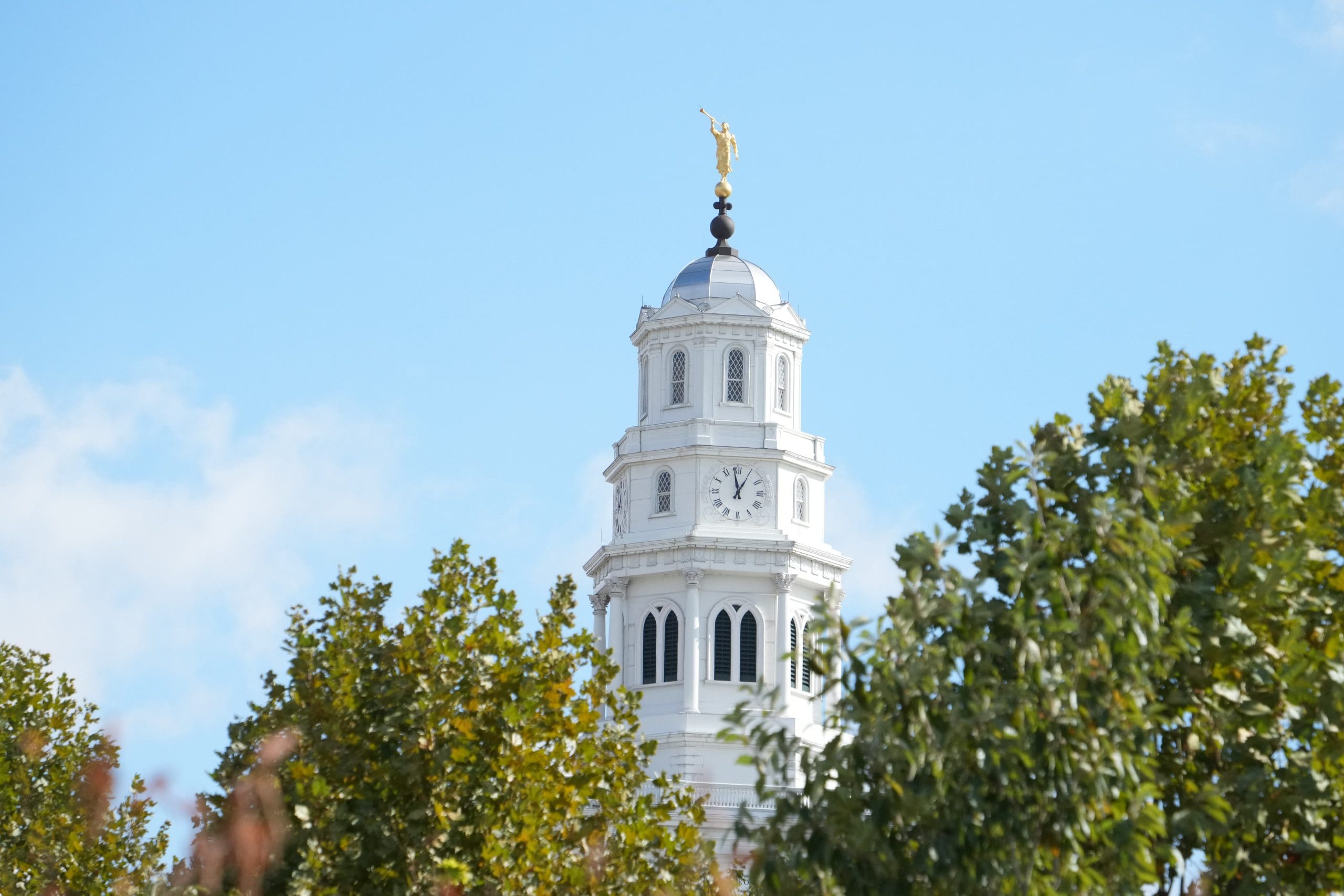
Brigham Young was centrally involved in completing the Nauvoo Temple despite intense persecution and internal turmoil, as well as in directing and administering its ordinances even while the Saints began their exodus westward toward the Great Basin—which also took place under his direction. After the departure of the Saints, the temple was vandalized, desecrated, and defaced. A fire set by an arsonist in 1848 destroyed its interior, leaving only an empty shell standing until, on 27 May 1850, a tornado hit the structure. According to Henry Horner’s 1939 Illinois: A Descriptive and Historical Guide, one source claimed that the storm seemed to “single out the Temple,” destroying “the walls with a roar that was heard miles away.”
Responding to news of the temple’s destruction, Brigham responded, “I would rather it should thus be destroyed than remain in the hands of the wicked.”
But the exiled Israelites who lamented “by the rivers of Babylon” eventually returned and, after a further and still-lengthier exile, many of their descendants live once more in the land of Israel, with Jerusalem as its capital. Indeed, exile and return, gathering and scattering and regathering, are major recurrent themes of the Hebrew Bible, the Old Testament, and of the Gospel in all its ages. The elements will melt with fervent heat and the heavens will be rolled up like a scroll but, in the end, the earth will be restored and receive its paradisiacal glory. We will lie down in death, but we will rise again.
In its humble and, in a certain sense, mundane way—a matter of bricks, boards, and stone—Nauvoo illustrates the Gospel’s promise of rebirth, of victory over death and defeat. Today, scores of senior missionaries serve in the rebuilt Nauvoo Illinois Temple and explain the brief but deeply significant history of the nineteenth-century Latter-day Saint city to visiting Latter-day Saints and curious nonmembers alike.
I myself have been able to serve and to worship in the temple here—something that, in my first several decades, I could never have predicted. I’ve thought of the Saints who went into exile from Nauvoo while taking one last look at it across the Mississippi River and who then learned of its desecration by drunken mobs, the destruction of its interior by arson, and, finally, its leveling by a tornado. I’ve wondered what those refugees would have made of the fact that it now stands again, fully finished this time, and fully dedicated for the first time, on the bluff overlooking the river. At night, it glows with a light that they, in their pre-electric era, could never have imagined.
I’ve seen what was left of the tavern in Warsaw where Thomas Sharp, the fiercely anti-Mormon editor of the Warsaw Signal, and his associates plotted the assassination of Joseph and Hyrum. I’ve seen the house where he lived.
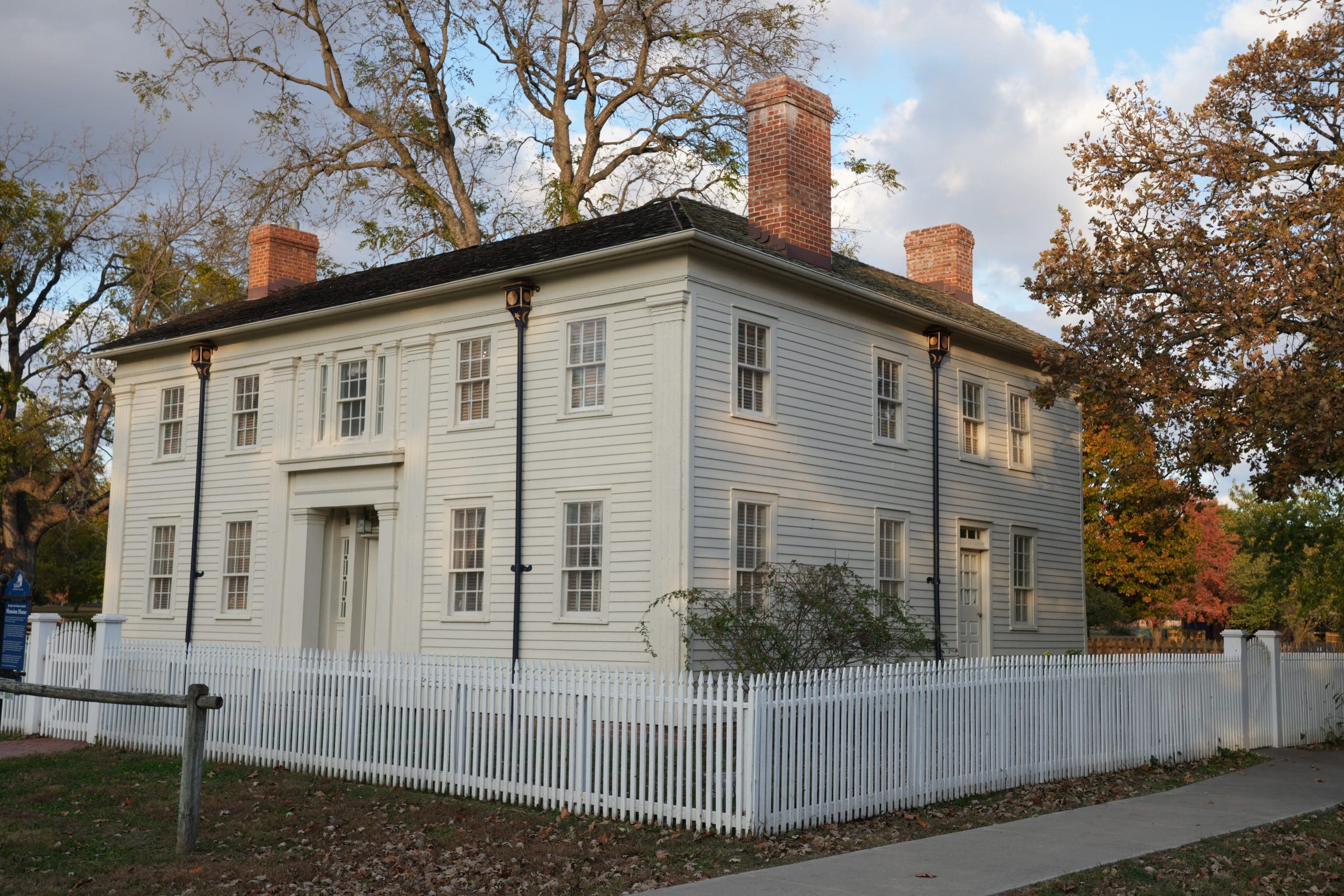
What, I’ve wondered, would Tom Sharp make of that temple on the hill, and of the return of the Latter-day Saints to Nauvoo and surrounding areas? What would he think of the fact that, as I’m told, a Latter-day Saint has restored his home and now occupies it? Would he be surprised to learn that, to the extent that he’s remembered today at all, it’s largely as a footnote to the story of Joseph and Hyrum Smith? Would he and the mobs that he helped to incite be astonished to learn that the Church of Jesus Christ of Latter-day Saints now owns Carthage Jail, in which Joseph and Hyrum were martyred, maintaining it as, in a very real sense, a shrine to their memory? I freely confess that I’m unchristian enough to hope that Sharp and his allies are aware of the return of the Latter-day Saints to Hancock County.
Could early members of the Church have foreseen that the properties that they were forced to abandon would ever be reacquired and restored? That, one day, tens of thousands of their fellow Latter-day Saints would come each year to visit Nauvoo, with reverence but also with smiles? That, to a large extent, it is pilgrims from far away, even from overseas, who patronize the city’s temple? Arriving in vehicles that would have been inconceivable to the wagon trains and handcart companies of the 1840s and 1850s? That, thanks to modern technology, many Saints living thousands of miles away, in places of which those early members could scarcely dream, are able to take “virtual tours” of the homes in which the first Latter-day Saints lived and of the streets that they walked?
“Generations yet unborn,” Joseph Smith prophesied in 1842, “will dwell with peculiar delight upon the scenes that we have passed through, the privations that we have endured; the untiring zeal that we have manifested; the insurmountable difficulties that we have overcome in laying the foundation of a work that brought about the glory and blessings which they will realize.”
And his prophecy has been fulfilled. In all of which, it seems to me, there are obvious lessons to be learned. One of them is that, even in the wreckage of our earthly hopes, when all seems irretrievably lost, there is still hope. The great illustration of this truth, of course, is the resurrection of Jesus Christ, which shows us that not even death is final.
“And God shall wipe away all tears from their eyes; and there shall be no more death, neither sorrow, nor crying, neither shall there be any more pain: for the former things are passed away. (Revelation 21:4)
“Weeping may endure for a night,” says Psalm 30:5, “but joy cometh in the morning.”
“And as for the perils which I am called to pass through,” wrote the Prophet Joseph Smith, from hiding, about a year and a half before his martyrdom, “they seem but a small thing to me, as the envy and wrath of man have been my common lot all the days of my life; and for what cause it seems mysterious, unless I was ordained from before the foundation of the world for some good end, or bad, as you may choose to call it. Judge ye for yourselves. God knoweth all these things, whether it be good or bad. But nevertheless, deep water is what I am wont to swim in. It all has become a second nature to me; and I feel, like Paul, to glory in tribulation; for to this day has the God of my fathers delivered me out of them all, and will deliver me from henceforth; for behold, and lo, I shall triumph over all my enemies, for the Lord God hath spoken it. (Doctrine and Covenants 127:2).
And then he was killed, with his brother. So where was his triumph? Let his mother, Lucy Mack Smith, have the last word here:
“After the [bodies of Joseph and Hyrum] were washed and dressed in their burial clothes, we were allowed to see them. I had for a long time braced every nerve, roused every energy of my soul and called upon God to strengthen me, but when I entered the room … , it was too much; I sank back, crying to the Lord in the agony of my soul, “My God, my God, why hast thou forsaken this family!” A voice replied, “I have taken them to myself, that they might have rest.”
“As I looked upon their peaceful, smiling countenances, I seemed almost to hear them say, “Mother, weep not for us, we have overcome the world by love; we carried to them the gospel, that their souls might be saved; they slew us for our testimony, and thus placed us beyond their power; their ascendancy is for a moment, ours is an eternal triumph.”
**
Watch the episodes of “Becoming Brigham” at becomingbrigham.com. Two quite different settings of Psalm 137 are Don McLean’s round (https://www.youtube.com/watch?v=uTnspbSjKVc) and Linda Ronstadt’s bluegrass version of a reggae tune (https://www.youtube.com/watch?v=u60fXbTsMDg).
Becoming Brigham, Episode 5: Why Brigham Young? Part Two
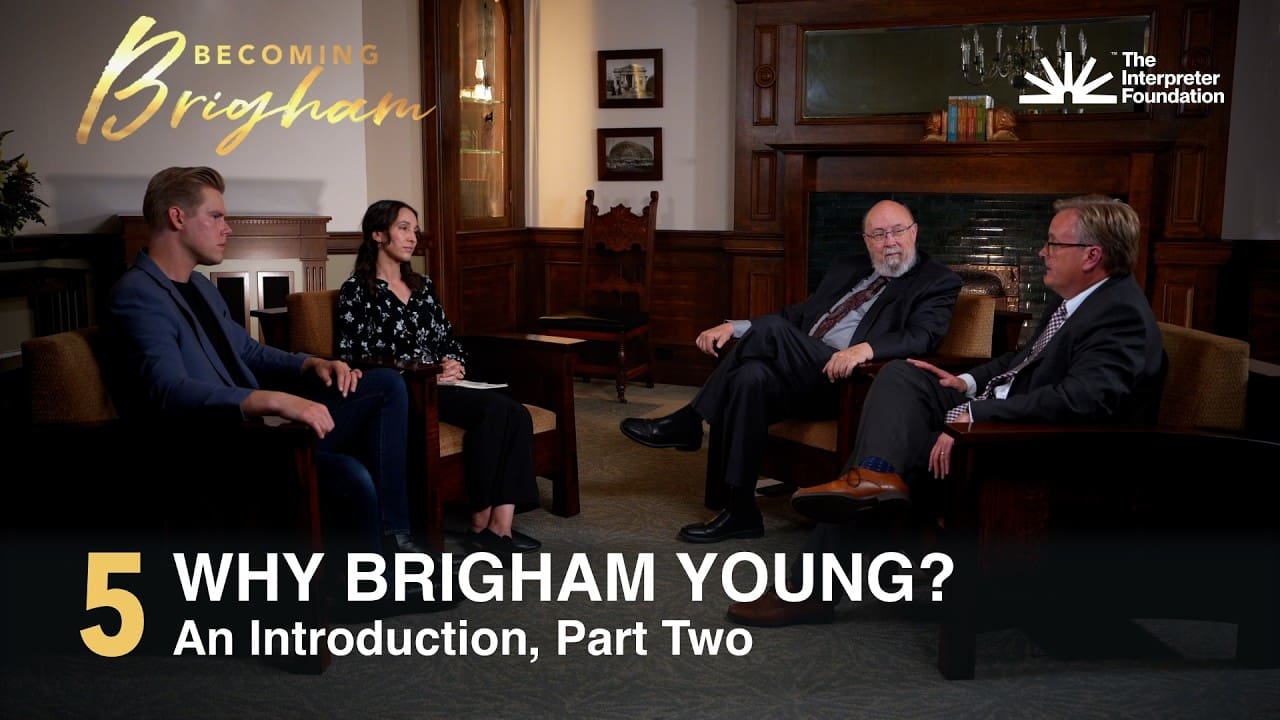
Our hosts continue their discussion with Matt Grow, managing director of the Church History Department. Was Brigham a man of violence? He did use inflammatory rhetoric at times. But interestingly the actual evidence points toward his being a man of peace. And what do we know about whether or not Brigham Young was a racist?
Becoming Brigham: The Video Series Premieres

For well over a year now, Redbrick Filmworks and the Interpreter Foundation have been working on a series of mini-documentaries bearing the title “Becoming Brigham.” The first episode goes live today, Monday, 26 January, at noon. (And one of the places where it will be accessible is right here at “Meridian Magazine.”). Further installments will appear on successive Mondays. Each episode—of which there will eventually be about 70 or 75—will run approximately fifteen minutes.
They’re hosted by Camrey Bagley Fox, who portrayed Emma Smith in the Interpreter Foundation’s 2021 dramatic film “Witnesses” and its 2024 film “Six Days in August”; by John Donovan Wilson, who played Brigham Young in the latter film; and by a retired Brigham Young University professor of Islamic studies and Arabic who shall remain nameless lest potential audiences be dissuaded from watching. Each episode features footage shot on location in New York, Ohio, Illinois, Iowa, Nebraska, and Utah, as well as extensive interviews with numerous Latter-day Saint historians who are experts on the subjects being discussed.
In fact, one of the most pleasant aspects of the project has been the wonderful support that it’s received from the Church History Department in Salt Lake City and from the overseers of the historical sites where filming has been done. The creators of “Becoming Brigham” have worked closely with Brent Rogers,
Managing Historian of the Church History Department, and have thus far completed interviews with such scholars as Thomas G. Alexander, James B. Allen, Susan Easton Black, LaJean Carruth, Gerrit Dirkmaat, Brett Dowdle, Ron Esplin, Matt Godfrey, Casey Griffiths, Brittany Chapman Nash, Reid Neilson, John Peterson, Paul Reeve, and Lisa Olsen Tait.
What’s behind the project? A significant factor behind it comes from my disappointment, over the past two or three years, at encountering active members of the Church of Jesus Christ of Latter-day Saints who disparage Brigham Young, the Church’s second president.
Some seem compelled to open any discussion of Brigham by describing him as “flawed.” And in an important sense, of course, this is surely true: Jesus Christ excepted, we’re all flawed—including Brigham’s critics. He certainly didn’t claim perfection for himself. “There are weaknesses manifested in men that I am bound to forgive,” he said on one occasion in 1860. “I am right there myself. I am liable to mistakes,” he continued, acknowledging that he was just as set in his feelings as any man alive, but, he said, “I am where I can see the light. I try to keep in the light.”
Often, the clear insinuation of describing Brigham as flawed seems to be that he was somehow uniquely flawed. Trying to reassure me that, despite his imperfections, they still accept him as the Lord’s instrument in his day, some people have explained to me that, well, God can work through wicked men. But I object to such statements. While he surely had his limitations and his flaws, Brigham Young wasn’t a wicked man. He was a good man.
Some go beyond merely talking him down. There are those who say that Brigham Young and the Quorum of the Twelve engineered an “apostolic coup” to usurp leadership of the Church. One active Church member told me that Sidney Rigdon should have assumed the presidency (or, as Sidney liked to call it, the “guardianship”) instead, but was tragically cast aside by the machinations of Brigham and the apostles. A few former members even assert that it was Brigham Young, using John Taylor and Willard Richards as his “hit men,” who planned the death of Joseph and Hyrum Smith at Carthage Jail—perhaps so they could forge Doctrine and Covenants 132 and impose plural marriage upon the Church. This would be mere laughable nonsense—no serious historian of whom I’m aware accepts it—if it weren’t so repugnant, slanderous, and evil. (The mob and the Carthage Greys must have been surprised and baffled when, having arrived to murder Joseph and Hyrum, they found that Elders Taylor and Richards had already done the killing. But they kept the secret throughout their lives, even when some of them were on trial for the crime. Amazing? No, ludicrous.)
The real historical Brigham Young was the last man who would ever have raised his hand against Joseph Smith. He was absolutely dedicated to the Prophet, both before and after the martyrdom in 1844.
An important scene in the Interpreter Foundation’s 2024 feature film “Six Days in August,” solidly rooted in history, beautifully illustrates his dedication. It depicts Brigham and Heber and others traveling secretly to Far West, Missouri, in obedience to Doctrine and Covenants 115:11 and 118:5, which directed them to depart for their mission to England from the temple site there on 26 April 1839. Such direction made perfect sense when the Saints were still located in Missouri. On 27 October 1838, however, Missouri’s governor, Lilburn W. Boggs, had issued his infamous “extermination order” against the Latter-day Saints and, by April 1839, the Church was gathering to western Illinois. Thus, returning to Far West for a departure to England made little earthly sense—it was in the wrong direction, for one thing—and, in fact, being there as a Latter-day Saint was extraordinarily dangerous. For Brigham and Heber and their companions, though, if Joseph Smith said to depart from Far West, they would do it.
In the early days of the Church, many once-faithful Saints fell away because they would no longer sustain Joseph as the Lord’s anointed prophet. In fact, Joseph said of the leaders in Kirtland that there were only two who had never “lifted their heel” against him—”namely Brigham Young and Heber C. Kimball.” (Heber C. Kimball, of course, was Brigham’s closest friend, even before their joining the Church, and eventually served as Brigham’s first counselor in the Church’s First Presidency.)
Another famous story illustrates Brigham’s deference to the Prophet Joseph. On one occasion, Joseph severely rebuked Brigham—who, you may recall, eventually came (for good reason) to be known as “the Lion of the Lord.” After the Prophet’s chastisement, everyone in the room waited for Brigham’s response, perhaps expecting an eruption. But his reply was, sincerely and simply, “Joseph, what do you want me to do?”
“I felt in those days,” Brigham later recalled of the time before he encountered the Book of Mormon and the Church, “that if I could see the face of a prophet, such as had lived on the earth in former times, a man that had revelations, to whom the heavens were opened, who knew God and his character, I would freely circumscribe the earth on my hands and knees.” And, in Joseph, he knew that he had found such a man.
“I know how I received the knowledge that I have got,” Brigham reflected in 1866. Remembering his early years with Joseph, he said “I had but one prayer, and I offered that all the time. And that was that I might be permitted to hear Joseph speak on doctrine, and see his mind reach out untrammeled to grasp the deep things of God.” Of his own relationship to Joseph, Brigham said that “an angel never watched him closer” and that he “would constantly watch him and if possible learn doctrine and principle beyond that which he expressed.” It required several years of this close attention to the Prophet, he declared with a bit of exaggeration, “before I pretended to open my mouth to speak at all.” Brigham Young took care never to “let an opportunity pass of getting with the Prophet Joseph and of hearing him speak in public or in private, so that I might draw understanding from the fountain from which he spoke.” “This,” he insisted, “is the secret of the success of your humble servant.”
Brigham Young often spoke of Joseph and his work: “I honor and revere the name of Joseph Smith,” he said in 1870. “I delight to hear it; I love it. I love his doctrine.” “I feel like shouting hallelujah, all the time,” he said in 1855, “when I think that I ever knew Joseph Smith, the Prophet whom the Lord raised up and ordained.” “I am bold to say,” he testified in 1862, “that, Jesus Christ excepted, no better man ever lived or does live upon this earth. I am his witness.”
On his deathbed, according to reports, the last words uttered by Brigham Young were “Joseph! Joseph! Joseph! Joseph!” If this is true, it wouldn’t surprise me to learn that the Prophet personally came to welcome his great successor and faithful disciple into the next world. Intriguingly, in this context, it’s reported that Emma Smith’s last words, spoken in Nauvoo on 30 April 1879, were, “Joseph! Joseph! Joseph!” and “Joseph, I am coming!” Just days before her death, she said that she had seen him in a dream, along with their deceased son Don Carlos and the Savior. Joseph, she said, took her to a beautiful mansion and promised her that she would have all of her children in the world to come.
One of the themes that have emerged from the making of “Becoming Brigham” is that, as the historian Ronald K. Esplin says in an interview for the series, among all the claimants to Church leadership who emerged after the murders of Joseph and Hyrum in mid-1844, it was only Brigham and the Twelve who wanted to carry out the full program and carry on the teachings that Joseph had laid out in Nauvoo. Prominent elements of Joseph’s agenda were the completion of the temple and, somewhat paradoxically, forsaking it for the Great Basin West. No other claimant to the succession—including Sidney Rigdon—was so committed to moving forward with those goals. And (no small point!) it was with the Twelve that the keys of priesthood authority resided after the deaths of Joseph and Hyrum.
On 8 August 1844, in the dark days following the martyrdom of the Prophet and the Patriarch, Brigham made this clear to the Saints, “You cannot appoint a prophet,” he said, “but if you let the Twelve remain and act in their place, the keys of the kingdom are with them and they can manage the affairs of the church and direct all things aright.”
Brigham Young and his fellow apostles understood the importance of completing the Nauvoo Temple, as many other would-be leaders (including, apparently, Sidney Rigdon) did not. But it wasn’t only a legacy project for them, an inheritance from their departed friend, Joseph Smith. And the challenges and threats from enemies of the Saints continued, while the pressure on them mounted to abandon Nauvoo and to leave. As the chief apostle, Brigham sought and received revelation. Having inquired of the Lord whether they should stay and finish the temple, he recorded simply in his diary for 24 January 1845: “The answer was we should.”
As President James E. Faust observed, Brigham Young had unwavering confidence in what he was doing because he knew that the plan was not his own. As he told the Saints nearly a decade after their arrival in the Valley of the Great Salt Lake, “I did not devise the great scheme of the Lord’s opening the way to send this people to these mountains.” Well then, who did? “It was the power of God that wrought out salvation for this people,” he insisted. “I never could have devised such a plan.” As one nineteenth-century non-Latter-day Saint visitor to his office recorded (and as others also noted), Brigham had remarkable self-confidence and “absolute certainty of himself and his own opinions.”
“Becoming Brigham” is an attempt to portray Brigham’s earliest encounter with the Restoration, his conversion, his training as an apostle for eventual leadership of the Church, the rise of the Twelve from their initial role as an outwardly-oriented missionary quorum to their eventual leadership of the overall Church. It will discuss Brigham Young’s presidency of the Church, including unvarnished examinations of controversial issues such as violence in Utah Territory (e.g., the notorious Mountain Meadows Massacre), race and slavery, relations with Native Americans, and plural marriage.
It relies upon the best available research concerning Brigham Young and the Twelve to provide a picture of the man that differs from the image in many minds. When I was growing up, I knew of Brigham as the great colonizer, a practical man, an organizational genius. But there was much more to him than that. As the late historian D. Michael Quinn pointed out, “One of the recurring themes in non-Mormon biographies of President Brigham Young is the idea that he was not a very spiritual man. Such interpretations, however, not only misrepresent his character, they also totally disregard the evidence, both published and unpublished, that refutes such a stereotype.”
Nor is the image of Brigham as harsh, callous, and autocratic true to the historical record. “Those of us who have worked with Brigham Young’s words,” says LaJean Carruth in an interview for “Becoming Brigham,” “we see a completely different man, a kinder man. A caring man. A loving man. . . . He wanted to serve God, and he strove with everything he had to lead the Saints.”
“I came to know a man,” says Ron Esplin, “whose heart was with the Lord from the very beginning. . . . He believed in Jesus. He believed enough to follow a disciple of Jesus named Joseph Smith.” As Lisa Olsen Tait puts it, “I do think that Brigham Young, fundamentally at the core of his soul, wanted people to flourish . . . and the way that would happen was by embracing the gospel of Jesus Christ . . . . I kind of like Brigham Young, actually. I think he’s very down-to-earth. I think he’s very human.” “And the people who knew these people best,” says Gerrit Dirkmaat, “like the people who knew Joseph, the people who knew Brigham, well, they’re the ones who are certain that they’re prophets.”
Members of the Church of Jesus Christ of Latter-day Saints today who disparage Brigham Young’s character and divinely-ordained leadership, whether they realize it or not, are sawing away at the branch of the tree on which they themselves sit, the line through which modern priesthood authority and temple ordinances come.
Modern prophets and apostles know better: President Gordon B. Hinckley, for example, kept a portrait of Brigham directly behind his desk, finding strength and inspiration in contemplating it. He often referred to the portrait, commenting that Brigham seemed to “watch over” the work of the Church.
But those who disdain Brigham Young aren’t wrong because accepting their opinions would have bad implications for the Church. They’re wrong because they’re wrong.
**
Several of the quotations used above may be found, with supporting references, in an excellent speech by President James E. Faust, entitled “Brigham Young: A Bold Prophet” (https://speeches.byu.edu/talks/james-e-faust/brigham-young-bold-prophet/).
When the American Elite Visited Joseph Smith in Nauvoo
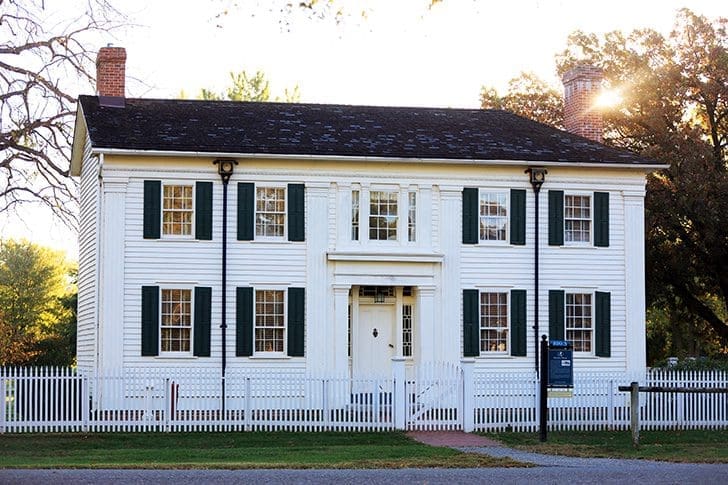
In May of 1844, just 45 days before Joseph Smith would be murdered in Carthage Jail, two imposing visitors arrived in Nauvoo just before midnight. They were Josiah Quincy and Charles Francis Adams from Massachusetts, both American bluebloods, born of powerful families. Adams was the grandson of John Adams and son of former president John Quincy Adams who would one day become a member of Congress and then American ambassador to England. Quincy’s father had been the mayor of Boston and the president of Harvard, and he too would become the mayor of Boston.
According to Spencer McBride’s new book Joseph Smith for President, these two had set out on a grand tour of the western United States, and on May 13th had boarded the steamboat Amaranth to travel north on the Mississippi River. They had no intent to stop in Nauvoo, but a fellow passenger, Dr. William Goforth, persuaded them that “much was good and interesting about this strange people” and, according to Quincy, “urged us to see for ourselves the result of the singular political system which had been fastened upon Christianity, and to make the acquaintance of his friend General Smith, the religious and civil autocrat of the community.”
Their steamer stopped at the Nauvoo landing, they unloaded their luggage in the dark and waited for morning to see “the promised land of the Mormons.” They awoke “in the gray light of morning, to find the rains descending in torrents and the roads knee-deep in mud.” Joseph Smith sent a carriage for them, and thus began a memorable and historic encounter, made so in part because nearly 40 years later, Quincy would write up the details of this meeting and his impressions of the prophet based on his extensive journal, and it would be published in a New York literary magazine. Then for years, Quincy’s words would be published and recounted by Latter-day Saints in large part because, despite himself, Quincy was impressed by Joseph Smith as “as an extraordinary man”, while utterly dismissing his religious claims.
Josiah Quincy described the prophet in an oft-repeated quote: “It is by no means improbable that some future textbook, for the use of generations yet unborn, will contain a question something like this: What historical American of the nineteenth century has exerted the most powerful influence upon the destinies of his countrymen? And it is by no means impossible that the answer to that interrogatory may be thus written: Joseph Smith, the Mormon prophet.”
In part, he was responding to the disdain the press heaped upon Joseph, but he wrote, “The man who established a religion in this age of free debate, who was and is today accepted by hundreds of thousands as a direct emissary from the Most High,–such a rare human being is not to be disposed of by pelting his memory with unsavory epithets. Fanatic, imposter, charlatan, he may have been; but these hard names furnish no solution to the problem he presents to us. Fanatics and imposters are living and dying every day, and their memory is buried with them; but the wonderful influence which this founder of a religion exerted and still exerts throws him into relief before us, not as a rogue to be criminated, but as a phenomenon to be explained.”
Certainly, when the carriage containing Quincy and Adams arrived at Joseph Smith’s place, and they got their first look at the prophet, it was a meeting of two vastly different cultures and you can hear it in Quincy’s descriptions and bewilderment, because he finds himself pulled in different directions. In his writing, he mixes compliments and even some awe about Joseph with a fair number of sneers. He cannot help himself.
Coming from the clean and elegant rooms of the East, all through his western tour, Quincy is assaulted in some ways by the dirt of the frontier. He has not been accustomed to the roll-up-your-sleeves work of daily labor. He, who has been remarkably educated is about to meet a man adored by thousands, who has been largely unschooled. As a Unitarian, Quincy would naturally assume that anyone who claimed to be a prophet was a fake, self-asserter, and he would decry the idea of revelation as opening the door to vast corrosion of society.
You can hear this in his description of arriving at Joseph’s home, which he calls the “tavern” because Joseph and Emma had to rent many rooms. He described “the group of rough-looking Mormons who awaited our descent at the door of the tavern…Pre-eminent among the stragglers by the door stood a man of commanding appearance, clad in the costume of a journeyman carpenter when about his work. He was a hearty, athletic fellow, with blue eyes standing prominently out upon his light complexion, a long nose, and a retreating forehead. He wore striped pantaloons, a linen jacket, which had not lately seen the washtub, and a beard of some three days’ growth.”
As they were introduced to the prophet, he said, “God bless you, to begin with!…raising his hands in the air and letting them descend upon the shoulders of Mr. Adams.” Then Joseph invited them into his home, as Quincy noticed, “A fine-looking man is what the passer-by would instinctively have murmured upon meeting the remarkable individual who had fashioned the mould which was to shape the feelings of so many thousands of his fellow-mortals. But Smith was more than this, and one could not resist the impression that capacity and resource were natural to his stalwart person.”
Unimpressed with Joseph’s linen jacket, Quincy was still impressed with the prophet’s “kingly faculty which directs, as by intrinsic right, the feeble or confused souls who are looking for guidance.”
The inn was crowded and finding a vacant room proved futile, so they ended up in a room where Joseph had to pull up the sheets over a slumbering guest while they talked. Joseph began talking about the history of the Latter-day Saints and their brutal treatment in Missouri. Quincy said that Joseph “spoke with bitterness of outrages to which they had been subjected in Missouri” and Adams recorded in his journal that the Mormons’ expulsion from the state “is one of the most disgraceful chapters in the dark history of slavery in the United States, and shows that the spirit of intolerance, religious and political, can find a shelter even in the fairest professions of liberty.”
They were interrupted by a call for breakfast where “a substantial meal was served in a long, back kitchen” with thirty others “being in their shirt-sleeves, as if they had just come from work.” Joseph took this opportunity to slip away and change and shave.
Then, its former occupant gone, they reconvened in their upstairs room, as Joseph’s brother Hyrum, and several other church leaders joined where the topic turned to religion. Quincy said, “These men constituted a sort of silent chorus during the expositions of their chief,” while fixing “a searching, yet furtive gaze upon Mr. Adams and myself, as if eager to discover how we were impressed by what we heard.”
Joseph showed them the Egyptian mummies and curiosities that his mother had and said, “This is my mother, gentlemen. The curiosities we shall see belong to her. They were purchased with her own money, at a cost of six thousand dollars;” and then, with deep feeling, were added the words, “And that woman was turned out upon the prairie in the dead of night by a mob.”
When the party emerged, the clouds had parted and Joseph invited his guests into a carriage to see the city and ascend the hill to the temple building site. Adams and Quincy were impressed by what they saw. “We drove to that beautiful eminence, bounded on three sides by the Mississippi, which was covered by the holy city of Nauvoo. The curve in the river enclosed a position lovely enough to furnish a site for the Utopian communities of Plato or Sir Thomas More; and here was an orderly city, magnificently laid out, and teeming with activity and enterprise. And all the diligent workers, who had reared these handsome stores and comfortable dwellings, bowed in subjection to the man whose unexampled absurdities we had listed that morning.”
Obviously, Quincy may have been impressed with Joseph, but not so with the things he said about religion. He noted the respect and love that nearly all of the city’s residents had as they passed and said, “If the blasphemous assumptions of Smith seemed like the ravings of a lunatic, he had at least brought them to a market where all people were as mad as he.”
Quincy said of the temple, “The Mormon [Nauvoo] Temple was not fully completed. It was a wonderful structure, altogether indescribable by me. Being, presumably, like something Smith had seen in a vision, it certainly cannot be compared to any ecclesiastical building which may be discerned by the natural eyesight. It was built of limestone, and was partially supported by huge monolithic pillars.” Since he knew little about what a temple meant, nor saw the temple anywhere near completion, he concluded, “The city of Nauvoo, with its wide streets sloping gracefully to the farms enclosed on the prairie, seemed to be a better temple to Him.”
After lunch, Joseph preached spontaneously from the lawn in front of his home, quickly attracting a crowd of 100. Quincy thought the sermon “rambling and disconnected” but was delivered with the fluency and fervor of a camp-meeting orator.” When the prophet asserted that baptism for sins is essential for salvation, a Methodist minister, according to Quincy said, “Stop! What do you say to the case of the penitent thief? Prophet. What do you mean by that?
“You know our Savior said to the thief, ‘This day shalt thou be with me in Paradise,’ which shows he could not have been baptized before his admission.”
Joseph responded, “How do you know he wasn’t baptized before he became a thief? At this retort the sort of laugh that is provoked by an unexpected hit ran through the audience; but this demonstration of sympathy was rebuked by a severe look from Smith, who went on to say: ‘But that is not the true answer. In the original Greek, as this gentleman (turning to me) will inform you, the word that has been translated paradise means simply a place of departed spirits. To that place the penitent thief was conveyed, and there, doubtless, he received the baptism necessary for his admission to the heavenly kingdom.” The other objections of his antagonist were parried with a similar adroitness, and in about fifteen minutes the prophet concluded a sermon which it was evident that his disciples had heard with the heartiest satisfaction.”
Later in the afternoon, Quincy said, “We drove to visit the farms upon the prairie which this enterprising people had enclosed and were cultivating with every appearance of success. On returning, we stopped in a beautiful grove, where there were seats and a platform for speaking.
“‘When the weather permits,’ said Smith, ‘we hold our services in this place; but shall cease to do so when the temple is finished.’
“‘I suppose none but Mormon preachers are allowed in Nauvoo,’ said the Methodist minister, who had accompanied our expedition.
“‘On the contrary,’ replied the prophet, “I shall be very happy to have you address my people next Sunday, and I will insure you a most attentive congregation.’
“‘What! do you mean that I may say anything I please and that you will make no reply?’
“‘You may certainly say anything you please; but I must reserve the right of adding a word or two, if I judge best. I promise to speak of you in the most respectful manner.’
“As we rode back, there was more dispute between the minister and Smith. ‘Come,’ said the latter, suddenly slapping his antagonist on the knee, to emphasize the production of a triumphant text, ‘if you can’t argue better than that, you shall say all you want to say to my people, and I will promise to hold my tongue, for there’s not a Mormon among them who would need my assistance to answer you.’”
Before he left Nauvoo, Quincy took some letters addressed to Joseph from a public wastepaper can. Reading one of them, Quincy said, “shows what pathetic sincerity the divine commission of Smith was accepted by a class of men which would seem to be intellectually superior to so miserable a delusion.” Despite all he had said earlier about the Mormons, being a strange people, the writer of the letter struck him as “really good material Smith managed to draw into his net. Were such fish to be caught with Spaulding’s tedious romance and a puerile fable of undecipherable gold plates and gigantic spectacles? Not these cheap and wretched properties, but some mastering force of the man who handled them, inspired the devoted missionaries who worked such wonders.”
He also found a letter from a Chicago attorney who was both a personal friend and a legal advisor of the prophet warning Joseph that there were plots against him.
“‘They hate you,’ writes this friendly lawyer, ‘because they have done evil unto you . . . My advice to you is not to sleep in your own house, but to have some place to sleep strongly guarded by your own friends, so that you can resist any sudden attempt that might be made to kidnap you in the night. When the Missourians come on this side and burn houses, depend upon it they will not hesitate to make the attempt to carry you away by force. Let me again caution you to be every moment upon your guard.’”
Quincy said, “The man to whom this letter was addressed had long been familiar with perils. For fourteen years, he was surrounded by vindictive enemies, who lost no opportunity to harass him. He was in danger even when we saw him at the summit of his prosperity, and he was soon to seal his testimony–or, if you will, to expiate his imposture– by death at the hands of dastardly assassins. If these letters go little way toward interpreting the man, they suggest that any hasty interpretation of him is inadequate.”
Joseph was a candidate for president of the United States when Quincy met him. He concluded, “Who can wonder that the chair of the National Executive had its place among the visions of this self-reliant man? He had already traversed the roughest part of the way to that coveted position. Born in the lowest ranks of poverty, without book-learning and with the homeliest of all human names, he had made himself at the age of thirty-nine a power upon earth. Of the multitudinous family of Smith, from Adam down (Adam of the “Wealth of Nations,” I mean), none had so won human hearts and shaped human lives as this Joseph. His influence, whether for good or for evil, is potent today, and the end is not yet.”
Face to Face: How Hebrew Reveals Women’s Priesthood Power

The following was originally published on Public Square Magazine. To visit their website, CLICK HERE.
In English, idioms appear only occasionally as colorful expressions, but in biblical Hebrew, idioms are constant, shaping the way meaning is conveyed.
Think of the phrase “kick the bucket.” To an English speaker, it is perfectly clear that no one is literally striking a pail with their foot. To someone learning English, however, the image is more than confusing. They would have to be told that it is an idiom, a soft turn of phrase that carries a meaning larger than the literal words.
The Hebrew Bible is filled with phrases like this: to “harden the heart,” to “lift up the face,” to “walk in the way,” to “know” someone, to “cover the feet,” to “gird up the loins,” to “set the face,” or to “eat bread.” These are simple examples, yet in a conceptual language, most phrases carry layers of idiom that remain difficult for us to perceive.
Now, you can imagine how this creates a problem for our modern understanding. For those of us who speak in hard languages like English, that creates a particular challenge. Hard languages train us to expect precision, one-to-one meanings, and fixed categories. Our minds are shaped by that rigidity, so the polysemy of this biblical Hebrew can feel foreign or even flattened when we encounter it. Ancient hearers lived in the flow of those multiple meanings and felt at home in them. We, as hard-language speakers, have to work against our instincts to even begin to comprehend the depth that biblical Hebrew carried so naturally.
Soft vs. Hard Language
Soft languages like Hebrew are capacious. A single word can hold multiple meanings at once. Take the word shema. In English translations, it appears as the command “hear,” as in Shema Yisrael—“Hear, O Israel.” To the ancient ear, shema held so much more depth than the flattened translation we hear today. It carried the sense of listening with understanding and responding in obedience. The Israelites, when specifically using the word shema, could not separate hearing from doing, so when they heard the call to shema, they understood it as a summons to act.
Soft languages like Hebrew are capacious. A single word can hold multiple meanings at once.
Hard languages, like modern English, are driven by categorization. They crave exactness: this word means this and not that. This is why idioms tend to puzzle us. If we insist that shema must be only “hear,” then the depth of the word is lost. For ancient Israel, shema joined hearing, understanding, and obedience into one living act. To flatten it into a single definition cuts away the conceptual depth that gave the word its power.
English and other modern hard languages perform well when clarity and efficiency matter. But they struggle with conveying layers of meaning that soft languages carry naturally. God speaks to us according to our understanding. Isn’t it interesting that even today, He draws on the conceptual depth in these soft languages when communicating with us? Could it be that modern English is too rigid to hold the mysteries in the language of God? Perhaps God is still speaking in soft, polysemic, and conceptual terms. If so, we would want to invest effort to learn the conceptual depth by which God has always communicated. As Joseph Smith, the first prophet of The Church of Jesus Christ of Latter-day Saints, wrote to an early church editor W. W. Phelps on November 27, 1832, he offered a heartfelt plea to God: “Oh Lord God, deliver us from this prison, almost as it were, of paper, pen, and ink, and of a crooked, broken, scattered and imperfect language.” That prayer is more true for us today than it was for them then.
The Puzzle of Kenegdo
The story of Adam and Eve has been told and retold for centuries. But what many of us receive today is a story shaped by layers of tradition. Generations of interpreters passed it down through debate, dogma, and politics. Artists gave it form in iconography, each picture coloring how Eve was seen. Over time, the narrative hardened into a familiar version in which Eve was created as subordinate to Adam and both were commanded to avoid the fruit.
Linguistics tells another story. When the Hebrew text is examined diachronically, tracing the earliest layers and the way meanings shifted over time, a very different picture appears. The text itself only records Adam being directly commanded concerning the fruit (see also Moses 3:16, which is even clearer on this point). This sets the stage for a problem. Adam alone could not fulfill the divine command. The ancient oral tradition left a clue in the ṭipḥa (¶)—a cantillation mark that signals a pause in the verse. Readers in antiquity would have recognized this as a deliberate stopping point. This is the moment where Adam stands in stasis. Something more was required to move the story forward.
The very next verse introduces that solution: “It is not good that man should be alone.” The Hebrew word ṭov, usually rendered “good,” can also mean “sufficient.” In other words, Adam by himself lacked sufficiency. Ancient oral tradition and semantic studies show that ṭov often implied functionality or adequacy rather than strictly moral value.
Into this insufficiency steps the figure we too quickly name Eve. The text first introduces her as ezer. Most translations reduce this word to “help,” but that translation obscures the deeper meaning. Hebrew has other words for ordinary “help.” Ezer is different. It appears only 21 times in the Hebrew Bible, and in nearly every case, it is bound to salvation or deliverance (Exodus 18:4; Deuteronomy 33:7; Psalm 33:20). Eve enters the story as ezer, the one who brings salvation to the problem Adam could not solve.
Her title is extended with the word kenegdo. Translations often render it as “meet” or “fit,” as in “an help meet for him.” This choice at least hints at equality, which was remarkable in the world of the translators at the time. But it still falls short of what the Hebrew conveys. Kenegdo literally means “standing opposite of” or “face-to-face with.” It’s an idiom that, taken at face value, describes one who stands across from another as an equal counterpart. Yet, as with all idioms, its real meaning lies in the depth of the concept it conveys.
Each time God entrusts a servant, the language is “face to face.” Jacob names the place Peniel because he saw God “face to face” and his life was preserved. Moses speaks with the Lord “face to face, as a man speaketh unto his friend” at the moment of his prophetic calling. The Levites stand before the Lord face to face to minister, signifying presence and commission. In each of these earliest instances and many more, the idiom marks the moment of authorization. Understanding the nature of soft language, to stand face to face is to receive priesthood.
Adam was not authorized to move forward in the story. Eve enters as the one who bears authorization. She stands face to face, fulfilling the very definition of priesthood. This idiom is difficult for hard-language speakers to grasp, yet in the Hebrew Bible it is unmistakably tied to authority.
Adam was not authorized to move forward in the story. Eve enters as the one who bears authorization. She stands face to face, fulfilling the very definition of priesthood.
The garden scene follows the same pattern. Eve is introduced not as subordinate but as salvation, as a priestly partner, as the one authorized to open the way forward. Let’s reiterate that one more time. Priesthood, at its core, is the authority of God given to act where others cannot. The narrative of Genesis sets up Adam in a position where he cannot move forward, bound by the command he received. Into that insufficiency enters Eve. She is introduced as ezer, the one who brings salvation, and as kenegdo, the one who stands face to face. The language ties her directly to the priesthood idiom that will echo throughout the Old Testament. This is not a derivative gift but the very solution God placed at the heart of the temple narrative.
Standing Face to Face in Nauvoo
The idiom of priesthood begins in Eden, but it does not end there. Eve as ezer kenegdo, standing face to face and embodying salvation and priesthood, is reborn in that same language when Joseph Smith restored the Relief Society, a women’s group of Latter-day Saints, in Nauvoo, Illinois. The archetype did not just disappear. Joseph Smith reestablished the Eden pattern when he invited women into the temple ritual.
In the Kirtland Temple, the first temple of the Church of Jesus Christ, women had no organized ritual role. They witnessed, sang, and rejoiced at visions, but the temple order remained incomplete. By the time the Latter-day Saints had moved to Nauvoo, three years after the Kirtland Temple, questions about women’s authority had come to the forefront of Joseph Smith’s mind. In March 1842, he organized women into the Relief Society. Emma Smith was sustained as president, fulfilling the earlier revelation that she was to be an “Elect Lady.” To the women gathered, Joseph Smith declared, “I now turn the key to you in the name of God.”
Week after week, Joseph Smith expanded their charge. He taught that women could heal, prophesy, and bless with divine sanction. He even described their role as “to save,” echoing the ancient role of ezer in Eden. Eliza R. Snow recorded that Joseph Smith promised the sisters they would form “a kingdom of priests as in Enoch’s day.” The culmination of this vision came in the Nauvoo Temple, where women participated alongside men in the ordinance they called “the endowment.” They clothed themselves in the same garments, entered the same covenants, and received the same blessings.
This was the difference between Kirtland and Nauvoo. In Kirtland, women stood as witnesses. In Nauvoo, they stood face to face with men in ritual, equal counterparts in the order of the priesthood, clothed in the same robes, speaking the same covenants. That balance echoes all the way back to Eden. Eve was the one who moved creation forward, standing as salvation, ezer kenegdo, face to face with Adam when he could go no further. In Nauvoo, women once again stood in that role. They moved salvation forward, clothed in priesthood, equal in covenant, bearing authority in the same idiom restored. The archetype of Eve was never a symbol frozen in the past. It was restored as living practice, carried into the temple, where women and men stood together as counterparts in the image of God.
Equal counterparts in the order of the priesthood, clothed in the same robes, speaking the same covenants. That balance echoes all the way back to Eden. Eve was the one who moved creation forward.
The temple is not finished. Its forms unfold in time, line upon line, precept upon precept. What Eden revealed in Eve as ezer kenegdo—salvation standing face to face—was restored again in Nauvoo, where women received what Joseph Smith called “keys.” There they receive the same endowment of priesthood power, and the same promises of future blessing and authority from God beside their brethren. Yet that restoration itself remains incomplete. The archetype of Eve continues to rise. Revelation never arrives in a single moment. Joseph Smith taught that light comes in increments, the way morning breaks upon the horizon. In the same way, the role of women as priestly partners was glimpsed in Eden, renewed in Nauvoo, and will be revealed with greater clarity as time moves forward. The archetype of Eve is not locked in the past. It is the pattern of the Elohim themselves, the image of God, male and female, and it continues to unfold.
If the garden was the beginning, and Nauvoo was a renewal, then the future still holds further unveiling. The temple is the vessel of that unveiling, carrying us deeper into the truths that were spoken from the beginning. We can trust that revelation will not stop. It will grow, it will deepen, and it will carry us into the fullness of what it means to stand face to face with God, as Adam and Eve once did.
To visit the Public Square Magazine website, CLICK HERE.
Come Follow Me Podcast #44: “A Voice of Gladness for the Living and the Dead”, Doctrine and Covenants 125-128

Scot
As the Restoration of the Fulness of the Gospel continued to unfold in the early 1840’s, one revealed doctrine thrilled the Latter-day Saints beyond imagination. Yes, there were some references to this doctrine in the Holy Bible, but no Christian denomination at that time understood it, and none practiced it. When the Prophet Joseph first made public this amazing truth on Saturday, August 15, 1840, many of the Saints present were so excited, they immediately ran to the Mississippi River to begin the practice. And what is this doctrine? Baptism for the Dead. Today we’ll talk about this glorious truth in detail.
Maurine
Welcome to Meridian Magazine’s Come Follow Me Podcast. We are Scot and Maurine Proctor and we are so happy to be with you again this week. Before we start, let’s remind you that we have created a beautiful Come Follow Me wall calendar for next year’s study of the Old Testament. Each page is a stunning photograph from the Old Testament lands, inviting you scene-by-scene into an ancient world where our favorite biblical stories happened. And week by week the Come Follow Me study lessons are shown to help you keep track of your studies. It’s just a beautiful and significant gift and perfect for all the people you love this Christmas. See it at latterdaysaintmag.com/2026, that’s latterdaysaintmag.com/2026.
Welcome to Meridian Magazine’s Come Follow Me Podcast. We are Scot and Maurine Proctor and we are delighted to be with you again this week as we give our 145th Podcast. We love being with you each week and are excited to cover sections 125 through 128 of the Doctrine and Covenants today with the lesson entitled “A Voice of Gladness for the Living and the Dead.”
As many of you know, Scot has created what he calls The Kirtland Diary for Thoughts and Personal Revelation. This provides daily space to write down thoughts and ideas, insights, revelation or just appointments and birthdays. You have to know that Scot has been passionate about photo-documenting the Church History sites for all of his adult life. He has pulled out all the stops on The Kirtland Diary and given his warmest, best, most moving pictures of Kirtland and Hiram, Ohio. This is a perfect gift for children, grandchildren, ministering families and just friends on your gift-giving list. Come and see The Kirtland Diary at latterdaysaintmag.com/Kirtland that’s simply latterdaysaintmag.com/Kirtland
Scot
In order to understand the coming forth of this most wonderful doctrine of salvation for the dead, we first have to go back in time about 17 years—to the late fall of 1823. As you well remember, some six weeks after young Joseph was told about the plates by the Angel Moroni, Alvin, Joseph’s oldest brother and dearest friend, took ill and within a short time he passed away. He left the family devastated by his absence. They could hardly look upon his place at the table without bursting into tears. And what hurt even more, the Presbyterian minister said at his funeral that because Alvin had not been baptized, he would be forever damned. All of this combined caused Lucy Mack Smith to write:
“Thus was our happiness blasted in a moment. When we least expected the blow, it came upon us. The poisoned shaft entered our very hearts’ core and diffused to deadly effect throughout our veins. We were for a time almost swallowed up in grief, so much so that it seemed impossible for us to interest ourselves at all about the concerns of life.” (Revised and Enhanced History of Joseph Smith by His Mother, Edited by Scot Facer Proctor and Maurine Jensen Proctor, Bookcraft, Salt Lake City, 1996, p. 119.)
Maurine
The Prophet Joseph later wrote: “Alvin, my oldest brother—I remember well the pangs of sorrow that swelled my youthful bosom and almost burst my tender heart when he died. He was the oldest and noblest of my father’s family. He was one of the noblest of the sons of men. Shall his name not be recorded in this book [the Book of the Law of the Lord]?” (Ibid, p. 120)
Now, fast forward to January 21, 1836, when, on that occasion in his office on the third floor of the Kirtland Temple, Joseph was shown a vision of the celestial kingdom.
2 I saw the transcendent beauty of the gate through which the heirs of that kingdom will enter, which was like unto circling flames of fire;
3 Also the blazing throne of God, whereon was seated the Father and the Son.
4 I saw the beautiful streets of that kingdom, which had the appearance of being paved with gold.
5 I saw Father Adam and Abraham; and my father and my mother; my brother Alvin, that has long since slept;
6 And marveled how it was that he had obtained an inheritance in that kingdom, seeing that he had departed this life before the Lord had set his hand to gather Israel the second time, and had not been baptized for the remission of sins. (D&C 137 2-6)
Scot
And you can see that this experience began to open Joseph’s heart and mind to the doctrine that was revealed to him and made public by him just four years later. In the 1836 vision the voice of the Lord said:
7 … All who have died without a knowledge of this gospel, who would have received it if they had been permitted to tarry, shall be heirs of the celestial kingdom of God; (D&C 137:7)
As Joseph continued to study the scriptures and to ask the Lord questions, this doctrine and ordinance would be restored.
Now, for you and me, this doctrine is quite easy to understand and we can look at it logically through the scriptures. 1) The worth of souls is great in the sight of God (see D&C 18:10) and 2) no unclean thing can enter the Father’s presence (See 1 Nephi 10:21; Alma 11:37; Alma 40:26; 3 Nephi 27:19; and Moses 6:57, for example) and 3) baptism, which makes one clean, is required for entrance into the heavenly kingdom of God for all who have reached the age of accountability or who are capable of sin in all ages of the world, and 4) untold millions and billions of our Heavenly Father’s children have gone to the grave without having been baptized by one who has the proper authority and many of these have never heard of Jesus Christ.
Maurine
As President Joseph Fielding Smith taught: “Baptism is literally, as well as a figure of the resurrection, a transplanting, or resurrection from one life to another—the life of sin to the life of spiritual life.” (Teachings of the Presidents, Joseph Fielding Smith, Chapter 13, p. 173)
And ALL (except for little children and those not capable of sin) must receive this ordinance.
What happens to all the untold billions of our Heavenly Father’s children who died knowing nothing of Jesus or of His sacred ordinances? Are they all to be forever damned as the preacher said of Alvin Smith?
Of course not!
And, of course, we have this wonderful passage in 1 Corinthians, chapter 15 verse 29:
29 Else what shall they do which are baptized for the dead, if the dead rise not at all? why are they then baptized for the dead?
Scot
Maurine, I have to cut in here for a couple of footnotes to what we’re saying. I wanted to see what the Christian world says about this verse in 1 Corinthians. What do their brightest and most notable say in their commentaries? Here are some few explanations they give.
This one is from Matthew Henry’s Concise Commentary on the Bible:
“Perhaps baptism is used here in a figure, for afflictions, sufferings, and martyrdom…What is, or will become of those who have suffered many and great injuries, and have even lost their lives, for this doctrine of the resurrection, if the dead rise not at all? Whatever the meaning may be, doubtless the apostle’s argument was understood by the Corinthians.”
And here’s an explanation from Barnes Notes on the Bible:
“There remain two other opinions, both of which are plausible, and one of which is probably the true one. One is, that the word baptized is used here as it is in Matthew 20:22-23; Mark 10:39; Luke 12:50, in the sense of being overwhelmed with calamities, trials, and sufferings; and as meaning that the apostles and others were subjected to great trials on account of the dead, that is, in the hope of the resurrection; or with the expectation that the dead would rise.”
Maurine
In Meyer’s New Testament Commentary he wrote:
Luther’s explanation, adopted again recently by Ewald and others, that “to confirm the resurrection, the Christians had themselves baptized over the graves of the dead…
And the Benson Commentary states:
“[S]ome, “In token of their embracing the Christian faith in the room of the dead, who are just fallen in the cause of Christ, but are yet supported by a succession of new converts, who immediately offer themselves to fill up their places, as ranks of soldiers that advance to combat in the room of their companions, who have just been slain in their sight.”
And the Bibleref.com site finishes the confusion with this commentary:
“Nothing in any of Paul’s writings, or elsewhere in the Bible, suggests there is value in being baptized on behalf of another person, living or dead. The New Testament is clear that individuals are responsible to God for their own sin and their own personal faith in Christ for the forgiveness of that sin.”
Scot
Now, let’s hear from Elder Bruce R. McConkie’s commentary on this same verse:
“Based on the eternal principle of vicarious service, the Lord has ordained baptism for the dead as the means whereby all his worthy children of all ages can become heirs of salvation in his kingdom. Baptism is the gate to the celestial kingdom, and except a man be born again of water and of the Spirit he cannot gain an inheritance in that heavenly world. (John 3:3-5.) Obviously, during the frequent periods of apostate darkness when the gospel light does not shine, and also in those geographical areas where legal administrators are not found, hosts of people live and die without ever entering in at the gate of baptism so as to be on the path leading to eternal life. For them a just God has ordained baptism for the dead, a vicarious-proxy labor. (D&C 124:28-36; 127; 128; 1 Cor. 15:29)” (Mormon Doctrine, 2nd ed., p. 73.)
“Baptism for the dead is thus one of the signs of the true Church. Where a people have the knowledge of this doctrine, together with the power and authority from God to perform the saving ordinances involved, there is the Church and kingdom of God on earth; and where these are not, there the Church and kingdom of God is not.” (McConkie, Bruce R., Doctrinal New Testament Commentary, Volume 2, p. 395)
Maurine
This all brings us back to the very next verse in 1 Corinthians, just eight words:
30 And why stand we in jeopardy every hour? (1 Corinthians 15:30)
We know that God’s work and His glory is to bring to pass “the immortality and eternal life of man.” (See Moses 1:39) We know that He will do everything possible to offer salvation without money or price to all who will accept the Savior Jesus Christ and follow His commandments and ordinances.
Scot
Now, fast forward to Saturday, August 15, 1840. We talked last week about the conditions in Nauvoo in those early days. There were mosquito-infested swamps in the Nauvoo Flats and many people were dying of malaria. Seymour Brunson, a personal friend of the Prophet Joseph, had passed away.
“At the funeral, Joseph offered words of comfort to Seymour’s widow, Harriet, and the thousands of Saints in the congregation. As he spoke, he looked at Jane Neyman, whose teenage son Cyrus had died before being baptized.
“Knowing that Jane was worried about the welfare of her son’s soul, Joseph decided to share what the Lord had taught him about the salvation of those, like his own brother Alvin, who had died without baptism.
Maurine
“Opening the Bible, Joseph read the words of the apostle Paul to the Corinthians: “Else what shall they do which are baptized for the dead, if the dead rise not at all? Why are they then baptized for the dead?” He noted that Paul’s words were evidence that a living person could be baptized vicariously for a deceased person, extending the benefits of baptism to those who were dead in body but whose spirits lived on.
“Joseph said God’s plan of salvation was designed to save all those who were willing to obey the law of God, including the countless people who had died never knowing about Jesus Christ or His teachings.
“Shortly after the sermon, Jane went to the river with an elder of the church and was baptized for Cyrus. When Joseph heard about the baptism later that evening, he asked what words the elder had used in the ordinance. When they were repeated back to him, Joseph confirmed that the elder had performed the baptism correctly.” (Saints, The Story of The Church of Jesus Christ in the Latter Days, Volume 1, The Standard of Truth, 1815-1846, Chapter 35, pp. 421-22)
Scot
What’s wonderful about this scene is the not only the faith of Harriet Brunson and Jane Neyman, but hundreds of others, in the next few days, enthusiastically went to the river and in some cases RAN to the river, to be baptized in behalf of their beloved ancestors, parents, children or brothers and sisters who had died not receiving the ordinance of baptism in this life.
And, Maurine, one of the most touching of these is Emma herself. She went down to the river and was baptized for her precious older sister, Phoebe Elizabeth Hale. Phoebe had married Denison Root in 1819 and then given birth to eight children. They were married 17 years, then Phoebe passed away on Christmas Day in 1836 just eleven months after her youngest child’s birth. In many ways, this may have been Emma’s “Alvin Experience” and weighed upon her. So, with great delight she was baptized by one who had authority for and in behalf of her dear Sister, Phoebe. And numerous stories could be told about others who joyfully performed this ordinance in behalf of loved ones who had passed.
Maurine
Now, you can imagine with so many Latter-day Saints going down to the river or to nearby streams and performing these baptisms for the dead, that the possibility of poor record keeping or having no witnesses might become an issue—and it did. By January of 1841, just five months after that first public announcement of the doctrine, Joseph received a revelation that baptisms for the dead were intended to be performed only in temples. This presented a challenge because the Nauvoo Temple would not be fully completed and dedicated until May 1, 1846 when most of the Saints would have already left the city to go west.
At that October, 1841 conference—what we would call General Conference—the prophet announced that no further baptisms were authorized until the font in the Nauvoo Temple was completed. The Saints went to with their might. They installed a beautiful hand-carved wooden font in the temple’s basement, enclosed by a temporary frame structure. Brigham Young dedicated the baptismal font in a public meeting on Monday, November 8, 1841. Thousands of proxy baptisms would be performed here before the entire temple was dedicated.
Scot
With any new doctrine or practice or ordinance in this dispensation, there is often instruction, commentary and explanation that follows. In the midst of all this excitement, look at the Chronology a little more closely to understand the context of this revelation [we can ad hoc some more details as needed]:
15 August 1840
Baptism for the Dead is taught publicly at Seymour Brunson’s funeral.
14 September 1840
Joseph Smith, Sr. passes away.
16 December 1840
Charter for the city of Nauvoo, the Nauvoo Legion and university is granted
4 Feb 1841
Joseph is commissioned Lt-General of the Nauvoo Legion
6 Apr 1841
The Cornerstone is laid for the Nauvoo Temple
Maurine
4 June 1841
Joseph is arrested on old Missouri charges
9 June 1841
Two-day trial begins at Monmouth, Illinois before Judge Stephen Douglas
7 Aug 1841
Don Carlos, Joseph’s younger brother, passes away at age 25.
15 Aug 1841
Joseph and Emma’s 14-month-old son, Don Carlos, passes away.
8 Nov 1841
The baptismal font is dedicated in the Nauvoo Temple
Scot
6 Feb 1842
Emma and Joseph have a stillborn son.
17 Mar 1842
The Female Relief Society of Nauvoo is organized with Emma as President
4 May 1842
The Temple Endowment is first introduced in this dispensation
6 May 1842
An assassination attempt on former Governor Lilburn W. Boggs in Missouri leads to accusations of Joseph Smith and Orrin Porter Rockwell
19 May 1842
Joseph is elected Mayor of Nauvoo
Maurine
8 Aug 1842
Joseph is arrested for alleged complicity in the Boggs assassination attempt
Later August 1842
Joseph goes into hiding
1 Sept 1842
Joseph writes an epistle while in hiding which becomes Section 127
6 Sept 1842
Joseph writes a second epistle to the Saints, in hiding, which becomes Section 128
And we could fill events and happenings between every line we have just reviewed. The work on the Nauvoo Temple was accelerating. The Twelve were in England much of this time and their many converts began arriving in Nauvoo—at first many families at a time, and then a steady flow of hundreds at a time. Nauvoo was becoming a bustling city that rivaled Chicago in size.
Scot
And the Lord, in His infinite mercy and wisdom, was providing the saving ordinances to not only the Living, but also to those who had passed beyond the veil. Jesus Christ continued to give aid and comfort and revelation to the prophet Joseph.
2 “And as for the perils which I am called to pass through,” Joseph wrote to the Saints, “they seem but a small thing to me, as the envy and wrath of man have been my common lot all the days of my life; and for what cause it seems mysterious, unless I was ordained from before the foundation of the world for some good end, or bad, as you may choose to call it. Judge ye for yourselves. God knoweth all these things, whether it be good or bad. But nevertheless, deep water is what I am wont to swim in. It all has become a second nature to me…
3 Let all the saints rejoice, therefore, and be exceedingly glad; for Israel’s God is their God, and he will mete out a just recompense of reward upon the heads of all their oppressors.
Maurine
Here’s a quick note, something to pay attention to in your studies of the Prophets of the Church. Notice verse 1 in section 128:
1 As I stated to you in my letter before I left my place, that I would write to you from time to time and give you information in relation to many subjects, I now resume the subject of the baptism for the dead, as that subject seems to occupy my mind, and press itself upon my feelings the strongest, since I have been pursued by my enemies. (D&C 128:1, emphasis added)
Whenever you hear the President of the Church use these kinds of words, like occupying his mind or pressing feelings—you can expect revelation.
Joseph would give us all the ordinances and instructions for the temple during this 1842 to 1844 period.
Scot
Here’s President Spencer W. Kimball during his first conference, during a training session of the Regional Representatives, April 4, 1974:
“Now, all of you have much to do with the missionary work of the Church in stakes or missions. May I now discuss with you some of the things which have been uppermost in my mind.” (As reported in the October 1974 Ensign, When the World Will Be Converted)
President Kimball became known for his constant push of missionary work and taking the Gospel to all the world.
And from President Russell M. Nelson, listen carefully:
“One of the things the Spirit has repeatedly impressed upon my mind since my new calling as President of the Church is how willing the Lord is to reveal His mind and will. The privilege of receiving revelation is one of the greatest gifts of God to His children.” (Revelation for the Church, Revelation for our Lives, April 2018, General Conference)
Look how he has since asked us to learn how to Hear Him and to seek for and receive personal revelation.
Maurine
Back to Nauvoo. When news of the assassination attempt of former Governor Lilburn W. Boggs reached Nauvoo and Joseph’s ears about May 14, 1842, things became more tense than ever. The initial suspect in the shooting was a silversmith named Tompkins in Independence, Missouri, but guess who stepped in to make sure Tompkins was acquitted? A citizens committee headed by one General Samuel D. Lucas—the same notorious man in Far West who had sentenced Joseph Smith and his companion prisoners to be shot in the town square the next morning.
Now Scot, let’s put all this in further context to gain a greater understanding of the Prophet Joseph in these last years of his life in Nauvoo before the Martyrdom. I think sometimes we, as tourists, go to Nauvoo and we do the pioneer games with our children, we take a carriage ride and hear stories of faith, we see the Temple upon the hill overlooking the horseshoe bend of the river and we get such a picture of peace and calm and serenity and the perfect retreat for the Latter-day Saints.
Scot
Right! But from the middle of May, 1842 on to the end of his life, add this truth to your imagination: Because of the constant prowl of Missourians and ne’er do wells who wanted to arrest Joseph or kidnap him and take him over the river to Missouri—remember, Missouri is just over 12 miles downriver—Joseph was seldom walking the streets of Nauvoo without ten, twenty or even thirty armed guards around him. His life was always threatened and his bodyguards were there to keep him safe.
And David Kilbourne, the postmaster directly across the river at Montrose, Iowa, sent a letter to Governor Thomas Reynolds of Missouri, saying: “that he “should not entertain a doubt that [the assassination attempt] was done by some of Joe’s minions at his instigation.”
Maurine
And the former Mayor of Nauvoo and member of the Church, John C. Bennett, had been excommunicated for immoral behavior and now had turned actively and aggressively against Joseph and the Church. He began to publish false claims against the Prophet and against Porter Rockwell starting rumors that spread far and wide very quickly. All of this combined to make things extremely dangerous for Joseph. By the first of August, 1842, warrants were issued by Governor Carlin of Illinois for Joseph Smith and Porter Rockwell. Adams County undersheriff, Thomas King, and his men arrived in Nauvoo on August 8 to make the arrests. Joseph had been arrested by Thomas King the year before and had been acquitted by Circuit Court Judge Stephen A. Douglas. On this round, Joseph was saved by a writ of habeas corpus under authority of the city charter of Nauvoo.
Habeas corpus is a recourse in law through which a person can report an unlawful detention or imprisonment to a court and request that the court order the custodian of the person, usually a prison official, to bring the prisoner to court, to determine whether the detention is lawful. In this case, it probably saved Joseph’s life—and it enraged Governor Carlin who felt undermined by a city charter over his executive office.
Scot
So, you can see with all this going on and attempts of extradition of Joseph to Missouri, he had to make a careful plan. As author Morris Thurston relates in a BYU Studies article: “On August 11, [Joseph] called an unusual council meeting after nightfall on a small island in the Mississippi River between Nauvoo and Montrose, Illinois. His wife Emma, his brother Hyrum, and other Church leaders and Mormon lawmen, including Newell K. Whitney, George Miller, William Law, William Clayton, and Dimick Huntington, set off from the Nauvoo shore in a skiff. Shortly after they arrived on the island, Joseph Smith and Erastus H. Derby arrived in a skiff from the Iowa side. There in the darkness they discussed the state of affairs and what to do about them. Judge James H. Ralston of Quincy, Illinois, and lawyer Stephen W. Powers of Keokuk, Iowa, were nearby, having promised to stay vigilant and to provide legal assistance on both sides of the river as needed by the Mormon prophet.”
Joseph determined to go into hiding. This helps you understand the first sentence in Section 127:
1 Forasmuch as the Lord has revealed unto me that my enemies, both in Missouri and this State, were again in the pursuit of me; and inasmuch as they pursue me without a cause, and have not the least shadow or coloring of justice or right on their side in the getting up of their prosecutions against me; and inasmuch as their pretensions are all founded in falsehood of the blackest dye, I have thought it expedient and wisdom in me to leave the place for a short season, for my own safety and the safety of this people.
Maurine
Joseph went into hiding for a number of weeks. He had a secret, hidden room for emergencies beneath his own dining room in the old homestead where his family was living at the time. But he would spend time in various safe houses and locations in Latter-day Saint communities in Illinois and Iowa and in the attic of Edward Hunter’s home in Nauvoo. Edward and Ann Hunter’s home was located just below the temple construction site on the slope coming down from “the bluff” to “the flats” of Nauvoo.
Remember, this is hot, humid Nauvoo where the temperatures can soar to over 100 degrees and the humidity be 95 – 99%. This is late August and early September. Joseph is hiding in the attic of the Hunter’s home. Where does all the heat of the house go in a setting like that? To the basement? No! To the attic. So, amidst all the strife and the possees coming after Joseph and the fear for his own safety and being separated from his precious family, he writes the following words:
22 Brethren, shall we not go on in so great a cause? Go forward and not backward. Courage, brethren; and on, on to the victory!
Isn’t that just stunning?! In that setting—he calls for courage and reminds us of this great cause.
Scot
Maurine, you know this, but when we took our four grandsons this past June to Nauvoo, this was our morning and evening ritual after our prayers with them. We put our hands all in at once and then folded them together like a cinnamon roll and said, “Shall we not go on in so great a cause?!” This really bound us together.
And I have to say, it would be hard for any person to not be discouraged or at least extremely worried in the circumstances he found himself in, but then look what he does: He reviews some of the major blessings of the unfolding restoration:
20 And again, what do we hear? Glad tidings from Cumorah! Moroni, an angel from heaven, declaring the fulfilment of the prophets—the book to be revealed.
[so there he reminds us of the coming forth of the Book of Mormon, given to Joseph by an angel of the Lord]
A voice of the Lord in the wilderness of Fayette, Seneca county, declaring the three witnesses to bear record of the book!
[There’s the reminder of the fulfillment of prophecies that three witnesses would be shown the plates by heavenly means and that this, indeed, did take place.]
Maurine
The voice of Michael on the banks of the Susquehanna, detecting the devil when he appeared as an angel of light! The voice of Peter, James, and John in the wilderness between Harmony, Susquehanna county, and Colesville, Broome county, on the Susquehanna river, declaring themselves as possessing the keys of the kingdom, and of the dispensation of the fulness of times!
[This was the reference to the restoration of the Melchizedek Priesthood and the apostolic keys being given by the ancient apostles and that Satan was thwarted by Mighty Michael himself to stop it]
21 And again, the voice of God in the chamber of old Father Whitmer, in Fayette, Seneca county, and at sundry times, and in divers places through all the travels and tribulations of this Church of Jesus Christ of Latter-day Saints!
[That’s a fascinating reference to something we do not know about: the voice of God in the chamber of old Father Whitmer. And he says it quite casually like Amulek in the Book of Mormon who, when he introduces himself, talks of his ancestor, Aminadi, “and it was that same Aminadi who interpreted the writing which was upon the wall of the temple, which was written by the finger of God.” (Alma 10:2) What?! We know nothing about this story!
Scot
And the voice of Michael, the archangel; the voice of Gabriel, and of Raphael, and of divers angels, from Michael or Adam down to the present time, all declaring their dispensation, their rights, their keys, their honors, their majesty and glory, and the power of their priesthood; giving line upon line, precept upon precept; here a little, and there a little; giving us consolation by holding forth that which is to come, confirming our hope! (D&C 128:20-21)
This method of communication and teaching that Joseph is using is brilliant. In hard or extremely difficult times, remind yourself of all the things that YOU DO KNOW and this will draw you closer to the Lord and His Spirit, yes, even “confirming our hope!” Nephi used the same method as he tried to get his brothers to help him build the ship. He reminded them no less than ten times of the things that he knew they knew. (See 1 Nephi 17: 17-48 and count the times Nephi says: Ye know or Ye also know)
Maurine
It’s a great teaching approach when a child is discouraged or has lost her way to remind her what she already knows. Start with the simplest things: “Darling, you know that you have had your prayers answered in the past, like at girl’s camp. You know that the priesthood works, remember when Daddy was healed from that horrible brown recluse spider bite? You know that the Spirit is real, remember our family home evening when we were talking about your great grandmother and you felt that feeling of love in your heart?” See, the Lord wants us to never forget our roots, never forget His teachings, His foundational truths—and as we remember, we will be lifted out of immediate darkness and discouragement.
Scot
And I know that this doctrine, this most glorious and beautiful doctrine and ordinance of Baptism for the Dead is part of the fulness of the Gospel of Jesus Christ. This is a sure sign of the character and nature of the God we worship that He is bringing about the salvation of His children on both sides of the veil. It brings us such joy to talk about these things. And we have to end this podcast with a tender story from our family.
Maurine
In 2007 we spent the entire summer in the British Isles with our two youngest daughters, Mariah, age 17, and Michaela, age 12. We were mainly doing family history research and just immersing ourselves in our ancestral homelands. These islands are very dear to our hearts. We planned one morning to do baptisms for the dead in the Preston England Temple. This would be Michaela’s first time to experience this. I remember as we went in the door to the temple, it was like we were going through a waterfall of the Spirit. We all felt it. The temple workers were so kind to us as visitors from America. Every part of the experience was wonderful and we were able to do a number of baptisms and confirmations, this same ordinance that had been revealed to Joseph Smith in Nauvoo.
Scot
On the way out of the baptistry area, just before leaving the temple, this kind, courteous, wonderful older English brother stopped our two girls to talk to them. He taught us all something we will never forget. In his beautiful English accent he said, “You know, I spent my career with the Royal Air Force and one of my duties on occasion was to stand near the Queen as she would lay a wreath on the tomb of the unknown soldier. And you know what? That’s all she could do for the dead—she could only lay a symbolic wreath of flowers as thanks—but what you two have done here today in the temple is provide real saving ordinances for the dead. This is something that really counts. You have done more than the Queen of England for the dead. And I thank you for your service here this morning.” He then kind of stepped back and saluted our daughters and said, “Thank you again.”
And so it is, in the ongoing restoration of the fulness of the gospel of Jesus Christ in these latter days, one of the great and wonderful truths restored is that all who have ever lived on this earth will have the opportunity to accept the ordinances of baptism and the laying on of hands for the gift of the Holy Ghost whether in this life or in the next. That is stunning.
[Together] Shall we not go on in so great a cause?!
Maurine
That’s all for today. We have loved being with you and talking about these great truths for Sections 127 and 128. Next week’s lesson will cover Doctrine and Covenants Sections 129-132 entitled: “When We Obtain Any Blessing from God, It Is by Obedience” Our sincere thanks to Jenny Oaks Baker for the beautiful music and to Michaela Proctor Hutchins, our daughter and the wonderful young 12-year-old who grew up and now produces this show. Have a wonderful week and see you next time.
“Come, Thou Fount of Every Blessing” Performed by Jenny Oaks Baker. Used with permission © 2003 Shadow Mountain Records
Come Follow Me for Sunday School: “A House unto My Name”, Doctrine and Covenants 124
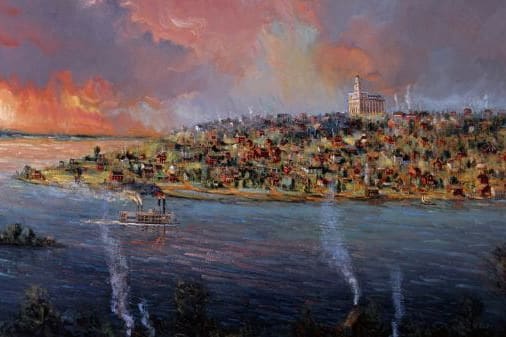
Cover image: Nauvoo the Beautiful, by Larry Winborg.
The Lord Delights in Integrity
When speaking about professional golfer Tony Finau, Jon Rahm said, “If you don’t like Tony Finau, there’s something seriously wrong with you.”
Tony Finau is a golfer who first came onto the professional scene in 2013, playing on the PGA Tour Canada. Then he qualified for his PGA Tour card in 2014.
You see to golf on the PGA tour, you have to earn your way. Since 1965, you have to qualify at the PGA qualifying tournament called Q school. Nowadays it’s the web.com tournaments. So, if you’re a new player like Finau was, you had to earn your spot by being in web.com tour play.
In the final tournament of 2014, he was battling for his finish spot which could determine whether he got his pro tour card. So much was riding on his play in those few days. It could eventually mean millions of dollars and entry into the PGA.
On an approach shot, Tony was making several practice swings. Then on his set up for his shot, he ever so lightly touched the ball with his club and the ball made a tiny movement. No one saw it, no cameras were recording his shot, but Tony saw it. He had a choice. Notify the officials or let it go. A single shot could make a difference in his future as a golfer if it meant making a difference in qualifying.
We all have such moments in life. No one watching. No cameras rolling. Will we live true to our values? Will we live up to what matters most?
Well, Tony called over the other players and informed them what had happened and he took a penalty shot. He said, “My father taught me to always be honest and never give up. I have always tried to do both.”
Finau would qualify for his pro card and would go on to win his first PGA tournament in 2016. Just a few months ago, he won his second PGA tournament at the Northern Trust. Finau, a member of the Church of Jesus Christ of Latter-Day Saints, is the first PGA golfer to be of Tongan and Samoan descent. Tony and his wife have four children.
Now, Tony is not the only golfer to demonstrate his desire to live in harmony with his values. Brian Davis was in South Carolina in a playoff with the chance to win his only PGA tournament. He hit his ball near the water and on his back swing he hit his club on a small grass reed. He called a two-shot penalty on himself. As a result, he got a double bogie on the hole, lost to Jim Furyk and it cost Davis $550,000.
Jon Huntsman was the founder of Huntsman chemical. When the company was still young and growing, Huntsman made a hand shake deal with another company. The handshake deal to was sell 40 percent of Huntsman Chemical Corp.
Huntsman had agreed to sell for $53 million, but after six months of delays, the value had ballooned to $250 million. Huntsman could easily have renegotiated the deal. He could have said, “oh, the market has changed.” But he stuck with the original deal despite the change in economic circumstances.
“I must tell you that throughout the last 12 to 15 years there have been many times I have wondered, ‘What about that $200 million?’ ” Huntsman said, “That’s a fortune, a mammoth fortune. I let it slip away. And on the other hand, I say, ‘My children are all in business. They know their father; they understand an agreement. If it was for $53 million or just $53, the principle is still the same. A deal is a deal. A handshake is a handshake. Integrity is integrity.”[i]
Throughout the scriptures, the Lord expresses love for those who have integrity of heart. In D&C 124:15 the Lord said he loved Hyrum Smith: “because of the integrity of his heart, and because he loveth that which is right before me.”
Years ago, Elder Marvin J. Ashton told BYU students about paintings and portraits that hung on the fourth-floor of the Salt Lake temple. It’s on the fourth floor where general authorities meet to council one with another and make decisions. And influencing their decisions at the time were pictures hanging on the wall. These paintings included a portrayal of Christ calling Peter and Andrew, the Crucifixion, and the Resurrection.
In addition, were portraits of the prophets of this dispensation. There was one portrait hanging on the wall that Elder Ashton wanted to highlight. He said:
“In this setting there [was] only one other picture in the entire room, and that is of Joseph Smith’s brother Hyrum. It is not only appropriate but a genuine tribute, proper and purposeful, that the portrait of this great man is on display with the Savior and the prophets of this dispensation. Not only a faithful brother and advocate of Joseph’s, but for all of us who meet there regularly he is the personification of integrity.”[ii]
Like Elder Ashton who sat in meetings on the fourth floor and was influenced by the portrait and example of Hyrum Smith, we too can take our inspiration from Hyrum and his personification of integrity to help us in our decision making.
Joseph Smith would write: “There was my brother [Hyrum] who next took me by the hand—a natural brother. Thought I to myself, Brother Hyrum, what a faithful heart you have got! Oh, may the Eternal Jehovah crown eternal blessings upon your head, and a reward for the care you have had for my soul! O how many are the sorrows we have shared together; and again we find ourselves shackled with the unrelenting hand of oppression. Hyrum, thy name shall be written in the book of the Law of the Lord, for those who come after thee to look upon that they may pattern after thy works.”[iii]
Hyrum was not the only person of integrity mentioned in Section 124. There are other saints praised for the integrity of their heart. Among them was George Miller. Before his conversion, Miller gave thousands of bushels of grain to the saints as they fled Missouri as well as the Prophet Joseph.
“When he heard the Prophet preach, he wrote, ‘I had no remaining doubts left in regard to the truth of the prophet.’ After being baptized, Miller was persecuted for his beliefs, he said:
‘My cattle were shot on the prairies…. My fences [were] laid down, and the flocks and herds of the prairies turned on my grain fields. I was vexed by petty lawsuits. Men that I had never had dealings with would recover sums of money from me, by bringing into the justice’s court false witnesses, and those that owed me would prove payment.’
His close association with the Prophet was the highlight of his years in Nauvoo: ‘I have known Joseph Smith intimately for near three & a half years,’ he wrote. ‘I unhesitatingly aver that … a more generous, liberal, honorable, high toned virtuous man, never existed on the footstool of the great Jehovah.'”[iv]
Integrity is defined as “the quality of being honest and having strong moral principles; moral uprightness” and “the state of being whole and undivided.” It seems that in today’s world we are often divided in our views. We embrace some teachings of modern prophets but are divided on others. We want to be selective in what we choose to follow. But integrity is the state of being whole: wholehearted in testimony, undivided in loyalty, and upright in our efforts to follow the prophets.
In these trying times, we pray for our children to remain whole in their faith and undivided in their testimony. There are so many devices used by Satan in our day to divide our testimony and entice us into half-hearted gospel living. It’s not easy with the tossing and turning caused by media, social media and criticism-laden voices of our day. Stress, depression, mood and popular opinion all have their way on our wholeness.
We could all use a portrait of Hyrum on the wall of our decision making to remind us that we will be protected and guided if we remain undivided in our testimony of the prophet and follow his teachings.
A Season Set Apart
Section 124 came at a time of temporary reprieve for the saints:
“In the year 1841, when [D&C 124] was given, this beautiful city had about 3,000 inhabitants. A charter had been granted by the Illinois Legislature, by which Nauvoo was given a liberal municipal government, with authority to form a militia and erect a university. A Temple was about to be built. The scattered Saints were gathering, and the settlements in Illinois were growing rapidly. The mission in Great Britain was highly successful. Such were the general conditions when this Revelation was given. The Church had a moment’s rest. There was calm before the next storm.”[v]
In Illinois, the saints found some kindness and hope. What a timely blessing for a group of people who endured so much for the cause of Jesus Christ. For a short while, they had a season to recover, rest and prepare for what was to come.
I believe the Lord gives us seasons in our life. Seasons in which we have the opportunity, perhaps even a calling, to grow, prepare and learn as the Lord wants us to grow.
Years ago, I learned this lesson first hand. I was the president of international for a large company. I was on the road every week. Long flights, lots of nights in hotel rooms. At first, I found myself reading a lot of novels or watching TV during my travel time. But as I looked at who I was becoming I decided that if for the next 3-5 years, I had to do this job, then I would do my best to take advantage of the time.
I had always thought that someday I would get my Ph.D. so I could become a college professor at some point in life. So, I enrolled in a Ph.D. program and used travel and idle time to read and do research. It was one of the greatest times of my life. I learned so much about me, about my area of study and about people. Life gave me a season and it became a great blessing to me.
Perhaps this is a season of life in which you are called to serve in a particular way. Perhaps as a father or mother, this is the season to become the best father or mother you can become. Perhaps this is a season to learn more in the scriptures. What season of life are you in and how could you serve the Lord or become more like him in this season?
As we look back to Nauvoo, perhaps this was the season in which the saints learned the pattern for temple building and ordinances. They would put these skills to use in the future building temples that would stand for years to come.
The Command to Build a Temple
Of the 145 verses in D&C 124, 34 verses are written instructions relative to the temple, building of the temple or ordinances related to the temple. The commandment to build a temple had been part of revelations to the saints since they first settled in Kirkland. In fact, of the three temples that had been commanded to be built, only one—Kirtland was actually constructed. Jackson County and Far West temples were never built. And, Kirtland would only be in use for 20 months.
With this track record, you must ask whether the saints questioned the commandment to build a temple in Nauvoo. I am sure they asked, Would the Nauvoo temple be completed? How long would they live in Nauvoo? Should they give of their meager substance to build a house to the Lord that may never be completed or used?
Perhaps they remembered the great miracles that happened in Kirtland as they built and dedicated that temple. Perhaps they talked to those who had done sacred ordinances in the temple. Perhaps they had the Spirit witness to be obedient no matter what.
Regardless, in August of 1840, when the prophet announced the intention to build a temple, the saints voted unanimously to begin excavation and build the temple. For four years, the saints sacrificed and worked in building the temple. Many gave the last of their possessions in obedience to the Lord’s command.
“However, once the temple started, persecution grew. After the death of Joseph Smith, Brigham Young saw that the church members would need to leave Nauvoo. They moved quickly to finish the temple. In November 1845, the top story of the temple was dedicated and the first endowments were performed in the temple. The ordinances would continue while the remaining floors were finished.
Brigham Young had planned to leave Nauvoo on February 4, 1846, but as he left the temple the night prior, he saw a large crowd of people waiting to receive their endowments. He delayed his departure for two weeks in order to serve them. Temple records relate that 5,615 Church members were able to receive the temple endowment before leaving Nauvoo.”[vi]
The brethren tried to sell the temple. But there were no immediate buyers. Ultimately the saints left the temple behind as they headed west.
“Then, on October 9, 1848, fire destroyed the temple. The History of Hancock County describes the scene:
‘About 3 o’clock (in the morning) fire was discovered in the cupola. It had made but little headway when first seen, but spread rapidly, and in a very short period the lofty spire was a mass of flame, shooting high in the air, and illuminating a wide extent of country. It was seen for miles away. The citizens gathered around, but nothing could be done to save the structure. It was entirely of wood except the walls, and nothing could have stopped the progress of the flames. In two hours, and before the sun dawned upon the earth, the proud structure, reared at so much cost—an anomaly in architecture, and a monument of religious zeal—stood with four blackened and smoking walls only remaining.’”[vii]
If the saints were to only have the temple for a short time, why then the command from the Lord to build a temple? The Lord answers this question in D&C 124:55: “to build a house to my name, even in this place, that you may prove yourselves unto me that ye are faithful in all things whatsoever I command you, that I may bless you and crown you with honor, immortality, and eternal life.”
While temples are important, the most important work, what really matters is what happens inside those temples: the ordinances, and what happens inside those that build and attend the temples. If the Lord wanted buildings, he could have them. What the Lord wants is what happens to us in the sacrifice for and building of temples.
I suspect that those who labored to build the Nauvoo temple grew spiritually during that season of their life and what they found in the building was godly traits that would last them for eternity. The temple building itself would burn, but the eternal characteristics built in the saints would last forever.
You also have to wonder the worth of temple ordinances. Could it be that the Lord loved those that received their ordinances in the temple so much that he would require the building of a temple to provide for those ordinances to be done? I think so. Ordinances are priceless. And it would not be the last time that ordinances would be performed in Nauvoo.
In 1937, the church acquired a portion of the temple block in Nauvoo. Eventually, the church would acquire all of the land where the Nauvoo temple once stood. Then, in the April 1999 general conference, President Hinckley announced that the Nauvoo temple would be rebuilt.
This time, professional laborers and contractors would build the Nauvoo temple. The tithes and offerings of millions of saints would support and pay for the construction. And I wonder if those original saints who gave so much for the construction of the temple were allowed to be present on June 22, 2002 for the dedication of the Nauvoo temple in our day. The temple today stands as a monument to the saints who gave so much to build a temple they would not be able to attend.
Now, what is the lesson for us in our day? The Lord will give revelations to his prophet that sometimes make little sense at the time. We are asked to give and do what we may not want to do without perfect clarity. But remember the Lord is building us on the inside and wants to prove our faithfulness in all things. His work will be accomplished both inside us and on the earth.
Place Your Trust in God Alone
In November 1839, Joseph Smith and a few of the brethren travelled to Washington D.C. to make an appeal to the president of the United States for wrongs done to the saints in Missouri. Joseph would record the following:
“On Friday morning, 29th, we proceeded to the house of the President. We found a very large and splendid palace, surrounded with a splendid enclosure, decorated with all the fineries and elegancies of this world. We went to the door and requested to see the President, when we were immediately introduced into an upper apartment, where we met the President, and were introduced into his parlor, where we presented him with our letters of introduction. As soon as he had read one of them, he looked upon us with a half frown, and said, ‘What can I do? I can do nothing for you! If I do anything, I shall come in contact with the whole state of Missouri.’”[viii]
Joseph realized that President Van Buren was in office for his own self-aggrandizement and worried more about votes than doing the right thing. So, they took their appeal to congress. They left hopeful that the Senate would take up the matter and seek justice in the matter. However, they soon learned that the matter never made it past the Senate Judiciary Committee.
The prophet Joseph concluded that they had brought the matter before all earthly tribunals and they would trust in God for whatever could be done in their circumstances. As the scripture says, “Trust in the Lord with all thine heart; and lean not unto thine own understanding. In all thy ways acknowledge him, and he shall direct thy paths” (Proverbs 3:5–6).
To place our will and trust in the hands of the Lord is perhaps our most significant quest in life. Government leaders will fail, governments will topple, degrees and certifications will not endure, wealth will disappear and misplaced confidence in the world will falter. But trust in the Lord will endure and stand. Even when wrongs have been done and what we want in our time does not come to pass, if we trust in the Lord, all things will work together for our good.
The Keys Remain with the Twelve
In D&C 124:127-128, the Lord says, “I give unto you my servant aBrigham Young to be a president over the Twelve traveling council; Which Twelve hold the keys to open up the authority of my kingdom upon the four corners of the earth, and after that to send my word to every creature.”
About this revelation, President Gordon B. Hinckley said, “The winter of 1843-1844 was a season of great tension in Nauvoo. Enemies were plotting the destruction of the Church. During that winter, on a number of occasions, Joseph assembled the Twelve in the upper room of his brick store on Water Street in Nauvoo. Our archives contain a number of documents attesting to these meetings and what was done in them. I have time to quote from the record of only one who was present. There were many. Wrote he of Joseph Smith:
“‘This great and good man was led, before his death, to call the Twelve together, from time to time, and to instruct them in all things pertaining to the kingdom, ordinances, and government of God. He often observed that he was laying the foundation, but it would remain for the Twelve to complete the building. Said he, ‘I know not why; but for some reason I am constrained to hasten my preparations, and to confer upon the Twelve all the ordinances, keys, covenants, endowments, and sealing ordinances of the priesthood … for, said he, the Lord is about to lay the burden on your shoulders and let me rest awhile; and if they kill me … the kingdom of God will roll on, as I have now finished the work which was laid upon me, by committing to you all things for the building up of the kingdom according to the heavenly vision, and the pattern shown me from heaven.’ (Parley P. Pratt, “Proclamation,” Millennial Star, 5, 151.)
“As you know, Joseph Smith was killed by the Carthage mob on June 27, 1844. On the following 8th of August a congregation of thousands assembled in Nauvoo. Sidney Rigdon, who had served as a counselor to Joseph Smith, spoke for an hour and a half, proposing that he be appointed guardian of the Church. There was no affirmative response. That afternoon Brigham Young spoke on behalf of the Apostles. Many present testified that he looked and sounded like the martyred Prophet. When, following his talk, a proposal was put that the Twelve lead the Church, having been given the keys by Joseph, the vote was overwhelmingly in favor. (“The Joseph Smith III Document and the Keys of the Kingdom,” Ensign, May 1981, 20).[ix]
Today we sustain the Quorum of the Twelve apostles as prophets, seers and revelators. And we understand that they hold the keys of the kingdom. This order provides the succession, revelatory process and leadership needed for our day.
Conclusion
D&C 124 is filled with lessons for our day. We can look to Hyrum, George Miller and others to guide us in making decisions and filling our life with integrity. The building of the Nauvoo temple, built under the unanimous support of the saints, stood only for a short while. But the ordinances done there were of great value, the obedience forged there would guide the saints for years to come, and the land dedicated for a temple would eventually hold a temple in the latter days.
When we place our trust in governments and organizations of the world, we must realize they will likely fail. When we place our trust in God, we can rely on him no matter what. And while many wonderful things happened in the season in Nauvoo, perhaps one of the most important was the education of the twelve who hold the keys of the kingdom.
[i] https://www.deseret.com/2005/12/31/19930604/honesty-still-the-best-policy.
[ii] Marvin J. Ashton, He Loveth That Which is Right, BYU Speeches, March 5, 1989.
[iii] As quoted in He Loveth That Which is Right, BYU Speeches, March 5, 1989.
[iv] Susan Easton Black, Who’s Who in the Doctrine and Covenants, 196 – 197.
[v] Hyrum M. Smith and Janne M. Sjodahl, Doctrine and Covenants Commentary, 768.
[vi] Church History in the Fulness of Times Student Manual, 303–304. The Nauvoo Temple: Destruction and Rebirth.
[vii] The Nauvoo Temple in Andrew Jenson, ed., Historical Record, June 1989, 872-873.
[viii] BYU Studies, Volume 4, Chapter3, The Prophet’s Effort at Washington to Obtain Redress of Grievances for the Saints, byustudies.byu.edu.
[ix] Gordon B. Hinckley as quoted at https://www.gospeldoctrine.com/doctrine-and-covenants/sections-121-138/section-124.
Picture This—The Mysterious Inverted Stars on the Nauvoo Temple

Without exception, Latter-day Saints on our Church History Tours gasp for joy and exclamation when they see the Nauvoo Temple for the first time. It is such an impressive temple and represents so much of sacrifice and renewal for our people. The most obvious symbols on this temple are the moonstones, the sunstones and the starstones. At first glance, a person quickly assumes the obvious meaning of these as representing the three degrees of glory. That is only partially correct. Let’s explore.

The Nauvoo Temple was built after the pattern given to the Prophet Joseph in a vision. He referred to that vision a number of times in various conversations with fellow saints. Here is an example of a meeting with the chief architect of the temple, William Weeks:
“In the afternoon, Elder William Weeks (whom I had employed as architect of the Temple), came in for instruction. I instructed him in relation to the circular windows designed to light the offices in the dead work of the arch between stories. He said that round windows in the broad side of a building were a violation of all the known rules of architecture, and contended that they should be semi-circular — the building was too low for round windows. I told him I would have the circles, if he had to make the Temple ten feet higher than it was originally calculated; that one light at the center of each circular window would be sufficient to light the whole room; that when the whole building was thus illuminated, the effect would be remarkably grand. I wish you to carry out my designs. I have seen in vision the splendid appearance of that building illuminated, and will have it built according to the pattern shown me.”[i]

The stylized crescent moonstones sit at the base of the pilasters, 30 in number, and the sunstones are placed at the top of the pilasters. Then above the sunstones are the inverted star windows, in red, white and blue and the inverted starstones in the soffit or eves of the roof of the temple. Do these stars represent the telestial kingdom, as referred to in the letter of the Apostle Paul to the Corinthians?[ii] Symbols can be very broad in their meaning and can represent a number of things—such is the case with these inverted stars.
Would it surprise you to know that this beautiful, stained glass star is a symbol of Jesus Christ? In Revelation 22:16 we read:
16 I Jesus have sent mine angel to testify unto you these things in the churches. I am the root and the offspring of David, and the bright and morning star.
Jesus is the bright and morning star. The morning star, Venus, appears on the horizon as a perfect inverted five-point star. This same symbol appears in cathedrals and ancient structures all over Europe. The inverted star was combined with the cross and place on doors, windows, banners and even battle armor. Early Christians regarded it as a symbol of Christ. The famous Amiens Cathedral in France (1230 A.D.) and the Marktkirche in Germany (1350 A.D.) still have the massive stained glass inverted stars.

The military’s highest award, the Medal of Honor, is an inverted star—and what a glorious symbol, for giving the last full measure—one’s life for his friends.
As we travel all over colonial America, we often see the inverted stars adorning period homes. Even the early American Flag used the inverted five-point stars until 1876.
[Insert Nauvoo_inverted_stars_0005 here]
When I look at those beautiful inverted stars on the Nauvoo Temple, I rejoice in thinking about the “bright and morning star” even Jesus Christ—the perfect adorning symbol on the temple.
And now you can picture this.
Notes:
[i] Lundwall, N.B., Temples of the Most High, Deseret Book Company, Salt Lake City, 1941, p. 46 (emphasis added).
[ii] See 1 Corinthians 15:40-42.
FEATURES