



On Mount Zion: Abraham’s Offering of Isaac
“They must needs be chastened and tried, even as Abraham, who was commanded to offer up his only son.”
Doctrine and Covenants 101:4
God’s Request and Abraham’s Obedience
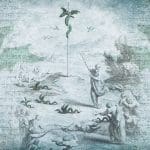
The temple site for which Abraham is most remembered is not at Beersheba, but a place some fifty miles north, the destination of an unexpected journey he was called to make while living at Beersheba. It is the startling story of his supreme sacrifice, the crowning event of his life. And it involves his beloved son Isaac, who according to the earliest sources was about twenty-five at the time. 1
Genesis announces the event as a test for Abraham (Gen. 22:1), 2 but the Zohar insists that Isaac “was also included in the trial.” 3
It began with a surprise conversation initiated by God, apparently at night. 4 Orson Hyde states that “the Spirit of the Lord came upon [Abraham],” 5 while Josephus tells that God actually appeared to him. 6
God addressed him by the name he had given him, the name meaning “Father of a multitude”: “Abraham” (Gen. 22:1), or, according to the Septuagint, God called his name twice: “Abraham, Abraham.” 7 To which Abraham responded in deep humility, “Here am I, Lord what willest Thou of Thy servant?” 8
According to Genesis, the Lord answered: “Take now thy son, thine only son Isaac, whom thou lovest, and get thee into the land of Moriah; and offer him there for a burnt offering upon one of the mountains which I will tell thee of” (Gen. 22:2).
In the words of a nineteenth-century writer,
God bids him sacrifice the son for whom he had waited so many years, and over whose birth he had so rejoiced: He bids him sacrifice his only son, the one link which there was between himself and the promise that his posterity should be as the dust of the ground and the stars of heaven in number: He bids him sacrifice Isaac whom he loved, towards whom his heart yearned with infinite tenderness, who had made his home bright and joyous, and to lose whom would be the darkening of all the days he had yet to live. 9
Josephus insists that this was not a command but a request, 10 a fact not apparent in the King James Translation “Take now thy son …” (Gen. 22:2). But this word “now” translates the Hebrew na, a particle of entreaty, 11 which translators of the stature of Robert Alter and Everett Fox say should be rendered in this verse as a request: “Take, pray, your son.” 12 So also the preeminent medieval Jewish scholar Rashi held that the meaning of this Genesis passage is not a command, but God was saying: “I request of you … ” 13
Jewish tradition similarly records the Lord as saying “please” 14 or “I have come to ask of thee something.” 15 Standing face to face with His beloved friend Abraham, and looking him in the eye, God gently requests the sacrifice of Abraham’s own beloved son, and then “keeps silent about his reasons.” 16
Many had been the commands that Abraham had received from the Lord, but never a request. It seemed to leave the door open for questions or discussion about the nearly unbelievable task the Lord had asked for. But the man who had pled with such fervor with the Almighty over the fate of Sodom now offered no dissent or discussion, no hedging or hesitation. He did not “stop to reason or argue with the Almighty,” noted Joseph F. Smith, but simply “went … without complaining or murmuring” to fulfill what God had asked. 17
Abraham could well have offered “a justifiable excuse,” pointing out that what God had asked contradicted the prior promises, says Yosef Albo, “but he refrained from doing so, suppressing his paternal feelings out of love of God.” 18 God had expressly recognized Abraham’s love for Isaac in asking for his sacrifice, and it was indeed Abraham’s love that was being tested: whom did he love the most, Isaac or God? 19
Such was Abraham’s love for and trust in the Almighty that even in the face of this horrendous deed, and even when it had been put to Abraham as a mere request, apparently all he needed to know was what God desired.
God’s wish was truly Abraham’s command, no matter how hard.
Abraham is the focus, but what about Sarah? “Has he told her where he is going? Has he said anything to her about what he is about to do? … The story does not tell us.” 20 At least directly, it doesn’t. But the lack of any protest makes it clear, as observed by one Latter-day Saint mother and leader, that “out of kindness to her,” Abraham did not disclose what he had been asked to do. 21 He simply, as Genesis tells, “rose early in the morning and saddled his donkey” – he did it himself, although he had many servants 22 – “and took his two lads with him, and Isaac his son, and he split wood for the offering, and rose and went to the place that God had said to him.” 23
Before they left that morning, according to rabbinic texts, Abraham and Isaac said their morning prayers, as was always their practice. 24
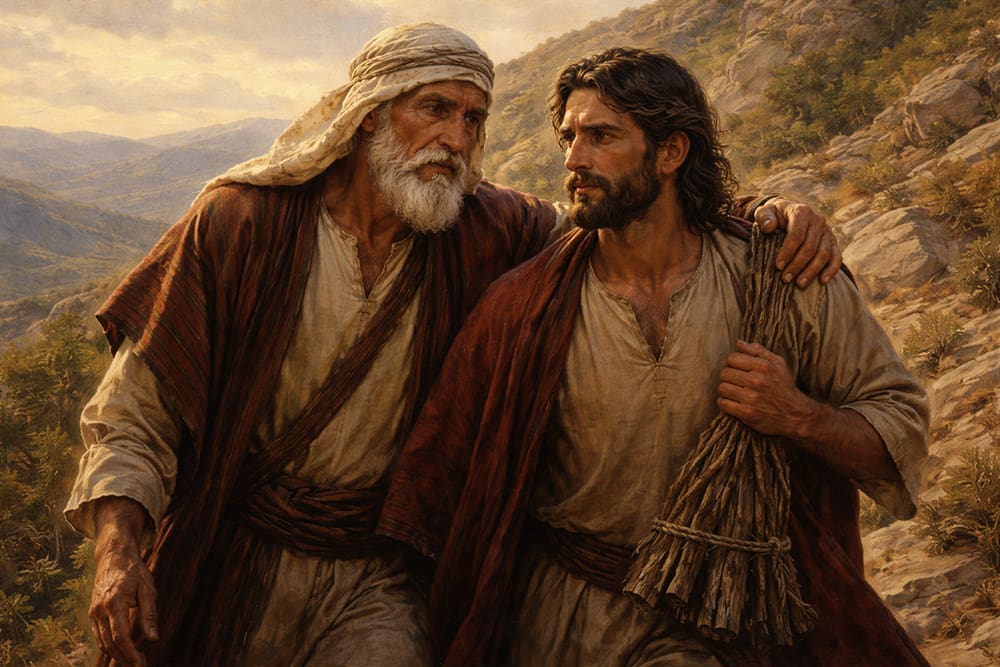
With the donkey carrying the wood and provisions, the party of four began the long walk northward and gradually upward to the hill country of Moriah, the destination designated by God. “The severity of the trial,” notes Henry Blunt, “was unspeakably increased by the three days’ journey.” 25 The deed was not to be done upon sudden impulse, but only after due deliberation as he walked beside his beloved son carrying the weight of a terrible secret. “
The secret was his alone,” says Elie Wiesel; indeed, “he alone knew there was a secret – and he refused to share it.” 26 He would keep his beloved son safe from pain or anxiety as long as possible, shouldering the entire painful burden as long as he could.
It might, of course, have been different. God might, as Origen pointed out, have commanded Abraham simply to take Isaac to the appointed place, and there asked for the sacrifice. But once Abraham is asked to make the sacrifice, the painful journey “is prolonged for three days, and during the whole three days the parent’s heart is tormented with recurring anxieties, so that the father might consider the son in this whole lengthy period, that he might partake of food with him, that the child might weigh in his father’s embraces for so many nights, might cling to his breast, might lie in his bosom. Behold to what an extent the test is heaped up.” 27
And what did Abraham tell Isaac as they walked along for three days together? Surely he had expected some day to impart to his beloved son his final testimony and blessing, but never under circumstances like these! And what was Abraham thinking as he walked along? “Notice the old gentleman,” said John Taylor, “tottering along with his son, brooding over the promises of God and the peculiar demand now made upon him.” 28 “We cannot conceive of anything that could be more trying and more perplexing than the position in which he was placed.29
Indeed, it would have been difficult enough to have even been apprised of Isaac’s impending death, but Abraham was asked to do the deed by his own hand. Did God not abhor human sacrifice? Was it not a perversion of that true order of sacrifice intended to signify the future sacrifice of the Beloved Son? Had not Abraham himself courageously opposed human sacrifice in Ur? Had not God rescued Abraham when he was about to be offered up in a sacrificial rite?
This new request was the ultimate of ironies. Nor was there anything in all the patriarchal records like it, for among the righteous, “nothing of the kind had ever transpired before as a precedent,” noted John Taylor. 30
And how could the divine promises through Isaac now be fulfilled? For “had not God promised great blessings through this very son? ” 31Thus Abraham was asked “to destroy the very thing that God had promised to protect and enhance: his posterity.” 32
In the words of John Taylor, “It was not only his parental feelings that were touched,” 33 for “through the spirit of prophecy, [he] had gazed upon his posterity as they should exist through the various ages of time. And among other things he saw the days of Jesus [and] … was glad. And after all this, God told him to take the life of his son. What, and thus prevent your posterity from coming upon the earth as you beheld it in vision? Yes, and in one stroke of the knife blast all these glorious, … blessed hopes.” 34
With Isaac, then, rested the future salvation of the entire world, the future of Zion, as Abraham well knew.
And what of the salvation of those already living in Abraham’s Zion? As pointed out by Jewish scholars,
What would happen to his followers and those who admired him if he slaughtered Isaac and the world learned that Abraham’s teachings had been violated in the grossest manner by the teacher himself? His entire lifetime of achievement would have been nullified. He would have been despised, vilified, ridiculed. 35
Well did one writer observe that what Abraham was asked to do “threatened to empty all the meaning from the story of his life.” 36 And yet he also knew, noted President Spencer W. Kimball, “that God would require nothing of him which was not for his ultimate good. How that good could be accomplished he did not understand,” 37 for this sacrifice seemed “so contradictory! … It was irreconcilable, impossible!” 38 It was, says Jacques Derrida, simply the “most cruel, impossible, and untenable” thing imaginable. 39
Joseph Smith even indicated that “if God had known any other way whereby he could have touched Abraham’s feelings more acutely and more deeply he would have done so.” 40 All of which is of more than historical interest to Latter-day Saints, of whom the Lord has said that they must be “tried, even as Abraham” (D&C 101:4).
No wonder that Abraham went, in the words of Spencer W. Kimball, “with breaking heart” 41 as he walked along with his beloved but condemned son, each step bringing them closer to the slaughter. In the Genesis account the journey is one of silence; we are not privy to Abraham’s words, much less his thoughts or feelings that he could share these with no one. His alone was the agony.
“On the third day,” says Genesis, “Abraham looked up and saw the place far away” (NRSV Gen. 22:4). How did he recognize it? Jewish tradition says he saw a pillar of fire or a cloud of glory resting on the mountain. 42 Then, continues Genesis, “Abraham said to his lads: “You stay here with the donkey, I and the lad will go yonder” 43 and “we will worship, and then we will come back to you” (NRSV Gen. 22:5).
Why did Abraham expressly say that he and Isaac would both return? Was he perhaps confused, not really knowing what he was saying? Was he carefully hiding the truth, knowing that he and Isaac would not really be returning? Or, as some of the Jewish sages believed, had the Holy Spirit suddenly prompted Abraham to utter these words, which were actually a prophecy? 44 Or, as another Jewish interpreter thought, did Abraham intend to bring Isaac’s bones back with him? 45 Or did Abraham believe that God would resurrect Isaac on the spot, so that Abraham and Isaac would indeed walk back together? 46
Once again we are not privy to Abraham’s inner thoughts as we witness his unstinting obedience.
Then “Abraham took the wood of the burnt offering and laid it on his son Isaac” (NRSV Gen. 22:6). The rabbis commented that Isaac’s carrying the wood for his own sacrifice “is like one who carries his own cross on his shoulder.” 47
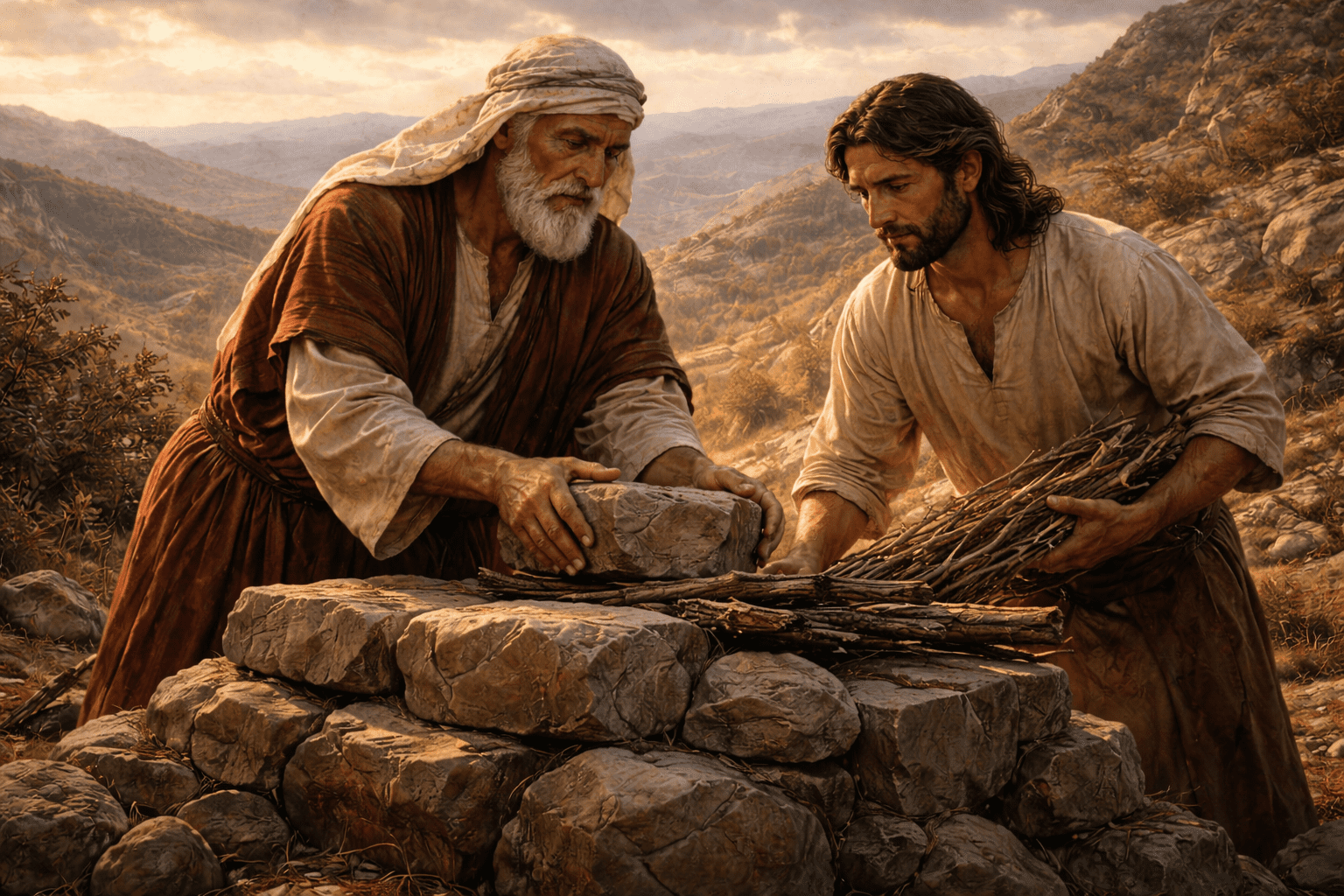
Then, taking “the firestone and the cleaver … in his own hand,” Abraham set out with Isaac, “and the two walked off together” 48 – hand in hand, says one midrash. 49 “Isaac broke the silence” 50 and “said to his father Abraham, Father!’ And he said, Here I am, my son.’ He said, The fire[stone 51] and the wood are here, but where is the lamb for a burnt offering?’ Abraham said, God himself will provide the lamb for a burnt offering, my son.’ So the two of them walked on together” (NRSV Gen. 22:7-8).
In the Hebrew text, the words “offering” and “my son” can be read in apposition, making Abraham’s answer ambiguous: was he merely addressing his son, or had he told him that he, Isaac, would in fact be the offering? Rashi insisted that Isaac now “understood that he was going to be slaughtered,” 52 yet he went willingly, “with equal heart.” 53
In the words of Elie Wiesel, “The two of them [were] alone in the world, encircled by God’s unfathomable design. But they were together … Together they reached the top of the mountain; together they erected the altar; together they prepared the wood and the fire.” 54
Notes 1 Josephus says Isaac was twenty-five or in his twenty-fifth year (Judean Antiquities 1.227). Jubilees says he was twenty-three (Jubilees 17:15). One rabbinic tradition says he was twenty-six or twenty-seven (see Feldman’s discussion in Josephus, 88-89 n. 702). The rabbinic tradition making Isaac thirty-six or thirty-seven appears to be a later embellishment connecting the sacrifice of Isaac with the death of Sarah, a connection absent in and seemingly contradicted by earlier sources. The King James depiction of Isaac as a “lad” (Gen. 22:5) tends to be misleading to our modern ear. The word “lad” in that verse translates the Hebrew naar -the same Hebrew word used in the very same verse to describe Abraham’s two servants. The word is used throughout the Old Testament with a wide range of age variation, including soldiers. See Brown, Driver, and Briggs, Hebrew and English Lexicon, 654-55. Referring to a number of Jewish texts, Louis Ginzberg notes, “Great emphasis is laid in the sources on the fact that although Isaac, at the time of the Akedah, was no longer a lad, but a grown-up man (different views are given as to his exact age . . .), yet he willingly submitted to his father’s wish.” Ginzberg, Legends of the Jews, 5:249 n. 229
2 Most modern translations translate the Hebrew verb as “tried” or “proved.”
3 Zohar 1:119b, in Sperling and Simon, Zohar, 1:372.
4After receiving the command, Abraham “rose up early in the morning.” Genesis 22:3. In the Qur’an, Abraham saw it in a dream. Surah 37:102, in Khatib, Bounteous Koran, 593.
5Journal of Discourses, 11:152.
6Judean Antiquities 1.223-24, in Feldman, Josephus, 85-87.
7Septuagint of Genesis 22:1, in Brenton, Septuagint, 25.
8Baring-Gould , Legends of the Patriarchs, 189; see Genesis 22:1-2.
9Goldman, In the Beginning, 792, quoting J. H. Blunt.
10Judean Antiquities 1.223-24, in Feldman, Josephus, 85-87.
11See Brown, Driver, and Briggs, Hebrew and English Lexicon, 609.
12Genesis 22:2, in Alter, Genesis, 103. Similarly, see other translations of this verse: “Pray take … ” in Fox, Five Books of Moses, 93; “Take, I pray thee … ” in Young, Young’s Literal Translation, 13 of Old Testament; and “Take, I beg of you … ” in Hirsch, T’rumath Tzvi, 105.
13Rashi on Genesis 22:2, in Rashi, Commentary, 199. So also Hershon , Rabbinical Commentary on Genesis, 121, including n. 2: “Take, I pray thee . . . “
14Tuchman and Rapoport, Passions of the Matriarchs, 68.
15Baring-Gould , Legends of the Patriarchs, 189; see Genesis 22:1-2.
17Stuy, Collected Discourses , 2:279.
18Yosef Albo in The Fundamentals of Judaism , quoted in Leibowitz, Studies in Bereshit, 202.
19Levenson, Death and Resurrection of the Beloved Son, 221-22, noting the emphasis in the Genesis text on Abraham’s love for Isaac, and noting Jubilees 17:16, 18.
21Carol B. Thomas, “Sacrifice: An Eternal Investment,” Ensign, May 2001, 63.
22As pointed out in Baring-Gould , Legends of the Patriarchs, 190.
23Genesis 22:3, in Alter, Genesis, 104.
24Kasher, Encyclopedia of Biblical Interpretation, 3:136, citing several sources.
25Blunt, Twelve Lectures , 220.
26Wiesel, Messengers of God, 97.
27Origen, Homilies on Genesis 8.3-4, in Oden, Ancient Christian Commentary, 2:103, omitting a question mark because only a portion of the first sentence is quoted.
28Journal of Discourses, 14:360.
31Oxenden, Portraits from the Bible, 45.
32Denny, An Introduction to Islam, 21.
33Journal of Discourses, 24:264.
34Journal of Discourses, 22:318.
35Scherman and Zlotowitz, Bereishis: Genesis, 1(a):599.
36Klinghoffer, Discovery of God, 61.
37Kimball, Teachings of Spencer W. Kimball, 59.
38Kimball, Faith Precedes the Miracle, 6.
40As reported by John Taylor in Journal of Discourses, 24:264. Similarly on another occasion John Taylor reported Joseph Smith’s statement that if God “could have invented anything that would have been more keen, acute, and trying than that which he required of Abraham he would have done it.” Journal of Discourses, 14:360.
41Kimball, Faith Precedes the Miracle, 6.
42Ginzberg, Legends of the Jews, 1:278-79.
43Fox, Five Books of Moses, 94. As faithfully reflected in this translation, the same Hebrew word is used in this verse to designate Abraham’s two young men (“lads”) and Isaac (“lad”). See also translations in Alter, Genesis, 104, and Wenham, Genesis 16-50, 97.
44See Ginzberg, Legends of the Jews, 1:279; and Rashi on Genesis 22:5, in Rashi, Commentary, 202.
45See Bachya ben Asher, quoted in Levenson, Death and Resurrection of the Beloved Son, 131.
46See Hebrews 11:17-19, and discussion in Levenson, Death and Resurrection of the Beloved Son, 130-31. Hebrews clearly says that Abraham was expecting that God would resurrect Isaac and thereby fulfill the promises, but whether Abraham thought this would happen immediately remains unclear.
47Genesis Rabbah 56:3:1, in Neusner, Genesis Rabbah, 2:280.
48Genesis 22:6, in Speiser, Genesis, 161.
49Midrash Hagadol, in Miller , Abraham Friend of God, 167.
50Genesis 22:7, in Speiser, Genesis, 161.
52Rashi on Genesis 22:8, in Rashi, Commentary, 203.
53Leibowitz, Studies in Bereshit, 200, quoting Rashi.
54Wiesel, Messengers of God, 96 (emphasis in original).
Power from Abrahamic Tests
Editor’s Notes: Today we rerun one of Truman Madsen’s classic essays.
Once I was in the valley known as Hebron, now beautifully fruitful and where tradition has it, there is a tomb to father Abraham. As I approached the place with Elder Hugh B. Brown, I asked, “What are the blessings of Abraham, Isaac, and Jacob?” Elder Brown thought a moment and answered in one word, “Posterity.” Then I almost burst out, “Why, then was Abraham commanded to go to Mount Moriah and offer his only hope of posterity?” It was clear that this man, nearly ninety, had thought and prayed and wept over that question before. He finally said, “Abraham needed to learn something about Abraham.”
You are aware that the record speaks of the incredible promise that Abraham after years of barrenness-which in some ways to the Israelites was the greatest curse of life-would sire a son who would in turn sire sons and become the father of nations. This came about after Abraham had left a culture where human sacrifice was performed. Abraham was then counseled, and if that is too weak a word, he was commanded to take this miracle son up to the mount.
We often identify with Abraham; we sometimes think less about what that meant to Sarah, the mother, and to Isaac, the son. If we can trust the Apocrypha, there are three details that the present narrative omits. First, Isaac was not a mere boy. He was a youth, a stripling youth on the verge of manhood. Second, Abraham did not keep from him, finally, the commandment or the source of the commandment. But having made the heavy journey, how heavy! He counseled with his son. Third, Isaac said in effect, “My father, if you alone had asked me to give my life for you, I would have been honored and would have given it. That both you and Jehovah ask only doubles my willingness.” It was at Isaac’s request that his arms were bound lest involuntarily, but spontaneously, he should resist the sinking of the knife. Only in the Book of Mormon, though many have assumed this, has a prophet said that this was in “similitude of God and his Only Begotten Son” (Jacob 4:5).
As we later ascended the mount traditionally known as Mount Moriah-it is just inside the east wall of Jerusalem-we remembered a statement of Brother Ellis Rasmussen of BYU: one can believe that it was to that same mount that another Son ascended. And this time there was no ram in the thicket.
Scholars are widely split over this account. At one extreme are those who say that it could not be, that it did not happen, that this is an allegory. We have here a description of the internal struggle that Abraham went through in trying to leave behind his boyhood training in . God would not require such a thing. One man put it to me this way, “That is a terrible way to test a man. A loving God would not do it.”
At the other extreme are those who have held that the story, if not true to history, is nevertheless true to life. However, they go further. They almost rejoice in the contradiction. They say this story illustrates that faith must do more than go beyond reason. Faith, if it is genuine, pulverizes reason. We must, as Kierkegaard put it, be “crucified upon the paradox of the absurd.”
My testimony is that both the rationalists and irrationalists have misread. For in modern times, we have been taught that this story does not simply lie in our remote past but in our own individual future. As modern revelation states, we must be “chastened and tried, even as Abraham” (D&C 101:4). Do you remember after that more than 900-mile march from Kirtland to Missouri we call Zion’s Camp-a march that from all mortal appearance was a failure, for it achieved nothing, someone came to Brigham Young and said, “What did you get out of that fiasco?” He replied, “Everything we went for–experience.” He could say that because he had only within hours been with the Prophet Joseph in a meeting where the Prophet had declared in substance, “Brethren, some of you are angry with me because you did not fight in Missouri. But let me tell you, God did not want you to fight. He wanted to develop a core of men ‘who had offered their lives and who made as great a sacrifice as did Abraham.’ Now God has found his leaders, and those of you who are called to positions who have not made that sacrifice will be required to make it hereafter” (DHC, II, p. 182, note.)
There is the recorded testimony of Wilford Woodruff and John Taylor, who described the Kirtland Temple experience-an outpouring so rich that some of those present honestly believed that the Millennium had come, that the era of peace had been ushered in, for they were so filled with the spirit of blessing and love, The prophet arose in that setting and said, “Brethren, this is the Lord that is with us, but trials lie ahead. Brethren [he was speaking to the Twelve], God will feel after you, and he will wrench your very heartstrings. If you cannot stand it, you will not be fit for the kingdom of God.” All too prophetic was that statement. Half of the original Council of Twelve later, as the Prophet put it, “lifted up the heel” against him and against Christ. Four others were at least temporarily disaffected. Only two, Brigham Young and Heber C. Kimiball, did not buckle under the pressure, and they were tried, too.
Commitment
Let us look at the implications for now. We live in a time when many are saying we need commitment, a total kind of commitment, a “risk-everything” kind of commitment. On that subject many contemporary writers are eloquent. But on the question, “To what does one commit?” vagueness and often vagaries are all that are offered. Someone asked me once, “What is the definition of a fanatic?” I answered in Santayana’s phrase, “A fanatic is a person who doubles his speed when he has lost his direction.” But what then is the name of a person who doubles and quadruples his effort when he has found his direction? That is commitment.
“A fanatic is a person who doubles his speed when he has lost his direction.” But what then is the name of a person who doubles and quadruples his effort when he has found his direction? That is commitment.
It is a mistake to suppose that Abraham acted in total ignorance-that his leap was a leap in the dark. If you consult the Inspired Version or even the King James, it is apparent that Abraham saw in vision the Son of Man (with a capital M meaning Man of Holiness, the eternal Father). He saw him; he saw his day; and he rejoiced (See Genesis 15:12. John 8:56) He received promises and accepted them. He was told, as our Pearl of Great Price reminds us, that he stood, even before mortality, among the mighty, the noble, and the great; that he was one of them; that he was chosen, which is more than simply called, before he was born; and that there therefore lingered in him a residual power of response to Christ that came out mightily in the hour of need (See Abraham 3:22-24).
We have been told that we are of Abraham. We are his children.
We have been taught that those of us who have joined the Church by conversion are just as much so as those of us who are born under the covenant (See D&C 84:33-34). We have been taught that the spiritual process that is to occur with us is not just a matter of changing names. It is a process whereby the blood itself is somehow purged, purified, and we literally become the seed of Abraham (See Teachings of the Prophet Joseph Smith, pp 149-150). But those who are Abraham’s descendants must also bear the responsibility of Abraham (See D&C 132:30-32).
We live in a time when everybody is willing to talk about rights, but it is rare to hear the words duty and responsibility. There never was a right, I submit, that did not have a corresponding duty. There never was a duty that did not also eventually entail a right.
We talk often as if the priesthood is solely a privilege. It is also a burden and many who have lived long in this Church know there are times, sometimes lengthy times, when the priesthood is much duty and very little right.
This leads to a statement allegedly made by the quotable J. Golden Kimball. Someone asked him how he accounted for the call of a certain brother to a certain position. He is supposed to have replied, “The Lord must have called him; no one else would have thought of him.”
Someone else was also complaining about how difficult it was to follow a certain leader. (You see, it is not just a matter of following the request to give a spectacular amount. What if you are called to give less than you can give? What if you are called not to be called? What if you are told only to wait for a decision and be patient?) In answer to this complaint, J. Golden says the legend, replied, “Well some of them are sent to lead us and some of them are sent to try us.” After the laughter and delight of that statement passes, the truth of it becomes apparent. All of us are sent to lead and to try each other. And the priesthood is given to try us to the core because of what it demands of us.
Sacrifices
May I speak only for a moment, out of the abstractions about some modern examples? You are aware that the Donner party, under the terror of their trauma west, lapsed into cannibalism. Not so with these modern human yet superhuman Latter-day Saints. Some of them died in each other’s arms. Some died with their hands frozen to the crossbar, always with their faces west.
Then there were the three young men, Brother Huntington, Brother Grant, Brother Kimball, all only eighteen years of age, who went with the relief party the second thousand miles to help with the Martin Handcart Company. On this trip they faced a stream that was swollen with ice and snow. Have you ever walked, even to the knee level, through such water? The pioneers almost hopelessly stood back, unable to go through in their weakened and emaciated condition. Those three boys carried every one of the company across and then crossed back, sometimes in water up to their waists. When Brother Brigham heard this, he wept and then rose in the majesty of his spirit and said, “God will exalt those three young men in the celestial kingdom of God.”
What about Brother Helaman Pratt, who had been in four states, driven from all, and who now had a toehold within an adobe house in the valley. Brigham Young called him in and said, “Brother Pratt, we are calling you to colonize in Mexico. You will be released when you die. God bless you.” Brother Pratt went. He was released when he died. One of the great things that came out of that Nazareth was a man named Henry Eyring.
There are sacrifices. But the prophets again and again insist that we ought to use a different word. How can it be called a sacrifice to yield up a handful of dust when what is promised is a whole earth? But we think we know better than God. We think that what we want for us is greater than what he wants for us. Then we simply violate the first commandment, which is to love God first and over all. The moment that pattern is followed he seeks in us the one thing that we do not really want to give up. Many of us will say that we do not have that kind of faith. But I submit to you that you do not have that kind of faith until you pass that test.
Until We Are Proven
Now we are back to the statement, the wise statement of Elder Hugh B. Brown: “Abraham needed to learn something about Abraham.” What did he learn? He learned that he did love God unconditionally, that God could now bless him unconditionally. Do you think his prayers had a different temper and tone after that? Do you think he could pray in faith, saying, “Lord, you know my heart,” and the echo would say, “And I know it.” John Taylor said that the Prophet taught that if God could have found a deeper way to test Abraham he would have used that (See JD 24:264). As Paul looked back and wondered how Abraham could have his willingness account for righteousness, his conviction was that Abraham believed Jehovah could raise his son from the dead if necessary in order to fulfill the promise, which that sacrifice scene contradicts. That is what God did ultimately with his own Son. (See Hebrews 11:19)
Brothers and sisters, all about us there are quibblings, demeanings, oppositions, negations, shrinkings. But I, as one who has feet of clay that go all the way to my waist, bear by testimony that is it the love of God that cries out for us to prove our love for him. He cannot bless us until we have been proved, cannot even pull out of us the giant spirit in us unless we let him. If we come offering what we think he wants, without having testimony that we are doing what he really does want, we are not yet prepared. I bear testimony that there is also in the record evidence that joy can attend us even in the midst of such sacrifice.
I bear testimony that there is also in the record evidence that joy can attend us even in the midst of such sacrifice.
It is a sweeter, perhaps a bitter, sweeter joy. But it comes when we know that we are acting under the will of Christ. There is also the testimony that he delights, he rejoices, with a power that is born of his own descent into pain when we thus respond.
Abraham was called the friend of God, the son of God, the father of the faithful. Modern revelation tells us that now he is a little higher than the angels. Abraham says the revelation, sits with Isaac and Jacob on thrones, “because they did none other things than that which they commanded.” They are no angels but are gods and have entered into their exaltation. (See D&C 132:37).
A Personal Reflection
Years ago, there was a moment when I became intoxicated with the idea that I could become a Rhodes Scholar.
It did not take me long to become convinced that that was also what God wanted for me. The greatest shock of my life to that point was when, after passing certain of the preliminaries with the committee, I sat down and heard the committee announce two other names as going to Oxford. I was so baffled. “You must be kidding. Don’t you understand? This is for me,” I thought. But they did not make a mistake.
I remember giving a talk the following Sunday, I am afraid a hypocritical talk, on prayer in a local ward where I announced that one of the great principles we had been taught is that when we pray we must always say, “Thy will be done,” and then listen for it, that half of prayer was listening. As I said that, I heard something, a kind of an imp on my shoulder saying, “You’re a fine one to talk that way. You’ve been saying, “Thy will be done as long as it’s my will” for months. Now you’re bitter, bitter as gall. Suddenly without any introduction that the audience could have understood I said, “I prophesy [strange thing for me to say, for I had never done that before] that the thing that I had expected and wanted but which has been denied this week will somehow be made up to me, that what I am to do (and I don’t know what that is) will somehow be better than what I was to do.” And then quite confused at what I had heard, I sat down.
I forgot that completely until the time came when, in circumstances I cannot relate, it became clear that I could do graduate studies at Harvard in New England. I had forgotten any relevance in that until the hour came (thirty-five years earlier than I hoped) that I was called to be a missionary again and a mission president in New England. I know there are those who will say, “You might just as well have gone to England and to Oxford, had you been able to cut it. It is only a coincidence.” I am here this morning to say that I am convinced in my soul that what was intended for me was not old England but New. When I prayed the bitterness out and the lingering peace of the Savior in, I had nothing but gratitude.
When I prayed the bitterness out and the lingering peace of the Savior in, I had nothing but gratitude.
Brothers and sisters, today we need Abrahams, Isaacs, and Jacobs. We need those who are willing to stand and who, having done all, stand. We have people now, and need more, who can listen to the living word and the present commitment of the Lord Jesus Christ through his prophets and stand. We are not a generation who will be recorded as that group who grumbled about our home teaching families. It seems to me such trivia is beneath the dignity of our heritage, the dignity of our calling, and the potential that God has in mind to prepare the world for the future. May God help us to respond and become sons of Abraham.
Would God Really Ask Abraham to Sacrifice His Covenant Son?—Come Follow Me: Genesis 18-23
Scot
I remember the first time I visited the massive, ancient building erected by Herod the Great in Hebron. He had it built over the Cave of Machpelah more than 2,000 years ago to mark and protect the sacred resting place of Abraham, Sarah, Isaac, Rebekah, Jacob and Leah. I walked into the building as a ten-year-old with a covering over my head and my parents, brothers and a number of friends at my side. There was one place where you could go to your knees and carefully look through a brass grate and see into the cave below. A small lamp was burning there. A feeling came over me at that moment, not only that this was a sacred place, but that I was connected to Abraham. He was my direct-line grandfather. I have never forgotten that moment.
Maurine
Welcome to Meridian Magazine’s Come Follow Me Podcast. We are Scot and Maurine Proctor and this week we will be covering Genesis chapters 18-23, in a lesson about Abraham and Sarah that has direct application to each one of us. Scot, I know that feeling you are talking about. We get that same feeling of connection with Joseph when we are in Egypt. I, too, felt that feeling of connection with Abraham in Hebron when you and I visited there not that many years ago. Who is this Abraham that has such a tie with his children? And who is this Sarah that is so important to all of us. The great prophet Isaiah said,
“1 Hearken unto me, ye that follow after righteousness. Look unto the rock from whence ye are hewn, and to the hole of the pit from whence ye are digged.
2 Look unto Abraham, your father, and unto Sarah, she that bare you; for I called him alone, and blessed him. (See 2 Nephi 8:1-2; Isaiah 51:1-2)
We are to do the works of Abraham. We are to be counted as his seed. We are to look unto these incredible, righteous parents. Let’s do that today and see what we can learn.
Scot
You know, Maurine, how I love to know the meanings of Hebrew words and names, and this is no exception. Abraham’s given birth name was Abram, which means exalted father. It also means ‘their shield,’ or ‘their protection.’ Abram was a sheik of the desert and he offered protection to all who came under his tent. When his name was changed to Abraham, this could mean father of many, and in context, the new name was given by the Lord and he was to be a father of many nations. (See Genesis 17:5)
Now, we have just one major challenge here, Abraham is now ninety-nine years old and Sarah is ninety and they have no children of their own. How can this promise be fulfilled?
Maurine
There’s an interesting juxtaposition here of life and destruction. Abraham and Sarah are longing with all their hearts to have posterity and now, in the opening scene of chapter 18 of Genesis, the Lord appears unto Abraham. (Genesis 18:1) We don’t know really anything about this vision, but then three holy men come to visit Abraham and Sarah on the heels of this vision. They give them two messages. The first message is that Sarah would have a son. (Genesis 18:10)
Now, when Sarah, who was in the tent door behind them, heard this, the King James Version translation says that she “laughed within herself.” (Genesis 18:12)
First of all, who were these three holy men? They are corporeal beings—they have bodies—they eat and touch and walk and are as other mortals except they have great powers. Clearly these are either unknown prophets to us or, more likely, they are three who have been sent from the City of Holiness, Enoch’s city that had been taken up.
Scot
That has always been my surmise, Maurine. So, they asked Abraham, “wherefore did Sarah laugh?” If we take the translation as it stands, this reminds us of Zacharias in the Temple when Gabriel was telling him that Elisabeth would conceive and bear a son. For after the great promise to be fulfilled was revealed to Zacharias from Gabriel, he said:
18 … Whereby shall I know this? for I am an old man, and my wife well stricken in years.
19 And the angel answering said unto him, I am Gabriel, that stand in the presence of God; and am sent to speak unto thee, and to shew thee these glad tidings.
But again, looking at the word ‘laughed’ in the Hebrew, it is more likely that Sarah, in this case, rejoiced, not laughed, within herself at the words that had been given. The holy men assured both of them by asking: “Is any thing too hard for the Lord?” (Genesis 18:14).
And, of course, we love what the Apostle Paul wrote of Abraham to the Romans in chapter 4:
18 Who against hope believed in hope, that he might become the father of many nations, according to that which was spoken, So shall thy seed be.
19 And being not weak in faith, he considered not his own body now dead, when he was about an hundred years old, neither yet the deadness of Sara’s womb:
Maurine
And I love this next description Paul uses:
20 He staggered not at the promise of God through unbelief; but was strong in faith, giving glory to God;
21 And being fully persuaded that, what he had promised, he was able also to perform.
22 And therefore it was imputed to him for righteousness.
(Romans 4: 18-22, emphasis added)
Scot
I have always hoped that it could be said of me, by my children, that I never staggered at the promises of the Lord but was strong in faith.
We always talk about the Abrahamic Test as only being the commandment of Abraham to sacrifice his covenant son, Isaac, but, don’t you think that perhaps 70 years of infertility for Sarah and Abraham could also be categorized the same way?
I think to really understand Abraham AND Sarah we need to look into the ancient records a little more and get to know them as a couple. We so appreciate the decades of work that were done by our friend E. Douglas Clark in writing the book, The Blessings of Abraham, Becoming a Zion People. We can’t recommend it highly enough.
Clark writes:
“If Zion begins in the heart, it culminates in the union of righteous hearts, as when Abraham married the lovely Sarai. All the sources attest that she was a close relative-perhaps a half-sister (the daughter of his father through another wife) (Gen. 20:12), or perhaps a niece or a cousin. The close kinship with Abraham and the quality of her character suggest the possibility of mutual sympathy and support long before their marriage. Had she been in the crowd that day when Abraham had been miraculously rescued [upon the altar before the wicked priest of Elkenah]? Had her prayers and faith helped sustain him during his trials and tribulations? Had her strength already been part of his success? Had she long prayed for this eternal union? Such questions remain as yet unanswered, although we do have Philo’s observation that she was ‘the darling of his heart,’ and their love for each other was profound.
Maurine
He continues: “The name Sarai, which God would later alter to Sarah, means “princess” or possibly “queen,” suggesting royal blood. Was this perhaps a reflection that her bloodline ran through the royal patriarchal line to which Abraham himself was heir? Or was her father, as an Islamic tradition tells, called Haran and did he rule as the king of Haran (perhaps Abraham’s uncle)? Or, as another Islamic tradition relates, was Sarah closely related to Nimrod or to one of his highest officials? (Given Terah’s high place at court, some sort of blood relationship with the Nimrod dynasty does not seem impossible.)
“Any or several of these are possible. But whatever the biological relationship with royalty, her name was a fitting title for a woman who possessed singular loveliness of both body and soul. Her unequaled physical beauty would turn the heads of the most powerful kings, while she was also “gifted with every excellence” and “great wisdom.” It is said that her spiritual attainments matched and in some cases exceeded those of her remarkable husband, she being gifted with profound “intuitive perception” of spiritual realities. A number of sources assert yet another name for her-Iscah, meaning “prophetess” or “seer.” And with all her talents, she had a deep “love and compassion . . . for the needy.” She was indeed “a Princess in name and in nature…”
“Jewish tradition insists that they were perfectly suited for each other…”
Scot
“…[Sarah] was not merely a strong personality in her own right, but, as Abraham’s spouse, was ‘an important balancing factor in his life. Abraham and Sarah were not just ‘a married couple’ but a team, two people working in harmony,’ as seen in the Genesis portrayal ‘of the two as one unit’ and ‘as equals’-‘as partners, working together for the same goals, walking together along the same path, united in thought, word, and deed.’ Or, as told by Philo, ‘Everywhere and always she was at his side, . . . his true partner in life and life’s events, resolved to share alike the good and the ill.’ Theirs was that priceless unity of heart and mind that is ever the hallmark of Zion. Having established Zion in their own hearts, they now began to establish it in their marriage and home, an enduring example for all couples aspiring to build Zion. ‘When the father of a family wishes to make a Zion in his own house,” declared Brigham Young, “he must take the lead in this good work, which . . . is impossible for him to do unless he himself possesses the Spirit of Zion. Before he can produce the work of sanctification in his family, he must sanctify himself, and by this means God can help him to sanctify his family.’
“Abraham and Sarah were a part of something larger than either of them. They were a family, they were Zion, and they are to be remembered together…”
Maurine
Clark says: “Constant obedience would be a hallmark of his life. He always, Philo noted, ‘made a special practice of obedience to God.’ Or, in the words of modern writers, ‘Abram’s characteristic was that in simple unhesitating faith he acted at once on every intimation of the divine will,’ demonstrating that his “one supreme motive [was] to honor and obey God.” It was Abraham’s first principle, the foundation of everything else he would accomplish, recalling the teaching of latter-day leaders that “obedience is the first law of heaven, the cornerstone upon which all righteousness and progression rest.” Abraham stands out in Judaism as “the illuminating example of perfect obedience to the commands of God rendered out of love.”
“And not just Abraham, but Sarah also. A midrash declares that both “perfectly obeyed the will of God.” In Nibley’s words, “they kept the law fully, and they kept it together.” Their perfect obedience is like that of their descendant Joseph Smith, who stated: “I made this my rule: When the Lord commands, do it.” (See The Blessings of Abraham: Becoming a Zion People by E. Douglas Clark, Covenant Communications, Salt Lake City, 2005, pp. 59-63)
Scot
I love looking deeper into Sarah’s life and into the life of this most remarkable ancient couple. It is truly worth our every effort to look unto Abraham and to look unto Sarah. Let’s go back to the reality of Abrahamic tests.
Maurine
Abrahamic tests really can and do come to all of us in some form or another at some time or another in our lives. It is part of the process by which God prepares us to come back into his presence.
Sarah, herself went through several deep tests and we are familiar with the most obvious one. As a covenant wife of Abraham, she too, is promised a vast posterity, but month after month, year after year, until the possibilities appear to have dried up, she cannot become pregnant. It is a pain with a recurring sharpness about it. Each month a hope, each month a let-down. How do you maintain faith in this God who promises so much and yet does not seem to deliver? Yet, Sarah like her husband does not charge God foolishly, but continues in perfect obedience, having faith in what she cannot see.
So often we are called upon to do the same—having faith in God’s absolute love and care for us, when the utmost desire is not answered—or should we say the screaming need that makes us writhe in pain, is not removed.
We cry out, please save my dying child, please help me pay these bills I’m drowning in, please take ths agony away—and if it does not happen, we face our ultimate test of trust. Can I go on serving God with all my heart when I faced such giants without help?
I’m sure that there are numerous ones of you who are listening right now who have gone through or are going through Abrahamic tests. I think one of the hardest ones to endure is when it is happening to our children or someone we love so much.
Scot
When the early saints in 1833 were suffering so much in Jackson County, Missouri, the Lord said of the afflicted, “I will own them, and they shall be mine in that day when I shall come to make up my jewels.” Sometimes it is when we are pushed to our extremities that we find how close the Lord can be.
So, there is something very powerful about these extremely difficult trials. Are they there to sanctify us—to prepare us to meet the Lord again in the eternal worlds?
Maurine
The second message that the three holy men had for Abraham and Sarah was that God was going to destroy the cities of Sodom and Gomorrah. The sins of these cities had become so great that only destruction (as in the days of the 16 named-Nephite cities that were destroyed at the time of the crucifixion) would stop this wickedness. Ezekiel gives further insight:
49 Behold, this was the iniquity of thy sister Sodom, pride, fulness of bread, and abundance of idleness was in her and in her daughters, neither did she strengthen the hand of the poor and needy.
50 And they were haughty, and committed abomination before me: therefore I took them away as I saw good. (Ezekiel 16:49-50)
Scot
And the warnings had come for many years before the destructions. The quaking of the earth and even volcanic eruptions had been going on for twenty-five years—to the point that the people had gotten used to this and had stopped paying attention.
Let’s turn to Genesis 18, verses 17-19:
17 And the Lord said, Shall I hide from Abraham that thing which I do;
18 Seeing that Abraham shall surely become a great and mighty nation, and all the nations of the earth shall be blessed in him?
19 For I know him, that he will command his children and his household after him, and they shall keep the way of the Lord, to do justice and judgment; that the Lord may bring upon Abraham that which he hath spoken of him.
See, there is that view of obedient Abraham, just as we read above from ancient and modern sources.
The record here is drawing a contrast between obedient and faithful Abraham and the wicked and rebellious cities of Sodom and Gomorrah.
Maurine
And Abraham, seeing what God is about to do, pleads that He will spare these cities if the Lord can find fifty righteous souls among them. The Lord says He will spare them for fifty. Abraham then asks the same mercy if but forty-five can be found. The Lord agrees. Abraham continues to ask for mercy for these cities if there be but forty, then thirty, then twenty, then Abraham boldly asks if there be but ten righteous and the Lord agrees He will spare the cities if but ten righteous are found.
Well, there were not ten righteous people, only four. And we learn from the Joseph Smith Translation that the three (not two) holy men or angels are sent to remove these righteous out of the city before the destructions come. (See JST Genesis 19:1)
Scot
We just have to draw upon Elder Holland for a moment for one thought about Lot, his two daughters and his wife as they were fleeing from these cities. They were told by the holy men to NOT look back, and you remember that Lot’s wife did look back.
Here’s Elder Holland:
“So, if history is this important—and it surely is—what did Lot’s wife do that was so wrong? As something of a student of history, I have thought about that and offer this as a partial answer. Apparently, what was wrong with Lot’s wife was that she wasn’t just looking back; in her heart she wanted to go back. It would appear that even before they were past the city limits, she was already missing what Sodom and Gomorrah had offered her. As Elder Maxwell once said, such people know they should have their primary residence in Zion, but they still hope to keep a summer cottage in Babylon (see Larry W. Gibbons, “Wherefore, Settle This in Your Hearts,” Ensign, November 2006, 102; also Neal A. Maxwell, A Wonderful Flood of Light [Salt Lake City: Bookcraft, 1990], 47).
Maurine
Elder Holland continues:
“It is possible that Lot’s wife looked back with resentment toward the Lord for what He was asking her to leave behind. We certainly know that Laman and Lemuel were resentful when Lehi and his family were commanded to leave Jerusalem. So it isn’t just that she looked back; she looked back longingly. In short, her attachment to the past outweighed her confidence in the future. That, apparently, was at least part of her sin.
“… I plead with you not to dwell on days now gone, nor to yearn vainly for yesterdays, however good those yesterdays may have been. The past is to be learned from but not lived in. We look back to claim the embers from glowing experiences but not the ashes. And when we have learned what we need to learn and have brought with us the best that we have experienced, then we look ahead, we remember that faith is always pointed toward the future. Faith always has to do with blessings and truths and events that will yet be efficacious in our lives. So a more theological way to talk about Lot’s wife is to say that she did not have faith. She doubted the Lord’s ability to give her something better than she already had. Apparently she thought—fatally, as it turned out—that nothing that lay ahead could possibly be as good as those moments she was leaving behind. (Holland, Jeffrey R., “Remember Lot’s Wife”: Faith Is for the Future, Devotional Address, BYU, January 13, 2009)
Scot
Let’s leave behind the destructions of Sodom and Gomorrah and jump ahead to the morning that Abraham left his camp and took his precious son, Isaac, on a three-day journey to Moriah with the firm intention to follow Jehovah’s command and offer him as a burnt offering.
What would have passed through Abraham’s mind that morning as he arose and took that journey? I think it’s significant that this journey had to take place first, that it wasn’t a sacrifice to just be done in the camp of Abraham and Sarah with no contemplative thoughts to precede it.
And the scriptural account says “that God did tempt Abraham” as he gave him this test. That word”tempt” in Hebrew is nasah (naw-saw’) and is better translated as “did make a test” for Abraham, or that God did prove or try Abraham—or God did put Abraham to the test. Remember, the scriptures are for us to learn from the examples of others, but they are also to show us patterns and types and to give us a knowledge that we, too, will be tested, tried and proved in mighty ways. Abraham’s test was indeed beyond great, and we have therefore named it “the Abrahamic test.”
Maurine
Now, back to Abraham on his way to Mt. Moriah. By the way, we have loved this story and this scene and these two men, Abraham and Isaac, so much, we named our tenth child, a daughter, after this mountain: Moriah—but we spell it with an “a” M-a-r-i-a-h.
Surely the horrible remembrance of his own father, Terah, bringing Abraham to be sacrificed upon the wicked altar of Nimrod was going through his mind as he trudged his way towards what would become a holy mountain. In that earlier experience, hundreds of thousands of people looked on as Abraham was to be sacrificed by the idolatrous priest of Elkenah. Were those cries and shouts of those people echoing in Abraham’s mind on the long hike to Moriah? The whole thought of human sacrifice and the wicked act of his father in his youth trying to take his own life must have been abhorrent to Abraham–it certainly had caused the breaking apart of his family. Here he was heading, now, to this mountain, taking his son, Isaac; his covenant son to an altar of sacrifice that he, Abraham, would build.
Scot
Hugh Nibley reports that a man dressed in black joined Abraham and Isaac soon before the sacrifice. This was Satan—and, of course he would be there at this pivotal moment in history. He cries out:
“Are you crazy — killing your own son!” To which Abraham replied, “For that purpose he was born.” Satan then addressed Isaac: “Are you going to allow this?” And the young man answered, “I know what is going on, and I submit to it.” First Satan had done everything in his power to block their progress on the road to the mountain, and then as a venerable and kindly old man he had walked along with them, piously and reasonably pointing out that a just God would not demand the sacrifice of a son.” (Nibley, Hugh, Nibley on the Timely and the Timeless, Deseret Book Company, Salt Lake City, 1978, p. 134) The man had asked him, “What kind of a God would ask this of any of his subjects? This makes no sense whatsoever! I would not do this horrible act.”
Maurine
How Abraham had longed for a son through Sarah all those lonely decades. With all their prayers and pleadings and then finally the miracle was promised, this, too, must have been echoing in Abraham’s spirit. Jewish tradition says that when Isaac was born, Sarah was so filled with joy that her skin became young again, the wrinkles falling away, and she counted her years with the age of her son. (See Proctor, Maurine Jensen and Scot Facer, Source of the Light, Deseret Book, Salt Lake City, 1992, p. 26) How can the promises be fulfilled if this, my covenant son, is sacrificed, Abraham must have thought over and over again?
And how old was this righteous son? The King James Version record does not make it clear, but we have some clues. Isaac clearly submitted to his father in all of this and was completely obedient. The record of Sarah’s death comes immediately after the test of the sacrifice of Isaac. She died at age 127, so that means Isaac was 37 upon her death. We learn a fascinating insight from Jacob, in the Book of Mormon:
5 Behold, they believed in Christ and worshiped the Father in his name, and also we worship the Father in his name. And for this intent we keep the law of Moses, it pointing our souls to him; and for this cause it is sanctified unto us for righteousness, even as it was accounted unto Abraham in the wilderness to be obedient unto the commands of God in offering up his son Isaac, which is a similitude of God and his Only Begotten Son.
Scot
As Isaac was in the similitude or likeness of the Savior Himself, it is quite likely that he was thirty-three years old when he was placed on the altar and nearly sacrificed. This had given Abraham and Sarah a generation with Isaac and they truly knew him, were deeply bonded with him and loved him with all their souls. Isaac could have easily overpowered his aged 133-year-old father, but such was not the nature of faithful Isaac.
Abraham took the wood of the burnt offering and laid it upon his son, Isaac, as they were about to hike to the top of Moriah. This too was in similitude or likeness of the Son of God. You have to remember, this was approximately 1,900 B.C. and the very mount they were climbing, Mount Moriah, would become the heart of the future Jerusalem and the very mount upon which the Son of God Himself, at the northern end, would be crucified.
Maurine
As they neared the place where the altar would be built, Isaac said to his father:
Behold the fire and the wood: but where is the lamb for a burnt offering? (Genesis 22:7)
And Abraham said, My son, God will provide himself a lamb for a burnt offering. (Genesis 22:8)
It appears from the record that at this late moment, just before the altar was to be built on Mount Moriah, Isaac did not know that he was to be the one sacrificed.
Elder Spencer W. Kimball gives some insights into Abraham at this moment:
“Exceeding faith was shown by Abraham when the superhuman test was applied to him. His young ‘child of promise,’ destined to be the father of empires, must now be offered upon the sacrificial altar. It was God’s command, but it seemed so contradictory! How could his son, Isaac, be the father of an uncountable posterity, if in his youth his mortal life was to be terminated? Why should he, Abraham, be called upon to do this revolting deed? It was irreconcilable, impossible! And yet he believed God. His undaunted faith carried him with breaking heart toward the land of Moriah with this young son who little suspected the agonies through which his father must have been passing. (Kimball, Spencer W., Conference Report, October 1952, p. 48)
Scot
Truman G. Madsen took Elder Hugh B. Brown to the Holy Land. It was a life-changing experience for Truman. He reported:
“Once I was in the valley known as Hebron, now beautifully fruitful and where tradition has it, there is a tomb to father Abraham. As I approached the place with Elder Hugh B. Brown, I asked, “What are the blessings of Abraham, Isaac, and Jacob?” Elder Brown thought a moment and answered in one word, “Posterity.” Then I almost burst out, “Why, then was Abraham commanded to go to Mount Moriah and offer his only hope of posterity?” It was clear that this man, nearly ninety, had thought and prayed and wept over that question before. He finally said, “Abraham needed to learn something about Abraham.”
“You are aware that the record speaks of the incredible promise that Abraham after years of barrenness-which in some ways to the Israelites was the greatest curse of life-would sire a son who would in turn sire sons and become the father of nations. This came about after Abraham had left a culture where human sacrifice was performed. Abraham was then counseled, and if that is too weak a word, he was commanded to take this miracle son up to the mount.
Maurine
Truman continues:
“We often identify with Abraham; we sometimes think less about what that meant to Sarah, the mother, and to Isaac, the son. If we can trust the Apocrypha, there are three details that the present narrative omits. First, Isaac was not a mere boy. He was a youth, a stripling youth on the verge of manhood. [Maybe older] Second, Abraham did not keep from him, finally, the commandment or the source of the commandment. But having made the heavy journey, how heavy! He counseled with his son. Third, Isaac said in effect, “My father, if you alone had asked me to give my life for you, I would have been honored and would have given it. That both you and Jehovah ask only doubles my willingness.” It was at Isaac’s request that his arms were bound lest involuntarily, but spontaneously, he should resist the sinking of the knife.” (Madsen, Truman G., Power from Abrahamic Tests, Meridian Magazine, September 2, 2003)
Scot
What a scene! And Dr. Hugh Nibley writes even more pointedly of the love and intimate relationship of Abraham and Isaac:
“To one who is aware of the interplay of pattern and accident in history, the stories of the sacrifice of Isaac and of Sarah are perfect companion pieces to the drama of Abraham on the altar. Take first the case of Isaac, who is just another Abraham: a well-known tradition has it that he was in the exact image of his father, so exact, in fact, that until Abraham’s hair turned white, there was absolutely no way of distinguishing between the two men in spite of their difference of age. ” Abraham and Isaac are bound to each other with extraordinary intimacy,” writes a recent commentator; “… the traditions regarding the one are not to be distinguished from those concerning the other,” e.g., both men leave home to wander, both go to Egypt, both are promised endless posterity and certain lands as an inheritance. What has been overlooked is the truly remarkable resemblance between Isaac on the altar and Abraham on the altar…
Maurine
“One of the strangest turns of the Abraham story” Nibley continues, “was surely Abraham’s refusal to be helped by the angel, with its striking Egyptian parallel. Surprisingly enough, the same motif occurs in the sacrifice of Isaac. For according to the Midrash, God ordered Michael, “Delay not, hasten to Abraham and tell him not to do the deed!” And Michael obeyed: “Abraham! Abraham! What art thou doing?” To this the Patriarch replied, “Who tells me to stop?” “A messenger sent from the Lord!” says Michael. But Abraham answers, “The Almighty Himself commanded me to offer my son to Him—only He can countermand the order: I will not hearken to any messenger!” So, God must personally intervene to save Isaac. Such a very peculiar twist to the story—the refusal of angelic assistance in the moment of supreme danger—is introduced by way of explaining that it is God and not the angel who delivers; so in the Book of Abraham:” … and the angel of his presence stood by me and immediately unloosed my bands; And his voice was unto me: Abraham, Abraham, behold, my name is Jehovah, and I have heard thee, and have come down to deliver thee….” (Abraham 1:15-16)” (Nibley on the Timely and the Timeless, pp. 131-133)
Scot
And here, approximately 19 centuries later, this same Jehovah, the Lamb of God, the Savior of the world, even Jesus Christ, would be brought to be sacrificed upon a cross, only this time, the pounding of the nails through the flesh and hands and wrists and feet would not be stayed and the spear in the side of the Savior would not be withheld. The infinite sacrifice of the Son of God would come to pass and bring about the merciful plan of the Father by providing for all of us this perfect Redeemer.
Maurine
That’s all for today. There’s always so much more to say. We’ve loved being with you. Next week we will be studying Genesis chapters 24 through 27 in a lesson called The Covenant is Renewed. As always, thanks to Jenny Oaks Baker for the music and thanks to our producer, our daughter, Michaela Proctor Hutchins. Have a great week and see you next time.
“Come, Thou Fount of Every Blessing” Performed by Jenny Oaks Baker. Used with permission © 2003 Shadow Mountain Records
The Temple Hidden in Genesis: Recovering the Sacred Architecture of the Covenant Path
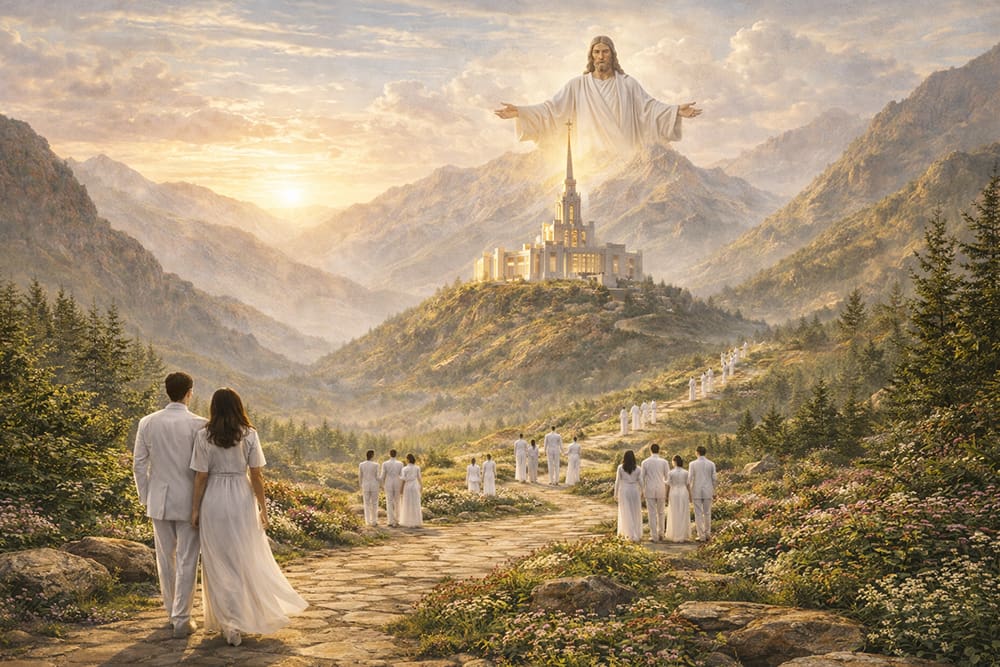
There is a way of reading Genesis that leaves us standing outside the text, admiring its antiquity the way one admires pottery behind museum glass. We note its literary structures, trace its documentary sources, catalog its ancient Near Eastern parallels, and move on—informed, perhaps, but entirely unchanged.
It is the peculiar tragedy of modern scholarship that it keeps immaculate records of things it has never really met. The text becomes a mere object of study: venerable, interesting, and firmly closed. A museum piece is lovely enough, but no one expects the pottery to suddenly speak; scripture, inconveniently for scholars, often does. A text that speaks has already smashed the glass case.

But there is another way of reading, older and stranger and more demanding, which insists that the text is a door rather than a display. The ancient rabbis who divided the Torah into its weekly portions understood this. They called each portion a Parashah, a “section,” but the word carries the scent of an opening up, an exposition. To read the Parashah was to enter it. The words cease to be ink and begin to behave like corridors. It was less like flipping a page and more like pushing open a well-oiled wooden door that creaks just enough to make you wonder what the Almighty is up to.
The God who once walked in gardens is not above meeting us again, even if we show up with dust on our shoes.
So did the early Christians who chanted the creation narrative over catechumens descending into baptismal waters, their bodies quietly doing what the words only dared to say.
And so, increasingly, do Latter-day Saints who recognize in these primordial stories the familiar architecture of their own temple worship—the same promise that the God who once walked in gardens is not above meeting us again, even if we show up with dust on our shoes. Heaven has never minded dust; it minds only distance.
The twelve Parashot of Genesis—from Bereshit to Vayechi—form a liturgical spiral. They trace humanity’s departure from the divine presence and chart the long, covenantal journey home. Read through the lens of restoration scripture, these ancient texts cease to be merely informative. They become transformative—a sacred cartography designed to lead the soul back through the veil and into the face of the Creator.1
The Cosmos as Sanctuary
Parashat Bereshit (Genesis 1:1–6:8)
The opening words of Genesis—Bereshit bara Elohim—have been parsed by grammarians for millennia. But grammar alone cannot account for the hush that falls over the reader who senses what is actually being described: the construction of a cosmic temple.2
The six days of creation follow a pattern that any temple-goer would recognize. Light is sundered from darkness as sacred space is carved out from chaos. Waters are gathered and bounded, echoing the great bronze sea that stood before Solomon’s sanctuary. Vegetation springs forth—the Tree of Life at the center—and luminaries are set in the heavens like the seven-branched menorah, casting their light into the Holy Place.3 It is as if creation begins by switching on the sanctuary lamp.
The temptation, the transgression, and the expulsion are the story of how humanity came to be separated from that sacred center, and how the long road back began.
The Sabbath, then, is no mere pause in labor. It is an enthronement—one in which the King sits down not because He is tired, but because creation is finally tidy enough for company. The Lord takes His seat within the completed sanctuary of the cosmos, and Adam and Eve are placed within the garden-temple as priests, clothed in glory, walking in the cool of the day with their Creator. The garden is the Holy of Holies. The man and woman are its ministers. And the narrative that follows—the temptation, the transgression, the expulsion—is the story of how humanity came to be separated from that sacred center, and how the long road back began.
The Book of Moses amplifies this drama with breathtaking intimacy. What Genesis compresses into spare prose, Moses expands into first-person revelation. The shifts in narrative voice—from “God said” to “I, the Lord God”—suggest what scholars have long suspected: these texts were performed.4
In early Christian baptismal rites, the creation and fall were recited as catechumens descended into the font and emerged, like Adam, into a new world. The text was script. It was the sort of theater where the stagehands are angels, the props are planets, and the audience keeps joining the cast midperformance.5 In such a drama, the surprise is not that the world is a stage but that the stage keeps expanding to fit new apprentices.
The Fall, in this rendering, is an expulsion from sacred space. Adam and Eve pass eastward, away from the Tree of Life, through the cherubim who now guard the way. But they do not leave empty-handed. God Himself clothes them in garments of skin—the first vestments, the original priesthood robes.6 Ancient Jewish sources understood these garments as more than covering for shame. They were investiture. They carried the authority and the promise that the way back would one day be opened.
The philosophers had asked for a Prime Mover; they received a Father with a broken heart.
And within this same Parashah, we encounter Enoch—a figure whose story Genesis barely sketches but whom the Book of Moses reveals in stunning fullness. Enoch sees something that shatters every assumption about divine impassivity: God weeps (see Moses 7:28-37).7
The universe is dry as mathematics until that moment when God, quite against the expectations of philosophers, reaches for a handkerchief. The vision is staggering. Enoch beholds the heavens weeping, the earth weeping, and at the center of it all, the God of heaven weeping over His children who have chosen darkness and imprisonment. “How is it that thou canst weep?” Enoch asks, bewildered.
The answer reorients everything: God’s tears flow because His children suffer. His anguish is not weakness but relation. He is not a distant architect; He is a Father watching His family wander into chains. A deity indifferent to suffering may be tidy, but He is not worth worshipping. This Enochic motif—preserved in ancient traditions and restored in the Pearl of Great Price—transforms the temple into a house of healing.
Heaven is not run by a celestial clerk stamping forms in triplicate; it is a Father flinging open prison doors. They are the means by which God’s tears are answered, by which the prisoners are released, and by which the breach between heaven and earth is finally repaired.
The Ark and the Altar
Parashat Noach (Genesis 6:9–11:32)
Parashat Noach recapitulates creation in reverse. The fountains of the deep burst open. The windows of heaven pour forth. The world returns to the watery chaos from which it was first organized. And in the midst of this un-creation, a single vessel floats: the Ark, with its three decks, its careful measurements, and its cargo of covenant life.
The rabbis noticed what modern readers often miss: the Ark’s dimensions mirror the later Tabernacle. Three levels. Increasing holiness. A microcosm of sacred space, preserving a remnant through the flood until the waters recede and the mountain emerges—the Even ha- Shetiyah, the Foundation Stone, the first solid ground of the new creation.8 The ark is less a boat than a boxedup future. The dove returns with an olive branch, and ancient tradition holds that she retrieved it from the Garden of Eden itself, whose gates had opened for her.9 The olive tree is the Tree of Life in miniature; its oil anoints priests and kings.
Noah’s first act on dry land is to build an altar. The smoke of his offering rises as a “restful smell,” and the Lord establishes His covenant with the sign of the bow in the cloud.10 The pattern is set: departure from the divine presence, preservation through trial, emergence into a renewed world, and the establishment of covenant through sacrifice. Every temple-goer walks this path.
Heaven, apparently, enforces the only building code that Babel consistently failed—humility.
Yet Noach also contains a warning. The builders of Babel seek to “make a name” for themselves, constructing a tower to storm the heavens by their own engineering.11 They are scattered. Their ascent fails because it is unauthorized, born of pride rather than covenant. Heaven, apparently, enforces the only building code that Babel consistently failed—humility.
By contrast, Enoch’s city—Zion—is “taken up” into the divine sphere, not by human effort but by divine invitation. The two paths diverge here and never converge: the Babylonian path of self-exaltation and the Zion path of covenantal purity.
The Call and the Covenant
Parashat Lech-Lecha (Genesis 12:1–17:27)
With Parashat Lech-Lecha, the narrative narrows. Universal history gives way to a single family, chosen and charged. Lekh lekha—”Go forth,” or better still, “Go to yourself”—is the divine command that sets Abraham on his journey toward a land he has never seen. It is the first great journey in which the destination is the traveler. It was a summons to lace up his sandals before he had the faintest idea what direction his feet would be taking.
Unlike the builders of Babel who sought to “make a name,” the Lord promises that He will make Abraham’s name great. The difference is everything.
The promises given to Abraham—posterity, land, a great name—are the blessings of the temple endowment, the conferral of priesthood power that will extend through his seed to all nations. Unlike the builders of Babel who sought to “make a name,” the Lord promises that He will make Abraham’s name great. The difference is everything. One name is carved on stone tablets by the Lord; the other is carved by men in wet bricks that don’t quite hold their shape. The name is given, not seized. It is received through covenant, not constructed through pride. And in the temple theology of the Restoration, this “great name” is understood as the sacred names and tokens that allow passage through the veil into the divine presence.
The covenant in Genesis 17 is notable for its inclusion of Sarah as an active participant.12 While previous iterations focused on Abraham, this version specifies that Sarah will be the mother of nations and that kings will arise from her. This reflects the Latter day Saint understanding of the “New and Everlasting Covenant of Marriage,” where both man and woman are required for the fullness of priesthood blessings.13 The covenant is not complete in the individual; it is completed in the union.
Divine Visitation and the Unthinkable Offering
Parashat Vayeira (Genesis 18:1–22:24)
Parashat Vayeira opens with three messengers appearing to Abraham at the oaks of Mamre. The domestic space becomes a site of revelation; the tent becomes a temple. Abraham washes their feet, serves them bread and meat, and receives the promise that Sarah will bear a son. The scene is a model of sacred hospitality—the proper reception of divine visitors that transforms ordinary space into holy ground. In Abraham’s tent, holiness arrives disguised as hungry travelers—proof that angels prefer supper to sermons. Hospitality, it seems, is the oldest liturgy.
But the Parashah culminates in the Akedah, the binding of Isaac, one of the most harrowing passages in all of scripture. God commands Abraham to offer his son—the child of promise, the heir of the covenant—as a burnt offering on Mount Moriah.14 The test goes contrary to reason, to prior commandments, and to every promise God has made. And yet Abraham rises early, saddles his donkey, and goes.
The heavens interrupt with that strange precision that feels like terrible timing only to those who cannot yet see the whole clock.
Ancient Jewish tradition identifies Mount Moriah with the future site of the Jerusalem Temple.15 The sacrifice of the ram in place of Isaac becomes the foundational act for the temple’s sacrificial system.
For Latter-day Saints, this underscores the necessity of the Atonement of our Lord as the ransom that allows humanity to escape the judgment foreseen by Enoch.16 Isaac is a type of Christ the beloved son, bound, laid upon the wood, willing to submit to the will of the Father.17 The angel’s intervention at the last moment is a reopening of the veil, a voice from heaven confirming Abraham’s faithfulness and renewing the covenant promises. The heavens interrupt with that strange precision that feels like terrible timing only to those who cannot yet see the whole clock.
Anchoring the Covenant in the Land
Parashat Chayei Sarah (Genesis 23:1–25:18)
Parashat Chayei Sarah begins with death—Sarah’s death—and Abraham’s purchase of the Cave of Machpelah as a burial site. This transaction is more than a funerary arrangement; it is the first legal acquisition of the Promised Land, a physical anchor for the covenant. The patriarchs and matriarchs will be gathered here: Abraham and Sarah, Isaac and Rebekah, Jacob and Leah. The cave becomes a family vault, a witness that the promise of land is not merely spiritual but tangible, rooted in specific soil. Faith may reach for the heavens, but it still insists on a deed to the soil. Faith may reach for the heavens, but it still insists on a deed to the soil.
The Parashah also narrates the search for a wife for Isaac—a meticulous quest to find a woman from Abraham’s own kindred, preserving the priesthood lineage.18 Rebekah’s willingness to leave her family and journey to an unknown land echoes Abraham’s own call. The pattern repeats: departure, trust, covenant.
The Birthright and the Blessing
Parashat Toledot (Genesis 25:19–28:9)
Parashat Toledot introduces the rivalry between Jacob and Esau, twins who struggled in the womb and whose conflict will shape the destiny of nations. Esau, the firstborn, is a man of the field; Jacob, the younger, dwells in tents.19 The “birthright” (bekhorah) is at stake—the right to preside over the family’s spiritual affairs, to hold the keys of the priesthood, and to receive the double portion. Esau sells his birthright for a bowl of lentil stew, despising it for immediate gratification.20 The stew was hot; the birthright was eternal. One cooled; the other endured. It is the oldest cautionary tale about trading eternity for lunch.
The stew was hot; the birthright was eternal. One cooled; the other endured. It is the oldest cautionary tale about trading eternity for lunch.
Jacob, by contrast, seeks the “blessings of the fathers” at any cost. The acquisition of Isaac’s blessing—while involving deception in the literal text—is interpreted in restoration scripture as the fulfillment of a pre-mortal election.21 The Lord had declared to Rebekah that “the elder shall serve the younger.” Jacob’s grasping, however morally ambiguous, aligns with a divine intention that precedes his birth.
The Ladder and the House of God
Parashat Vayetze (Genesis 28:10–32:3)
Fleeing from Esau’s wrath, Jacob lies down at a certain place with a stone for his pillow. In his dream, he sees a ladder—or perhaps a staircase, a ramp, a ziggurat of light—with angels ascending and descending, and the Lord standing above it.22 Joseph Smith taught that the three principal rounds of this ladder correspond to the three degrees of glory: telestial, terrestrial, and celestial.23
The path to heaven is the one staircase where the handrail is polished by constant angelic traffic.
Jacob discovers that heaven is not far—merely higher. Each rung is a covenant. Each step is an ordinance. The destination is the presence of God, who speaks from the top and renews to Jacob the promises given to Abraham and Isaac. Jacob awakens and declares, “This is none other than the house of God, and this is the gate of heaven” (Genesis 28:17). He names the place Beth-el—”House of God”—and sets up his stone pillow as a pillar, anointing it with oil. He has stumbled upon, or been led to, the prototype of every temple that would follow.
The ladder is the covenant path made visible, and Beth-el is the place where heaven and earth meet.24 It is the one staircase where the handrail is polished by constant angelic traffic. Jacob discovers that heaven is not far—merely higher.
The Embrace at Peniel
Parashat Vayishlach (Genesis 32:4–36:43)
Years pass. Jacob has wrestled with Laban, acquired wives and children and flocks, and now he must face the brother he wronged. The night before the reunion, he remains alone. And there, in the darkness, a man wrestles with him until dawn.
The Hebrew word for this wrestling—he’aveq—is peculiar. It may describe something more intimate than combat: a ritual embrace.25 In ancient temple liturgy, the “Sacred Embrace” was the moment when the god conferred upon the initiate three gifts: ankh (life), djed (stability), and was (dominion).26 These were transmitted through physical gesture—an embrace, a kiss, a clasping of hands. It appears that when the Windows of Heaven finally open, they do not reveal a lecture hall, but a living room; God, it seems, prefers a handshake to a dissertation. Revelation, like friendship, travels by touch more than theory. When the Windows of Heaven finally open, they do not reveal a lecture hall, but a living room; God, it seems, prefers a handshake to a dissertation. Revelation, like friendship, travels by touch more than theory.
Jacob emerges from this encounter with a limp and a new name: Israel, “one who has striven with God and prevailed”—or, as some ancient sources render it, “the man who has seen God.”27 He names the place Peniel, “the face of God,” and declares: “I have seen God face to face, and my life is preserved” (Genesis 32:30). When he meets Esau the next morning, Jacob says something extraordinary: “I have seen thy face, as though I had seen the face of God” (Genesis 33:10). The reconciliation with his brother is possible because he has first been reconciled with heaven. The embrace at Peniel has prepared him for the embrace at the ford. The temple makes peace possible.
The Garment of the Beloved Son
Parashat Vayeshev (Genesis 37:1–40:23)
The Joseph cycle begins with Parashat Vayeshev, introducing the theme of the beloved son and his rejection by his brethren. Central to this narrative is the ketonet passim, traditionally translated as a “coat of many colors” but understood in Latter-day Saint scholarship as a priesthood garment.28
The term passim likely refers not to colors but to marks or embroidery.29 The Greek chitona poikila suggests an ornamented tunic; the Vulgate’s tunicam polymitam refers to special needlework. This was the original garment of the priesthood, descended from Abraham to Isaac to Jacob and finally to Joseph—the younger son who held the birthright. The jealousy of the brothers was not over pretty colors but over authority. Ancient documents suggest that when Jacob felt the coat, he recognized it by three marks.
A man might find himself wearing the future before he has even lived through the afternoon.
This garment is linked to the garment of Adam in the Garden of Eden, which ancient sources claim was preserved through Noah and eventually reached Abraham. The “odor of the Garden of Eden” was said to cling to it, confirming its divine origin.30 The brothers strip Joseph of his garment, dip it in blood, and present it to their father as evidence of death. The imagery is unmistakable: the beloved son, rejected by his brethren, his priestly robe stained with sacrificial blood.
The coat of Joseph is a prophecy worn as clothing.31 It is hard to hide destiny when it hangs in your closet. It is a startling thought that the mind of God can be expressed in needlework, and that a man might find himself wearing the future before he has even lived through the afternoon.
The Revealer of Secrets
Parashat Miketz (Genesis 41:1–44:17)
Parashat Miketz depicts Joseph’s exaltation in the Egyptian court. Pharaoh gives him a new name—Zaphenath-paneah, variously interpreted as “the God has said: he will live” or “the revealer of secrets”—and a wife, Aseneth, the daughter of a priest of On.32 The disclosure of the new name is a vital element of temple ascent. God reveals His own name—and the new name of the disciple to those who approach the final gate.33
In the household of faith, even a wedding invitation is a summons to the cosmic stage.
Joseph’s elevation from prisoner to vizier mirrors the soul’s journey from bondage to glory, from the pit to the throne. The ancient book Joseph and Aseneth provides a temple-like expansion of the biblical text, explaining how a non-Israelite woman could marry a patriarch.34
In this narrative, Aseneth undergoes a conversion process that includes prayer, angelic visitation, and a ritual kiss that bestows upon her the spirit of life, wisdom, and truth. This ritualized marriage is an initiation into the covenant, mirroring the crowning of couples in ancient Christian wedding rites.35
It is the sort of romance that begins with an angel and ends with an altar, proving that in the household of faith, even a wedding invitation is a summons to the cosmic stage. In Egypt, Joseph rises by remembering the God whom Egypt had forgotten.
The Gatherer of Israel
Parashat Vayigash (Genesis 44:18–47:27)
In Parashat Vayigash, the reconciliation between Joseph and his brothers serves as a type of the final gathering of Israel. Joseph’s self-revelation—”I am Joseph your brother”—is a moment of profound emotional and spiritual turning (Genesis 45:3–4). The name Joseph connects to two Hebrew verbs: yasap (“to add”) and ‘asap (“to gather in”).36
This iterative divine action is a major theme in the Book of Mormon, where the Lord “sets his hand again the second time” to recover the remnant of His people.37 Joseph of Egypt is the gatherer of his family, providing them with provisions for the journey into a land of safety. Joseph’s role as a savior during the famine is a type of Christ.
Grace usually arrives in loaves long before it arrives in lectures.
Just as Joseph provided the physical bread of life to his brothers who had rejected him, Jesus Christ provides the spiritual bread of life to the house of Israel. The brothers who once found Joseph’s dreams intolerable now find his grain indispensable. Their envy had sold him; their hunger now summoned him.
It is the oldest proof that grace usually arrives in loaves long before it arrives in lectures. The remnant of the seed of Joseph is identified as a people of covenant who will play a key role in the latter-day harvest ingathering.
The Blessing of the Loins
Parashat Vayechi (Genesis 47:28–50:26)
The final Parashah, Vayechi, deals with Jacob’s last blessings upon his sons. The adoption of Ephraim and Manasseh as Jacob’s own sons ensures that the double portion of the birthright remains with Joseph’s house (see Genesis 48:5). The name Ephraim is a dual noun meaning “doubly fruitful,” signaling his destiny to become the firstborn in Israel.38
This fruitfulness is not merely physical; it is a priesthood fruitfulness that allows the descendants of Joseph to become a light to the nations and to deliver people from spiritual bondage. The brightest lamps are those lit from ancient fires.
In JST Genesis 48 and 50, Jacob prophesies of a future “choice seer” who would be raised up from the fruit of the loins of Joseph. This seer would be named after his father and after the patriarch Joseph, and he would do a marvelous work and a wonder to restore the knowledge of the covenants. The prophecy establishes a direct link between the Genesis patriarchs and the Restoration, framing the entire history of Israel as a single, unfolding temple drama.
The conclusion of Genesis is described as inhabiting the world to come. For Latter-day Saints, the “world to come” is the celestial kingdom, and the provisions for the journey are the covenants and ordinances revealed in the temple. We are like travelers packing for a country where the language is already familiar, and where even the stones seem to have been waiting for our arrival.
We are like travelers packing for a country where the language is already familiar, and where even the stones seem to have been waiting for our arrival. The turning initiated by Adam and Eve is completed when the house of Israel is reunited, blessed by their father, and looking forward to the day when they will return to the promised land—and beyond it, to the presence of God.
The Living Text
To read Genesis as a temple text is to refuse the role of spectator. The ancient Christians who performed the creation narrative over the baptismal font understood that scripture is not meant to be observed but inhabited. The marks on Joseph’s coat, the rungs of Jacob’s ladder, the embrace at Peniel—these are not antiquarian curiosities. They are invitations. They wait patiently, like hosts who knew you were coming even when you did not.
The twelve Parashot trace a path that every disciple walks—departure, trial, covenant, ascent, and return. The geography of Canaan becomes the architecture of the temple. The stories of the patriarchs become the pattern for our own lives. And at the end of the journey, as at the beginning, there is a face. “I have seen God face to face,” Jacob declared, “and my life is preserved” (Genesis 32:30).
Father is still waiting at the threshold, perhaps wondering why we took so long to find the key. The door, after all, was never locked.
This is the promise that Genesis holds out—not as history alone, but as prophecy. A prophecy that continues to be fulfilled every time a son or daughter of the covenant enters the house of the Lord and, through the ordinances there, is brought back into the presence from which humanity once departed.
The scroll is still unrolling—an ancient script that keeps adding characters who bear a suspicious resemblance to ourselves. The liturgy is still being sung, the door remains open, and the Father is still waiting at the threshold, perhaps wondering why we took so long to find the key. The door, after all, was never locked.
Footnotes
1 Jeffrey M. Bradshaw, The First Days and the Last Days: A Verse by Verse Commentary on the Book of Moses and JS–Matthew (Salt Lake City: Eborn Books, 2021). Bradshaw’s work synthesizes ancient Near Eastern temple theology with Latter-day Saint restoration scripture, arguing that the Book of Moses functions as a “temple text” designed to guide readers through the stages of the plan of salvation. See https://interpreterfoundation.org/books/the-first-days-and-the-last-days/
2 See https://latterdaysaintmag.com/the-creation-narratives-and-the-art-of-missing-the-point/
3 The menorah as cosmic symbol is discussed in Carol Meyers, The Tabernacle Menorah (Missoula, MT: Scholars Press, 1976).
4 The shifts in narrative voice in the Book of Moses—from third-person narration to first-person divine speech—have been analyzed by Bradshaw as evidence of a performative, ritual context. See Jeffrey M. Bradshaw, “The Ezekiel Mural at Dura Europos: A Tangible Witness of Philo’s Jewish Mysteries?” BYU Studies Quarterly 49, no. 1 (2010): 4–49.
5 The use of Genesis in early Christian baptismal liturgy is well attested. See Hugh Nibley, “The Early Christian Prayer Circle,” BYU Studies 19, no. 1 (1978): 41–78; and Bradshaw, “An Early Christian Context for the Book of Moses,” Interpreter: A Journal of Latter-day Saint Faith and Scholarship (2021), https://interpreterfoundation.org/journal/an-early-christian-context-for-the-book-of-moses
6 The “garments of skin” (kotnot ‘or) have been interpreted in Jewish tradition as priestly vestments. See Genesis Rabbah 20:12, which records a debate about whether the garments were of skin (‘or) or light (‘or, spelled differently). The Zohar elaborates on the garments as containing divine wisdom. For LDS interpretation, see Hugh Nibley, “Sacred Vestments,” in Temple and Cosmos (Salt Lake City: Deseret Book, 1992), 91–138.
7 The weeping God motif is unique to the Restoration and has no direct parallel in the Hebrew Bible, though it resonates with passages in Jeremiah and Hosea where God expresses grief over Israel. For analysis of the Enochic weeping tradition, see “Book of Moses Evidence: Themes of Weeping,” Scripture Central, https://scripturecentral.org/evidence/themes-of-weeping. See also Terryl Givens and Fiona Givens, The God Who Weeps: How Mormonism Makes Sense of Life (Salt Lake City: Ensign Peak, 2012).
8 The Even ha-Shetiyah (Foundation Stone) tradition is preserved in the Mishnah (Yoma 5:2) and elaborated in later midrashic sources.
9 The tradition that the dove retrieved the olive branch from the Garden of Eden is found in Genesis Rabbah 33:6. See also Bradshaw’s discussion of the olive tree as a symbol of the Tree of Life in “Temple Symbolism in the Garden of Noah,” Meridian Magazine, https://latterdaysaintmag.com/article-1-11852/
10 The “restful smell” (re’ach nichoach) of Noah’s sacrifice (Genesis 8:21) uses language that recurs throughout Leviticus in connection with the Tabernacle offerings, reinforcing the cultic context of the narrative.
11 The contrast between Babel and Zion is developed in Moses 7:18–21, where Enoch’s city is described as a community of “one heart and one mind” that is eventually “taken up into heaven.” See also Hugh Nibley, Enoch the Prophet (Salt Lake City: Deseret Book, 1986).
12 Genesis 17:15–16. Sarah’s inclusion in the covenant is emphasized by the change of her name from Sarai to Sarah and the explicit promise that she will be “a mother of nations.”
13 The “New and Everlasting Covenant of Marriage” is described in D&C 131:1–4 and 132:19–20. For the ancient roots of this concept, see Bradshaw’s discussion of the Abrahamic covenant in In God’s Image and Likeness 2: Enoch, Noah, and the Tower of Babel (Salt Lake City: Eborn Books, 2014).
14 Genesis 22:1–2. The command to sacrifice Isaac is introduced with the Hebrew word nissah (“tested”), indicating a trial of faith rather than a permanent demand.
15 2 Chronicles 3:1 identifies Mount Moriah as the site of Solomon’s Temple. The connection between the Akedah and the temple is developed extensively in Jewish tradition.
16 Moses 7:45–47. Enoch foresees the suffering of humanity and the necessity of the Atonement to redeem them from “measureless” judgment.
17 See Patrick D. Degn and David S. Christensen, Types and Shadows of the Old Testament: Jesus Christ and the Great Plan of Happiness (Salt Lake City: Deseret Book, 2018).
18 Genesis 24:1–67. The search for Rebekah emphasizes the importance of endogamy (marriage within the covenant community) for preserving the priesthood lineage.
19 Genesis 25:27. The contrast between Esau as “a man of the field” and Jacob as “a quiet man, dwelling in tents” has been interpreted symbolically: Esau represents the natural man, while Jacob represents the spiritual seeker.
20 Genesis 25:29–34. Esau’s sale of his birthright for “a mess of pottage” is cited in Hebrews 12:16 as an example of profanity—treating sacred things as common.
21 Genesis 25:23; see also Romans 9:10–13. The pre-mortal election of Jacob is a theme developed in restoration scripture; see 2 Nephi 3:4–5 and Abraham 3:22–23.
22 Genesis 28:12. The Hebrew sullam, traditionally translated “ladder,” may refer to a stairway or ramp, similar to the ziggurats of Mesopotamia.
23 Joseph Smith’s interpretation of Jacob’s ladder is recorded in Joseph Smith, discourse, 1843, in History, 1838–1856, volume D-1 [1 August 1842–1 July 1843], Joseph Smith Papers, Church History Library, The Church of Jesus Christ of Latter-day Saints, Salt Lake City, Utah, as excerpted in Teachings of the Prophet Joseph Smith, comp. Joseph Fielding Smith (Salt Lake City: Deseret Book, 1976), 304–5. See also Bradshaw, “In His Own Time, and in His Own Way: Jacob Ascends the Ladder of Exaltation,” https://latterdaysaintmag.com/in-his-own-time-and-in-his-own-way-jacob-ascends-the-ladder-of-exaltation/
24 Genesis 28:18–19. The anointing of the pillar with oil anticipates the later anointing of the Tabernacle and its furnishings (Exodus 40:9–11).
25 Jeffrey M. Bradshaw, drawing on Eugene Seaich, interprets the wrestling as a ritual embrace. See “In His Own Time, and in His Own Way: Jacob’s Ascent to the Heavenly Temple,” https://latterdaysaintmag.com/in-his-own-time-and-in-his-own-way-jacobs-ascent-to-the-heavenly-temple/
26 The Egyptian ankh, djed, and was symbols are well attested in temple iconography. For their ritual significance, see Erik Hornung, Conceptions of God in Ancient Egypt: The One and the Many, trans. John Baines (Ithaca, NY: Cornell University Press, 1982). Bradshaw applies this framework to the Peniel narrative in his Meridian Magazine and Interpreter articles.
27 The etymology of “Israel” (yisra’el) is debated. The folk etymology in Genesis 32:28 connects it to sarah (“to strive”). Other proposals include “God strives,” “God rules,” or “the one who sees God” (ish ra’ah El). President Russell M. Nelson taught, “With the help of two Hebrew scholars, I learned that one of the Hebraic meanings of the word Israel is ‘let God prevail.’ Thus the very name of Israel refers to a person who is willing to let God prevail in his or her life.” Russell M. Nelson, “Let God Prevail,” Ensign or Liahona, November 2020, 92–95, accessed February 4, 2026, https://www.churchofjesuschrist.org/study/general-conference/2020/10/46nelson.
28 Hugh Nibley, “The Garment of Adam,” in Temple and Cosmos (Salt Lake City: Deseret Book, 1992), 139–64.
29 The term passim in ketonet passim has been variously interpreted. The Septuagint renders it chitona poikilon (“ornamented tunic”), while the Vulgate has tunicam polymitam (“tunic of many threads”). Nibley and Bradshaw argue that the term refers to marks or embroidery indicating priestly authority.
30 The tradition that the garment of Adam carried the “odor of the Garden of Eden” is found in Pirke de-Rabbi Eliezer 24 and the Zohar.
31 The typological reading of Joseph as a Christ figure is ancient, appearing in patristic sources such as Ambrose’s De Joseph Patriarcha. For LDS development of this theme, see S. Kent Brown, “The Exodus Pattern in the Book of Mormon,” BYU Studies 30, no. 3 (1990): 111–26.
32 Genesis 41:45. The meaning of Zaphenath-paneah is debated; suggestions include “the God has said: ‘he will live’“ and “the revealer of secrets.” See Kenneth Kitchen, On the Reliability of the Old Testament (Grand Rapids: Eerdmans, 2003), 345.
33 The disclosure of the divine name and the new name of the initiate is a central element of temple theology. See D&C 130:11.
34 Joseph and Aseneth is a Jewish pseudepigraphal work, likely composed between 100 BCE and 115 CE, that narrates Aseneth’s conversion and marriage to Joseph in elaborate, ritual terms. See C. Burchard, “Joseph and Aseneth,” in The Old Testament Pseudepigrapha, ed. James H. Charlesworth (Garden City, NY: Doubleday, 1985), 2:177–247. For the “ritual kiss” and initiation motifs in Joseph and Aseneth, see Bradshaw’s discussion in “In His Own Time, and in His Own Way: Jacob’s Ascent to the Heavenly Temple.”
35 For Byzantine wedding rites, see Marriage in Byzantium: Christian Liturgical Rites from Betrothal to Consummation (Cambridge University Press, 2024).
36 Matthew L. Bowen, “‘I Shall Gather In’: The Name Joseph, Iterative Divine Action, and the Latter-day Harvest Ingathering of Israel,” Interpreter: A Journal of Latter-day Saint Faith and Scholarship (2020), https://scholarsarchive.byu.edu/cgi/viewcontent.cgi?article=1899&context=interpreter
37 2 Nephi 29:1; Isaiah 11:11. The “second time” motif emphasizes the iterative nature of God’s gathering work.
38 Genesis 41:52; Jeremiah 31:9. The name Ephraim (‘ephrayim) is a dual form, suggesting “double fruitfulness.” See Victor Hamilton, The Book of Genesis: Chapters 18–50, NICOT (Grand Rapids: Eerdmans, 1995), 510.
FEATURES