



When We Are Up Against a Red Sea—Come Follow Me Podcast, Exodus 14-18
Maurine
Welcome. We’re Scot and Maurine Proctor, and this is Meridian Magazine’s Come Follow Me podcast, where today we’ll study Exodus chapters 14 through 18 at the miraculous moment in the history of the children of Israel, where the Lord parts the Red Sea, and they pass through on dry ground in an ultimate triumph for the Lord over Egypt. Now, we have with us today Jeffrey M. Bradshaw. He has a PhD in cognitive science, but is particularly known by Latter-day Saints for his detailed commentaries on the Old Testament, the Pearl of Great Price, and temple themes in scriptures. He and his wife, Kathleen, are the parents of four children and many grandchildren, and have served missions in the Democratic Republic of Congo both in the mission office, and in the Kinshasa Temple. If Jeff writes anything, we always want to read it, and we’re so glad to have you with us today, Jeff. Welcome.
Jeff
There’s just tons of questions there that we could explore in Exodus, but for some reason, this afternoon, partly, I think, out of the influence of a wonderful essay I read that Maurine shared with me earlier, I’ve just been more focusing on the personal side. So I think we’ll post some articles on that. in the coming weeks about Exodus, and I would recommend one book to you if you really want to find something that has the latest scholarship on the Exodus, but is also, I think, from fairly believing folks. It’s called Five Views on the Exodus. Historicity, chronology, and theological implications, and the editors are Jansen and Gundry, and it’s got some great scholarship in their perspectives on the exodus.
Leaving that aside, I guess one of the things I just thought of an hour ago, that I really like to share with you, is from Ralph von Williams, Wonderful, 1906 English hymnal. And he’s my favorite 20th century composer, but he didn’t write the words, but to me, the words are very meaningful, when we were thinking about the Exodus.
“Father, hear the prayer we offer,
Not for ease, that prayer shall be,
But for strength, that we may ever
Live our lives courageously.
“Not for ever in green pastures
Do we ask our way to be,
But the steep and rugged pathway,
May we tread rejoicingly.
“Not forever, by still waters,
Would we idly rest and stay,
But would smite the living fountains
From the rocks along our way?
“Through our strength and hours of weakness
In our wanderings be our guide,
Through endeavor, failure, danger,
Father, be thou at our side.”
I think the thing that stands out to me most, when I think about the Exodus, is that one—not forever by still waters, would we idly rest and stay. Boy, we sure wish sometimes for those tranquil times of our childhood, those of us who had that privilege. But I like the image, instead of waiting by the water, of smiting the living fountains from the rocks along the way.
That takes faith, to just say, I’m going to forge ahead, with Abraham. You know, the rough translation that Nibley gave to Genesis chapter 12 of the beginning of Abraham’s stories, Lech lecha, which can be translated as, “Get up and get going.” I always think of Elder Oaks statement: “Revelation most often comes when we’re on the move. There’s just something about moving forward in faith that’s invigorating.
I’m hoping today that we can talk about the invigorating era in which we’re living right now, because I think we’re being forced to just move ahead into the unknown nearly every day, where hardly anything is constant, and everything’s on the move. in bad ways and sometimes in good ways. requires faith, and that faith brings such a vibrance to life, and, because that faith is confirmed when we exercise it, I think it also is a great strength to us as we move forward.
Maurine
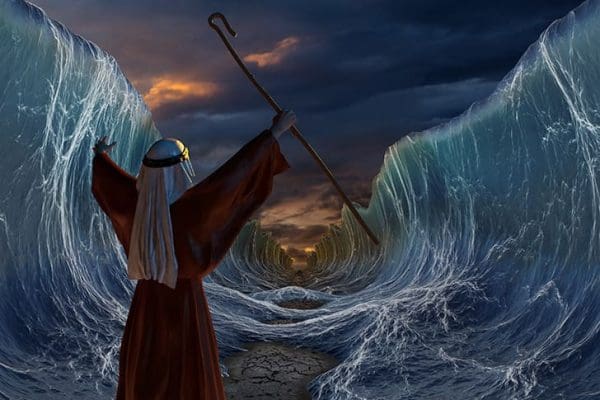
It’s interesting that when we exercise great faith, it’s usually because we’re moving into some kind of a wilderness. For the Children of Israel, it was a very real wilderness, with little vegetation, I guess, a few acacia trees, scarce water, and when they start, they think that Pharaoh has finally decided to let them go, but we see in the beginning of Exodus chapter 14, he has changed his mind. yet again. So here they are camped before the Red Sea, and the chariots of the Egyptians are coming upon them and they fear. I think it’s so interesting that as we read it from the comfort of our armchairs, we feel a little superior to the Children of Israel. We say, Come on, the Lord brought you out with a strong hand from Egypt. He’s shown you every kind of miracle you could ever imagine, and yet, here you are, trembling as this army is coming. I think it’s interesting, that the Children of Israel have moved from treading in mud and slops to make bricks, to seeing the greatest power in the ancient world brought to its knees on their behalf. If that’s not enough to demonstrate that God is with them, He leads them with a cloud by day and a pillar of fire by night. This is, after all, impressive stuff.
Still, when the destructive army, with blood in its heart, comes pounding toward them, the children of Israel are simply terrified, and they yelled, “Because there were no graves in Egypt, hast thou taken us away to die in the wilderness? Wherefore, hast thou dealt thus with us to carry us forth out of Egypt? Is not this the word that we did tell thee in Egypt, saying, Let us alone, that we may serve the Egyptians? For it had been better for us to serve the Egyptians than that we should die in the wilderness.”
We think, ho, ho, ho, from our armchairs, and we’re not in the wilderness ourselves when we’re reading this, and we think, “How could you be so silly as to forget that the Lord is with you?” But it’s a different thing in our own lives when we are suddenly thrust into these very threatening situations, where we have a Red Sea before us and an army coming at us, and we know that—I‘m using that here as a metaphor—but we have those times that we are simply full of anxiety when we would like to be full of faith. How can we be full of faith at those times?
Jeff
Well, I have one thought on that, and again, another… one of my favorite sayings is coming to mind. I can’t tell you the author of it now, but, essentially, it’s in French, it says, “La foi est un doute qui va de l’avant”, which means, more or less in English, faith is doubt that forges ahead, sure, to find the truth. So I think the answer there, at least for me, is just to plunge ahead and I think the reason my faith has grown when I plunge ahead, just don’t get paralyzed by doubt or uncertainty, is because that faith has been confirmed time after time. I’m so grateful for that.
I find that when I move ahead with faith, somehow, to use a metaphor of President Packer, that headlight, the shining in front of me, maybe 5 or 10 feet, keeps shining ahead of me five or 10 feet as I move forward, and I can see enough to take the next few steps. It’s not anything profound or anything fancy, but, I have found, through experience, that when we move ahead in faith and do the best we can, rather than just wondering what we should do, that light will keep ahead of us, and our faith will be confirmed.
Maurine, I like what you said about our armchair observations of the Children of Israel, because sometimes we’re pretty critical of them in going right back to fear when they’ve seen all these miracles. Now we sit here and read it in a book, and we’ve read it all of our lives, and we know these stories, but they’re in the midst of it and they forget all the miracles. I have to say, okay, now, do I do the same thing sometimes? If I’m facing a very, very difficult challenge, or I’m feeling depressed or dark or discouraged, do I forget all the miracles the Lord has extended to me? Do I forget all the blessings that I’ve received? Do I forget all those amazing prayers that were answered over the years?
The answer is sometimes yes. That is what brings about fear, is forgetting. So I think that’s what we’ve talked about many times in our marriage, that important word that President Kimball talked about in the scriptures, that most important word is “remember.” So, there the Children of Israel were. It wasn’t really that long since the miracles, but they’re already forgetting, and, boy, does that bring about fear if you forget. Well, and fear is such an overpowering feeling. It’s hard to remember anything else.
Maurine
I use the word “fear” to encompass, stress, anxiety, all the sorts of negative emotions that paralyze us, hold us back, bring us pain, because they hurt, and they’re real, and they’re very powerful, and to remember, at that time, is critically important. In fact, I found, in my own life, that if I’m in one of those storms of fear, that I’m also being filled with lies about the nature of my life, or the nature of my experience, or I am catastrophizing what is about to happen. So, I stop, and I tell myself true things that I absolutely know. I fight the lies with the truth, and I say, “Well, I may be afraid right now, but I absolutely know that God lives. I absolutely know that I have seen Him answer my prayers again and again. I know He loves me because I have felt that in my past. I can remember that.
It’s interesting, as I say to myself these true things, these little glimmers of light, these thoughts of light, the darkness begins to go away. Because fear is a kind of cloud that is self-generating. gets worse and worse as we sit there and stay, instead of move back into the light in our thinking.
Jeff
When I think about remembering, and I think that’s really powerful, what Scot said, and what you said about remembering the truth rather than the lies, to me, my favorite friend is the scriptures. In Shadowlands, C.S. Lewis says, “I read to know that I’m not alone.”
To me, my go-to place isn’t just my own thoughts. My recourse is, of course, to prayer, but I love the scriptures because I find that when I’m feeling quite alone, there are people there going through things that resonate with me, and I say, you know, I recognize what they’re going through, because that’s exactly what I feel. It’s not exactly necessarily what I’m going through because they’ve gone through much greater things than I’ve ever experienced. I especially love Genesis and Exodus, because I feel so close to the characters that are there. They just touch me to my heart and when I read them, I don’t feel alone because they feel so real to me.
They feel real to me in a paradoxical way, not, because, I have ultimate trust in the history, but because spiritually, I can say, I know that the experiences that they describe in their accounts of scripture are real. I can trust them.
Scot
I am especially moved by the faith that has come to other members of God’s family throughout the scriptures as they reflect on the exodus of the Children of Israel, especially Nephi. He is constantly saying things like, “Let us be strong, like unto Moses,” and when he’s trying to remind Laman and Lemuel to stop, murmuring so much, he reminds them of all the things that they know from their childhood. They’ve known these things all their lives. Nephi tells them, “You know that Moses put forth his hand, and the Lord parted the Red Sea, and they did walk across the Red Sea on dry ground,” and “You know all these things.”
In our dispensation, the Lord refers to this specifically in section 8, and he puts it in a very interesting context, because he says, “For behold, I will tell you in your mind, and in your heart, by the Holy Ghost, which shall come upon you, and which shall dwell in your heart, now behold,” and then he describes, this is the definition, this is the spirit of revelation. Then he says, this is the spirit by which Moses brought the children of Israel through the Red Sea on dry ground. So he’s tying in the whole definition of revelation with Moses, bringing the Children of Israel through the Red Sea.
I’d be interested in your thoughts about that, Jeff, because that’s always moved me, and I think there’s something to that that we can all learn.
Jeff
Well, do you mind if I share a personal experience on revelation and going through the desert? I guess I’ll just say by way of preface, I don’t want to compare anything I’ve done to what they went through in the desert, but in fact, the desert, for me, has always been a comforting place. I love the Utah deserts, especially not far from where I grew up in Salt Lake, and we’d love to spend my time down there.
So it was kind of natural back in 2006, when I had a chance to go a little ways north from Oman into the empty quarter, the Rub’ al Khali and we made a short stop there. The specific location we were at is a fairly remote place. There’s a place called Ubar there that’s reputed to have gone back to about 3000 BC, a crossing of two trails that was only discovered in the early 1990s by NASA looking at satellite maps. So we took the trail, I say we, because I took a guide who’d been recommended to me named Ahmed, and we took our car out in the desert. The whole way out there, we joked and talked about stories. He’d heard about people who got lost out there, some who’d lost their lives, some whose car got stuck or they’d been attacked by people, and we were kind of laughing them off, and I said, “Okay, it’s about time to go back.”
We were out there about 30 miles somewhere. off the road, and I said, I just want to go out here and walk for a while. I want to walk for a while, just where I see sand in all directions, and nothing else. So I got out of sight of the car, and everything else, and fortunately, I found my way back to the car, but there was Ahmed digging underneath the tire, letting some air out, and he’d gotten stuck. The car had gotten stuck. We just couldn’t move it. We couldn’t budge it. In fact, the sand was so doggone hot, we could hardly dig.
We decided the only thing to do was to walk out. Fortunately, there was a road we were on, that we found, and started walking, but we were a long ways away for such a walk. We walked pretty well until about the sun went down, and then we continued. About the time the moon disappeared, we somehow lost the road. It was just impossible to see. Ahmed started getting tired, and I’d say, “Let’s keep going,” and he’d say, “I just want to rest a little while.” These five or ten minute naps, every half hour, meant we were losing time. One time, I walked back half an hour to find him there, because he hadn’t caught up with me. Finally, I just felt prompted, “You better keep moving,” and it was kind of crazy. I thought about staying near where I was, because I was kind of near the road that way, I really wasn’t sure which way to go, but I just kept feeling prompted.
I needed to move ahead, partly with the thought that when the sun came out, we had basically drunk all our water, and being that far away from civilization, it wouldn’t take long to be just dried up, dried up and shrivel away, especially if I was moving the wrong direction. I fancied at one point that I could see just a little faint glow off in the distance. At that point, I was a little bit delirious, and I wasn’t sure if it was real or not, but I, thought, “lead kindly light.” I was too hoarse to sing it, but it ran through my mind in strange ways. I just said, I’ve got to keep moving forward. I’ve got to keep moving forward,” and to keep going in that direction.
The problem is, you know, if you’re 20, 25 miles out, and you’re just a few degrees off course, and the only town, of any consequences, is Ubar, then you could miss it very easily and just keep going. I could have been going the opposite direction for all I knew. You know, we all heard, Elder Uchtdorf’s talk about walking in circles, how people tend to walk in circles, especially with no landmarks. That’s the way it was. Beautiful, though.
Anyway, make a long story short, I really felt… guided. It was the complete absence of any landmarks that led me to a total reliance on God. Finally, I got to one point, and I felt I had to stop, you know. I thought about Jacob out there in the wilderness, laying my head on the stones, and I slept for about half hour, and then I thought—it was about 4 a.m. there—and I thought, I’ve got to keep moving, because once the sun comes up, there’s going be nothing in any direction. I’m not going to be able to get anywhere besides I’ll just dry up and blow away like a tumbleweed. About 5 a.m., I started to hear a little hum and it turned out, there were some generators out there in the desert. I thought, oh, it could just be a power plant, or who knows what? Maybe unmanned. But it turned out to be a little village. It was almost sunrise. Our beautiful Muslim friends are going be getting up for the sunrise minarets. If I actually get to this little village and can lay down on the sidewalk, they’ll find me, and that’s about as much strength as I had. Then I heard the most beautiful thing I’ve ever heard in my life—sure enough, that beautiful, beautiful sound calling them to prayer. It finally sounded, and one of the families came over, saw me lying on the sidewalk, and then ran back to the house, and got me a gallon jug of water, and then they went off to prayer, and I drowned that thing so fast, you couldn’t believe it. I just lay on the sidewalk and was full of joy.
I don’t know why I went through that experience, except for that really taught me, because the desert had never been that unfriendly to me, and I’d probably never been quite that lost in my life before. I’ve had a few other situations where my life has flashed before my eyes. But I really, I really learned for myself that when we have no other landmark that God can guide us. I don’t think that was a physical light I was following, at least not at first. I certainly didn’t hear anything, at least not till the last hour. But I knew that God was leading me along. I think in some ways, I’ve never been the same since.
So, my own experience, I’m sure, not so daunting, is sort of the experiences of deserts and terrible trials that people go through, especially those people who are suffering things every day of their life. It’s very small. But, I know that God is real and that his faith can lead us when we have nothing else to direct us, and that has changed me. When you have that kind of experience that is so sacred, and you’ve relied on the Lord, and He’s been there for you, it helps you understand in those times when you pray, and it feels like you’re not getting any answer, and your problem is very complex before you, that he really is still there.
Maurine
If he remembers you in the empty quarter, he remembers you in your empty bedroom, as you were praying with all your heart, for a child, or a grandchild, or something that lies before you, that is truly frightening, because you’re not sure it will work out at all. Scot, we had a wonderful experience when a lot was at stake. When we were trying to get into Oman, the first time we went to the best candidate for Nephi’s Bountiful, we needed to get in because we were taking photographs for a book we were doing, and it just didn’t look like we were going to possibly get in.
We talked to someone in Jerusalem who was in travel, and they said, We can’t get you a visa here to get into Oman. You’ll have to fly to Cairo and so we did.
Scot
If you want to talk about a wilderness experience, just be in the traffic in Cairo. The first thing we did was go to the United States embassy, and they said there was absolutely no way you’ll get into Oman. In those days, this was 30 years ago. They only issued 8,000 visas a year, and 6,000 of them were for Arab-speaking people, and the other 2,000 were mainly for Africans and Europeans. So we just really were told, you cannot get a visa, but they gave us a letter that said that we had permission to at least try to obtain a visa. We got into this taxi from our hotel to go to the Omani embassy, and it was amazing what happened, because, first of all, our taxi driver was dressed in white, and he had a white skull cap. This is not uncommon in that country, but he seemed almost like from another world. He was very calm and very spiritual, it seemed. And we told him we were going to the Omani embassy, and he started driving, and the traffic was just horrible. But at that moment, the Spirit whispered to both of us, didn’t it, Maurine, that we were feeling absolutely calm, and that everything would work out, and then the Spirit told you a most interesting thing.
Maurine
Well, the spirit was really kind in this, and it was interesting that there was such noise and cacophony around us with this traffic. It was horns blaring, and all kinds of ruckus, and you wouldn’t think that would be a moment where you’d feel the Spirit calm you, but we were very nervous about going to this embassy, because we knew it was just almost impossible to get a visa, and we really needed to. This huge calm that came over us, and the Spirit said that when we went into the embassy, that we should not take no for an answer, and that I should respond culturally like an Arab woman. In other words, I shouldn’t go up and assert myself and fill out my own form, and that kind of thing, that I should hold back a little when we went into the embassy, which is not my natural tendency.
Scot
At all. So, we went in there, and we went to the man in charge, and he was sitting there at his desk, and he said, “May I help you?” And we said, “Yes, we would like to obtain visas.” I always slow down and kind of put a little accent into my voice.
Maurine
Of course it’s not the right accent. It’s just whatever comes.
Scot
“We would like to get visas for your country, for Oman”, and I handed him our passports and said, “If that would be possible.” He said, It is impossible, and he handed the passports back to us, and that was the end of the conversation.
But we also had the impression, at that point, that it wasn’t going to be the end of the conversation, and so we just sat across from his desk on the couch and looked at him, and we just kept staring at him. We stared at him for probably 30 or 40 minutes, and he started fidgeting, and he started getting nervous. Finally, he kind of motioned us to come up, and he said, “Perhaps I can give you visas next Tuesday, Inshallah,” which means, according to the will of God, and so in our minds, we gave each other a high five because we knew that it was His will that we get in. Sure enough, next Tuesday we came in, and the visas were stamped for us, and we were able to get into Oman, which was a great miracle and led to all kinds of amazing things.
But I do know what you’re saying, Jeff, that the Lord can direct in any situation. He can give revelation. He can put ideas into your mind. He can give you that light that you think that you’re seeing, or he can give you that sound that you heard so that you could continue forward. He really does take care of his children in the wilderness, and he gives them revelation and understanding that they need for that specific situation. In our situation, in that embassy, He just gave us the calm that this was absolutely going to happen even though we’d just been told it was impossible.
Maurine
We felt that calm so keenly, we went and booked non-refundable tickets to get into Oman, knowing that we were going to be able to go, even though all the signs said no. I think that is what the Lord can do for you. You don’t just spend your life looking at the outward signs that are right there, because so often they look threatening, they look like, “No, no, no, things aren’t going to work out well.” The Lord knows how to quietly make things work out well. That was a very significant trip for us and opened all kinds of doors.
Scot
Jeff, I’m fascinated by the fact that every time the crossing of the Red Sea is mentioned in scriptures, it always has that little phrase that says “on dry ground,” What is the Lord telling us? Is it just that it’s not a sloppy miracle? It’s a really nice miracle, or what have you thought about that? Because it’s always there with that account.
Jeff
I’ve never thought about it, so I don’t have anything deep to say about it, except for, I think, it’s, like many other literary beauties in scripture that it’s a very nice literary construct that kind of is almost hyperbole. We know that the ground wasn’t completely dry, right? It was wet under their feet, no matter whether there was one inch or two inches or minus one inch there. But I think it’s trying to say, to develop the contrast between the Egyptian chariots and the Israelites who had faith, that one was, you the rock that stood firm, and the other was washed away.
Maurine
One thing that interests me in this whole account is the development of Moses. He tells the Lord so often that he’s inadequate, that he can’t do it, that this is too much for him, and then, he develops to the point that he can raise a rod and part the Red Sea. What interests me about that is what the Lord can do with pretty raw material in terms of sanctifying us, helping us grow in confidence and ability and understanding.
It seems like a perfect type of what can happen to the Children of Israel, who are murmuring and wavering all over the place, if they’ll really put their trust in the Lord. This development of Moses is a promise for what can happen to us, that we can become a different people than the weak and sometimes fearful people that we are.
Jeff
Let me tell you another story about some of the people I love in the Democratic Republic of Congo and Africa. I think I’ll use them as an example of developmental strength, compared to us, I think, many times when I look at the problems that they face in many parts of the world, including in the Congo, I think that the Lord has granted them such great faith and miracles, as I think we all feel, because they have, in short, conquered the challenges they have.
A brother, by the name, I’ll call him a brother, he wasn’t a member of the church at the time, but he feels like a brother to me named, lived with his family in a remote region of what was then Zaire, what is now the Democratic Republic of the Congo. In 1975, he began looking for a new church. There were troubles in his church, that he and others, in neighboring villages, had been attending, and people were scattering, some here and some there, and he really went to the Lord and wanted to know what to do. So, talk about in a desert, remote place, the Lord, knowing him and helping him, it was there. He decided to fast and pray for three days. One night, during his fast, he had a dream where he was given the answer to his prayer. He saw the names of three churches mentioned in his dream. I don’t know exactly what it looked like, but somehow those three churches were names were given to him.
He chose a scriptural way of getting an answer to his prayers. We sometimes don’t think about this, and I’m not sure I can recommend it, but he said, “I’m going to cast lots.” So, you know, you submit several options to the Lord and let him choose. That’s actually in Proverbs 16:33, I think it says, “The lot is cast into the lap, but the disposing thereof is from the Lord.” He had enough faith to believe that. So he got all the men gathered inside this little grass hut and all the women and children outdoors. That was just the way it was done, in their culture, and he wrote the names of the three churches on three pieces of paper. He threw up in the air, and they landed on the ground, face down, and then he called a young man from the outside. He came in, and it had to be that innocent child who came and picked one of them, and on it was the name of our church.
They did that three times, and each time it was the name of our church. So, they decided that they were going to name themselves, The Church of Jesus Christ of Latter-day Saints. At that time, The Church of Jesus Christ of Latter-day Saints, was not in the Congo. There weren’t any missionaries there until 1986. Yet, he didn’t even know if there was such a church out there. But, they formed a church, and it wasn’t until a couple years later, according to the version of the report that I got that a Catholic nun wandered by and said, “Oh, that’s the church in Salt Lake City.”
They said, “Where’s Salt Lake City?” They wrote a letter to President Kimball at that time and got a reply from President Faust I think, the reply came in 1979. They wanted to have some church materials and things, and Elder Faust’s letter said, “I advise that the church is not now organized, and your part of the world, and we are unable to say at this time whether or not whether we will be able to have any activity organization in the future. I pray the Lord will bless you in your interest in the gospel of Jesus Christ.” End of story.
Seven years later, after they continued meeting through all that time, a mission president said he was coming to a city that was only 800 kilometers away, so he wrote him a letter and said, “Please come and meet me at the airport.” Of course, my friend didn’t get the letter until long after he’d come, so he didn’t get to meet him or any other church representative, but his group just kept on meeting.
In 1991, the mission president sent an expedition up there to see if anybody was still there. They had more than 500 people who were meeting together in about a dozen villages, reading the Book of Mormon in little Sunday school classes each week. I think it was the Book of Mormon that kept him going. The brother who went up there wrote a report, and they were immediately forgotten again.
Really, the only other word we have from them in the next two decades was two other brothers who wandered out into a district conference and came from nowhere in 2013, several hundred kilometers in ragged clothes, and a couple bicycles They were ordained to the priesthood and probably sent back. None of the other people had been baptized, even. Now, in 2021, we heard these accounts and wanted to find out if they were still there.
So just through a set of miracles, two missionaries who spoke their dialect, who had just come home from their missions went out to this very remote area. They made a two-week journey by boat and raft and sleeping on the top of a banana truck. And lo and behold, these congregations were still meeting, the third and fourth generations, the founders having long passed away.
You know, you think of the scripture in Hebrew, right? “These all died in faith, not having had the promise, but saw it from afar.” A few, maybe a handful, had made it to some city and been baptized, but the rest were waiting. One thing I’m excited about is next month, I get a chance to go out there with a counselor from the mission presidency. We’re renting a little private plane and going out there to that remote area. And the nearest branch is now only 200 kilometers away. Well, it’s group, not a branch. I’m thinking about those people who are begging, according to the missionaries who were sent out there, begging to be baptized, begging to have the blessings of the temple, which they’ve heard about, but never seen, blessings of the priesthood, so they can bless their children and who are sharing the Book of Mormon.
One young man, who the missionaries found was asked on a video, “Have you ever read the Book for Mormon?” And he said, “Yes,” just very modestly. They said, “Well, how many times?” He just said so sweetly, “So many times, I can’t count.” Here they were being tested for their faith.
Sometimes, I guess my thought is this: sometimes the miracle of faith and wandering in the wilderness alone may take decades for some of us. I’m really praying, along with some of our other friends, that they don’t have to wait much longer to have their prayers answered, and to receive the gospel, which they love and value so much.
The Lord never forgets any of his saints in the end, though he sometimes makes them wait a long time.
Maurine
I love that story, and I wonder how we can become more constant friends of the Lord. It’s so easy to have fear overwhelm us, or take stock of the popular trend of the day and distance ourselves from the Lord. What do we do to be constant, to be as they would say, all in? Because that’s where miracles are found. That’s where you begin to feel Him in a different way. I think that fear and hard times and times when you’re not hearing an answer are hard to live with if you haven’t, at one point, made a decision that no matter what, you’ll stand by him, because fear is very corrosive to your spirit, and murmuring is very corrosive to your spirit. Any thoughts on that, Jeff?
Jeff
The answers are so, so simple that it sounds almost trite but I find strength in scripture study and prayer. I find that if I do that every day, I just feel the Lord speaking to me throughout the day. I feel like I drift through life unaffected. I just don’t feel the corrosive influences when I remember to do those simple things.
Scot
I absolutely agree, and as you were talking, Maurine, and then, as you commented, Jeff, I was thinking about the children of Israel and how the Lord sent manna to them every day, and we have, later, the teachings of the Savior in the Sermon on the Mount, as he taught us what we refer to as the Lord’s Prayer, where we say, give us this day our daily bread. There’s a kind of a reference to the manna, and we think, well, that doesn’t happen today because we don’t go out and gather this manna from the ground, like they did in those days, but we do receive daily bread from the Lord, and we also come to realize that that daily bread is the bread of life, and it comes from our daily reading in the scriptures.
To me, this whole thing is connected with receiving manna every day in the wilderness: “Give us this day our daily bread,” and as we read the scriptures, study them every day, and have our prayers, we really do receive the things that we need, and the Lord never leaves us wanting, as we are absolutely faithful in this thing. I am a firm believer in receiving that daily bread from the word every day. I really am.
Jeff
Okay, could I add something? I guess what impels me to hold on to the iron rod is the fact that I see what God has done and is doing in the world as real. I think it was Neal A. Maxwell who quoted from the works of a British writer, who said, “If men could see the work of God and His kingdom as brightly and as much of a reality as they see Fleet Street, they would hardly have a feeling for any other motive than to give their lives to God.”
It sort of comes down to, to me, in what is more absolute and real and foundational in life. Is it these transitory goals that take our attention every day? Or is it the supernal realities of eternity? When those things are firmly in view, then the corrosive and terrible influences of life fade away, and the goodness and the opportunities to do God’s work in the world becomes paramount and becomes more real, and all the fading glory of man’s achievements.
Maurine
I think having a true understanding of God’s attributes is really important, because some of us think of him falsely as a vending machine. We say a prayer, we want a certain outcome, a certain thing to happen, and we expect to see it immediately. That’s not the God we have. He is working on a much larger project, which is our souls and fitting them for heaven, fitting them for his presence. I think if we can trust that, instead of saying, Why didn’t this happen to me? And when it should have. I had a young friend, I was talking to, who said to me, “I thought that when I graduated from college, I’d have a husband and a good job, and I have neither a husband nor a good job. Therefore, God doesn’t love me.” That seems to me to come from a very false understanding of what he’s about. Because what he’s about is our feasting on this word, and coming to understand things from a completely different point of view about what’s important, what matters, and to feel his love in some real ways, even when things are really tough for us. We can feel him in powerful, powerful ways.
Scot
We have delighted today being with Jeffrey Bradshaw, as he has joined us in this podcast, and we thank him for sharing his thoughts and his testimony today. As always, we thank Jenny Oaks Baker for the music which accompanies this podcast, and we’re grateful to our producer, Michaela Proctor Hutchins. Have a wonderful week and see you next time.
FEATURES