




The Secret Life of Trees—and What It Teaches Us About Zion

The attack begins quietly. A cluster of bark beetles pierces the outer bark of a spruce, tunneling inward where sap once flowed freely. To a passerby, nothing seems amiss. The tree does not cry out, sway, or fall. Yet inside its tissues, alarms are already sounding. Volatile organic compounds rise through the trunk and into the air, while deeper still, another message travels more urgently—downward, into the roots, and outward through microscopic fungal filaments woven through the soil like living threads. The wounded tree is calling for help.
Within this underground network, neighboring trees receive the signal. Some begin producing defensive chemicals that make their bark hostile to the insects. Others divert carbon and nutrients toward the injured spruce, strengthening it against the invasion. What appears above ground as a solitary tree under siege is, in truth, a communal struggle. As the Apostle Paul wrote, “whether one member suffer, all the members suffer with it.” Long before humans understood the science, creation itself was already living that truth.
Scenes like this reveal how astonishing the secret life of trees truly is. Far from passive, isolated organisms locked in silent competition, trees participate in a dynamic system of communication, cooperation, and mutual care—one that functions largely beyond human sight. Beneath the forest floor lies an intricate biological infrastructure often called the wood wide web, formed by symbiotic fungi known as mycorrhizae. Through this network, trees exchange chemical signals, water, carbon, and minerals, responding collectively to threats and sustaining one another through stress, disease, and scarcity.
I’ve recently been reading about the growing scientific understanding of how trees communicate and share resources—as in the example above. I was both amazed and astonished by what I see as the hand of our creator in the phenomenon. This led me to thinking about how the example of trees actually offers a meaningful analogy for how communities of Saints are invited to live and care for one another.
Researchers describe forests not as collections of isolated organisms but as living networks, where trees are connected through underground fungal systems allowing them to exchange nutrients, send warning signals, and sustain weaker members of the grove. This wood wide web challenges older assumptions about competition as the primary driver of survival and instead highlights cooperation, interdependence, and long term stewardship. For Latter-day Saints, this picture resonates deeply with gospel teachings about unity, covenant responsibility, and the quiet but essential ways disciples strengthen one another.
In a forest, mature trees often play a crucial role in the health of the whole. Through underground networks, they can direct water, carbon, and minerals to saplings growing in the shade or to trees damaged by disease or drought. These older trees do not thrive by hoarding resources. Their strength is expressed by sharing what they have so the forest as a whole can endure. In the restored gospel, a similar pattern appears in the Lord’s vision of Zion. The Saints are taught in Moses chapter seven that they should be of one heart and one mind and there should be no poor among them. This unity is not merely emotional agreement. It is practical, lived support, where those with greater strength, experience, or resources lift those who are still growing.
The wood wide web also reveals communication in a forest is often subtle and unseen. Trees send chemical signals through their roots and fungal partners to warn neighboring trees of pests or environmental threats. The exchange is not loud or dramatic, yet it can mean the difference between resilience and collapse. In a ward or branch, much of the most important ministering happens in similar ways. A quiet text message, a meal left on a doorstep, a listening ear after a long day, or a prayer offered in private can transmit spiritual nourishment and reassurance.
Doctrine and Covenants Section 42 teaches Saints are to care for the poor and the needy, administering to their relief both spiritually and temporally. This charge does not always require public recognition. Like the forest network beneath the soil, covenant care often works best when it is steady, humble, and motivated by love rather than visibility.
Another striking aspect of tree communication is it does not erase individuality. Each tree remains distinct, with its own shape, species, and role within the ecosystem. Cooperation does not require uniformity. Instead, diversity strengthens the system, since different trees contribute different resources and respond differently to stress. The Church of Jesus Christ of Latter-day Saints is likewise composed of individuals with varied backgrounds, talents, and testimonies. Paul’s teaching that the body has many members, each with a necessary function, aligns well with this natural pattern. When Saints recognize not everyone gives or receives in the same way, they can better appreciate how the Lord weaves diverse contributions into a unified whole.
The science of forest networks also underscores the cost of disconnection. When land is over harvested or the fungal networks are damaged, trees become more vulnerable to disease and environmental extremes. Isolation weakens them. For Saints, spiritual isolation carries similar risks. President Russell M. Nelson has repeatedly emphasized the importance of ministering and covenant belonging, especially in a world where loneliness and fragmentation are increasing. When members withdraw from one another, whether through neglect, judgment, or simple busyness, the community loses channels through which faith, hope, and resilience flow. Rebuilding those connections requires intention, patience, and sometimes repentance, much like restoring a damaged ecosystem requires time and care.
There is also a lesson in how trees support those that appear least productive. Some trees that no longer produce leaves or seeds may still receive nutrients through the network, remaining alive for years. Scientists suggest these trees can still contribute structurally or ecologically in ways not immediately obvious. In the gospel context, this challenges Saints to reconsider how they view worth and contribution. Individuals who struggle with illness, doubt, age, or disability may not fit common expectations of productivity, yet their presence, prayers, and quiet endurance can bless a ward in profound ways. The Savior’s ministry consistently affirmed the value of those on the margins, and the covenant community is strongest when it honors the same principle.
Seeing the forest through the lens of cooperation rather than competition invites Saints to reflect on stewardship. Trees do not consume endlessly without regard for others. Their survival is tied to the health of the whole environment. Likewise, the law of consecration, whether lived formally or informally, calls members to see their time, talents, and resources as entrusted by God for the blessing of His children. Supporting one another is not an optional kindness. It is a covenant expression of discipleship. As King Benjamin taught, service to others is inseparable from service to God.
The wood wide web does not replace faith or doctrine, yet it offers a powerful natural parable. God often teaches through His creations, and the interconnected forest stands as a living example of life flourishing through shared strength. For communities of Saints, this scientific insight affirms a gospel truth. We are not meant to stand alone. Through covenants, ministering, and daily acts of care, the Lord binds His people together, allowing spiritual nourishment to flow where it is most needed. Like a healthy forest, a healthy community of Saints grows resilient, compassionate, and enduring when each member is willing to share light, strength, and sustenance with those around them.
Why Did the Lord Talk About One Mighty and Strong?
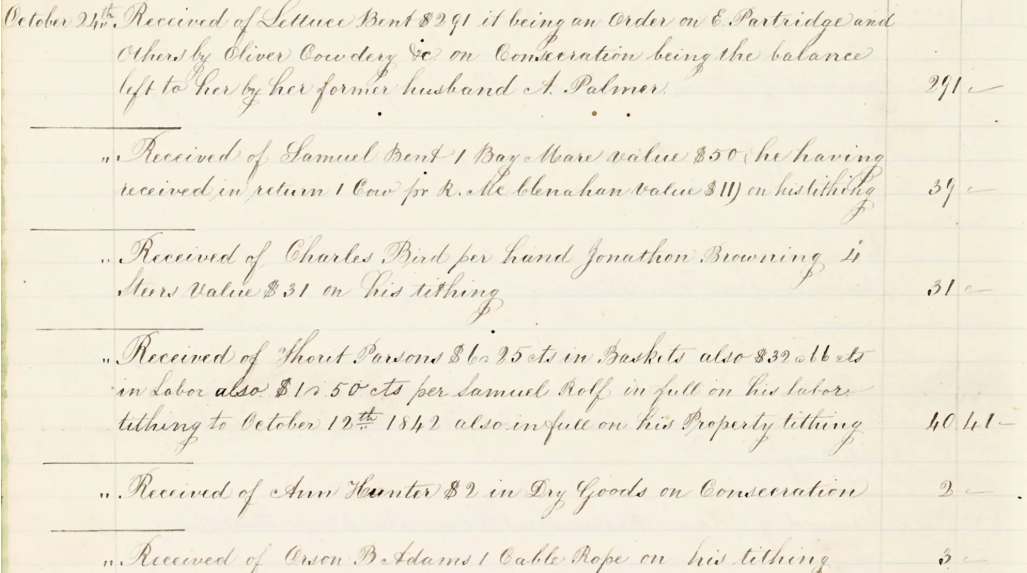
“And it shall come to pass that I, the Lord God, will send one mighty and strong, holding the scepter of power in his hand, clothed with light for a covering, whose mouth shall utter words, eternal words; while his bowels shall be a fountain of truth, to set in order the house of God, and to arrange by lot the inheritances of the saints whose names are found, and the names of their fathers, and of their children, enrolled in the book of the law of God.” Doctrine and Covenants 85:7
The Know
In November 1832, the Prophet Joseph Smith wrote a letter to William W. Phelps after returning to Kirtland, Ohio. At the time, Phelps was responsible for Church publications in Independence, Missouri, and was an influential Latter-day Saint there. In his letter, Joseph addressed issues that the Church in Missouri was facing. Most prominent among these was the issue of Saints receiving inheritances in Zion under the law of consecration.1 During this time, “at least some individuals had not followed the commandment to consecrate their properties and had consequently not received an inheritance.”2
In this context, Joseph clarified, “It is the duty of the Lord’s clerk, whom he has appointed, to keep a history, and a general church record of all things that transpire in Zion,” including the actions of the faithful and those who apostatized from the Church (Doctrine and Covenants 85:1–2). Furthermore, only those who lived the law of consecration could receive all the blessings promised to them by the Lord.3
In the letter, Joseph also included a prophecy that would eventually become Doctrine and Covenants 85. According to this prophecy, “one mighty and strong, holding the scepter of power in his hand, clothed with light for a covering” would be called by God “to set in order the house of God, and to arrange by lot the inheritances of the saints whose names are found . . . in the book of the law of God.” Furthermore, “that man, who was called of God and appointed, that putteth forth his hand to steady the ark of God, shall fall by the shaft of death, like as a tree that is smitten by the vivid shaft of lightning” (Doctrine and Covenants 85:7–8).
Due to the strong language of this prophecy, many have wondered whom the “one mighty and strong” might refer to. Some individuals, after having left the Church, have even claimed that they were this individual, often in an effort to gain notoriety or form their own splinter organization. However, in so doing they ignore the context behind this prophecy and misread what position is being referred to by the Lord.
The most comprehensive and authoritative commentary on this section was provided in 1905 by the First Presidency, then consisting of Presidents Joseph F. Smith, John R. Winder, and Anthon H. Lund.4 In their statement, the First Presidency rightly noted that “this whole letter, as also the part of it subsequently accepted as a revelation, relates to the affairs of the Church in Missouri, the gathering of the Saints to that land and obtaining their inheritances under the law of consecration and stewardship; and the Prophet deals especially with the matter of what is to become of those who fail to receive their inheritances by order or deed from the bishop.”5 As such, the prophecy must be viewed in this light.
Before Joseph wrote his letter, the Lord had called Edward Partridge to be the bishop of the Church and oversee the Church in Missouri. As a part of his duties, Bishop Partridge would “divide unto the saints their inheritance, even as I have commanded,” and he was “appointed to be a judge in Israel, like as it was in ancient days, to divide the lands of the heritage of God unto his children” (Doctrine and Covenants 57:7; 58:17). In other words, the bishop’s duty in Zion was to “to set in order the house of God” as a judge in Israel, and he was appointed “to arrange by lot the inheritances of the saints whose names are found . . . in the book of the law of God” (Doctrine and Covenants 85:7).
Furthermore, between 1831 and 1833 there was much conflict between the Church leaders in Independence and Kirtland. As the First Presidency observed in 1905, “The brethren in those days were limited in their experience. The Church had been organized but as yesterday. The order of the Priesthood was not understood then, as it is today.”6 Thus, corrections had to be issued frequently to preserve the unity of the Church. Occasionally, these corrections even had to be issued to Edward Partridge.7 It would appear that this was one such correction: “[Edward Partridge] was warned of the judgment of God impending, and the prediction was made that another, ‘one mighty and strong,’ would be sent of God to take his place, to have his bishopric —one having the spirit and power of that high office resting upon him . . . in other words, one who would do the work that Bishop Edward Partridge had been appointed to do, but had failed to accomplish.”8
However, Bishop Partridge repented and faced some of the most intense persecution for his testimony when the Saints were driven out of Jackson County, Missouri. In an uncanonized revelation to Joseph Smith given on November 7, 1835, the Lord expressed that He was pleased with Bishop Partridge and that Partridge was forgiven of his sins.9 As such, he “undoubtedly obtained a mitigation of the threatened judgment,” so the coming forth of one mighty and strong “may also be considered as having passed away and the whole incident of the prophecy closed.”10 Furthermore, in instructions to Oliver Cowdery delivered in 1834, Joseph Smith clarified that the warning against steadying the ark of God was a general warning to all the Saints and did not refer to anyone in particular.11
In their statement, the First Presidency also noted that if this prophecy was not just a conditional warning and entailed a future fulfilment, the one mighty and strong “will be a future bishop of the Church who will be with the Saints in Zion, Jackson county, Missouri, when the Lord shall establish them in that land. . . . He will be designated by the inspiration of the Lord, and will be accepted and sustained by the whole Church, as the law of God provides.”12 Furthermore, the phrase “set in order the house of God” in this revelation “should most certainly be interpreted by the whole subject of the revelation”; therefore, this phrase is “limited to setting in order the house of God by arranging by lot the inheritances of the Saints.”13 As such, this will not entail the overturning of God’s Church or His prophet.14
The Why
Ever since this revelation was received, it “has been used by vain and foolish men to bolster up their vagaries of speculation, and in some cases their pretensions to great power and high positions they were to attain in the Church,” noted the First Presidency in 1905.15 However, the Lord’s Church is a house of order, and such claimants to special power or authority outside of the Church can therefore be summarily dismissed.
This was not a new issue at the time of the prophecy. In 1830, Hiram Page had a seer stone through which he claimed to receive revelations regarding the upbuilding of Zion and the Church. As the Lord revealed through Joseph, however, such was not the case: “No one shall be appointed to receive commandments and revelations in this church” except the prophet (Doctrine and Covenants 28:2). This doctrine has been repeatedly emphasized by the prophets and apostles of the Church since this time.16 As with any calling or priesthood office, “no man taketh this honour unto himself, but he that is called of God, as was Aaron” (Hebrews 5:4). If this prophecy was not merely a conditional prophecy and does pertain to some future bishop of the Church, he will likewise be called of God through the proper revelatory channels.
Because there are those who do make these claims, however, it is important for Latter-day Saints to be aware of the context and full meaning behind this revelation. This is especially important so they can avoid accidentally seeking to steady the ark of God, as this revelation warns against. As the First Presidency taught, “The Latter-day Saints . . . should be so well settled in the conviction that God has established his Church in the earth for the last time, to remain, and no more to be thrown down, or destroyed; and that God’s house is a house of order, of law, of regularity. . . . The Church of Christ is with the Saints.”17
Further Reading
Casey Paul Griffiths, Scripture Central Commentary on the Doctrine and Covenants, 4 vols. (Scripture Central; Cedar Fort, 2024), 3:89–96.
Steven C. Harper, Making Sense of the Doctrine and Covenants: A Guided Tour Through Modern Revelations (Deseret Book, 2008), 304–6.
Joseph F. Smith, John R. Winder, and Anthon H. Lund, “One Mighty and Strong,” Improvement Era, October 1907, 929–43.
For a deeper spiritual discussion on this section and how to apply it today, listen to the Come Follow Me Podcast on D&C 85–87.
Endnotes
- 1. For a discussion on how the law of consecration was practiced in 1832 and why Latter-day Saints still keep this commandment today, see Scripture Central, “Why Are Saints Invited to Live the Law of Consecration? (Doctrine and Covenants 42:30),” KnoWhy 791 (May 6, 2025).
- 2. “Letter to William W. Phelps, 27 November 1832,” historical introduction, The Joseph Smith Papers; see also Casey Paul Griffiths, Scripture Central Commentary on the Doctrine and Covenants, 4 vols. (Scripture Central; Cedar Fort, 2024), 3:89–90.
- 3. Doctrine and Covenants 85:3–5. See Steven C. Harper, Making Sense of the Doctrine and Covenants: A Guided Tour Through Modern Revelations (Deseret Book, 2008), 304–6, for a discussion on how this section clarifies aspects of the law of consecration and the Saints’ agency.
- 4. Joseph F. Smith, John R. Winder, and Anthon H. Lund, “One Mighty and Strong,” Improvement Era, October 1907, 929–43. This statement was originally published in Joseph F. Smith, John R. Winder, and Anthon H. Lund, “First Presidency Statement,” Deseret News, November 11, 1905. This statement has also been made available in James R. Clark, ed., Messages of the First Presidency of The Church of Jesus Christ of Latter-day Saints, 6 vols. (Bookcraft, 1965–71), 4:107–20.
- 5. Smith, Winder, and Lund, “One Mighty and Strong,” 933.
- 6. Smith, Winder, and Lund, “One Mighty and Strong,” 934.
- 7. See, for example, Doctrine and Covenants 58:14–16; 84:54–58; 90:34–36.
- 8. Smith, Winder, and Lund, “One Mighty and Strong,” 937.
- 9. This revelation reads, in part, “I am well pleased with my servant Isaac Morley and my servant Edward Partridge because of the integrity of their hearts in laboring in my vineyard for the salvation of the souls of men. Verily, I say unto you, their sins are forgiven them.” Stephen O. Smoot and Brian C. Passantino, eds., Joseph Smith’s Uncanonized Revelations (Religious Studies Center, Brigham Young University; Deseret Book, 2024), 77.
- 10. Smith, Winder, and Lund, “One Mighty and Strong,” 939–40. The First Presidency goes on to liken this incident to the sickness and healing of Hezekiah recorded in 2 Kings 20:1–6. In that prophecy, Hezekiah was told he would soon die, but it was then rescinded when Hezekiah prayed to the Lord. As such, the coming forth of one mighty and strong could likewise be a conditional prophecy that passed without incident due to Bishop Partridge’s repentance.
- 11. These instructions have been preserved in a letter from Oliver Cowdery to John Whitmer dated January 1, 1834: “Brother Joseph says, that the item in his letter that says, that the man that is called &c. and puts forth his hand to steady the ark of God, does not mean that any one had at the time, but it was given for a caution to those in high standing to beware, lest they should fall by the shaft of death as the Lord had said.” “Letter to William W. Phelps, 27 November 1832,” p. 3n14, The Joseph Smith Papers.
- 12. Smith, Winder, and Lund, “One Mighty and Strong,” 941. They continue: “His coming will not be the result of a wild, erratic movement, or the assumption of authority by a self-appointed egotist seeking power that he may lord it over the people; God’s house is one of order, and admits of no such irregular procedure.”
- 13. Smith, Winder, and Lund, “One Mighty and Strong,” 942.
- 14. Stephen E. Robinson and H. Dean Garrett, A Commentary on the Doctrine and Covenants, 4 vols. (Deseret Book, 2000–2005), 3:73–74, also note that Jesus Christ is the archetypal one mighty and strong and that should there be a future or millennial presiding bishop, he will need to be called by God in the proper order established by God.
- 15. Smith, Winder, and Lund, “One Mighty and Strong,” 930.
- 16. For more on this, see Scripture Central, “Why Does God Give Revelation for the Church Only to the Presiding Prophet? (Doctrine and Covenants 28:2),” KnoWhy 783 (March 18, 2025).
- 17. Smith, Winder, and Lund, “One Mighty and Strong,” 942. See also Mark E. Peterson, “Salvation Comes Through the Church,” Ensign, July 1973.
How Did the Joseph Smith Translation Serve as a Springboard for Many Revelations?

The following article was originally published at Scripture Central. Visit their website here.
“And, verily I say unto you, that it is my will that you should hasten to translate my scriptures . . . for the salvation of Zion. Amen.” Doctrine and Covenants 93:53
The Know
Between June 1830 and July 1833, the Prophet Joseph Smith spent much of his time working on a new translation of the Bible (commonly referred to as the Joseph Smith Translation, or JST, today). Significantly, Kent P. Jackson and other scholars have noted, “Over half of the revelations in the Doctrine and Covenants came between June 1830 and July 1833, the time during which Joseph Smith was working on his New Translation of the Bible.”1
Because of this, it should not be surprising to find repeated references, allusions, and other connections to the Joseph Smith Translation of the Bible within the Doctrine and Covenants. Indeed, as Robert J. Matthews, one of the leading scholars on the JST, observed, “Many verses in the Doctrine and Covenants do not radiate their full meaning and are obscure to a modern reader until he learns that there is a connection to Joseph Smith’s translation of the Bible.”2 The fact that so many revelations were received during the time when the work on the translation of the Bible was underway “is not a coincidence but a consequence. It was Joseph Smith’s study and translation of the Bible that set the stage for the reception of many revelations on the doctrines of the gospel.”3
Throughout Joseph’s revelations, readers will find “regulatory and instructional information about the Joseph Smith Translation, giving direction about when to begin, when to pause, who is to scribe, and what parts of the Bible to translate next, as well as exhortation to move more rapidly and make plans for publication.”4 From Joseph’s revelations, we learn that Sidney Rigdon, John Whitmer, and Frederick G. Williams had each been called at various points to scribe for Joseph Smith during the translation process.5 These scribes took their calls seriously and were of great aid to Joseph Smith during the translation process.
Other passages in the Doctrine and Covenants instruct Joseph when to pause or continue the translation given the needs of the Church.6 Once the translation had been completed, the Lord also gave the Saints instructions to print the new translation and secure its copyright, though neither of these could be accomplished in Joseph Smith’s lifetime.7 Other revelations stressed how important this work would be for the Saints. In one memorable passage, the Lord instructed Joseph, “I say unto you, that it is my will that you should hasten to translate my scriptures . . . for the salvation of Zion. Amen.”8
Many revelations came as Joseph and his scribes learned new and important doctrines while translating the Bible. As Matthews observed, “Often revelations of doctrinal significance first came to Joseph Smith during his labors with the translation [of the Bible].”9 Occasionally a revelation would come as questions were raised during the translation process. One of the most memorable and important revelations in this dispensation regarding the kingdoms of glory came precisely because Joseph’s revelatory translation of John 5:29 caused Joseph and Sidney to marvel and meditate on what they had just learned (see Doctrine and Covenants 76:18–19). Doctrine and Covenants 77 is a series of questions and answers about the book of Revelation that arose as a result of the translation process. Furthermore, portions of Doctrine and Covenants 132 regarding plural marriage were first revealed to Joseph as early as 1831 when he was translating the chapters in Genesis about Abraham and Sarah.10
Doctrine and Covenants 29:31–42 contains information about “the spiritual and temporal creations, agency, the rebellion of Lucifer, the fall of Adam and the introduction of the gospel to Adam and his posterity.”11 All these themes are found in JST, Genesis (located in Moses 1–4), which Joseph Smith had translated before receiving this revelation.12 Similarly, the law of consecration was only revealed after Joseph Smith had received Moses 6–7, relating to Enoch and the city of Zion, as well as many of the revelations referring to the location of Zion in this dispensation. In these cases, it would appear that the Joseph Smith Translation was a strong influence on the Saints’ understanding of building a Zion community preparatory for the Second Coming.13
Another important doctrine that was first revealed to the Saints through Joseph’s translation of the Bible was the age of accountability. In JST, Genesis 17:11, the Lord tells Abraham, “Children are not accountable before me until they are eight years old.”14 This portion of the Bible was translated sometime in the spring of 1831 and was undoubtedly shared with the Church when it was received. Later, in November 1831, the same doctrine would be reiterated in Doctrine and Covenants 68:25–27. Thus, this important point of clarification, which was not mentioned by Mormon in his letter found in Moroni 8, was revealed “six to nine months earlier than it appears in the Doctrine and Covenants.”15
Doctrine and Covenants 84:25–27 also contains material regarding the Melchizedek and Aaronic Priesthoods that parallel JST, Exodus 34. While it is not clear which revelation came first, both were received close together: Section 84 was received September 22 or 23, 1832, and JST, Exodus 34 was translated sometime in August or September 1832.16
Another revelation, found in Doctrine and Covenants 86 and containing an explicit and expansive explanation of the parable of the wheat and the tares, was received in connection with the Joseph Smith Translation of Matthew 13.17
The Why
Because the Joseph Smith Translation was so prominent in the revelatory process, it provides important context for modern readers who want to better understand Joseph Smith’s revelations. Robert J. Matthews explained, “As we become better acquainted with the books of holy scripture, we more fully recognize that it is important to our understanding to look into the background whence the revelations came. . . . Until we have become familiar with the background, our comprehension of any book is liable to be superficial.”18
The Joseph Smith Translation of the Bible provides much of that context. Kerry Muhlestein observed,
In the infancy of the Church, Joseph’s revelatory work on translating the Bible and his other concurrent revelations laid, stone by stone, a doctrinal foundation upon which the Church would firmly stand. The revelations resulting in the Joseph Smith Translation, which he called the New Translation, and those in the Doctrine and Covenants are not two separate sides of this foundation but are instead many individual stones that overlay and interlock.19
As such, the JST is, according to Matthews, “a preliminary source for many of the theological statements in the Doctrine and Covenants.”20
Furthermore, the Joseph Smith Translation “was the means and the process by which many of the doctrines of the gospel were revealed in the very early days of this dispensation.”21 It also served to aid Joseph Smith in his own understanding of the gospel and the Bible as well. As the Lord Himself later described, He always speaks to His prophets “after the manner of their language, that they might come to understanding” (Doctrine and Covenants 1:24). In this way, the Joseph Smith Translation helped Joseph become more familiar with the Bible while also providing the means whereby plain and precious truths of the gospel could be restored.22 In many ways, his faithful and diligent work on the Joseph Smith Translation of the Bible helped Joseph to magnify and fulfill the calling that he had received from God to become the Prophet of the Restoration in this culminating dispensation of the fullness of times.
Further Reading
Kent P. Jackson, Understanding Joseph Smith’s Translation of the Bible (Religious Studies Center, Brigham Young University; Deseret Book, 2022), 157–71.
Kerry Muhlestein, “One Continuous Flow: Revelations Surrounding the ‘New Translation,’” in The Doctrine and Covenants: Revelations in Context, ed. Andrew H. Hedges, J. Spencer Fluhman, and Alonzo L. Gaskill (Religious Studies Center, Brigham Young University; Deseret Book, 2008), 40–65.
Robert J. Matthews, “Doctrinal Connections with the Joseph Smith Translation,” in The Doctrine and Covenants: A Book of Answers, ed. Leon R. Hartshorn, Dennis A. Wright, and Craig J. Ostler (Deseret Book, 1996), 27–42.
Robert J. Matthews, “A Plainer Translation”: Joseph Smith’s Translation of the Bible, a History and Commentary (Brigham Young University Press, 1985), 255–66.
Robert J. Matthews, “The Joseph Smith Translation: A Primary Source for the Doctrine and Covenants,” in Hearken, O Ye People: Discourses on the Doctrine and Covenants (Randall Book, 1984), 79–92.
1. Kent P. Jackson, Understanding Joseph Smith’s Translation of the Bible (Religious Studies Center, Brigham Young University; Deseret Book, 2022), 157. See also Robert L. Millet, “Joseph Smith’s Translation of the Bible and the Doctrine and Covenants,” in Studies in Scripture, vol. 1, The Doctrine and Covenants, ed. Robert L. Millet and Kent P. Jackson (Deseret Book, 1989), 138, who notes that approximately 56 percent of the Doctrine and Covenants was revealed during this time period.
2. Robert J. Matthews, “Doctrinal Connections with the Joseph Smith Translation,” in The Doctrine and Covenants: A Book of Answers, ed. Leon R. Hartshorn, Dennis A. Wright, and Craig J. Ostler (Deseret Book, 1996), 29.
3. Robert J. Matthews, “A Plainer Translation”: Joseph Smith’s Translation of the Bible, a History and Commentary (Brigham Young University Press, 1985), 256. Mattews continues on this page: “There is an inseparable connection between the New Translation of the Bible and many of the revelations that constitute the book of Doctrine and Covenants.”
4. Matthews, “Doctrinal Connections,” 28.
5. See Doctrine and Covenants 35:20 for Sidney Rigdon’s call; Doctrine and Covenants 47:1 for John Whitmer’s call; and an uncanonized revelation dated January 5, 1833, for Frederick G. Williams’s call. For a discussion on the context of this uncanonized revelation as well as the text of the revelation itself, see Stephen O. Smoot and Brian C. Passantino, eds., Joseph Smith’s Uncanonized Revelations (Religious Studies Center, Brigham Young University; Deseret Book, 2024), 57–58.
6. See Doctrine and Covenants 37:1, 41:7, and 73:3–4. Elsewhere, the Lord instructed Joseph to pause the translation of the Old Testament to focus on the New Testament (Doctrine and Covenants 45:60–61), to not translate the Apocrypha (Doctrine and Covenants 91), and to pause the translation efforts for a time (in an uncanonized revelation dated March 20, 1832). For a discussion on the context of this uncanonized revelation and the text of the revelation itself, see Smoot and Passantino, Joseph Smith’s Uncanonized Revelations, 55–56.
7. See Doctrine and Covenants 94:10–12; 104:58; and 124:89–90. A portion of section 104 dealing with securing the copyright of the new translation has not been canonized but can be found in Smoot and Passantino, Joseph Smith’s Uncanonized Revelations, 59–61. In the case of Doctrine and Covenants 124:89–90, William Marks was instructed to print the new translation, but he did not obey this counsel; see Matthews, “Doctrinal Connections,” 40.
8. Doctrine and Covenants 93:53. Doctrine and Covenants 42:12–15 also suggested that the JST would be used to teach the fullness of the gospel when it would be completed. Other passages related to the coming forth of the JST include Doctrine and Covenants 42:56; 43:13; and 90:13.
9. Matthews, “Doctrinal Connections,” 28. See also Matthews, “Plainer Translation,” 257.
10. It is likely that this came as a direct result of Joseph reading about the patriarchs Abraham and Jacob having multiple wives while he was translating the Old Testament. For discussions on this topic, see Jackson, Understanding Joseph Smith’s Translation, 169–70, Casey Paul Griffiths, Scripture Central Commentary on the Doctrine and Covenants, 4 vols. (Scripture Central; Cedar Fort, 2024), 4:235–36.
11. Robert J. Matthews, “The Joseph Smith Translation: A Primary Source for the Doctrine and Covenants,” in Hearken, O Ye People: Discourses on the Doctrine and Covenants (Randall Book, 1984), 82–83. Matthews also notes, “The doctrinal emphasis of these topics is clear and prominent in the JST but is almost totally lacking in any other Bible.” See also Matthews, “Doctrinal Connections,” 32; see also Matthews, “Some Relationships,” 4–5.
12. For a discussion on how this revelation and the JST fit together alongside the Book of Mormon’s teachings on the Creation and Fall, see Kerry Muhlestein, “One Continuous Flow: Revelations Surrounding the ‘New Translation,’” in The Doctrine and Covenants: Revelations in Context, ed. Andrew H. Hedges, J. Spencer Fluhman, and Alonzo L. Gaskill (Religious Studies Center, Brigham Young University; Deseret Book, 2008), 51–52. Also see Jackson, Understanding Joseph Smith’s Translation, 158–59, for a comparison between the wording of the Joseph Smith Translation and Doctrine and Covenants 29 to highlight how this revelation was influenced by the JST.
13. See Doctrine and Covenants 38:4; 42:1, 2, 30–55, 59; 45:11–12. For discussions on how these sections were influenced by the JST, see Matthews, “Doctrinal Connections,” 34–36; Matthews, “Primary Source for the Doctrine and Covenants,” 83–86; Matthews, “Some Relationships,” 6; Muhlestein, “One Continuous Flow,” 53, 57, 61.
14. For the complete Joseph Smith Translation in parallel columns with the King James Version, see Kent P. Jackson, ed., Joseph Smith’s Translation of the Bible: The Joseph Smith Translation and the King James Translation in Parallel Columns (BYU Press; Religious Studies Center, Brigham Young University; Deseret Book, 2021).
15. Matthews, “Some Relationships,” 7; see also Matthews, “Plainer Translation,” 260–261; Matthews, “Primary Source for the Doctrine and Covenants,” 87; Matthews, “Doctrinal Connections,” 40; Matthews, “Some Relationships,” 8; Millet, “Joseph Smith’s Translation,” 140.
16. See Jackson, Understanding Joseph Smith’s Translation, 165.
17. Jackson, Understanding Joseph Smith’s Translation, 165–66; Matthews, “Doctrinal Connections,” 38. See further John W. Welch, “Modern Revelation and the Parable of the Wheat and the Tares: A Guide to Research About the Apostasy,” in Early Christians in Disarray: Contemporary LDS Perspectives on the Christian Apostasy, ed. Noel B. Reynolds (Foundation for Ancient Research and Mormon Studies, 2005), 101–32.
18. Matthews, “Some Relationships,” 2.
19. Muhlestein, “One Continuous Flow,” 40–41; see also Millet, “Joseph Smith’s Translation,” 142.
20. Matthews, “Doctrinal Connections,” 28.
21. Matthews, “Plainer Translation,” 265; see also Matthews, “Doctrinal Connections,” 40, 42; Thomas E. Sherry, “What If There Were No Joseph Smith Translation of The Bible?,” in Joseph Smith and the Doctrinal Restoration, ed. W. Jeffrey Marsh (Religious Studies Center, Brigham Young University; Deseret Book, 2005), 319.
22. See Matthews, “Primary Source for the Doctrine and Covenants,” 90; Scott H. Faulring, Kent P. Jackson, and Robert J. Matthews, eds., Joseph Smith’s New Translation of the Bible: Original Manuscripts (Religious Studies Center, Brigham Young University, 2004), 20.
Visit Scripture Central’s website here.
What is Your Ebenezer?

We are thrilled with the addition of the hymn “Come Thou Fount of Every Blessing” to the new hymnbook. We sing:
Here I raise my Ebenezer,
Here by Thy great help I’ve come,
And I hope by Thy good pleasure,
Safely to arrive at home.
An Ebenezer is a stone of help. A stone was originally set up by Samuel as a token of gratitude for deliverance from the Philistines. An Ebenezer is a sign to Heavenly Father to express our gratitude for all He has blessed us with.
One of the questions I am asked most often when teaching Emergency Preparedness and on Facebook is: “I’m spending all this time, effort, and money to prepare and I have friends and family who tell me they will just come to our house when disaster strike. I don’t really want to share when they had money, time and space to do it themselves. Am I wrong?”
We were recently watching a show interviewing survivors of the Lahaina fire and telling their story. At one point we commented that there were a lot of homeless and wondered how many people opened their homes to survivors. There are only so many rentals and hotel rooms available following a disaster.
Imagine a fire storm such as in southern California or a hurricane such as in North Carolina this past year. The stores are gone, as is everything you owned. There are only so many things you can purchase on your credit card and financial help from agencies is extremely small. What do you do? Hopefully, there will be people around to fill in the gaps. That can be us!
“And behold, thou wilt remember the poor, and consecrate of thy properties for their support that which thou hast to impart unto them, with a covenant and a deed which cannot be broken. And inasmuch as ye impart of your substance unto the poor ye will do it unto me…..” D&C 42: 30-13
Who are the poor? Joseph Smith reminds us. Poor does not refer just to those who are having trouble paying their bills but also those who are poor in spirit. Those who have lost hope. Those who have lost faith.
Bishop H. David Burton, Presiding Bishop: “The Prophet Joseph Smith taught that it is our responsibility ‘to feed the hungry, to clothe the naked, to provide for the widow, to dry up the tear of the orphan, to comfort the afflicted, whether in this church or in any other, or in no church at all, wherever he finds them’ (Times and Seasons, 15 Mar. 1842, 732). May we be generous with our time and liberal in our contributions for the care of those who suffer” (“Go, and Do Thou Likewise,” Ensign, May 1997, 77).
Matthew 25:37–40: “Then shall the righteous answer him, saying, Lord, when saw we thee an hungred, and fed thee? or thirsty, and gave thee drink? When saw we thee a stranger, and took thee in? or naked, and clothed thee? Or when saw we thee sick, or in prison, and came unto thee? And the King shall answer and say unto them, Verily I say unto you, Inasmuch as ye have done it unto one of the least of these my brethren, ye have done it unto me.”
“Thou wilt remember the poor, and consecrate of thy properties….” What is consecration if we are asked to consecrate?
“But consecration is more than the act of giving. It is the sanctification that comes of giving willingly, for the right reasons, which section 82 describes as “every man seeking the interest of his neighbor and doing all things with an eye single to the glory of God” (v. 19). To consecrate is not to give away; it is to sanctify or make sacred or holy. Possessions, time, and spiritual gifts can be made sacred by offering them
Consecration is setting something apart as holy for the Lord’s work. Latter-day Saints voluntarily dedicate their time, talents, and means to establishing the kingdom of God. As Elder David A. Bednar taught, consecration “is motivated by charity and produces an increased desire to serve.” In the temple, Church members covenant to live the law of consecration. The highest form of consecration is giving all we are and all we can become to building the kingdom of God.” (Gospel study guide)
When considering disasters and our preparedness, we have been told to refer to this as Emergency Preparedness and Response. Are we prepared to respond?
Would you be prepared to provide toothpaste and toothbrushes, soap, food, cleaning supplies when the Stake president asks for them for a shelter being set up at the church? Would you be prepared to provide housing for a family when the Bishop calls to ask?
Years ago, I interviewed a man, we’ll call him John, who lived 50 miles from a devastating hurricane. A friend called and asked if they could bring their motor home and live on their property until power was restored and people were let back into the area. The man said of course and when the friends showed up, they had two other families with their motor homes who they brought with them. They had nothing. They needed everything from toothpaste to toilet paper to food. John shared all the supplies he had and since the power was out even 50 miles away from landfall, stores were only accepting cash. Guess what…those families didn’t have cash, but John did, so there went his stash. He was committed to being more stocked up on supplies just in case he was called on again to provide help without it affecting his savings.
Many of the items needed following a disaster are inexpensive and easy to store for years. Consider the dollar store.
Toothbrushes with cap, family size toothpaste and of course dental floss. Dental floss has many uses during an emergency when supplies may be limited.
Hygiene items: Deodorant, shampoo, shaving cream, 6 combs, or 3 large bars of soap
Medical needs: antibacterial cream, cortisone cream, bandages, and 2 pack hand sanitizers. Teething gel is available and a great addition to kits even if you don’t have a child; adults get toothaches too and a dentist may not be an option for a day or two.
Five glow bracelets or 2 glow sticks: Glow bracelets are the perfect way to keep track of kids in a crowd. Glow sticks can provide light without running down precious batteries.
Baby wipes: Great for cleaning up after working or eating as well as for use with a baby.
My favorite cleaner is just $1.25 at the dollar store.
Start there. Start small but start now. You may have food storage, but do you have those things that may be needed by someone else?
I enjoyed the movie Horton Hears a Who. I still think about the reaction of Whoville’s city council, “Nothing ever happens here and nothing ever will”. These days we need more people like Horton, who recognize that even when others are oblivious to wise counsel, we must not doubt ourselves when it is time to be smart – time to be educated about world conditions and prioritize our preparedness.
No matter where you live, things are happening, and they will affect you and your family. Your home may not be destroyed by an earthquake, hurricane, tornado, wildfire or terrorism, but your current way of life could be permanently altered. Certainly, those who believe in the Lord’s return, trust that some big changes will accompany those events and will want to be prepared in every way for themselves and anyone who may need them.
As you sing “Here I raise my Ebenezer” ask yourself “what is my Ebenezer?”. Our emergency preparations can be our Ebenezer. It can be our way of showing gratitude for all we have been blessed with as we follow the prophets and prepare to respond.
To ask a question or get help please contact Carolyn through the comment section or by sending a message through the Totally Ready Facebook page.
Why Are Saints Invited to Live the Law of Consecration?

View the original post on Scripture Central.
“And behold, thou wilt remember the poor, and consecrate of thy properties for their support that which thou hast to impart unto them, with a covenant and a deed which cannot be broken.” Doctrine and Covenants 42:30
The Know
When Joseph Smith was commanded to move the Church to Kirtland, Ohio, he and the Saints were promised that the Lord would there “give unto you my law; and there you shall be endowed with power from on high” (Doctrine and Covenants 38:32). Details about that law and promised blessing were soon revealed in Doctrine and Covenants 42, detailing the law of consecration that the Saints were invited to begin following.1 In short, the Saints were commanded to consecrate, or sanctify, all that the Lord has blessed and will bless them with in order to assist in building up His kingdom, thus enabling all to establish once again a pure Zion community.
When Joseph received this revelation, many in the Kirtland area had already been prepared for it. The word Zion prophetically appears in the Book of Mormon almost fifty times.2 By early 1831 Joseph Smith had also worked on his inspired translation of the Bible through the early chapters of Genesis, which spoke of a people whom the Lord named “Zion, because they were of one heart and one mind, and dwelt in righteousness; and there was no poor among them” (Moses 7:18). In addition, many would have also read about the early Church in Jerusalem, whose members “were of one heart and of one soul: neither said any of them that ought of the things which he possessed was his own; but they had all things common” (Acts 4:32). Perhaps most of all, they may have been deeply inspired when they read that the righteous people in the Book of Mormon had been greatly blessed for four generations as they “had all things common among them” after the resurrected Jesus instructed and ministered among them (4 Nephi 1:3).
Previously, in 1829, Isaac Morley had started a small community called the Family on his farm just outside of Kirtland that sought to emulate this idealistic belief of early Christianity.3 When the first missionaries came to Kirtland in the winter of 1830–31, many in this community, including Isaac Morley, were well prepared and readily joined the Church.
However, there were significant problems in how certain principles had been practiced by the Family that worried Joseph. As Steven C. Harper summarized, “Their practices undermined personal agency, stewardship, and accountability,” and many members were still only interested in their own profit at the expense of others in the Family.4 Thus, John Whitmer noted that they “were going to destruction very fast as to temporal things.”5 When Joseph received section 42, it offered many needed divine corrections to how these well-intended Saints were trying to implement this exalted law.
The revelation clearly taught that the law of consecration could be practiced only when based on righteous principles and doctrines. Harper thus compared the law of consecration to “a three-legged stool,” with each leg being a foundational doctrine: agency, accountability, and stewardship.6 The law of consecration is also founded on the truth that “individual freedom and the private ownership of property . . . exist in relationship to God. Our culture ignores God’s ultimate ownership of everything, but the law of consecration is founded on that fundamental truth.”7
God will never take away anyone’s power to act for themselves, and individuals alone are accountable for what they do with the things they have been given stewardship over. Hence, the Lord declared, “Every man shall be made accountable unto me, a steward over his own property, or that which he has received by consecration, as much as is sufficient for himself and family” (Doctrine and Covenants 42:32).
Practicing this law became a primary concern for many members of the Church. The members of the Family were among the first to accept this revelation, and Joseph recorded that their errors were “readily abandoned for the more perfect law of the Lord.”8 This was especially true when Doctrine and Covenants 70 was revealed, which affirmed that “none are exempt from this law who belong to the church of the living God” (verse 10).
In the early days of the Church, members who consecrated their property would lay it “before the bishop of my church and his counselors” and actually deed it to the Church. The bishop in turn would then give the member stewardship over that property (Doctrine and Covenants 42:32). The call to consecrate properties was given, moreover, in connection with a command to “remember the poor, and consecrate of thy properties for their support that which thou hast to impart unto them, with a covenant and a deed which cannot be broken” (Doctrine and Covenants 42:30). This call was made several times in those years, especially as poor Saints moved into Kirtland and Missouri and relied on the compassion of their fellow Saints (see Doctrine and Covenants 48:2–3).
Oftentimes, property deeded to the Church did not actually exchange hands, but the act nonetheless showed the Saints’ faith and willingness to live the laws and principles of God.9 It was also left up to their discretion what or even how much they consecrated—Joseph even instructed the bishop Edward Partridge not to infringe upon any man’s agency, knowing that the Lord would judge each individual one day.10
A specific initiative to apply the law of consecration included the organization of the Literary Firm, intended to use consecrated funds to support those people who were working full-time to print Church scriptures and materials. In addition, the United Firm (occasionally known as the United Order) operated between 1832 and 1834 and consisted of eleven leaders using their consecrated properties to assist each other in managing some affairs of the Church.11 While the United Firm was dissolved with the revelation in Doctrine and Covenants 104, that was not the end of the law of consecration—simply the end of one way that the law of consecration was practiced by those particular people to accomplish a dedicated goal.12
In 1838, an additional revelation was received regarding how the Saints could live the law of consecration. In a letter to Joseph Smith, the Apostle Thomas B. Marsh optimistically reported, “The people seem to wish to have the whole law of God lived up to; and we think that the church will rejoice to come up to the law of consecration, as soon as their leaders shall say the word, or show them how to do it.”13 In response to their faithful readiness, Joseph Smith received and delivered Doctrine and Covenants 119 on July 8, 1838, which declared that the Saints now “shall pay one-tenth of all their interest annually; and this shall be a standing law unto them forever” (verse 4). As a standing law forever, Latter-day Saints pay tithing today as part of keeping the law of consecration.14
The Why
In The Church of Jesus Christ of Latter-day Saints today, members no longer deed their property to the Church and receive in return a written stewardship for their property. However, that does not mean Saints do not live the law of consecration today, as it has never been rescinded. Steven C. Harper summarized, “Some peripheral practices have been adapted, but all of the core doctrines endure. Some means have been modified. The end of eternal life remains.”15 Likewise, President Gordon B. Hinckley taught, “The law of sacrifice and the law of consecration were not done away with and are still in effect.”16
In the temple endowment, Latter-day Saints specially covenant to keep the law of consecration as it has been explained in Joseph Smith’s revelations. As such, the imperative to keep all aspects of that law is something that Latter-day Saints should strive to keep. By paying a full tithing as well as by dedicating to God’s purposes all our time, talents, and all else God has blessed us with, people find fulfillment, love, and joy, living this outward recognition that everything is ultimately God’s and that He honors people by enabling us to bless others in this world. As Harper notes, “There is nothing in the temple or the Doctrine and Covenants that discourages us from keeping the law of consecration here and now. We are not waiting for a green light from the Lord. He is waiting for us.”17 Through living the law of consecration, Latter-day Saints can take hold of the promise the Lord gave to all who follow it: “That my covenant people may be gathered in one in that day when I shall come to my temple. And this I do for the salvation of my people” (Doctrine and Covenants 42:36).
As Hugh Nibley has observed, the temple covenant made to live the law of consecration is “made by the individual to the Father in the name of the Son, a private and personal thing, a covenant with the Lord. He intends it specifically to implement a social order—to save his people as a people, to unite them and make them of one heart and one mind, independent of any power on earth.”18 Ultimately, it is up to each individual to live the law and underlying principles of consecration, and by so doing they can most effectively remember the poor, the needy, and help prepare all the world for the Second Coming of Christ, just as the Lord promised in revealing this exalted and exalting law.
Further Reading
Steven C. Harper, Let’s Talk About the Law of Consecration (Deseret Book, 2022).
Steven C. Harper, “‘All Things Are the Lord’s’: The Law of Consecration in the Doctrine and Covenants,” in The Doctrine and Covenants: Revelations in Context, ed. Andrew H. Hedges, J. Spencer Fluhman, and Alonzo L. Gaskill (Religious Studies Center, Brigham Young University; Deseret Book, 2008), 212–28.
Frank W. Hirshchi and Karl Ricks Anderson, “Consecration,” in Encyclopedia of Mormonism, ed. Daniel H. Ludlow, vol. 1 (Macmillan, 1992), 312–15.
Hugh Nibley, Approaching Zion (Foundation for Ancient Research and Mormon Studies; Deseret Book, 1989), 422–86.
Footnotes
1. See Scripture Central, “Why Were the Saints Commanded to Gather in Ohio? (Doctrine and Covenants 38:32),” KnoWhy 788 (April 15, 2025).
2. For example, “seek to bring forth my Zion at that day” (1 Nephi 13:37), “the laborer in Zion shall labor for Zion” (2 Nephi 26:31), and “I . . . shall establish again among them my Zion” (3 Nephi 21:1).
3. For more on the Morley farm and community, see Mark Lyman Staker, Hearken, O Ye People: The Historical Setting of Joseph Smith’s Ohio Revelations (Greg Kofford Books, 2009), 43–48.
4. Steven C. Harper, Let’s Talk About the Law of Consecration (Deseret Book, 2022), 10.
5. John Whitmer, History, 1831–circa 1847, p. 11, The Joseph Smith Papers.
6. Harper, Let’s Talk About the Law of Consecration, 14.
7. Harper, Let’s Talk About the Law of Consecration, 13. God has repeatedly declared that all things in the heavens and the earth are His; see Doctrine and Covenants 104:14; Moses 6:4; Exodus 9:29; Psalm 24:1–2.
8. History, 1838–1856, volume A-1 [23 December 1805–30 August 1834], p. 93, The Joseph Smith Papers.
9. See Harper, Let’s Talk About the Law of Consecration, 27–35.
10. Harper, Let’s Talk About the Law of Consecration, 50–51.
11. For more on the Literary Firm, see Harper, Let’s Talk About the Law of Consecration, 36–39. The United Firm was referred to as the United Order in the printed revelations to obscure its identity from enemies of the Church and is still referred to as such in the Doctrine and Covenants today.
12. See Harper, Let’s Talk About the Law of Consecration, 40–45, 57–63. For a more complete discussion of the United Firm, see Max H. Parkin, “Joseph Smith and the United Firm: The Growth and Decline of the Church’s First Master Plan of Business and Finance, Ohio and Missouri, 1832–1834,” BYU Studies 46, no. 3 (2007): 5–66; Staker, Hearken, O Ye People, 230–35.
13. Letter from Thomas B. Marsh, 15 February 1838, p. 45, The Joseph Smith Papers.
14. While some may believe that the law of tithing is a lesser law or a replacement to the law of consecration, nothing in Doctrine and Covenants 119 frames it as such. As Harper, Let’s Talk About the Law of Consecration, 76–77, notes, the reasons the Lord told Saints to pay tithing “are the same reasons noted [in Doctrine and Covenants 42] for obeying the law of consecration: to relieve poverty, purchase land for the Saints, build a temple, and build up Zion so that those who make and keep covenants can gather to a temple and be saved. . . . There is nothing in the revelation to indicate that tithing is a lesser or lower law to be replaced someday.” Casey P. Griffiths, Scripture Central Commentary on the Doctrine and Covenants, vol. 4 (Scripture Central; Cedar Fort, 2024), 102, likewise observes: “Doctrine and Covenants 119 was received within the framework of the law of consecration. It did not rescind or replace the law of consecration. Instead, it was intended to act as a financial law of sacrifice and a subset of the law of consecration.” See also Frank W. Hirshchi and Karl Ricks Anderson, “Consecration,” in Encyclopedia of Mormonism, ed. Daniel H. Ludlow, vol. 1 (New York: Macmillan, 1992), 312–15.
15. Harper, Let’s Talk About the Law of Consecration, 100.
16. Teachings of Gordon B. Hinckley (Deseret Book, 1997), 639.
17. Harper, Let’s Talk About the Law of Consecration, 95.
18. Hugh Nibley, Approaching Zion (Foundation for Ancient Research and Mormon Studies; Deseret Book, 1989), 468.
Come, Follow Me for Sunday School: “Ye Are the Children of the Covenant”, 3 Nephi 20-26

Cover image: Illustration of Christ appearing to the Nephites by Andrew Bosley.
The ministry of Jesus Christ was divided into two parts: pre- and post-resurrection. In 3 Nephi, we are blessed to receive both parts, which He calls “the fulness of the gospel” (20:30).
In the four Gospels, we get the pre-resurrection teachings of the Savior, which are called “the law of the Gospel.” Then, in Acts 1:3, we read that He taught the disciples the “things of the kingdom of God” for forty days after His resurrection, but we get only hints of what those things were.
In 3 Nephi, we get the pre-resurrection teachings of the Savior, such as the Sermon on the Mount. Then, in 3 Nephi 26, He teaches that there are “greater things” to be learned—those things he taught the disciples in his forty-day post-resurrection ministry but were not recorded.
To prepare the Nephites for these “greater things,” He first administers the sacrament to them in a miraculous way (20:3-9). Now filled with the Spirit, they are ready to receive their covenants. “Ye are the children of the covenant,” He tells them (20:26), speaking of the covenant which the Father made with Abraham that “in [his] seed shall all the kindreds of the earth be blessed—unto the pouring out of the Holy Ghost” (20:27).
What is a covenant?
Like a contract, a covenant is an agreement between two or more parties that they will perform certain things and receive certain rewards if they perform those things. However, unlike an ordinary contract, a gospel covenant is based on love. The parties in a contract are not asked to love one another, but the parties in a gospel covenant commit to something higher. It is a commitment of love, which is why the Lord speaks of His relationship to Israel as like a marriage covenant between loving spouses (for example, see Isaiah 62:5, Hosea 2:14-23, John 3:29, Revelation 21:2, 9-10).
What does the gospel covenant require us to do?
First, we are invited into the covenant. “If they will repent and hearken unto my words,” the Lord says, “I will establish my church among them, and they shall come into the covenant and be numbered among this the remnant of Jacob” (21:22). We are to repent and call upon the Lord all our lives. Repentance, as President Russell M. Nelson says, is not a one-time thing. “Repentance is not an event; it is a process. It is the key to happiness and peace of mind. . . . Focus on daily repentance” (“We Can Do Better and Be Better,” April 2019 General Conference).
We also covenant to “hearken unto [the Savior’s] words” forever. How do we do this? By scripture study and following the prophet of the Lord, of course. But we also seek and listen for revelation to ourselves. President Nelson also says, “I plead with you to increase your spiritual capacity to receive revelation. . . . . Pray in the name of Jesus Christ about your concerns, your fears, your weaknesses—yes, the very longings of your heart. And then listen! Write the thoughts that come to your mind. Record your feelings and follow through with actions that you are prompted to take. As you repeat this process day after day, month after month, year after year, you will ‘grow into the principle of revelation’” (“Revelation for the Church, Revelation for Our Lives,” April 2018 General Conference). Note that the people of Nephi kept a covenant of obedience strictly after the Savior’s visit: “They did do all things even as Jesus had commanded them” (26:20).
A second covenant we make is to “offer unto the Lord an offering in righteousness. Then shall the offering of Judah and Jerusalem be pleasant unto the Lord” (24:3-4). Although this commandment is given specifically to priesthood holders, it applies to all. What offerings should we give? Jesus commands the people to write down this commandment: “Bring ye all the tithes into the storehouse . . . and prove me now herewith . . . if I will not open you the windows of heaven, and pour you out a blessing that there shall not be room enough to receive it” (24:10). Our greatest offering is the sacrifice of a broken heart and a contrite spirit (D&C 59:8-10).
Another key covenant is chastity. “Depart ye, depart ye, go ye out from thence; touch not that which is unclean; go ye out of the midst of her; be ye clean that bear the vessels of the Lord” (20:41). Quoting Isaiah, the Lord instructs us to leave “spiritual Babylon” and stay strictly away from the sexual immorality Babylon represents. The “vessels of the Lord” refer to the temple implements the priests of Israel were to return to Jerusalem after the Babylonian exile. We also covenant to be a pure and chaste priesthood as we serve in the temple of the Lord.
Finally, the people covenanted to consecrate everything they had to the work of the Lord. Elder Bruce R. McConkie taught, “The law of consecration is that we consecrate our time, our talents, and our money and property to the cause of the Church: such are to be available to the extent they are needed to further the Lord’s interests on earth” (“Obedience, Sacrifice, and Consecration,” April 1975 General Conference). We learn that the people of Nephi “had all things in common among them.” They also performed consecrated service: “They taught and did minister one to another” (26:19).
We too are called to consecrate our time, talents, and wherewithal to the great work of gathering Israel. “Awake, awake again, and put on thy strength, O Zion. . . . Shake thyself from the dust; arise” (20:36-37). If we are sleepy and gathering dust in our work for the Lord, let’s “awaken, arise, and inspire the inhabitants of the earth as a mighty force for righteousness,” as President Nelson has asked (“Daughters of Zion,” New Era, Nov. 1985, 9). In our time “shall the Father work a work, which shall be a great and a marvelous work” (21:9); we have the opportunity to be part of that work, which President Nelson has called “the greatest challenge, the greatest cause, and the greatest work on earth”—the gathering of Israel (“Hope of Israel,” Worldwide Youth Devotional, June 3, 2018).
How do we serve in this “greatest work on earth”? “Enlarge the place of thy tent and let them stretch forth the curtains of thy habitations; spare not, lengthen thy cords and strengthen thy stakes” (22:2). We gather “scattered Israel” by enlarging our “tents,” that is, bringing people into our homes and hearts—family members, neighbors, less-active members, and those who don’t yet belong to the Church. President Nelson asks us to “expand our circle of love to embrace the whole human family.” We “strengthen the stakes” by faithfully fulfilling our callings.
As children of the covenant, Elder Bruce R. McConkie explained, “It is our privilege to consecrate our time, talents, and means to build up his kingdom. We are called upon to sacrifice, in one degree or another, for the furtherance of his work. Obedience is essential to salvation; so, also, is service; and so, also, are consecration and sacrifice” (“Obedience,” op. cit.).
To this point in the Savior’s ministry to the people of Nephi, He has been preparing them for even greater knowledge and covenants. Just as He taught “the things of the kingdom” to the disciples in Palestine for forty days after His resurrection, so He taught the people in the New World the “greater things” of the kingdom. In 3 Nephi 26, He presents to them what we might call an “apocalyptic” revelation: an account of the Lord’s entire plan from first to last. “He did expound all things, even from the beginning until the time that he should come in his glory—yea, even all things which should come upon the face of the earth” (26:3).
Prophets such as Adam, Enoch, Abraham, Moses, and Joseph Smith have received such apocalyptic (“opening of the veil”) presentations since the beginning. The Lord wants His people to understand His plan, but that understanding is only for those who are prepared to receive it. We note that Mormon is commanded not to record the things of chapter 26: “Behold, I was about to write them . . . but the Lord forbade it” (26:11). saying, I will try the faith of my people” (26:11).
Why did the Lord permit Mormon to record only the “lesser part of the things which he taught the people” (26:8)? Clearly, Mormon’s readers were not to have access to the greater things of the plan of salvation until they were ready for them. “When they shall have received this [the Book of Mormon], which is expedient that they should have first,” Mormon explains, “if it shall so be that they shall believe these things then shall the greater things be made manifest unto them” (26:9). Readers of the book will be blessed with greater knowledge and covenants once they have demonstrated enough faith to accept and live by the covenants revealed in the Book of Mormon: “I will try the faith of my people,” says the Lord (26:11). We are told that not “even a hundredth part” of those hidden teachings could be written; those who are prepared can have access to the richness of those truths in the holy temple.
Every covenant is associated with a sign or a token. The sign of the covenant to us is the Book of Mormon itself: When in the latter days people “shall begin to know these things—it shall be a sign unto them, that they may know that the work of the Father hath already commenced unto the fulfilling of the covenant which he hath made unto the people who are of the house of Israel” (21:7). So the Book of Mormon is not just a guidebook to the gospel: in itself, it is the sign of the fulfillment of his covenant in his glorious coming.
The covenant of the Lord is a “covenant of peace.” If we are faithful to that covenant, the Lord says, “My kindness shall not depart from thee . . . O thou afflicted, tossed with tempest, and not comforted!. . . thou shalt be far from oppression for thou shalt not fear, and from terror for it shall not come near thee” (22:10-11, 14).
How Can The Book Of Mormon Help Saints Live The Law Of Consecration?

Sign up for Meridian’s Free Newsletter, please CLICK HERE
Visit Book of Mormon Central’s Website
Follow Us on Facebook
“For behold, are we not all beggars? Do we not all depend upon the same Being, even God, for all the substance which we have?”
Mosiah 4:19
The Know

Throughout history, many civilizations and communities have sought to establish a perfect society, one which could provide prosperity and well-being for all of its citizens.1 This was especially true during the early period of the Restoration. American historian, Richard Bushman, noted, “Between 1787 and 1860, 137 communitarian experiments were undertaken in the United States. All sought to improve the world by forming miniature societies on ideal principles.”2
Many church converts in Ohio had been a part of one of these groups, known as “the Family.”3 They sincerely tried to live as an ideal community on Isaac Morley’s farm, but without divine revelation they misunderstood the principle of stewardship.4 In February of 1831, the Lord revealed the proper principles of consecration and stewardship (Doctrine and Covenants 42:32) and called Edward Partridge as the first bishop of the church to oversee the consecrated properties and administer stewardships to those who entered the covenant.5 In light of this revelation, the communal efforts at Morley’s farm were “readily abandoned for the more perfect law of the Lord.”6
Although subsequent revelations would expand on the Law of Consecration and adapt it to the needs of the Saints,7 many of its fundamental principles had already been taught in the Book of Mormon. For instance, Jacob taught his people that they should first seek “for the kingdom of God,” and then afterward it was appropriate to seek and obtain riches “for the intent to do good—to clothe the naked, and to feed the hungry, and to liberate the captive, and administer relief to the sick and the afflicted” (Jacob 2:18–19).
To help his people understand why this law was given, King Benjamin asked, “For behold, are we not all beggars? Do we not all depend upon the same Being, even God, for all the substance which we have, for both food and raiment, and for gold, and for silver, and for all the riches which we have of every kind?” (Mosiah 4:19).
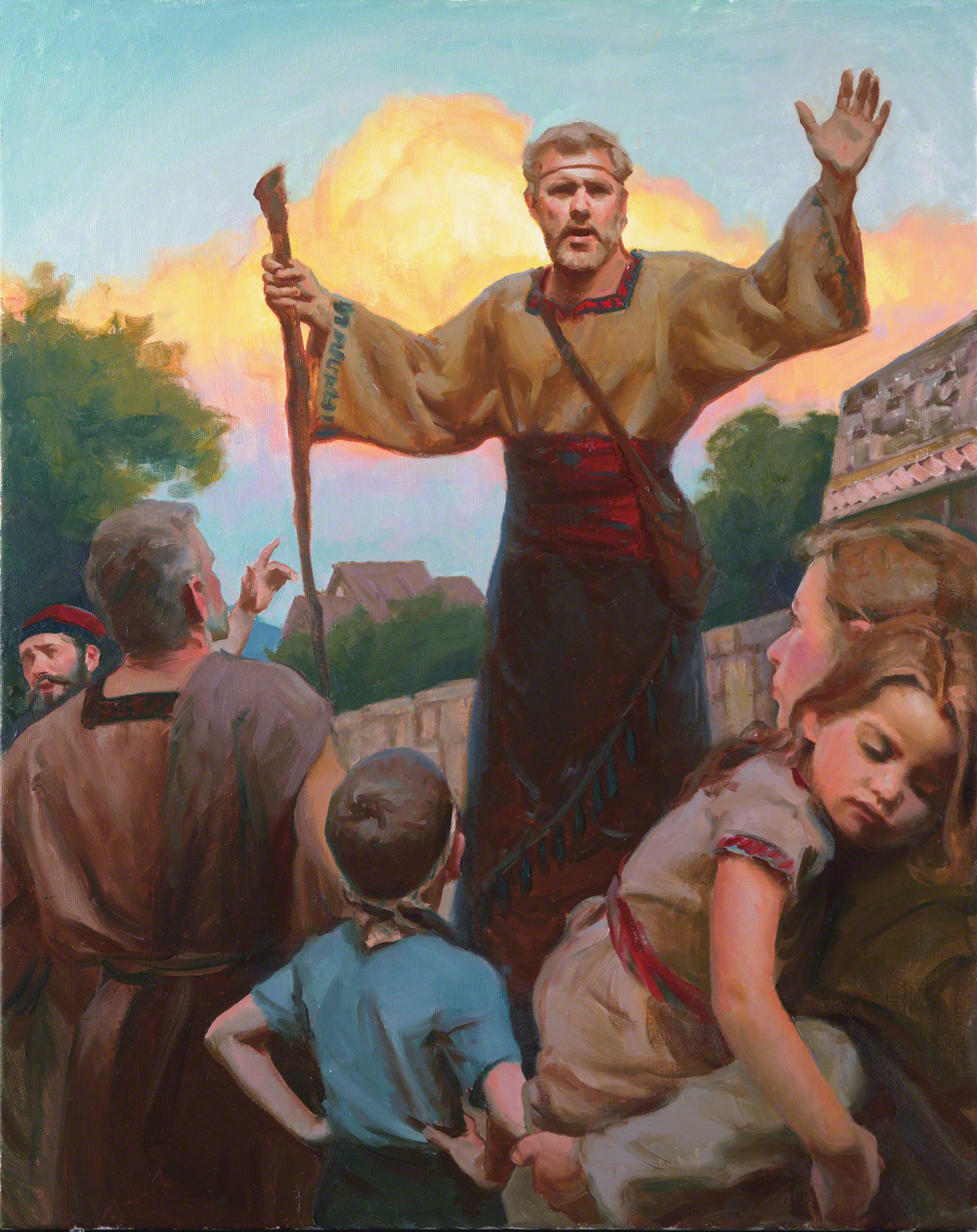
Teaching True Doctrine by Michael T. Malm
“Alma commanded that the people of the church should impart of their substance, every one according to that which he had; if he have more abundantly he should impart more abundantly; and of him that had but little, but little should be required; and to him that had not should be given” (Mosiah 18:27).
Amulek warned that “if ye do not remember to be charitable, ye are as dross, which the refiners do cast out, (it being of no worth) and is trodden under foot of men” (Alma 34:29).
The Book of Mormon even demonstrates what can be achieved when a people collectively live this law. After the Savior’s ministry in 3 Nephi, they “had all things common among them; therefore there were not rich and poor, bond and free, but they were all made free, and partakers of the heavenly gift” (4 Nephi 1:3).8 In these and many other ways, the Book of Mormon can help readers understand the Law of Consecration and develop the faith to live it.
The Why
Unfortunately, during the early years of the Restoration, not all the Saints were enthusiastic about living the Lord’s law. One Church historian, Steven Harper, noted that “some saints [simply] refused. Others were untaught, and many were scattered. Some rebellious Saints even challenged the law in court.”9 For these reasons, the early implementation of this law was “temporarily suspended,” as described by Frank Hirschi.10 Yet the fundamental doctrines and principles of the law have continued on. President Gordon B. Hinckley affirmed that “the law of sacrifice and the law of consecration were not done away with and are still in effect.”11
President Henry B. Eyring explained that the Lord’s way of helping His children meet their temporal needs has “at times been called living the law of consecration. In another period His way was called the united order. In our time it is called the Church welfare program.” And while the “names and the details of operation are changed to fit the needs and conditions of people,” the Lord always “requires people who out of love have consecrated themselves and what they have to God and to His work.”12
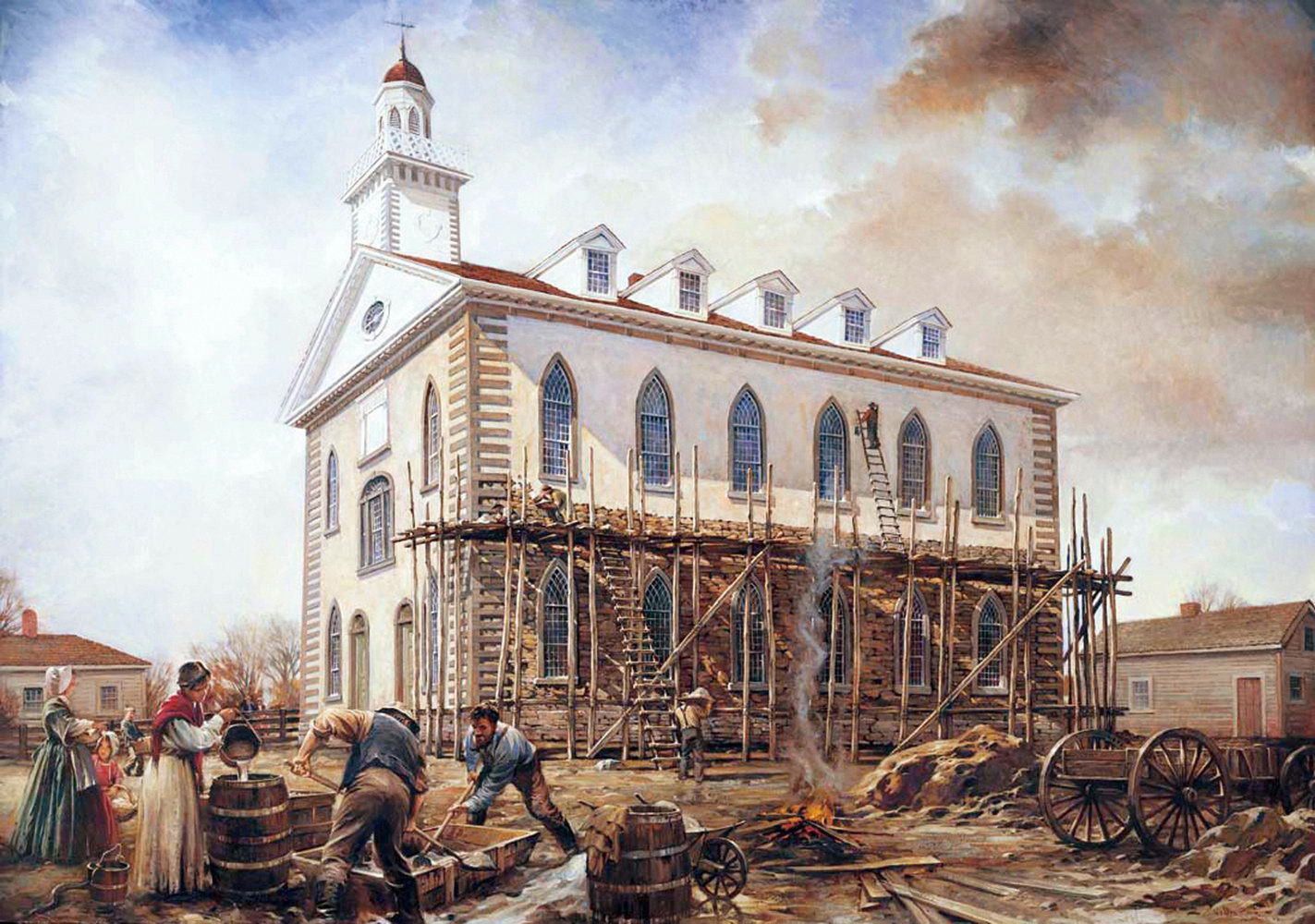
Kirtland Temple by Walter Rane
The Book of Mormon provides powerful doctrines and moving examples of those who exemplified such love and consecration. LeGrand Baker found that the book “leads its readers to charity and thus to the personal fulfillment of the law of consecration.”13 On the other hand, the Book of Mormon shows how “a love of things [rather than a love of God or of fellow men] produces social separation and economic inequality.”14 It demonstrates how, like Zeezrom, one can overcome a lust for wealth and prestige.15 And it depicts how a willingness to give up every worldly possession, as in the case of King Lamoni’s father, can lead to repentance and conversion (see Alma 22:15).16
Elder Neal A. Maxwell recognized that ultimately, the “submission of one’s will is really the only uniquely personal thing we have to place on God’s altar.”17 Thus consecration is about much more than merely giving up surplus property to the poor, or receiving such properties if in need. It is about each individual giving himself or herself to the Lord, “with all your might, mind, and strength, and your whole soul” (2 Nephi 25:29). It entails a willingness to “give all of our time, talents, and means to the building up of the Lord’s earthly kingdom.”18
After the members of “the Family” who sought Zion at Isaac Morley’s farm willingly submitted to the Lord’s revelations, it was recorded that “unity and harmony prevailed throughout the church.”19Communities that likewise live the Law of Consecration, as properly understood and taught by the Lord’s servants and beautifully portrayed in the Book of Mormon, will surely find their own abodes of peace and prosperity. As President Marion G. Romney taught, this law “exalts the poor and humbles the rich. In the process, both are sanctified.”20
Further Reading
Steven C. Harper, “All Things Are the Lord’s: The Law of Consecration in the Doctrine and Covenants,” in The Doctrine and Covenants: Revelations in Context, ed. Andrew H. Hedges, J. Spencer Fluhman, and Alonzo L. Gaskill (Salt Lake City and Provo, UT: Deseret Book and Religious Studies Center, Brigham Young University, 2008), 212–228.
Lindon J. Robison, “‘No Poor Among Them,’” Journal of Book of Mormon Studies 14, no. 1 (2005): 86–97, 130.
Neal A. Maxwell, “‘Swallowed Up in the Will of the Father,’” Ensign, November 1995, online at lds.org.
Frank W. Hirschi, “Law of Consecration” in Encyclopedia of Mormonism, 4 vols., ed. Daniel H. Ludlow (New York, NY: Macmillan, 1992), 1:312–314.
Marion G. Romney, “Living Welfare Principles,” Ensign, November 1981, online at lds.org.
Notes:
1.See Hugh Nibley, Approaching Zion, The Collected Works of Hugh Nibley, Volume 9 (Salt Lake City and Provo, UT: Deseret Book and FARMS, 1989), 487–523.
2.Richard Lyman Bushman, Joseph Smith: Rough Stone Rolling (New York, NY: Vintage Books, 2005), 165.
3.See Steven C. Harper, “The Law,” in Revelations in Context: The Stories behind the Sections of the Doctrine and Covenants (Salt Lake City, UT: The Church of Jesus Christ of Latter-day Saints, 2016), online at lds.org.
4.For example, they believed that “what belonged to a brother belonged to any of the brethren,” leading them to “take each other’s clothes and other property and use it without leave: which brought on confusion and disappointments.” John Whitmer, History, 1831–circa 1847, p. 11, online at josephsmithpapers.org.
5.See Sherilyn Farnes, “‘A Bishop unto the Church,’” in Revelations in Context, online at lds.org.
6.History, 1838–1856, volume A-1, p. 93, online at josephsmithpapers.org.
7.See Doctrine and Covenants 51; 78; 82:17–21; 83; 85; 104.
8.See Lindon J. Robison, “‘No Poor Among Them,’” Journal of Book of Mormon Studies 14, no. 1 (2005): 86–97, 130. See also, Andrew C. Skinner, “Zion Gained and Lost: Fourth Nephi as the Quintessential Model,” in Fourth Nephi through Moroni, From Zion to Destruction, ed. Monte S. Nyman and Charles D. Tate Jr., The Book of Mormon Symposium Series, Volume 9 (Provo, UT: Religious Studies Center, Brigham Young University, 1995), 295: “The scriptural phrase ‘had all things in common’ is undoubtedly used to characterize those who lived the law of consecration.”
9.Harper, “The Law,” online at lds.org.
10.Frank W. Hirschi, “Law of Consecration” in Encyclopedia of Mormonism, 4 vols., ed. Daniel H. Ludlow (New York, NY: Macmillan, 1992), 1:312. See also, Karl Ricks Anderson, “Consecration in Ohio and Missouri,” in Encyclopedia of Mormonism, 1:314–315.
11.Gordon B. Hinckley, Teachings of Gordon B. Hinckley (Salt Lake City, UT: Deseret Book, 1997), 639.
12.Henry B. Eyring, “Opportunities to Do Good,” Ensign, May 2011, 22, online at lds.org.
13.LeGrand L. Baker, The Book of Mormon as an Ancient Israelite Temple: Nineteen Classic Temple Characteristics of the Book of Mormon (Salt Lake City, UT: Eborn Books, 2012), 132.
14.Robison, “‘No Poor Among Them,’” 93. See also, Book of Mormon Central, “Why Did Mormon Emphasize the Zoramites’ Costly Apparel? (Alma 31:28),” KnoWhy 283 (March 6, 2017).
15.See Book of Mormon Central, “Why Would Zeezrom Attempt to Bribe Amulek? (Alma 11:22),” KnoWhy 118 (June 9, 2016). For Zeezrom’s repentance and transformation see, Alma 15:2–12.
16.The fact that Lamoni’s father was a powerful Lamanite king makes the story of his conversion, and his willingness to forsake his worldly possessions and status, even more meaningful. See Book of Mormon Central, “What Did It Mean to be King over All the Land? (Alma 20:8),” KnoWhy 128 (June 23, 2016).
17.Neal A. Maxwell, “‘Swallowed Up in the Will of the Father,’” Ensign, November 1995, online at lds.org.
18.Bruce R. McConkie, “Obedience, Consecration, and Sacrifice,” Ensign, May 1975, online at lds.org.
19.John Whitmer, History, 1831–circa 1847, p. 21, online at josephsmithpapers.org.
20.Marion G. Romney, “Living Welfare Principles,” Ensign, November 1981, online at lds.org.
What is the Law of the Celestial Kingdom?
(Receive a free PDF copy of Zion—Our Origin and Our Destiny. Please click here: www.pillarsofzion.com)
To consecrate something is to sanctify, purify and set it apart for a sacred use, to make it holy, to dedicate it solemnly to a special service, or to give it religious sanction as with an oath or a vow.[i] When we make the covenant of consecration, we agree to consecrate our lives, including everything that we have, will have, are or will be. According to President Kimball, we consecrate “our time, talents and means to care for those in need-whether spiritually or temporally-and in building the Lord’s kingdom.” [ii]
Hugh Nibley asks, “And how much is one able to give? Exactly as much as the Lord has given him—all that which the Lord has blessed you, or with which he will bless you.”[iii] Lived properly, the covenant of consecration paves the way and lays the foundation for the establishment for Zion in a righteous person’s life.
A Brief History of Consecration
The first recorded revelation concerning consecration was April 7, 1829, when the Lord instructed Joseph Smith to “seek to bring forth and establish the cause of Zion.”[iv] This was no small task. Zion is the celestial order of things, for both individuals and societies.[v]
Some descriptions of consecrated Zion people include: their belief that all things belong to God and that they are stewards[vi]; their willingness to be unified by esteeming other people as themselves[vii]; their retaining and exercising their free agency[viii]; their willingness to set aside selfishness and become equal with all the saints of God, according to their wants, needs and family situations[ix] by consecrating their “time, talents, strength, properties, and monies”[x]; and their being accountable to the Lord for the discharge of their covenant and stewardships.[xi]
Anciently, Enoch managed to establish the ideal of Zion among his people, who later joined to create Zion, the city. These people exercised faith in Jesus Christ, repented of their sins, embraced the fullness of the New and Everlasting Covenant, and thereby became “of one heart and one mind, and dwelt in righteousness; and there was no poor among them.”[xii] The vehicle that made this condition possible, and that will make it possible in the latter-days, was the Law of Consecration.
At the beginning of 1831, “the Lord revealed to the Prophet Joseph Smith in Fayette, New York, that anciently he had taken the Zion of Enoch to himself and then commanded him to go to Ohio to receive the law [the law of Zion].”[xiii]
A month later, February 9, 1831, the Lord revealed to the Prophet “the law,” or thelaw of Zion, that which the Prophet specified as “embracing the law of the Church.”[xiv] This law became known as Section 42 of the Doctrine and Covenants, and in it the Lord revealed the cornerstones of the Law of Consecration.
D&C 42—The Cornerstones of Consecration
The “Law of the Church,” Section 42 of the Doctrine and Covenants, lists four cornerstones of the Law of Consecration:
- Mutual assistance–the Lord expects his disciples to sustain and help one another.
- Proper use of priesthood–the priesthood is to be used to benefit those who are physically and spiritually ill or in need.
- The need for faith—according to God’s will, a person can be healed [physically, emotionally and spiritually] by the power of the priesthood if that individual has faith in Jesus Christ and if he is “not appointed unto death,” information that gives confidence to the person as he realizes that the Lord has given him time to work out his exaltation.
- Reciprocal love–the Lord expects his disciples to love one another and to become one.[xv]
The Law We Must Live to Achieve the Celestial Kingdom
President Ezra Taft Benson said, “The law of consecration is a law for an inheritance in the celestial kingdom. God, the Eternal Father, His Son Jesus Christ, and all holy beings abide by this law. It is an eternal law.”[xvi] People whose lives are consecrated to the Lord “set their hearts on righteousness and having actually put first in their lives the things of God’s kingdom.”[xvii]
The Church Welfare Plan describes a consecrated person as one who does not seek for worldly riches; who esteems his brother as himself; who, through tithes and offerings, helps to build up the Kingdom of God by caring for the temporal needs of those General Authorities whom God has called into full-time service; who makes his worldly goods available, over and above his family’s necessities, for the Lord’s work; and who, with his time, talents and means, takes care of the temporally and spiritually poor.[xviii] Quoting the Church Welfare Plan, Bruce R. McConkie wrote,
“The practice of the law of consecration is inextricably intertwined with the development of the attributes of godliness in this life and the attainment of eternal life in the world to come. ‘The law pertaining to material aid is so formulated that the carrying of it out necessitates practices calculated to root out human traits not in harmony with requirements for living in the celestial kingdom and replacing those inharmonious traits with the virtues and character essential to life in that abode.’ (Bowen, The Church Welfare Plan, p. 13).”[xix]
Then quoting a supporting scripture, Elder McConkie added, “For if you will that I give you a place in the celestial world, you must prepare yourselves by doing the things which I have commanded you and required of you.”[xx]
Consecration’s Foundational Principles
Elsewhere in the scriptures, we learn that the Law of Consecration is built on the foundational principles of agency, stewardship, accountability and labor.
- Agency. An agent is someone who has the power and authority to act.[xxi] Therefore, agents have agency, which is the ability to “act for themselves,”[xxii] or to the ability to act for himself with respect to a given responsibility or obligation.[xxiii] Agents have the capacity to be accountable for their actions. Whereas freedom is the power and privilege to exercise our will and act upon it,agency is the power, independence of mind and individual will to choose in the first place.
Elder McConkie wrote: “Four great principles must be in force if there is to be agency: 1. Laws must exist, laws ordained by an Omnipotent power, laws which can be obeyed or disobeyed; 2. Opposites must exist–good and evil, virtue and vice, right and wrong–that is, there must be an opposition, one force pulling one way and another pulling the other; 3. A knowledge of good and evil must be had by those who are to enjoy the agency, that is, they must know the difference between the opposites; and 4. An unfettered power of choice must prevail.”[xxiv]
Moral agency describes our ability to act upon and be accountable for spiritual matters.[xxv] Zion people exercise their God-given agency to choose to make and keep the New and Everlasting Covenant (the Covenant), and to reject the enticements of Babylon. And choose we must. Posing the choice between Zion and Babylon, Elijah asked, “How long halt ye between two opinions? if the Lord be God, follow him: but if Baal [Babylon], then follow him.”[xxvi] Being lukewarm on the issue is not acceptable: “I know thy works, that thou art neither cold nor hot: I would thou wert cold or hot. So then because thou art lukewarm, and neither cold nor hot, I will spue thee out of my mouth.”[xxvii]
That these opposites (hot and cold) exist makes agency possible: “And it must needs be that the devil should tempt the children of men, or they could not be agents unto themselves; for if they never should have bitter they could not know the sweet.”[xxviii] Therefore, we are free to choose our destiny: Zion, to our salvation, or Babylon, to our condemnation. “Behold, here is the agency of man, and here is the condemnation of man; because that which was from the beginning is plainly manifest unto them, and they receive not the light.”[xxix]
Having chosen Zion and thus having overcome Babylon, Zion people enjoy the highest degree of moral agency and its resulting freedom. Agency and freedom flourish in Zion: “If the Son therefore shall make you free, ye shall be free indeed.[xxx] “And because that they are redeemed from the fall they have become free forever, knowing good from evil; to act for themselves and not to be acted upon….”[xxxi]
Conversely, agency and freedom decrease in Babylon: “And the whole world [Babylon] lieth in sin, and groaneth under darkness and under the bondage of sin.”[xxxii] Choosing Babylon results in fewer choices and less freedom to exercise agency, while choosing Zion results in limitless choices and unequalled freedom to exercise agency.
- Stewardship. When a person exercises his agency to live the Covenant, he makes a conscious choice to become a steward of the Lord’s property. His approach to ownership is “the earth is the Lord’s, and the fulness thereof….”[xxxiii] Elder Bruce R. McConkie said, “Underlying this principle of stewardship is the eternal gospel truth that all things belong to the Lord. ‘I, the Lord, stretched out the heavens, and built the earth, my very handiwork; and all things therein are mine …. Behold, all these properties are mine, … And if the properties are mine, then ye are stewards; otherwise ye are no stewards.’ (D&C 104:14, 55-56).”[xxxiv]
We are expressly forbidden to hoard property or claim it as our own: “I command thee that thou shalt not covet thine own property….”[xxxv] Therefore, a Zion person’s claim to his property is subordinate to the Lord’s claim. As Martin Harris learned, property must be consecrated for the building up of the Kingdom of God and the establishment of Zion, which provides that no poor should exist among us. Ultimately we will be held accountable for the discharge of our stewardship.[xxxvi]
A Zion person’s stewardship, sometimes referred to as “portion,”[xxxvii] or “inheritance,”[xxxviii] is to be used to support his own family, and then “conveying back to the Lord’s storehouse any surplus which accrued [for the poor]. (D&C 42:33-34, 55; 70:7-10).” Elder McConkie added, “It is by the wise use of one’s stewardship that eternal life is won.”[xxxix] Zion people do not take their covenant of stewardship lightly; they know that everything depends on their faithfulness in this responsibility: “And whoso is found a faithful, a just, and a wise steward shall enter into the joy of his Lord, and shall inherit eternal life.”[xl]
- Accountability. The Lord said, “…every man shall be made accountable unto me, a steward over his own property….”[xli] Upon the principle of moral agency, stewards are free to manage their stewardships, but they are not free from being accountable to the Lord: “…it is required of the Lord, at the hand of every steward, to render an account of his stewardship, both in time and in eternity. For he who is faithful and wise in time is accounted worthy to inherit the mansions prepared for him of my Father.”[xlii] Clearly, we will one day stand before God to give an accounting of our deeds, which will include the management of our stewardship. Our performance will determine the trusts and stewardships given to us in eternity.
Zion people are under covenant to account for their earthly stewardships to the Lord’s servant, the bishop: “Verily I say unto you, the elders of the church in this part of my vineyard shall render an account of their stewardship unto the bishop, who shall be appointed of me in this part of my vineyard. These things shall be had on record, to be handed over unto the bishop in Zion.”[xliii] For this reason, we report to the bishop each year regarding our tithes and offerings, and we account to him during our temple recommend interview. Elder David A. Bednar said that we account to God every night in prayer.[xliv]
- Labor. Elder Bruce R. McConkie wrote, “Work is the great basic principle which makes all things possible both in time and in eternity. Men, spirits, angels, and Gods use their physical and mental powers in work.”[xlv] Work, like other principles, exists in degrees ranging from telestial to celestial. Adam was commanded to work to support his family,[xlvi] which is a celestial endeavor, but he was not commanded to set his sights on empire building, plundering, extorting, leveraging, competing, augmenting his balance sheet or amassing personal wealth on the backs of the poor, all of which are telestial. Adam worked to create the first Zion upon the earth: Adam-ondi-Ahman. There he labored to sustain his immediate family and to bless the lives of others.
Likewise, Enoch worked to establish Zion, as did Melchizedek and Nephi: “And it came to pass that I, Nephi, did cause my people to be industrious, and to labor with their hands.”[xlvii] They worked together for the benefit of all. They labored to establish righteousness. They worked in unity to raise crops, smelt ore to create weapons for defense, and fashion objects of beauty. Together, they built buildings and a temple. Because of their celestial level of labor they were blessed with prosperity and familial strength: “And it came to pass that we began to prosper exceedingly, and to multiply in the land.”[xlviii]
Things began to fall apart when the Nephites became selfish and began to work on a telestial level. Jacob chastised them for searching “for gold, and for silver, and for all manner of precious ores” for the purpose of obtaining riches “more abundantly than that of your brethren,” causing the errant one to be “lifted up in the pride of your hearts, and …suppose that ye are better than they.”[xlix] This kind of labor is not justified in Zion; it is condemned. President Kimball said, “As I understand these matters, Zion can be established only by those who are pure in heart, and who labor for Zion, for the ‘laborer in Zion shall labor for Zion; for if they labor for money [riches] they shall perish’ (2 Ne. 26:30).2 Ne.26:31).”[l]
Jacob taught the celestial law of labor and its underlying motivation: “Think of your brethren like unto yourselves, and be familiar with all and free with your substance, that they may be rich like unto you. But before ye seek for riches, seek ye for the kingdom of God. And after ye have obtained a hope in Christ ye shall obtain riches, if ye seek them; and ye will seek them for the intent to do good–to clothe the naked, and to feed the hungry, and to liberate the captive, and administer relief to the sick and the afflicted.”[li] Clearly, we must work, but what we work for determines if the work is telestial or celestial.
Conversely, “idleness has no place [in Zion],” said President Benson, “and greed, selfishness, and covetousness are condemned. [Zion] may therefore operate only with a righteous people.”[lii]
Conclusion
The Law of Consecration is a subject as glorious as its Founder. It is the law of the Celestial Kingdom revealed to us in this telestial setting for our salvation and exaltation. By this law the Kingdom of God prepares the way for the establishment of Zion as a holy community and Zion as individual people. We must learn all we can about this law then live it, otherwise we cannot expect to obtain an inheritance in the Celestial Kingdom.
The foundational principles and cornerstones of Consecration are equality, unity, mutual assistance, proper use of the priesthood, faith, reciprocal love (charity), agency, stewardship, accountability and labor. This is the law by which hearts are purified, and by which we are ushered into the presence of God. Only upon the Law of consecration can we become one in our marriages, families, wards, stakes, the Church, and one with the Father and the Son.
Author’s Note:
Receive a free PDF copy of Zion—Our Origin and Our Destiny. Please click here: www.pillarsofzion.com. Follow our Internet missionary project: www.gospelideals.org. And LIKE us on www.facebook.com/gospelideals.
________________________
[i] See American Heritage Dictionary, “Consecrate” and “Sanctify”
[ii] Spencer W. Kimball, The Teachings of Spencer W. Kimball, edited by Edward L. Kimball, p.366
[iii] Hugh Nibley, Approaching Zion, p.427
[iv] D&C 6:6
[v] See D&C 105:5
[vi] See D&C 38:17; 104:11-14
[vii] See D&C 38:24-27; 51:3, 9; 70:14; 78:6; 82:17
[viii] See D&C 104:17
[ix] See D&C 51:3
[x] Bruce R. McConkie, Mormon Doctrine, “Consecration,” p.157
[xi] See D&C 72:3; 104:13-18
[xii] Moses 7:18
[xiii] Encyclopedia of Mormonism, “Consecration,” p.312
[xiv] D&C 42 introduction
[xv] List adapted from Clark V. Johnson, Sperry Symposium 1989, “The Law of Consecration: The Covenant That Requires All and Gives Everything”
[xvi] Ezra Taft Benson, The Teachings of Ezra Taft Benson , p.121
[xvii] Bruce R. McConkie, Mormon Doctrine, “Consecration,” p.157
[xviii] See Albert E. Bowen, The Church Welfare Plan, p.6
[xix] Bruce R. McConkie, Mormon Doctrine, “Consecration,” p.157
[xx] D&C 78:7
[xxi] See American Heritage Dictionary, “Agent”
[xxii] 2 Nephi 2:26
[xxiii] See D&C 29:35
[xxiv] Bruce R. McConkie, Mormon Doctrine, 2d ed., “Agency,” p.26
[xxv] See D&C 29:35
[xxvi] 1 Kings 18:21, insertion added
[xxvii] Revelation 3:15-16
[xxviii] D&C 29:39
[xxix] D&C 93:31
[xxx] John 8:36
[xxxi] 2 Nephi 2:26
[xxxii] D&C 84:49-50
[xxxiii] Psalms 24:1
[xxxiv] Bruce R. McConkie, Mormon Doctrine, 2d ed., “Stewardships,” p.767
[xxxv] D&C 19:26
[xxxvi] See D&C 72:3-4; 51:19; Luke 16:2; 19:17; Matthew 25:14-30; D&C 82:3, 11; 78:22
[xxxvii] D&C 51:4
[xxxviii] D&C 51:4; 57:15
[xxxix] Bruce R. McConkie, Mormon Doctrine, 2d ed., “Stewardships,” p.767
[xl] D&C 51:19
[xli] D&C 42:32
[xlii] D&C 72:3-4
[xliii] D&C 72:5-6
[xliv] See David A. Bednar, “Pray Always,” Ensign, November 2008
[xlv] Bruce R. McConkie, Mormon Doctrine, 2d ed., “Work,” p.847
[xlvi] Genesis 3:19
[xlvii] 2 Nephi 5:17
[xlviii] See 2 Ne 5:10-16
[xlix] Jacob 2:12-14
[l] Spencer W. Kimball, The Teachings of Spencer W. Kimball, p.363
[li] Jacob 2:17-19
[lii] Ezra Taft Benson, “A Vision and a Hope for the Youth of Zion,” Devotional Speeches of the Year [Provo, Utah: BYU, 1978], p. 74.
FEATURES