






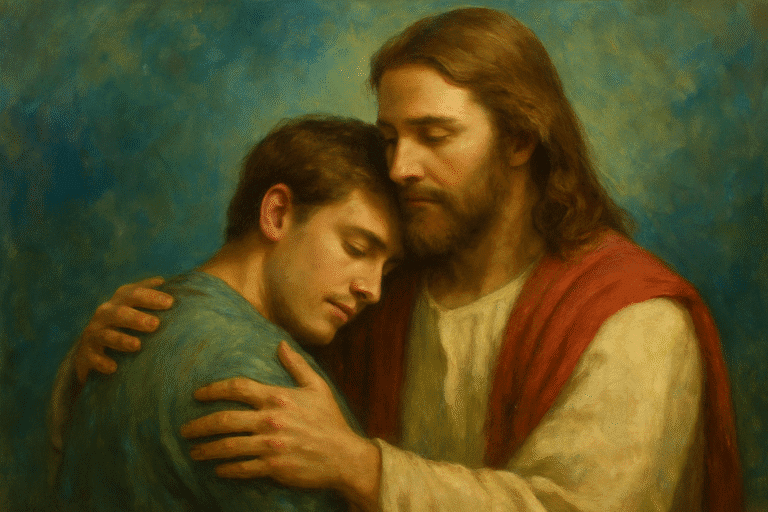


A little boy asked his mother at bedtime, “When we die and go to heaven, how will we find each other?” As his mother was trying to come up with a reply that would satisfy her son, the boy answered his own question: “Never mind, I’ll meet you at Jesus.”
The phrase, “I’ll meet you at Jesus,” keeps coming to my mind as I study the Doctrine and Covenants and the call to build Zion. In my first year of high school, the course of study was Church History, focused on the Doctrine and Covenants. My instructor emphasized the building of Zion, and by the end of the school year I was frustrated that the early Saints never accomplished that task. I often wondered, Why weren’t they able to build Zion?
In the intervening decades, I’ve come to feel great compassion for those early converts to the church who were dealing with far more than the task of creating a Zion community. Their testimonies were young, much of the church’s organizational structure and many core doctrines were gradually being revealed. And then, there was that pesky little issue of being driven repeatedly from their houses and simply trying to survive.
Sitting here now in my comfortable home, with a solid church organization established, and the full Gospel Library literally at my fingertips, I must ask myself: How can I build Zion? Pondering this question has led me back to the little boy’s pronouncement: I’ll meet you at Jesus. Jesus Christ–with His Atonement, teachings, and example–is the only road to Zion.
Kim–a visitor in my ward –shared a story from her childhood. As an eight-year-old, young Kimberly couldn’t wait to be baptized. When her big day arrived, she was thrilled to enter the water and participate in that essential ordinance. Afterward, while she changed into dry clothing and sat through the remainder of the baptismal service, Kimberly was determined to stay as pure as she was at that moment for the rest of her life. However, during the brief car ride home from the chapel, there was contention among siblings and Kimberly lost her temper, hitting one of her brothers and calling the other one a pig.
I chuckled as Kim recounted her story, until she shared that young Kimberly was devastated that she had sinned so easily after making a heartfelt commitment to follow Jesus Christ. Most of us can probably relate to both feelings: determination to keep God’s commandments, and frustration when we fall short of that ideal again and again.
I’ll Meet You At Jesus
Why is it so hard to be consistently good? If it were easy to build Zion in this dispensation, it would have been accomplished long ago. But the natural man is a formidable opponent, and we wrestle with him daily. We are proud and selfish and short-tempered. We are lazy and jealous and easily distracted. But the only road to Zion is the Savior, and so we say, I’ll meet you at Jesus by partaking mindfully of the sacrament each Sabbath day. I’ll meet you at Jesus as we daily repent of our sins. As we approach Jesus regularly through sincere repentance, the seeds of a Zion life begin to sprout in our hearts.
I had a fascinating conversation last spring while visiting my friend Shannon.* She seemed a bit preoccupied when I first arrived at her home, and eventually shared with me what was on her mind. Earlier that morning, Shannon had been chatting with a woman from her neighborhood, when their interaction took a political turn and Brenda began singing the praises of the current president of the United States. She felt that he was being wonderfully proactive, shaking things up, and that he had accomplished a great deal in his first few months in office. It was obvious from the way Brenda spoke, that she assumed Shannon shared her views.
But Shannon actually held vastly different political opinions–feeling deeply troubled at the actions of the president. She was unsure how to respond to Brenda without causing contention, so she mostly kept silent. Listening to Shannon recount her experience, I could almost see the wheels turning in her head as she processed the encounter. She was stunned that someone of her same faith could have such opposite views on critical matters. Yet, she admitted that Brenda was a faithful Christian woman. How could both things be true?
As we finished our conversation, I felt like giving Shannon a high five to celebrate the fact that her first response was not to badmouth a neighbor she disagreed with. She wasn’t being critical. She was honestly trying to examine Brenda’s position and determine if it had merit. I’d like to think Brenda would’ve done the same for Shannon if their roles had been reversed.
Shannon’s actions basically said, “I’ll meet you at Jesus. I’ll give you the benefit of the doubt and acknowledge that you’re entitled to your own opinions.” She showed the Christlike attribute of humility, which paves the way for unity in relationships, rather than division.
This experience demonstrates what Elder Dieter F. Uchtdorf was speaking of when he taught, “…[it] doesn’t mean changing my heart to align with yours. Nor does it mean changing your heart to align with mine. It means that we all change our hearts to align with the Savior.” (1) In other words, I’ll meet you at Jesus.
One of the hardest surprises of my adult life was the discovery that I could not change anyone else. No preaching, no pressuring, no lecturing can change another person. The only person I can change is myself, and a deep change of my nature is only possible through the Atonement of Christ.
Years ago, I wrote about my struggle to overcome my serious weaknesses of being judgmental and self-righteous. https://latterdaysaintmag.com/i-will-lay-the-gavel-down-subduing-the-pharisee-in-me/ These traits were holding me back spiritually. One day while studying scriptures, I was struck more than ever before by the Savior’s question and counsel: “…why beholdest thou the mote that is in thy brother’s eye, but considerest not the beam that is in thine own eye? … Thou hypocrite, first cast out the beam out of thine own eye; and then shalt thou see clearly to cast out the mote out of thy brother’s eye.” (Matthew 7:3,5) It was time for me to cease finding fault with others and start “considering the beam.”
“As I began to focus on repenting of my own sins, on overcoming my own weaknesses, my appreciation for the Savior’s Atonement and His willingness to forgive me increased dramatically, as did my empathy for others who were fighting their own battles with sin and weakness. The daily business of grappling with my personal beams has left little time to fret over someone else’s mote.” (2)
Perhaps “considering the beam” can become an important part of our daily repentance. Instead of criticizing others, we can make our own life more pleasing to God. Then, we can humbly show by our interactions with friends, family, and co-workers–even those we disagree with–“I’ll meet you at Jesus. I’ll meet you with the kind of humility and compassion the Savior taught and lived.”
Elder Dale G. Renlund spoke on this subject. “After the Savior’s visit to the Americas, the people were unified; “there was no contention in all the land.” Do you think that the people were unified because they were all the same, or because they had no differences of opinion? I doubt it. Instead, contention and enmity disappeared because they placed their discipleship of the Savior above all else. Their differences paled in comparison to their shared love of the Savior…” (3)
With Jesus Christ as our common denominator, our unifying force, we can declare to each other no matter our differences, “I’ll meet you at Jesus.” He is the only road to Zion.
*names changed
Notes:
- Elder Dieter F. Uchtdorf, By This All Will Know That You Are My Disciples, April 2025 general conference.
- Lynne Perry Christofferson, I Will Lay the Gavel Down, Meridian Magazine, Oct. 17, 2018.
- Elder Dale G. Renlund, The Peace of Christ Abolishes Enmity, April 2021 general conference.