




Born When the Light Begins to Return; A Birthday Letter to Joseph Smith
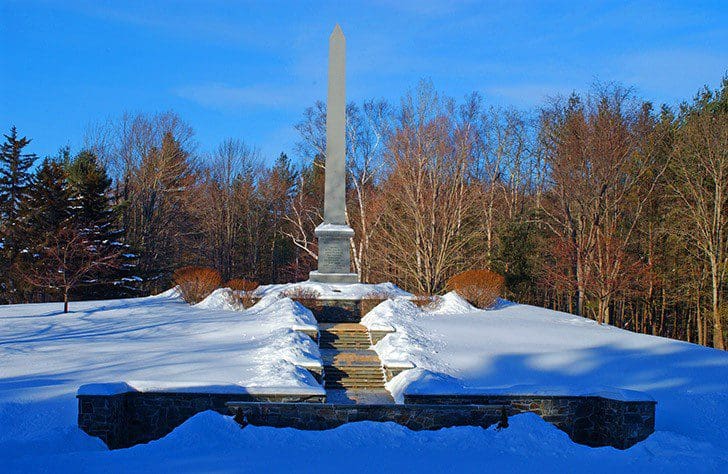
Happy Birthday tomorrow to Joseph Smith. In a 20 x 24 foot log cabin in a remote, nearly forgotten corner of Vermont, where winter comes hard and deep and would leave a family shivering in their cabin, a baby boy was born Monday, December 23, 1805. Since the winter solstice that year was December 22, this birth literally marked the day when the light began returning to the northern hemisphere where he lived, and would signal a new day on earth.
Nothing was particularly auspicious about the birth of Joseph Smith, nor would anyone have noted anything special about his family. His father, Joseph Smith Sr. had recently been cheated in a business deal when he crystallized ginseng and sent it to China and a dishonest Mr. Stevens had pocketed the proceeds in the journey. As a result, having lost their farm in Tunbridge, Vermont, the Smiths were now living on a farm rented from Lucy Mack Smith’s father and trying to eke crops out of New England’s rocky soil.
The cabin itself was most distinguished by being divided right down the middle between Royalton and Sharon townships, but we take it that Joseph was born on the Sharon side of the cabin because the family told us.

Still, as obscure, backwoods, and freezing as this birth was, the Lord sent in disguise there the mighty head of the dispensation of the fulness of times. When we take tour groups to this cabin site every year, we crowd around inside the outlined foundation and sing the reality:
The morning breaks, the shadows flee; Lo, Zion’s standard is unfurled! The dawning of a brighter day, The dawning of a brighter day Majestic rises on the world.
We are reminded again what F.W. Boreham said, “A century ago [in 1809] men were following, with bated breath, the march of Napoleon, and waiting with feverish impatience for the latest news of the wars. And all the while, in their own homes, babies were being born. But who could think about babies? Everybody was thinking about battles.
“In one year between Trafalgar and Waterloo, there stole into the world a host of heroes! Gladstone was born at Liverpool; Alfred Tennyson was born at the Somersby rectory…Oliver Wendell Holmes made his first appearance at Massachusetts…and Abraham Lincoln drew his first breath at Ole Kentucky. Music was enriched by the advent of Frederic Chopin at Warsaw, and of Felix Mendelssohn at Hamburg.

“Which of the battles of 1809 mattered more than the babies of 1809? We fancy that God can only manage His world by big battalions when all the while He is doing it by beautiful babies. When a wrong wants righting, or a work wants doing, or a truth wants preaching, or a continent wants opening, God sends a baby into the world to do it.”[1]
A Much Anticipated Birth
Though Joseph’s birth escaped notice of everyone, except his family, it had been much anticipated by the ancients, for, led by seeric vision, they knew who he was and what he would do.
Joseph of Egypt, more than three thousand years before Joseph Smith’s birth, spoke of him. We know this because Lehi quotes from him in giving his son, Joseph, a blessing.
“For Joseph [of Egypt] truly saw our day [and was told] … “A choice seer will I raise up out of the fruit of thy loins; and he shall be esteemed highly among the fruit of thy loins. And unto him will I give commandment that he shall do a work…which shall be of great worth…even to the bringing of them to the knowledge of the covenants which I have made with thy fathers… “Unto him will I give power to bring forth my word unto the seed of thy loins—and not to the bringing forth my word only, saith the Lord, but to the convincing them of my word, which shall have already gone forth among them. “And his name shall be called after me; and it shall be after the name of his father. And he shall be like unto me; for the thing, which the Lord shall bring forth by his hand, by the power of the Lord shall bring my people unto salvation” (2 Nephi 3:5-7).

Consider this. Before Moses led the Children of Israel out of Egypt, before the Red Sea was parted, before he received 10 Commandments on Mt. Sinai, long before when Joseph was serving in Pharoah’s court about 1500 BC, so far back in the mists of antiquity we cannot see much, Joseph of Egypt already knew of Joseph Smith, in fact, knew of him by name. This detail of God’s orchestration expands our puny minds.
It is interesting that in early America, fathers often named their oldest son after themselves, and Joseph Smith’s father was indeed Joseph Smith. But that is not how it went in the Smith family. The oldest son did not get his father’s name. First, Lucy and Joseph had an infant son, who is not named. Then their family order goes like this: Alvin, Hyrum, Sophronia, Joseph. The Joseph, who is the prophet of the restoration, was the fifth child—and why did they finally get around to naming a son Joseph? They did not know they were fulfilling a prophecy that had been in place for at least three thousand years.
Joseph of Egypt also knew that his descendant named Joseph would bring forth the Lord’s word that would also convince the people of the word that had “already gone forth among them.” An important role of the Book of Mormon is to bear testimony of the truthfulness of the Bible.
Nephi’s Small Plates
Of course, we do not hear from Nephi what he knew about Joseph Smith, but in his account, we are reminded that the Lord knows the end from the beginning, and that includes one important specific event of Joseph Smith’s life. As Nephi records his history, the Lord asked Nephi to make two sets of plates. The larger plates were to cover the secular history of the people, but more specifically, the smaller plates were a record of sacred things.
Why make two sets of plates? Making plates is not an easy job, neither is recording two separate accounts. Nephi admits that he does not know the reason that the Lord has made this request of him:
“Wherefore, the Lord hath commanded me to make these plates for a wise purpose in him, which purpose I know not. “But the Lord knoweth all things from the beginning” (1 Nephi 9:5,6).
Indeed, the Lord does know all things from the beginning, even to the detail that Joseph and Martin Harris would translate 116 pages from those large plates, and then Martin, hoping to please the demands of an angry wife, would take the translation back to Palmyra, where they were stolen.
Those 116 pages were the Book of Lehi, and, thanks to the Lord’s absolute foreknowledge of the events of Joseph’s life, the small set of plates, which covered the same period, were there ready to be translated and take the place of those lost 116 pages in the final manuscript of the Book of Mormon.
The Lord knew this Joseph Smith whom He was sending into the world. God knew his devotion, his courage, his visionary capacities, his mighty unshakeable faith, his resilience in the face of every manner of persecution, and even the learning curve that would be required to fulfill his powerful role as the first prophet of this dispensation. God knew who he was calling from before the foundations of this earth and let this mighty and powerful head of the last dispensation come disguised as a farm boy.
Imperfect and Important Circumstances
If Joseph Smith’s birth was to a rural family where the demands upon him would limit his education, this was according to the Lord’s plan. If their skirting the edges of poverty would mean he would grow up with resourcefulness and hard work as a legacy, this, too, was according to the Lord’s plan. Were there no erudite and great families to which to be born or a place where he could be privately tutored? Were there no fine houses, no Mount Vernons’ or Monticello’s instead of this 20 x 24 foot cabin in the back woods of Vermont? Of course, there were.
Yet as Paul said, “God hath chosen the foolish things of the world to confound the wise; and God hath chosen the weak things of the world to confound the things which are mighty” (1 Cor. 1:27). Joseph’s tutor would be the great God and his angels, and he would come to the ideal family for him who would support him through his most difficult times.

Indeed, Joseph’s passionate desire for truth mirrors his mother, Lucy Mack Smith. If there was one woman who would be chosen to profoundly influence him, this woman was an apt choice. She writes in her History of Joseph Smith by His Mother, Revised and Enhanced Edition, that in the fall of 1802, she lived in Randolph, Vermont, when a heavy cold, cough and fever set in. She was one of weak lungs, susceptible to sickness, and this time, she became so ground down with illness that Mr. Murkley, a Methodist minister, heard came to see her and she in her weakness she said, “could not bear the noise of a footfall except in stocking feet, nor a word to be spoken in the room except in whispers.”
Lucy said, “I dreaded to have him speak to me, for said I to myself, “I am not prepared to die, for I do not know the ways of Christ,” and it seemed to me as though there was a dark and lonely chasm between myself and Christ that I dared not attempt to cross.
I thought as I strained my eyes towards the light (which I knew lay just beyond the gloomy veil before me) that I could discover a faint glimmer.
Mr. Murkley left, and my husband came to my bed and caught my hand and exclaimed as well as he could amidst sobs and tears, “Oh, Lucy! My wife! You must die. The doctors have given you up, and all say you cannot live.”
I then looked to the Lord and begged and pleaded that he would spare my life that I might bring up my children and comfort the heart of my husband. Thus I lay all night, sometimes gazing gradually away to heaven, and then reverting back again to my babies and my companion at my side, and I covenanted with God that if he would let me live, I would endeavor to get that religion that would enable me to serve him right, whether it was in the Bible or wherever it might be found, even if it was to be obtained from heaven by prayer and faith. At last, a voice spoke to me and said, “Seek, and ye shall find; knock, and it shall be opened unto you. Let your heart be comforted. Ye believe in God, believe also in me.”
Lucy said, “In the anxiety of my soul to abide by the covenant which I had entered into with the Almighty, I went from place to place to seek information.” At last, she heard of a minister who was noted for his piety and went eagerly to his church, hoping to find the gospel “which alone could satisfy my soul—the bread of eternal life.”

But she was sorely disappointed. “When the minister commenced, I fixed my mind with breathless attention upon the spirit and matter of the discourse, but all was emptiness, vanity, vexation of spirit, and fell upon my heart like the chill, untimely blast upon the starting ear ripening in a summer sun. It did not fill the aching void within nor satisfy the craving hunger of my soul. I was almost in total despair, and with a grieved and troubled spirit, I returned home, saying in my heart, there is not on earth the religion which I seek. I must again turn to my Bible, take Jesus and his disciples for an example. I will try to obtain from God that which man cannot give nor take away. I will settle myself down to this. I will hear all that can be said, read all that is written, but particularly the word of God shall be my guide to life and salvation, which I will endeavor to obtain if it is to be had by diligence in prayer.”
If Lucy’s quest to find the Lord’s truth sounds familiar, it is because this earnest desire was also so planted in Joseph Smith’s heart. This is a case of like mother, like son, coupled, of course, with the fire inherent in the soul of one who had always been a pillar of faithfulness since the pre-mortal world.
What to Make of Joseph?
Since the Lord knows what He is doing and why, we can be certain that this boy born on Dec. 23, 1805 came to circumstances customized for him and the role he would play. Indeed, when the Lord wants to change the world, He sends a baby—and people still do not know what to make of him.
Several scholars, who are not members of the Church, were interviewed for a recent documentary on Joseph Smith, and they grappled with how to explain the astonishing work he accomplished.
The late Robert V. Remini of the University of Illinois at Chicago said, “Do I personally believe? No. I have no evidence for that. And as a historian, I must base my conclusion on that. However, you can say, look what he did! Is one human being capable of doing this without Divine help and intervention?”
Laurie F. Maffly-Kipp, professor and historian at the University of Washington, said, “I find Joseph Smith a remarkable person. He had a charisma that is undeniable, I think, and had a vision for a community that was unlike anything else that’s ever been created.
“So, as a historian, I’m interested in how that comes about. How is it that certain people can gain that kind of affection and respect from other people and also the kind of denunciations he received at the same time?”
Richard T. Hughes, professor of American Religious History at Messiah University added, “If I believed, I obviously would become a Mormon. But having said that, if we want to understand a tradition, we’ve got to take seriously what the representatives of that tradition tell us. What do I think is the significance of all of these stories taken together? It’s the heart of the Latter-day Saint restoration. The concern to recover direct communion with God.”
Astute historians do not know what to make of Joseph Smith. Latter-day Saints are amazed at this prophet, and simply grateful. On Joseph’s birthday, we always like to remember him.
[1] (F. W. Boreham, Mountains in the Mist: Some Australian Reveries [1919], 166-67, 170)
If Joseph Smith Had a Birthday Party, Who Would Come?
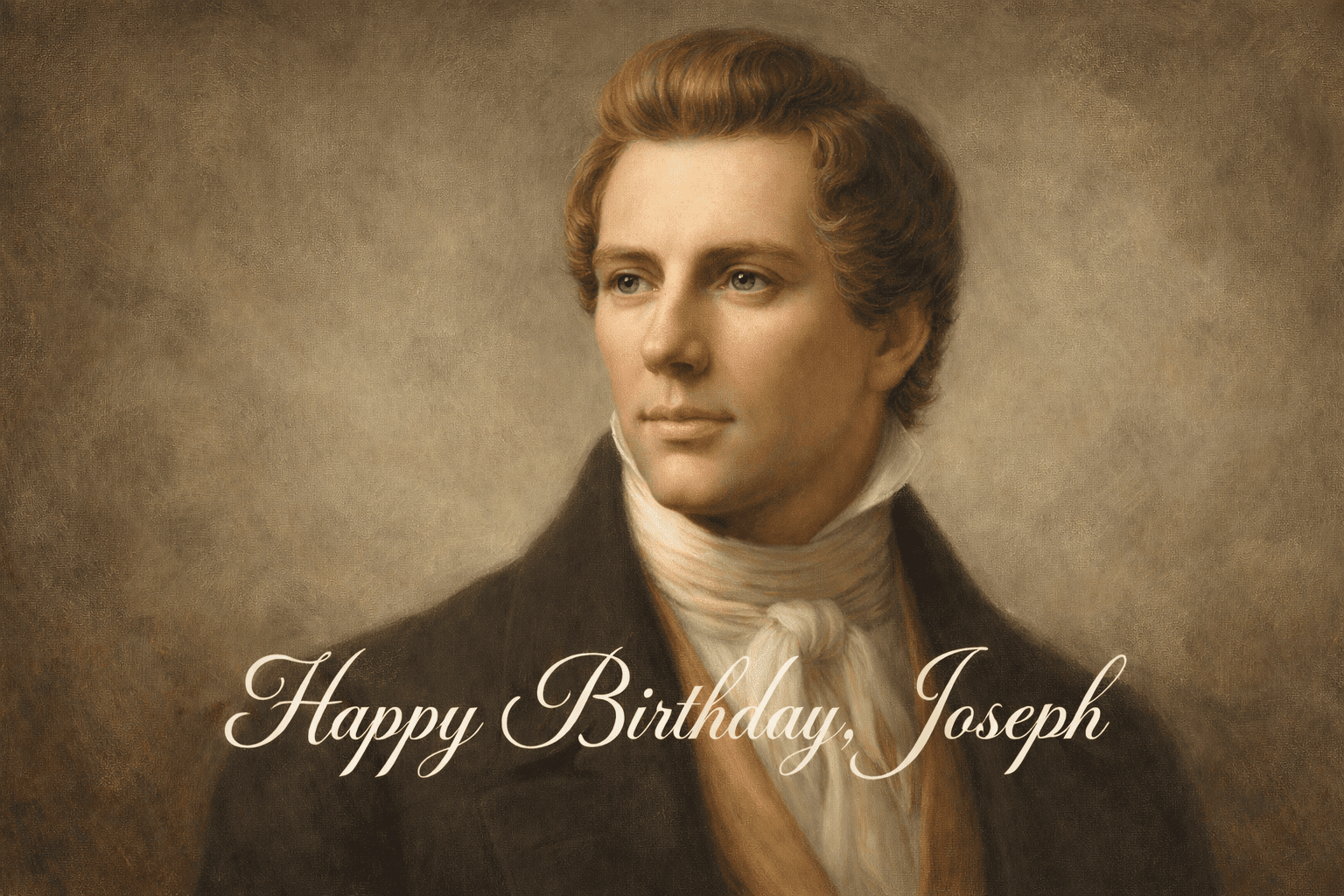
Joseph Smith’s Birthday Party: Who Would Come?
When Joseph Smith met Moroni for the first time, Moroni told him that his name “should be had for good and evil among all nations” (Joseph Smith—History 1:33). I decided to have a birthday party for Joseph on December 23, 2025. He will be 220 years old. I sent invitations to people who said good about him. Here is a sampling of the people who came.
William W. Phelps: Brother Joseph!
Joseph: Brother Phelps!
William W. Phelps: I wanted to be the first at this celebration because of the false witness I bore against you in Missouri. As I said in my letter to you in 1838: “I am as the prodigal Son…. I have been greatly abased and humbled…. I know my situation, you know it, and God knows it, and I want to be saved if my friends will help me…. I have done wrong and I am sorry. The beam is in my own eye…. I ask forgiveness in the name of Jesus Christ of all the saints…. I want your fellowship”1
Joseph: Of course, you are welcome here. I’m sure you remember my words: “Come on, dear brother, since the war is past, for friends at first, are friends again at last”2
William W. Phelps: And I hope you remember the words I wrote about you: “Praise to the man who communed with Jehovah! Jesus anointed that Prophet and Seer. Blessed to open the last dispensation, kings shall extol him, and nations revere”3
…
Miriam Stowell: Hello, Joseph. It’s Miriam Stowell. I am here with my sister, Rhoda.
Joseph: Thank you for coming. I remember you both. When I was working for your father, there was a court case against me in 1830, and you two were called to testify about my character.
Rhoda Stowell: Yes. When we were summoned as witnesses, we were interviewed separately. They asked us about your behavior towards us both in public and private. We told them that you always treated us respectfully. Your accusers realized they had no case, and the charges were dropped.4
Joseph: Thank you. I am grateful to you both.
….
Matthew L. Davis: Hello, Joseph. I was a journalist from New York. I attended a sermon you gave in February of 1840 in Washington, D.C., and met you briefly. You impressed me so much that I wrote about meeting you in a letter to my wife. I told her that you were a “plain, sensible, strong-minded man [and that] everything [you] said [was] in a manner to leave an impression that [you were] sincere.” I told her you didn’t use levity or fanaticism. I said you were dignified in your deportment.” I remember that you had “a ready sense of humor.” I watched you interact with the people there. I saw you “stand up for the rights of others to practice their religion free of violence and discrimination.”5
Joseph: Thank you. Those are kind words.
…
Peter Hardeman Burnett: Joseph, it is so nice to see you again.
Joseph: Peter Burnett! Thank you for coming.
Peter Hardeman Burnett: “I well remember the first time I saw you. It was at Far West, and I heard you preach two sermons. I was so impressed that in June 1839, I acted as your defense attorney.
Joseph: Yes. I recall your bravery, your willingness to defend me with your pistol if necessary.
Peter Hardeman Burnett: That is true. I was a young attorney assisting Alexander Doniphan. We were afraid you might be mobbed, forcibly seized, and hung. I gave some introductory remarks in defense of you and the others who had been kept in Liberty Jail. After Doniphan’s closing remarks in your defense, the “maddened crowd,” which “foamed and gnashed their teeth,” acted in a wild and threatening manner. As tension mounted, “I slipped [my] hand down upon [my] pistol, determined “to spend [my] life, if necessary, to protect [your life]”6
….
Alexander Donaphan: I am here too, Joseph.
Joseph: Why, it’s Brigadier General Alexander Donaphan! Thank you for saving my life when General Lucas held a kangaroo court and declared me, along with my brother Hyrum, Sidney Rigdon, Lyman Wight, Alexander McRae, and Caleb Baldwin guilty of treason. I know you refused to shoot us, saying something like: “It is cold blooded murder. I will not obey your order. … [I]f you execute these men, I will hold you responsible before an earthly tribunal, so help me God”.7
Alexander Donaphan: Of course, I defended you. You were “a peaceable, sober, industrious, and law-abiding people.”8
Joseph: Thank you both for your heroic stance. History remembers, and I will always remember your valiant service.
….
William S. West: Hello, Joseph. You probably don’t remember me. My name is William S. West.
Joseph: Yes, Mr. West, I do remember you. I think you visited me in Kirtland. Did we not have a conversation about the mummies and scrolls and the writings of Abraham?
William S. West: We did. But what stayed with me, and what I wrote a pamphlet about, was the record of Joseph, who was sold into Egypt. I remember you told me that it contained “important information respecting the creation, the fall of man, the deluge, the patriarchs, the Book of Mormon, the lost tribes, the gathering, the end of the world, the judgment, etc. etc.”9 I understand that because of persecution you never finished translating Joseph’s writings and that they were never published.
Joseph: Yes, you are correct. However, in the Lord’s timing, the record of Joseph will be translated and published for the world to read.
William S. West: I look forward to that opportunity. Happy Birthday.
Joseph: Thank you for coming.
….
Mary B. Noble: Hello, Brother Joseph. When I was twenty-three, you came to my father’s home in Avon, New York. The year was 1834. “I can truly say at the first sight that I had a testimony within my bosom that [you were] a man chosen of God to bring forth a great work in the last days.” Your words were “meat and drink to me…. The principles [you] bore of the truth of the Book of Mormon… made a lasting impression upon my mind…. Never did I hear preaching sound so glorious to me as that did. I realized it was the truth of heaven, for I had a testimony of it myself.”10
….
Harold Bloom: Hello, Joseph. I am Harold Bloom. I was born in 1930 and spent my career as a professor of humanities at Yale University. When I heard about this birthday celebration, I wanted to share what I wrote about you.
Joseph: Pleased to meet you, Professor Bloom. Did you write for good or for ill?
Harold Bloom: In the essay I wrote about you, I think I used the phrase “religious genius” about ten times. “As a Jewish Gnostic, I am in no position to judge [you] as a revelator, but as a student of the American imagination I observe that [your] achievement as national prophet and seer is unique in our history. Ralph Waldo Emerson and Walt Whitman were great writers, Jonathan Edwards and Horace Bushnell major theologians, William James a superb psychologist, and all these are crucial figures in the spiritual history of our country. [You] did not excel as a writer or as a theologian, let alone as psychologist and philosopher. But [you were] an authentic religious genius, and surpassed all Americans, before or since, in the possession and expression of what could be called the religion-making imagination.”11
Joseph: Those of generous words. Thank you for coming.
….
Mercy Fielding Thompson: I was baptized in Canada when I was twenty-nine. “I [saw you] under a great variety of circumstances, in public, in domestic and social life and in sacred places. I saw [you] by the bedside of Emma… in sickness, exhibiting all the solicitude and sympathy possible for the tenderest of hearts and the most affectionate of natures to feel. You were also there at the deathbed of my beloved companion…. [Your] tears of love and sympathy freely flowed…. [There were times,] I [saw you] as if carried away by the power of God beyond all mortal conception, when speaking to the Saints in their public gatherings; and in less public places I have heard [you explain] to the brethren and sisters the glorious principles of the gospel, as no man could, except by prophetic power…. Yet you were unassuming as a child.”12
Joseph: Thank you, Sister Mercy. Your husband, Robert, was my scribe and clerk, a man to be trusted. When he died in 1841, we mourned his passing. We missed him. He was a bright and capable man, the co-editor of the Times and Seasons newspaper. And you, Mercy, thank you for your faithful and dedicated service to the gospel of Jesus Christ throughout your life.
….
Robert V. Remini: Hello, Joseph. My name is Robert Remini. I was a history professor at the University of Illinois at Chicago. I wrote a book about you in 2002, titled Joseph Smith. In it, I wrote that you were “unquestionably the most important reformer and innovator in American religious history.”
Joseph: I thank you for that praise, but you know that everything I was able to do, for example, read and dictate the text of the Book of Mormon to my scribes, was by the gift, power, and mercy of God. When God calls a person to do His will, He qualifies them to do it. Such was my blessing.
Robert V. Remini: Yes. I know that about you. I wrote that you were “a man of compelling charisma, charm, and persuasiveness, a man absolutely convinced that his religious authority came directly from God.”13
….
Three officers of the law: Joseph, we are three men who were sent to arrest you at your parents’ home. Our names are not in any historical accounts, and we still want to go unnamed. Here is our story. We burst into the home, and your mother said: “Gentlemen, suffer me to make you acquainted with Joseph Smith, the Prophet.” [We] stared at [you] as if [you] were a spectre. [You] smiled, and stepping towards [us], gave each [of us your] hand, in a manner which convinced [us] that [you were] neither guilty nor yet a hypocrite.” You then sat with us and explained your situation to us in some detail. Then you stood up and said, “Mother, I believe I will go home now—Emma will be expecting me.” Two of us sprang to our feet and offered to go with you to protect you. As we talked amongst ourselves, we said:
1st Officer. “Did you not feel strangely when Smith took you by the hand? I never felt so in my life.”
2nd Officer. “I could not move. I would not harm a hair of that man’s head for the whole world.”
3rd Officer. “This is the last time you will catch me coming to kill Joe Smith, or the Mormons either.”
1st Officer. “I guess this is about my last expedition against this place. I never saw a more harmless, innocent appearing man than the ‘Mormon’ Prophet.”14
Joseph: Thank you for your courageous actions, and thank you for coming.
….
George Manwaring: Hello, Joseph. I am George Manwaring. I never met you in life, as I was born ten years after you and Hyrum were martyred. Although I had only a few weeks of formal schooling, the Lord blessed me to become a music teacher, stenographer, poet, and penman. My Father in Heaven gave me the gift to write hymns. Five of my hymns are in the hymnbook that is in use today. I wrote “Joseph Smith’s First Prayer.” The inspiration for the song came as I contemplated C.C.A. Christiansen’s painting, ”The Vision,” which shows the Father and Son appearing to you. Even though I was blessed to write the words, they fill me with awe every time I think of them.15
Joseph: Thank you, Brother Manwaring, and “awe” is the correct word. I have found it beyond human verbal expression to describe the experience. But you did well. It was a lovely morning in the spring of 1820. I did kneel. The forces of the adversary did fill my soul with deep despair until the light came and dispelled the darkness. I did see God the Father and His Son, and rapture did fill my bosom.
….
It has been an enlightening opportunity to celebrate Joseph’s birthday. As Apostle Franklin D. Richards wrote in the preface to the Pearl of Great Price, 1851 edition: “As impervious as the minds of men may be at present to these convictions, the day is not far distant when sinners, as well as Saints, will know that JOSEPH SMITH was one of the greatest men that ever lived upon the earth, and that under God he was the Prophet and founder of the dispensation of the fulness of times, in which will be gathered together in one all things which are in Christ, both which are in heaven and which are on earth.”
If any of you who read my articles are interested, I have compiled 102 of the essays I wrote for Meridian Magazine into a book, Brass Tacks 2.0. It is available on Amazon.
End Notes
1. Joseph Smith Papers, Documents, Volume 7: September 1839–January 1841, ed. Matthew C. Godfrey and others [2018], 304–5.
2. Teachings of Presidents of the Church: Joseph Smith [2007], 398.
3. Hymns, 27.
4. https://www.fairlatterdaysaints.org/answers/Joseph_Smith%27s_family_as_trustworthy_and_hard-working.
6. Peter Hardeman Burnett, Recollections and Opinions of an Old Pioneer (New York: D. Appleton and Co., 1880), 56–57, [ca. June 1838; Far West, Missouri].
7. History of the Church, 3:190–91.
8. https://bhroberts.org/records/dAzxtc-bSQXKk/alexander_doniphan_describes_the_mormon_missouri_war
9. William S. West, A Few Interesting Facts Respecting the Rise, Progress, and Pretentions of the Mormons, Warren, Ohio, 1837, 16.
11. https://yalereview.org/article/harold-bloom-on-joseph-smith
14. History of Joseph Smith by His Mother Lucy Mack Smith, 254-255.