



Come Follow Me Podcast #5: “This Is the Spirit of Revelation,” Doctrine and Covenants 6-9

Maurine
Just a few months after the 116 manuscript pages of the Book of Lehi were lost, a young man arrived in Manchester, New York. He had dark brown eyes, a slight build, a prominent lower jaw, high forehead and, as one described, a roman nose. He was hired to be a teacher in New York’s Joint District 11. The small frame schoolhouse was located just about a mile south of the Joseph and Lucy Mack Smith Farm on Stafford Road. In this first teaching job, he had 107 little “scholars.” Little did he know he would become a teacher for millions yet unborn. His name…was Oliver Cowdery.
Welcome dear friends to Meridian Magazine’s Come Follow Me Podcast. This is Scot and Maurine Proctor with a lesson this week called “This is the Spirit of Revelation” and includes Doctrine and Covenants sections 6-9. In order to understand these marvelous sections, we have to understand the backstory of how they were received.
Scot
By the end of September of 1828, the Prophet Joseph had repented of his sins in succumbing to the pressures of Martin Harris. The Angel Moroni had restored the Plates and the Urim and Thummim back to him and he was ready to begin translating again. He was promised by the angel that a scribe would be sent to assist in this work. We don’t always know or understand the Lord’s timing, because a scribe would not be sent for nearly seven months.
As Oliver was living in Manchester—and especially with the Smith family, he could not help but hear numerous stories about Joseph. The more he heard, the more curious he was. He could not stop thinking about the plates and about this growing desire to be a scribe for the translation process.
We learn from Joseph’s personal writings this amazing insight: “The Lord appeared unto a young man by the name of Oliver Cowdery and shewed unto him the plates in a vision and also the truth of the work and what the Lord was about to do through me his unworthy servant; therefore, he was desirous to come and write for me to translate.” (A History of the Life of Joseph Smith, in Dean C. Jessee, comp. and ed., Personal Writings of Joseph Smith, rev. ed. (Salt Lake City: Deseret Book, 2002), p. 14.)
Maurine
We know that Oliver had turned to the Lord in fervent and secret prayer and pled to know what he should do and if this whole matter was true. He made this announcement to the Smith family one evening: “I have now resolved what I will do, for the thing which I told you seems working in my very bones insomuch that I cannot for a moment get rid of it.” (Lucy Mack Smith, Preliminary Manuscript, p. 432) “I have made it a subject of prayer and I firmly believe that it is the will of the Lord that I should go. If there is a work for me to do in this thing, I am determined to attend to it.” (Revised and Enhanced History of Joseph Smith by His Mother, Edited by Scot Facer Proctor and Maurine Jensen Proctor, Salt Lake City: Bookcraft, 1996, p. 182)
Scot
During this time, Oliver had become acquainted with one Fayette, New York man: David Whitmer, who was also very curious about this work of Joseph Smith and the talk of an ancient record engraved upon gold plates. Before Oliver went the 130 miles south to Harmony, he talked once more with David Whitmer and promised that he would keep him informed and let him know if this work had any merit and if it was true.
Lucy Mack Smith also recorded about Oliver before he left Manchester: “From this time, Oliver was so entirely absorbed in the subject of the record, that it seemed impossible for him to think or converse about anything else.” (Smith, Preliminary Manuscript, p. 434.)
Maurine
As soon as Oliver finished his term with the school district, he, with Samuel Harrison Smith, immediately left on the five-day journey to Harmony. The weather was horrendous with incessant, cold spring rains. By the time they made it to Harmony, Oliver was suffering from a frost-bitten toe.
They arrived on Sunday evening, April 5, 1829. Joseph had been expecting Oliver’s arrival—because the angel had promised that the Lord would send a scribe. Joseph and Oliver stayed up together that first night very late as Joseph gave Oliver detailed accounts of his history, the finding of the plates, the revelations that he had received, his interactions with the Angel Moroni and the work that lay before them.
That Monday, April 6, 1829 was a day of taking care of lots of business and practical items. Then, on Tuesday morning, April 7, 1829 the great work of translation began in earnest.
Scot
I love how the Lord prepares certain people to be of help when help is needed. Joseph and Emma had practically no money, and no food and yet the commandment had been given to do this great work. Who should show up on the scene, but Joseph’s dear friend, Joseph Knight, Sr.
We learn this from Joseph’s Knight’s writings:
“Now Joseph and Oliver came up to see me and asked if I could help them buy some provisions, they having no way to buy them. When they arrived I was not there. I was in the Catskills. But when I came home my folks told me what Joseph wanted. I had engaged to go to the Catskills again the next day and I went, but I did buy a barrel of mackerel and some lined paper for writing. When I returned home, I bought some nine or ten bushels of grain and five or six bushels of taters and a pound of tea. I left to see them and they were in want. Joseph and Oliver were gone seeking employment for provisions, but they found none. They returned home and found me there with the provisions and they were glad for they were out. Their family consisted of four, Joseph, and his wife, Oliver, and Samuel Smith. They went back to work and had provisions enough to last until the translation was finished.” (Backman, Milton V., Eyewitness Accounts of the Restoration, Deseret Book Company: Salt Lake City, 1983, p. 118, emphasis added)
Maurine
The Lord has everything in His hands, in perfect orchestration. We saw a remarkable example in our own lives.
Many years ago we went with CHOICE humanitarian to build a school in a small village called Vudumudi in Andre Pradesh in India. To have a high school in his village was the dream of a boy who had grown up there, been able to get an education, and become a teacher in Washington DC. His name was Dr. Samuel and he had faithfully put aside part of his paycheck every week for years and years to build this school. What a story of diligence and loyalty.
Our team brought many resources and was able to help to nearly complete this beautiful school, but it became evident as we moved along that we would need the support of the government for accreditation and other needs.
Yet, in India, there is so much red tape to get help with a school. Without that support you are dead in the water, but to get that support often requires under-the-table money—which CHOICE, of course, was not willing to pay. This shell of a school could end up sitting there for years and not be able to be used.
Scot
We needed a Joseph Knight Sr. to step in and help us! So, I know you remember this, Maurine, your mother took us and all of our siblings and their spouses to Banff, Alberta, Canada. This was just a few months after our trip to India. Early one morning we got on the shuttle bus near Lake Louise to go take a gondola ride. Eleven of our family got on that shuttle that morning and just one other man, clearly from India. We slid over to talk to him because we didn’t want him to feel outnumbered and unattended.
Since we had been working in India we wanted to let him know how much we loved his country and what we had just been doing in Andre Pradesh with the school. We talked to him on that brief shuttle ride and told him that we needed government support to get the school finished and how difficult that was going to be.
Maurine
He looked at us and he said, “I can help you with that. My father is the minister of education for India. We can help.” AND HE DID! Within weeks we had all the paperwork and the required documents for the school and the full support of the government there.
What are the chances that on this shuttle ride in Banff, Alberta Canada, so many thousands of miles away from India, that we would just so happen to sit down by this man who could solve the challenge of getting government support for this school in Vudimudi? India has 1.3 billion people, and we happened to sit down by the right man, in the right place, at the right time. Those are needle in a haystack chances—except for the Lord’s intervention.
The Lord knows how to move people to the places they need to be at just the right time.
Scot
We will see this kind of thing happening over and over and over again in the early days of the Restoration. And I love how the Lord just uses everyday people to answer our prayers. Joseph and Polly Knight had befriended the prophet four years earlier and were his loyal and faithful friends. We will see this with Brother John Benbow in England, Vienna Jaques in Kirtland, John Tanner and many others arriving just when they were needed with the right gifts for the kingdom of God to roll forth. And there is no greater feeling than to know that the Lord is using you as an instrument in His hands to do some good work.
Wouldn’t you have loved to be a fly on the wall to observe that translation process in Harmony in Joseph and Emma’s small cabin? These were wondrous days, or as Oliver recorded, “These were days never to be forgotten—to sit under the sound of a voice dictated by the inspiration of heaven, awakened the utmost gratitude of this bosom! Day after day I continued, uninterrupted, to write from his mouth, as he translated, with the Urim and Thummim, or as the Nephites would have said, “Interpreters,” the history, or record called the Book of Mormon.” (Messenger and Advocate 1, (October 1834): 14)
We do have some contemporary descriptions so that we can get a sense of how things happened.
Scot
Here’s Emma’s description:
“[During the translation] the plates often lay on the [table “” not found /]
, without any attempt at concealment, wrapped in a small linen tablecoth, which I had given him [Joseph] to fold them in. I once felt . . . the plates, as they thus lay on the table, tracing their outline and shape. They seemed to be pliable like thick paper, and would rustle with a metalic sound when the edges were moved by the thumb, as one does sometimes thumb the edges of [a] book. . . . I did not attempt to handle the plates, other than [through the linen cloth] . . . I was satisfied that it was the work of God, and therefore did not feel it to be necessary to do so. I knew that he [Joseph] had them, and was not specially curious about them. I moved them from place to place on the table, as it was necessary in doing my work. . . . Oliver Cowdery and . . . [Joseph] wrote in the room where I was at work.” (Backman, Milton V., Eyewitness Accounts of the Restoration, Deseret Book Company: Salt Lake City, 1983, p. 107)
Scot, we need to remember that this small cabin in Harmony was just that: Small! There is no way that Emma and Samuel were not aware of every part of the translation process. They certainly must have felt the Spirit daily as this sacred work was going on.
Scot
In an interview with her son, Emma also gave these insights into the translation process:
I wrote for Joseph Smith during the work of translation, as did also Reuben Hale [Emma’s brother] . . . and Oliver Cowdery. . . . The larger part of this labor was done [in] my presence and where I could see and know what was being done . . . During no part of it [the work of translation] did Joseph Smith have any mss. or book of any kind from which to read or dictate except the metalic plates which I knew he had. . . . Joseph Smith could neither write nor dictate a coherent and well-worded letter, let alone dictate a book like the Book of Mormon. . . . The Book of Mormon is of divine authenticity—I have not the slightest doubt of it. I am satisifed that no man could have dictated the writing of the manuscripts unless he was inspired; for, when acting as his scribe, your father would dictate to me hour after hour; and when returning after meals, or after interruptions, he would at once begin where he had left off, without either seeing the manuscript or having any portion of it read to him. This was a usual thing for him to do. It would have been improbable that a learned man could do this; and, for one so ignorant and unlearned as he was, it was simply impossible.” (Backman, Eye-Witnesses, p. 127)
Maurine
So, the work of translation moved forward in marvelous ways.
Naturally, Oliver wanted to know more about his own role in this work and he asked the Prophet Joseph to seek revelation in his behalf. Section 6 of the Doctrine and Covenants was given and this became very personal for Oliver.
14 Verily, verily, I say unto thee, blessed art thou for what thou hast done; for thou hast inquired of me, and behold, as often as thou hast inquired thou hast received instruction of my Spirit. If it had not been so, thou wouldst not have come to the place where thou art at this time.
This deeply touched Oliver, but there was much more in verses 22 and 23:
22 Verily, verily, I say unto you, if you desire a further witness, cast your mind upon the night that you cried unto me in your heart, that you might know concerning the truth of these things.
23 Did I not speak peace to your mind concerning the matter? What greater witness can you have than from God?
Scot
This is one of our favorite verses and it teaches us a very powerful principle. Sometimes we may have questions. Sometimes we may slip into doubts. Sometimes we may wonder about where we are right now spiritually. What great counsel this is to remember the things that you already know—”cast your mind upon the night that you cried unto me in your heart…” All of us have had some interactions with the Holy Ghost teaching us various truths—whether we recognize them or not. It is a wonderful practice to reflect back on the things that we absolutely know to be true.
Maurine
And these verses were very personal for Oliver Cowdery because, as Joseph recorded:
“After we had received this revelation, he [Oliver Cowdery], stated to me that after he had gone to my father’s to board, and after the family communicated to him concerning my having got the plates, that one night, after he had retired to bed, he called upon the Lord to know if these things were so and that the Lord manifested to him that they were true, but that he had kept the circumstance entirely secret and had mentioned it to no being, so that after this revelation having been given, he knew that the work was true, because no being living knew of the thing alluded to in the revelation but God and himself.” (Backman, Eye-Witnesses, p. 104)
So, this is the powerful question: What greater witness can you have than from God?
In a world that absolutely puts down spiritual experiences and revelation and inspiration from God, it is necessary that we remember that there are NO greater witnesses than that which we receive from God. This is encouraging to me. I am often reflecting upon the things I know by the Holy Spirit and as I review those things, I just feel stronger and stronger and better and better.
Scot
Let’s explore that process of revelation as we are taught in Sections 8 and 9—sections specifically given to Oliver Cowdery but they apply to each one of us. First of all, Section 8, verses 2 and 3—Let’s define the Spirit of Revelation: “Yea, behold, I will tell you in your mind and in your heart, by the Holy Ghost, which shall come upon you and which shall dwell in your heart. Now, behold, this is the spirit of revelation.
So, He first tells us in our mind. Sometimes we leave our minds out of the equation. We cannot do this. Have you ever had a thought that pops into your mind and then as you ponder it, it begins to grow and feel good to you? Well, remember: It started in your mind.
Scot
So the Lord tells us in our mind and in our heart. What is it like? Could we be receiving revelation and not realize it?
When Loren Dalton was a mission president he gave a talk to his missionaries about following the Spirit, and, he said, “To my surprise, my talk did not bring the results I had anticipated. Rather than have lots of missionaries reporting back to me about their miracles from following the whisperings of the Holy Ghost, I had a number of missionaries scheduling interviews with me. One after another, they would come in and, with tears in their eyes, they would say, ‘President…I don’t think I have ever had a prompting of the Spirit in my whole life.’ After a lot of very similar interviews, hearing these wonderful and worthy young men and women feeling terrible because they thought that the Lord didn’t think enough of them to ever communicate to them, it hit me that I had skipped a very important “first step” in teaching our missionaries how to act on the promptings of the Spirit. Before they could ask for and act on them, they needed to be taught how to recognize these whisperings of the Holy Ghost. “
Scot
President Dalton told his missionaries that they needed to recognize three important facts.
FACT #1: The Holy Ghost is a Spirit.
FACT #2: We also have a Spirit.
FACT #3: When the Holy Ghost talks to us, it is one spirit (the Holy Ghost) talking to another spirit (our Spirit).
“These facts seem straightforward and easy to understand. However, the problem is that we have been in our earthly tabernacles for so long, that we have forgotten how spiritual beings communicate. So, in order to understand how it works, we need to understand it in a “PHYSICAL” way. It is as simple as this. When the Holy Ghost talks to us, his prompting (or whisper) pops into our head like a good idea.”
Maurine
President Dalton said, “I like to call it a ‘BING!’ moment. Of course, we know that God could appear to us or send an angel to talk to us, but, as we learn in Alma 37:6-7, it is usually by “small and simple means” that He works with us. Why would He appear to us when He can accomplish the same thing by sending us a prompting to our minds (a “BING!”)?
“The problem is that, all too often, when these ideas pop into our minds, we think the idea or thought that just popped into our heads is OUR OWN thought and, as a result, we don’t give as much credence to it. We usually feel like, ‘Sure. That is a good idea. I will do it later when I am done with this thing I am doing now.’ But, when we finish with that thing we are currently doing, we have forgotten about the ‘BING’ and, as a result, we never act on it. However, we don’t feel badly about not doing it, because we think it was just our thought.”
Scot
In Section 9, the Lord tells Oliver that after he studies something out in his own mind, “then you must ask me if it be right, and if it is right I will cause that your bosom shall burn within you; therefore, you shall feel that it is right. But if it be not right you shall have no such feelings, but you shall have a stupor of thought that shall cause you to forget the thing which is wrong; therefore, you cannot write that which is sacred save it be given you from me” (Doctrine and Covenants 9:7-9).
Often we think that a burning in our bosom or a stupor of thought is the only way God talks to us, but it is important to recognize that the Spirit’s whispers to you may not always be so dramatic.
Maurine
Joseph Smith said, “A person may profit by noticing the first intimation of the spirit of revelation; for instance, when you feel pure intelligence flowing into you, it may give you sudden strokes of ideas, so that by noticing it, you may find it fulfilled the same day or soon; (i.e.) those things that were presented unto your minds by the Spirit of God, will come to pass; and thus by learning the Spirit of God and understanding it, you may grow into the principle of revelation, until you become perfect in Christ Jesus.”
Scot
In Doctrine and Covenants 11:13, the Lord says, “I will impart unto you of my Spirit which shall enlighten your mind.” This means that thoughts will pop into your head, ideas formulate, a little urgency to do something. An idea will rest in your mind and begin to grow. It will sound like your own voice, but notice that Joseph Smith says to notice the “first intimations”
Maurine
We have been seeking daily to notice the Lord’s voice in our lives and not just discount it as our own idea—or take credit for it either. Once, it weighed on my mind several times to call a friend of mine, but the time didn’t seem just right because I had so many things to do. At any given moment, it didn’t seem that I had time for a conversation. But what do you know, I saw her this weekend and she said she’d been sick and had a really bad week. The Spirit had been talking to me, all along. I just didn’t respond. I thought it was my own idea.
Another day recently, I woke up in the morning with a list of things to do, but the idea occurred to me that I needed to write an article for Meridian Magazine on a particular topic, and I also knew just what I wanted to say. This time, I did pay attention and re-outlined my day so that I could create this article that had just popped into my head. I realized only later that the Spirit had been speaking to me.
Scot
Our friend and former ministering brother, Lincoln Watkins said, “My prayers are answered in a somewhat frustrating way. I don’t pray over a problem or a question or situation and then get an answer in the near future. It’s never really worked that way for me. I recognize the answers to my prayers by looking in the rear-view mirror. When I look back over my life and consider the twists and turns, the events, the joys, the successes, the unimaginable blessings which I’ve received, I can see the pattern of answers to my prayers by a loving Heavenly Father. “
Maurine
We can grow in our ability to recognize revelation and act upon it. It is a most important spiritual skill—and it is a learned skill. We love those exceptional moments when we feel a cascade of light in our souls that brings tears to our eyes. We love those moments of revelation when “ye know that the word hath swelled your souls, and ye also know that it hath sprouted up, that your understanding doth begin to be enlightened, and your mind doth begin to expand” (Alma 32:34). This is delicious when you feel this expansion of mind and soul.
Scot
It is also important to know that revelation falls in a broad range of experiences. Before Christ came to the Nephites, “they heard a voice as if it came out of heaven; and they cast their eyes round about, for they understood not the voice which they heard; and it was not a harsh voice, neither was it a loud voice; nevertheless, and notwithstanding it being a small voice it did pierce them that did hear to the center, insomuch that there was no part of their frame that it did not cause to quake; yea, it did pierce them to the very soul, and did cause their hearts to burn (3 Nephi 11:3.)
Piercing them to their very soul. Sometimes a revelation can be that profound. The Lord’s voice is “not a voice of thunder, neither [is] it a voice of a great tumultuous noise, but behold, it [is] a still voice of perfect mildness, as if it had been a whisper”(Helaman 5;30).
Maurine
Sometimes revelation has no words to it, but is just a feeling of calm and soothing peace that comes over us. It is recorded in Doctrine and Covenants 111 that when Joseph Smith went to Salem, Massachusetts, he was told this: “And the place where it is my will that you should tarry, for the main, shall be signalized unto you by the peace and power of my Spirit, that shall flow unto you” (D&C 111:8).
So revelation comes in many ways and in many intensities to us, but most often the Lord tells us in our minds and in our hearts. We have to learn to trust these thoughts and act on them.
Scot
There is this mysterious addition to that definition in Doctrine and Covenants 3, so that it’s perfectly clear:
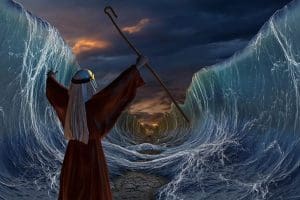
“…behold, this is the spirit by which Moses brought the children of Israel through the Red Sea on dry ground.”
Now, what does that mean?
Maurine
I think we see a laser insight into one of the classic miracles of the history of the Hebrew Nation. There is Moses up against a seemingly impossible situation. Moses looks one way and there are the powerful armies of Pharaoh bearing down on them with the intent to destroy all the Hebrews. Moses looks the other way and there is the Red Sea.
Now, here the Lord is teaching us about the Spirit of Revelation: “This is the spirit by which Moses brought the children of Israel through the Red Sea on dry ground.”
Perhaps the message is this: In this impossible situation, Moses cried to the Lord with all of his heart for mercy, for protection. Perhaps he cried: SAVE US! And into his mind came a thought, “If the Lord could help me part these waters with the Rod of God, we could cross this Sea and escape from the Egyptians forever.
Scot
And as Moses pondered on this thought, the Holy Ghost came upon him and dwelt in his heart. Then the voice of God came to Moses: “But lift up thy rod, and stretch out thine hand over the sea, and divide it: and the children of Israel shall go on dry ground through the midst of the sea.” (Exodus 14:16)
“And Moses stretched out his hand over the sea; and the Lord caused the sea to go back by a strong east wind all that night, and made the sea dry land, and the waters were divided.” (Exodus 14:21)
Can you imagine how much courage this took on the part of Moses? There is a lesson here for each of us to put our trust in the Spirit of the Lord and the thoughts that come into our minds by the power of the Holy Ghost.
Maurine
For me, this idea of speaking to our heart goes like this: the idea that has come to our mind, feels good. It feels right. It feels grounded and consistent. It may not be what you initially thought you would do with your day. It might be a surprise or suggest you do something you hadn’t planned on. It might be just an odd passing impression. It might be just a sense of peace and assurance around an idea. To me that is feeling it in your heart.
It reminds me of something funny that happened once. Scot and I were riding through southern Utah talking about what our next book project would be. We had done a series of big photographic books with text and so we were brainstorming on the next. It started to rain and it came to us that it might be fun to do a book called “When the Desert Rains.” We thought we could talk about hope and flowers that bloom out of barren spots in our lives. We chattered about it for a couple of hours, and thought it was an interesting possibility, but the next morning when we woke up we thought, what was that idea we were talking about yesterday? We could hardly remember. We’d lost all passion and interest about it through the night—and thus, When the Desert Rains, was never born. We had felt it in our minds a little bit, but finally in our hearts—not all. Sometimes we laugh. “Is this going to be another When the Desert Rains idea—in other words—not an impression from the Spirit but a lame idea that was lost very quickly when our hearts just didn’t respond.
Scot
So we practice to receive revelation. It is our privilege as children of God and covenant people with the gift of the Holy Ghost.
Joseph Smith said, “God hath not revealed anything to Joseph, but what He will make known unto the Twelve, and even the least Saint may know all things as fast as he is able to bear them, for the day must come when no man need say to his neighbor, Know ye the Lord; for all shall know Him … from the least to the greatest [see Jeremiah 31:34].”
Learning how to receive this gift is worth a lifetime of effort.
Maurine
That’s all for today. This has been Meridian Magazine’s Come Follow Me podcast. Next week we’ll study Doctrine and Covenants Sections 10 and 11, “That You May Come Off Conqueror.” Thanks to Paul Cardall for the music and for Michaela Proctor Hutchins who produces this show. See you next week.
Powerful Lesson from Moroni; Joseph Moves to Harmony, Pennsylvania

Sign up for Meridian’s Free Newsletter, please CLICK HERE
To celebrate the study of the Doctrine & Covenants and Church History this year, Meridian is serializing The Revised and Enhanced History of Joseph Smith by His Mother.
To see the previous installment, click here.
To see all the installments, published in order, click here.
Revised and Enhanced History of Joseph Smith by His Mother—
Chapter 20
By Lucy Mack Smith
A man tries to unify the churches in Palmyra. Joseph gives a prophecy about Deacon Jessup that is fulfilled. Joseph goes to the hill September 22, 1824, and is unable to obtain the plates. A lesson from the angel on keeping all the commandments. Joseph works for Josiah Stowell in Harmony, Pennsylvania. The frame house is completed. Joseph becomes acquainted with Emma Hale.
Winter 1824 to December 1825
Shortly after the death of Alvin, a man began laboring in the neighborhood to effect a union of all the churches, that all denominations might be agreed and thus worship God with one mind and one heart.
This, I thought, looked right. I wished to join them, and I tried to persuade my husband to do so, and it was the inclination of all the family to unite with their numbers, except Joseph. He refused from the first to attend the meetings with us.[1] He would say, “Mother, I do not wish to prevent you from going to meeting or joining any church you like, or any of the family who desire the like; only do not ask me to do so, for I do not wish to go. But I will take my Bible and go out into the woods and learn more in two hours than you could if you were to go to meeting for two years.”[2]
To gratify me, my husband attended some two or three meetings, but peremptorily refused going any more, either for my gratification or any other person’s. But he did not object to myself and such of the children as chose to go or to become church members, if we wished.
During this excitement, Joseph said, “It will do you no hurt to join them, but you will not stay with them long, for you are mistaken in them. You do not know the wickedness of their hearts. I will,” said he, “give you an example, and you may set it down as a prophecy. Now, you look at Deacon Jessup. You hear him talk very piously. Well, you think he is a very good man, but suppose that one of his poor neighbors owes him the value of one cow. This man has eight small children. Suppose the poor man should be taken sick and die, leaving his wife with one cow but destitute of every means of support for herself and family. Now, I tell you that Deacon Jessup, religious as he is, wouldn’t hesitate to take the last cow from the widow and orphans rather than lose the debt, although he has an abundance of everything.” This seemed impossible, but it was not one year from the time this was spoken until we saw the very thing fulfilled.

Very sad notice which appeared in the Wayne Sentinel, Wednesday, September 29, 1824, ten months after Alvin’s death.
After a short time, the first shock occasioned by Alvin’s death passed off, and we began to resume our usual avocations.[3]
The angel had informed Joseph that he might make an effort to obtain the plates on the twenty-second of the ensuing September [1824].[4] Accordingly, when the time arrived he visited the place where the plates were hid; and supposing at this time that the only thing required, in order to possess them until the time for their translation, was to be able to keep the commandments of God-and he firmly believed he could keep every commandment which had been given him-he fully expected to carry them home with him. Having arrived at the place appointed, he removed the moss and grass from the surface of the rock, and then pried up the flat stone, according to the directions which he had received. He then discovered the plates lying on four pillars in the inside of the box. He put forth his hand and took them up, but when he lifted them from their place, the thought flashed across his mind that there might be something more in the box that would be of a pecuniary benefit to him. In the excitement of the moment, he laid the record down in order to cover up the box, lest someone should come along and take away whatever else might be deposited there. When he turned again to take up the record, it was gone, but where he knew not, nor did he know by what means it had been taken away.
He was much alarmed at this. He knelt down and asked the Lord why it was that the record was taken from him. The angel appeared to him and told him that he had not done as he was commanded, for in a former revelation he had been commanded not to lay the plates down, or put them for a moment out of his hands, until he got into the house and deposited them in a chest or trunk having a good lock and key; and contrary to this, he had laid them down with the view of securing some fancied or imaginary treasure that remained.
In the moment of excitement, Joseph was overcome by the powers of darkness and forgot the injunction that was laid upon him.
After some further conversation, Joseph was permitted to raise the stone again, and there he beheld the plates, the same as before. He reached forth his hand to take them, but was hurled to the ground with great violence. When he recovered, the angel was gone, and he arose and returned to the house, weeping for grief and disappointment.
As he was aware that we would expect him to bring the plates home with him, he was greatly troubled, fearing that we might doubt his having seen them. As soon as he entered the house, my husband asked if he had obtained the plates. The answer was, “No, Father, I could not get them.”
His father then said, “Did you see them?”
“Yes,” replied Joseph, “I saw them, but could not take them.”
“I would have taken them,” rejoined his father, with much earnestness, “if I had been in your place.”
“Why,” returned Joseph, in quite a subdued tone, “you do not know what you say. I could not get them, for the angel of the Lord would not let me.”[5]
Joseph then related the circumstance in full, which gave us much uneasiness, as we were afraid that he might utterly fail of obtaining the record through some neglect on his part. We, therefore, doubled our diligence in prayer and supplication to God, in order that he might be more fully instructed in his duty and be preserved from all the wiles and machinations of him “who lieth in wait to deceive.”[6]

This spacious frame house was Alvin’s idea. Hyrum and some neighbors would finish it.
Having the building of the house already paid for, we thought it would be well to set the mechanics at work and have it completed. We accordingly did so, and ere long, we had a pleasant, commodious habitation ready to receive us. Mr. Stoddard, the principal workman on the house, would have been very glad to have purchased it for fifteen hundred dollars, but that was no temptation. Nothing could persuade Mr. Smith to abandon the scene of his labor and the toiling of this family, for here they had borne the burden and heat of the day. We contemplated with much happiness the enjoyment of the fruit of our labors.
A short time before the house was completed, a man by the name of Josiah Stowell[7] came from Chenango County, New York, with the view of getting Joseph to assist him in digging for a silver mine.[8] He came for Joseph on account of having heard that he possessed certain means by which he could discern things invisible to the natural eye.
Mr. Stowell came into the Palmyra district with Joseph Knight Sr.[9] to buy grain. In that way he became acquainted with the Smith family.
This project of Stowell’s was undertaken from this cause-an old document had fallen into his possession, in some way or other, containing information of silver mines being somewhere in the neighborhood in which he resided.
Joseph endeavored to divert him from his vain pursuit, but he was inflexible in his purpose and offered high wages to those who would dig for him in search of said mine, and still insisted upon having Joseph to work for him. Accordingly, Joseph and several others returned with him and commenced digging. After laboring for the old gentleman about a month without success, Joseph prevailed upon him to cease his operations, and it was from this circumstance of having worked by the month, at digging for a silver mine, that the very prevalent story arose of Joseph’s having been a money digger.

The Isaac and Elizabeth Hale home in Harmony Township, Pennsylvania, has recently been restored.
While Joseph was in the employ of Mr. Stowell, he boarded a short time with one Isaac Hale, and it was during this interval that Joseph became acquainted with his daughter, Miss Emma Hale,[10] to whom he immediately commenced paying his addresses, and was subsequently married.
When Mr. Stowell relinquished his project of digging for silver, Joseph returned to his father’s house.[11]
Soon after his return we received intelligence of the arrival of a new agent for the Evertson land, of which our farm was a portion. This reminded us of the last payment, which was still due and which must be made before we could obtain a deed to the place.
Having made the acquaintance of a couple of gentlemen from Pennsylvania, Mr. Stowell and Mr. Knight, who were desirous of purchasing a quantity of wheat, which we had down on the place, we agreed with them that if they would furnish us with a sum of money requisite for the liquidation of this debt, the wheat should be carried to them in flour the ensuing season.
Having made this arrangement, Mr. Smith sent Hyrum to the new agent in Canandaigua to inform him that the money should be forthcoming as soon as the twenty-fifth of December 1825. This, the agent said, would answer every purpose, and he agreed to retain the land until that time. Thus assured that all was safe, we gave ourselves no further uneasiness about the matter.

Josiah Stowell lived in this area when Joseph Smith came to work for him.
When the time had nearly come for my husband to set out for Pennsylvania to get the money, Joseph called Mr. Smith and myself aside and told us that he had felt so lonely ever since Alvin’s death, that he had come to the conclusion of getting married if we had no objections. He thought that no young woman that he ever was acquainted with was better calculated to render the man of her choice happy than Miss Emma Hale, a young lady whom he had been extremely fond of since his first introduction to her. His father was highly pleased with Joseph’s choice, and told him that he was not only willing that he should marry her but desired him to bring her home with him, that we might have the pleasure of her society.
Since Mr. Smith was going to Mr. Stowell’s and Mr. Knight’s to get the money to bring up the arrearages on the farm, Joseph concluded to set off with him as soon as the necessary preparations could be made.
Notes
[1] Probably Joseph did not mingle with other churches at this time, in response to these two statements from the First Vision: “I was expressly commanded ‘to go not after them,’ at the same time receiving a promise that the fullness of the Gospel should at some future time be made known unto me” (History of the Church 4:536). Also, “I asked the Personages who stood above me in the light, which of all the sects was right . . . and which I should join. I was answered that I must join none of them, for they were all wrong. . . . He [the Personage who addressed Joseph] again forbade me to join with any of them.” (JS-H 1:18-19, 20.)
[2] Joseph the Prophet would later state: “Could you gaze into heaven five minutes, you would know more than you would by reading all that ever was written on the subject” (History of the Church 6:50).
[3] To add insult to injury, the most horrible rumors began to circulate in Palmyra about Alvin’s interment and what had been done to his body. Preston Nibley wrote of this: “There is something pathetic in the publication of this ‘notice’ by Father Smith. It is evident that various unfounded and harmful rumors were being circulated in the neighborhood regarding the Smith family, probably directed against Joseph, Jr., who had related the story of his visions. Then the rumors grew, and some uninspired yokel put out the story that Father Smith had allowed certain physicians to remove Alvin’s body from its grave to be dissected. Father Smith’s prompt denial and publication of the notice effectually put an end to these rumors.” (In Lucy Mack Smith, History of Joseph Smith by His Mother, ed. Preston Nibley [Salt Lake City: Bookcraft, 1954], p. 332.)
[4] In all former versions of this work, Lucy’s story of Joseph’s 1824 visit to the Hill Cumorah has been placed before the death of Alvin. This was because Lucy’s account of his death was recorded as November 19, 1824, rather than the correct year of 1823. In this version the accounts have been placed in their proper chronological order.
[5] Catharine (or Katharine) Smith Salisbury (Joseph’s younger sister) spoke of this time: “I well remember the trials my brother had, before he obtained the records. After he had the vision, he went frequently to the hill, and upon returning would tell us, ‘I have seen the records, also the brass plates and the sword of Laban with the breast plate and interpreters.’ He would ask father why he could not get them. The time had not yet come.” (In Backman, Eyewitness Accounts, p. 53.)
[6] It appears that the Lord was preparing not only Joseph to receive the record but the whole Smith family as well; for all would face severe trials from the world for their support of Joseph.
[7] Josiah Stowell was born at Winchester, New Hampshire (just twenty-three miles south of where Lucy Mack Smith was born), in 1770. Josiah’s last name has also been spelled Stoal and Stowel.
[8] It is well to note that Joseph was, of course, on the Hill Cumorah, September 22, 1825. Joseph recorded in his history: “In the month of October, 1825, I hired with an old gentleman by name of Josiah Stowel” (History of the Church 1:17). At this time, the Smith family house had been under construction for three years, and Joseph first became acquainted with Emma Hale; that is, in late fall 1825.
[9] Joseph Knight Sr. was born in 1772 at Oakham, Massachusetts. He married Polly Peck about 1795 and moved in 1810 to a farm at Colesville, Broome County, New York, where he and his family remained for nineteen years. (See Papers, p. 496.) Joseph and Polly had seven children, including Newel and Joseph Jr. The Knight family would play a critical role in the Restoration by helping provide the means for Joseph to translate the Book of Mormon and being a constant support to him throughout his life.
[10] Emma Hale was born July 10, 1804 (she was seventeen months older than Joseph), in Harmony, Susquehanna County, Pennsylvania. Isaac and Elizabeth Hale lived in a comfortable home (foundation dimensions are thirty by forty-two feet) with their nine children.
[11] Clearly Joseph was trying to help raise the money for the last payment on the farm. Joseph came back to the farm sometime in November 1825.
FEATURES