





Learning How to Parent the Way God Does

We all want to be good parents. We want to be close to our children and we want them to develop into good people. We have mental pictures of loving, peaceful, happy families extending into eternity.
But the toast burns, milk spills, chores get forgotten, squabbles break out. Children act childishly.
And we parents get tired, distracted, frustrated, and overwhelmed. Life burdens us.
In spite of our noble aspirations, we spend a lot of time being irritated with our children—sometimes downright angry. Family scripture study devolves into sibling spats. Family prayers either involve chaos or they are neglected. Sibs fight. Children act irresponsibly.
We don’t know whether to be angry with the children or disgusted with ourselves. We slump into parental despair. It seems that all is not right in our families.
Unless we have the heavenly perspective. Terryl and Fiona Givens have focused us on the God who is the perfect model of parenting.
One comfort is to be found in a God whose power is in His magnanimity as well as His wisdom. These two traits mean that His divine energies are spent not in precluding chaos but in reordering it, not in preventing suffering but in alchemizing it, not in disallowing error but in transmuting it into goodness. . . . If God can transform cosmic entropy and malice alike into fire that purifies rather than destroys, how much more can He do this with the actions of well-intentioned but less-than-perfect [parents]. (pp. 78-79, Terryl & Fiona Givens, The Crucible of Doubt, 2014, Deseret Book)
God can transform our parenting crises into growth for us and for our children. If we draw Him into our parenting.
Life is supposed to be hard. Parenting is supposed to test us to see whether failed efforts will lead to better attempts. God wants to see if we will learn and keep trying. He wants us to learn the power of His principles. He wants us to discover that we cannot be the parents we should be without His heavenly help.
Ultimately, He wants us to become partners with Him. Our imperfect but wise and persistent efforts on earth will yield not only faith-filled children on earth but reformed and refined character in our own souls. That is God’s purpose. That is godly parenting. This series of articles describes the four foundational principles of parenting. It is intended for earnest and imperfect parents who would like to become godly parents.
We rarely recognize the eternal significance of parenting in God’s plan. Parenting is God’s central task: “He doeth NOT ANYTHING save it be for the benefit of the world” (2 Nephi 26:24, emphasis added). Parenthood is also His core identity; first and foremost, He calls Himself Father.
Earthly parenting is the place where we learn the vital lessons to prepare us to join Him in His work. It is, above all else, an apprenticeship for godliness.
Research has shown that LDS people have distinctive beliefs about parenting—but their parenting is like everybody else’s. What a shame that our extraordinary understanding of God’s plan and character have not informed and enriched our way of caring for our children! What a tragedy that our parenting light doesn’t shine brighter.
What are the distinctive doctrines that could make our parenting more heaven-like? What are the principles that God models in His own parenting that should be the core of ours? How can the principles be translated into practices that strengthen our families?
Benefiting from Science and Scripture
God has always had the best answers to all questions and challenges. Yet we rarely mine God’s truth for all its riches.
I believe that science can be combined with God’s truths to help us find powerful answers especially in the area of parenting. God’s principles of parenting are surprisingly consistent with the great discoveries of research.
A national project reviewed decades of research and released a report called the National Extension Parent Education Model which identified six principles as foundational to good parenting (Smith, Cudaback, Goddard, & Myers-Walls, 1994). I would like to take four of those principles—the ones I believe are most essential—and enrich them with spiritual perspectives to form a Model for Godly Parenting.
In this article I will introduce each of these four principles. I will use the analogy of building a house to help us envision the key ideas for raising children. Then future articles will be dedicated to looking at each principle in greater detail and discussing how to apply each of them to making your parenting more godly.
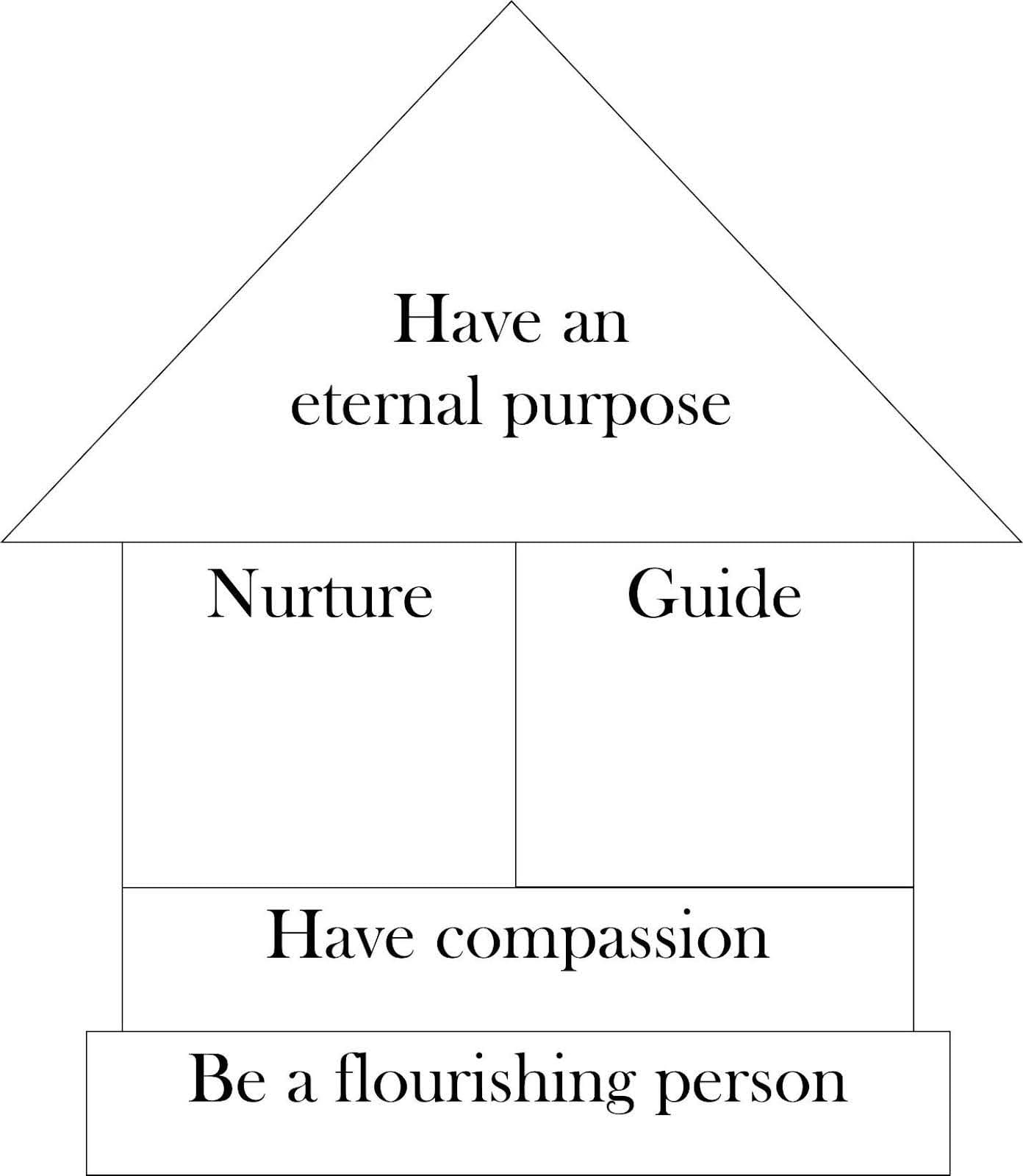
The Footings: The Flourishing Parent
At the very base of any substantial structure are the footings or footers. This substantial course of concrete is generally wider than the foundation and assures that the foundation (and the whole structure) will not settle and crack. The integrity of the structure depends on the strength and the solidity of those footings.
What are the footings of parenting? What does the entire structure rest on? I believe that the footings are the state of mind and quality of character of the parent. Parenting scholars often speak of the concept of “parent care for self”, meaning that a parent must be a healthy, functioning human in order to be a good parent. A miserable, unhappy person is not likely to be an excellent parent.
Further, when we are not built on the Rock, the storms of parenting will wash us away. When we are built upon the Rock of our Redeemer, we are solid (Matthew 7:24).
The Gospel of Jesus Christ suggests that we must be converted before we can strengthen others (Luke 22:32). A corrupt tree cannot bring forth good fruit (3 Nephi 14:17). The same principle applies to parenting. A dead tree trunk cannot nourish the branches. A troubled, hostile, bitter parent will find it difficult or impossible to deliver life-sustaining truth and goodness to children. A person who is spiritually alive and growing is more likely to be a flourishing parent, capable of nourishing children and helping them thrive.
Of course the Gospel prescribes very specific actions if we are to be flourishing people. In fact, God provides a surprisingly tart directive to parents
Teach parents that they must repent and be baptized, and humble themselves as their little children, and they shall all be saved with their little children. (Moroni 8:10)
The foundational principles of faith, repentance, and covenant-making have special relevance to parenting. These are the principles of spiritual growth. We must be earnest about our relationship with God if we are to be the best parents.
The Foundation: Compassion
Built on the footings of a great structure is the foundation. The scholarly model of parenting recommends “Understanding” as the foundation of parenting. This concept encompasses everything from understanding normal development to understanding a child’s unique temperament and circumstances. Understanding is vitally important.
God prescribes something even richer than understanding: Compassion. While understanding entails a knowledge of development and personality, compassion involves being “touched with the feeling of our [children’s] infirmities” (Hebrews 4:15). Compassion goes beyond understanding the child and entails a readiness to act in the interest of the child. This is best done when we see the world through the eyes of the child. Compassion is the offering of our whole souls to experience the lives of other people.
Compassion is exactly what Jesus did as part of the atonement. Not only did He bear the burden of our sins, but He also bore our infirmities so that His compassion would be fully informed (Alma 7:11-12). We can NEVER rightly say to Him: “You just don’t understand!” He does understand. He bore every pain, discomfort, and disappointment any human ever suffered so that He would have perfect compassion.
Jesus invites us to have compassion for our children. I believe that our development of compassion is absolutely foundational to good parenting. In the absence of compassion, we cannot respond to children’s challenges in ways that help them learn and grow.
The Body of the House: Nurture and Guidance
The body of the house involves two companion processes. In the scientific community we call them nurture and guidance. God calls them something similar in scripture. “And, ye fathers, provoke not your children to wrath: but bring them up in the nurture and admonition of the Lord” (Ephesians 6:4).
I believe that God chose the words “nurture” and “admonition” very deliberately. It is exactly those words that Enos uses in describing the godly parenting that he received (Enos 1:1).
Nurture is any behavior that the child experiences as warm, caring, and supportive. The key is how the child experiences the behavior. In other words, all the parental “I love you’s” in the world do not constitute nurture unless the child feels loved.
This is where wise guidance provides the perfect balance for gracious nurturing. Children must not only be loved but also learn the law of the harvest. “Be not deceived; God is not mocked: for whatsoever a man soweth, that shall he also reap” (Galatians 6:7). Children must be taught eternal principles and the consequences of disregarding them.
The reality of mortal parenting is that children won’t always feel loved or loving when they are learning the law of the harvest. Sometimes we don’t feel loved by God even though His love never fails. Yet we can create a bond that is stronger than the cords of death (D&C 121:44) while helping children learn to honor the principles of eternal growth: “I, the Lord, am bound when ye do what I say; but when ye do not what I say, ye have no promise” (D&C 82:10).
We can best teach children when we ourselves are striving to honor the laws of God. Then we strive to teach our children the very principles that guide our lives.
The Roof: Eternal Purpose
Our objective is not merely to get our children through mortality in a way that keeps them out of hell in eternity. Those of us who have the fullness of the Gospel have loftier ambitions. We are preparing our children to do the work that God does and, in the process, we are preparing ourselves to do as God does and be as God is. YIKES! That is an exalted objective! In fact it is fully impossible for mere humans—unless we get divine help. When we understand God’s eternal purposes, we are humbled. When we earnestly seek heavenly counsel, we are taught from on high, including how to more effectively, compassionately, and wisely parent our children.
In the following articles, we will walk through each of these principles in more detail including the specific processes that help us succeed at this sacred and blessed opportunity of rearing children. I invite you to join me for that journey.
Reference: Smith, C. A., Cudaback, D., Goddard, H. W., & Myers-Walls, J. (1994). The National Extension Parent Education Model. Manhattan, KS: Kansas State University.
Defending Motherhood Just Takes Three Words

It works when a friend points out your lost earning potential.
It works when a stranger at the park scowls at the antics of your tired three year old.
It works when your boss implies that you’ll fall behind if you take maternity leave.
It works when your professor delays your graduation.
It works when the teacher at your son’s high school teacher raises an eyebrow that you’re pregnant again.
It works when your parents question your fostering/adopting/in-vitro decision.
It works whether your kids are behaving angelically or demonically. It works whether you feel fresh or frazzled.
It works because these three tiny words contain no hint of religion or politics. They don’t preach, and can be said in whatever tone of voice is most appropriate for the moment: gentle, chipper, humorous, even apologetic.
It works because it speaks to everyone present, not just the person you’re addressing. Your children are often listening, and they need to hear it. YOU are listening, and perhaps you need to hear it most of all.
It works because it’s true.
It works because these three words are a testimony. Your testimony. Your understanding of God’s whole glorious plan, and your personal commitment to that plan, all rolled into a phrase that takes less than two seconds to say. And when you speak testimony of something true, even in just three words, the Spirit of God can echo them deep inside someone’s heart.
It works because it hints at a life span of joys you don’t have time to elaborate on: newborn snuggles, first steps, bathtub splash parties, play-doh creations, dried tears, secret crush confidences, bike rides, raking leaves, family vacations, diplomas, and eventually grandkids.
It works because it implicitly acknowledges that there are stresses, sacrifices, and impediments that might legitimately frighten someone away from motherhood. It doesn’t ignore the strain, the pain, or the weight gain. It doesn’t attempt to whitewash away the hourly struggles to balance nutrition, finances, education, fitness, sleep, and babies. Or the tears and prayers during teenage power struggles.
It works even if you just want to proactively advocate for motherhood in neutral situations. For example, if you take several kids in public just twice a week on average, you’ll have an easy opportunity to say it around 312 times this year, to people from all walks of life. That likely-low estimate assumes that during each outing three strangers will observe, “You’ve got your hands full.”
Mommy blogs offer lots of witty comebacks for mothers who don’t know what to say in awkward situations. Most are either contrived and cheesy (“Hands full now, hearts full later!”) or snarky (“Wanna babysit?”)
This answer is different. It works because it helps open hearts. And when you say it, either at the grocery store or at the office party, most people will feel its truth and instantly agree.
You shrug, smile, and say “It’s worth it.”
Three Creation Accounts – One Divine Plan

In Latter-day Saint belief, the Creation is revealed through three complementary accounts: Genesis in the Old Testament, the Book of Moses, and the Book of Abraham in the Pearl of Great Price. These records do not compete with one another. Together, they offer a richer understanding of God’s nature, humanity’s identity, and the purpose behind the earth’s creation.
Genesis offers the most familiar account. Traditionally attributed to Moses as the author, it presents Creation in a majestic and orderly manner, describing how God formed the heavens and the earth, organized life, and created man and woman in His image. The language is formal and universal, emphasizing divine authority and the goodness of God’s work. Genesis teaches what happened—the world was created deliberately, with order and purpose. It preserves the core narrative upon which later revelation builds.
The Book of Moses expands the narrative through modern revelation. As Joseph Smith worked on the Joseph Smith Translation of the Bible, he received inspired clarification and restoration of Genesis material. The earliest portions of that work are now published as the Book of Moses, which can be understood as Genesis revealed anew rather than rewritten. This record strengthens the traditional view of Mosaic authorship by portraying Moses as a prophet who spoke directly with God and received divine instruction about Creation and humanity’s role within it.
The Book of Moses therefore shifts the focus from events to intent. Instead of opening with the formation of the earth, it begins with Moses learning who God is and why Creation matters. God declares, This is my work and my glory—to bring to pass the immortality and eternal life of man. Creation is framed as part of a plan centered on humanity. The earth exists not merely as a beautiful world, but as a place where God’s children can exercise agency, form families, and progress toward Him. The Fall of Adam and Eve is presented not as a failure, but as a necessary step toward making joy, growth, and redemption possible.
The Book of Abraham reaches even further back, describing events before the earth was formed. Abraham records a premortal council where God presented His plan to His spirit children. Creation is portrayed as a carefully organized process, carried out in stages through divine cooperation. This account emphasizes intention and preparation rather than sudden creation. It also teaches human beings existed as spirits before mortality and were known and instructed by God long before their birth on earth.
Read together, these accounts reveal Creation and salvation are inseparable. Genesis teaches what God did. The Book of Moses explains why He did it. The Book of Abraham shows how it was planned. Each prophet received revelation suited to his mission and audience, and God repeated the story not to correct earlier accounts, but to deepen understanding as His children were prepared to receive more.
This combined view also addresses common questions. The days of Creation need not be literal twenty-four-hour periods but can represent extended phases of organization. The Fall becomes a purposeful part of God’s design rather than a tragic disruption. Faith in Creation does not require rejecting science, since Latter-day Saint doctrine allows for divine direction working through natural processes.
Together, these records demonstrate how revelation works. God teaches gradually, adapting truth to the needs and understanding of His children. Genesis spoke to an ancient covenant people. The Book of Moses sought humanity’s place in an eternal plan. And the Book of Abraham contemplated the heavens and God’s work beyond the earth. Each account reflects both divine consistency and divine patience.
These Creation accounts also invite personal engagement. Believers are encouraged to seek understanding through study, prayer, and continuing revelation. The same God who instructed Moses and Abraham invites individuals to gain insight suited to their own lives. The Creation thus becomes more than doctrine—it becomes a witness of God’s involvement and care.
Above all, these accounts teach identity. If life existed before the earth, if a plan was prepared in heaven, and if the world was created with humanity in mind, then no person is an accident. Each individual has divine potential and an eternal purpose. The Creation story, as revealed in Genesis, and through Moses and Abraham, is ultimately about who we are, where we came from, and where God invites us to go. Together, these three witnesses testify the world was created with love, intention, and eternal purpose, and that every child of God has a place in His plan.
Podcast: The Lessons only Your Body Can Teach You.

 In part two of the doctrine of the body, we explore the sacred lessons that can only be learned through a mortal body—one that aches, changes, gives life, and wears out. Through Latter-day Saint doctrine and personal reflection, we examine how physical weakness, pain, and limitation can become holy ground for faith, surrender, and deeper trust in Jesus Christ. If your body has ever felt like a burden or a betrayal, this episode invites you to see it instead as a powerful teacher in God’s plan.
The Eternal Implications of Miscarriage, Stillbirth, and Abortion

It was fall 1973 and my wife (Maradee) and I had just moved back to Cache Valley where I was about to start teaching Economics at Utah State University. Maradee was about four months pregnant and we were anticipating adding a second child to our family. The first months had been uneventful, but then things quickly went wrong and she had a miscarriage.
We experienced all the uncertainty, anguish, and guilt that tend to be associated with a young couple having a miscarriage but managed to move forward with our lives. Just over a year later, we were blessed with the birth of our daughter, Lisa. All went well and she is now an amazing wife and mother.
As I looked at my precious infant daughter, I wondered, “Is she the same spirit who didn’t make it the first time or is she a completely different person? And if different, what is the status of the spirit who was programmed for the fetus that miscarried?” At some point, I will know for sure, but not right now.
In contrast, our fourth child, Jenny, had a myriad of special needs. We cared for her for 38 years until she passed away in 2017. Although our experience was much more difficult than the temporary setback of a miscarriage, the ultimate outcome is clear. Jenny never approached the standard for accountability, so her destiny is guaranteed by D&C 137:10, “…. all children who die before the years of accountability are saved in the celestial kingdom of heaven.” On another occasion, I would like to share the pathos and humor of our chaotic 38 years with Jenny.
One purpose of this article is to consider what happens to spirits that don’t properly enter mortality–miscarriages, stillbirths, and, yes, abortions. Do they bypass the normal process of mortality or are they recycled into another body as part of an alternative path for that spirit?” The outcome of those three situations is the same, but the cause of not being born differs dramatically. With miscarriage and stillbirth, the reason is a biological malfunction, but with abortion it is a conscious choice to terminate the pregnancy.
A second purpose is to look more closely at abortion and to consider how abortion can be viewed much differently through the lens of the restored gospel, as compared to other religious perspectives. The goal here is not to debate whether abortion is right or wrong, but to probe what is the eternal consequence. However, I acknowledge that I support the Church’s position on this issue.
Miscarriage and Stillbirth
The Church of Jesus Christ of Latter-day Saints (hereafter, Church) does not record stillbirths or miscarriages on church membership records. The Church’s policy generally involves recording ordinances and milestones such as births, baptisms, confirmations, and other ordinances for individuals who are born alive. Moreover, temple work is not done when there is a miscarriage or stillbirth. That would seem to imply that the process isn’t complete until the spirit has had its opportunity for mortality through birth. However, there is some ambiguity because the Church Handbook also refers to those who die before birth as “children” and specifically states that the lack of requirement for temple ordinances “does not deny the possibility that they may be part of the family in the eternities.” [Handbook, 38.7.3)
The issue of whether or not the spirits associated with a miscarriage or stillbirth get a second chance at mortality can be inferred, but specific doctrinal statements are difficult to find. Under God’s plan, every one of His children will have the opportunity to have the experiences necessary to realize their eternal potential as a child of God. One of these requirements is a physical body. That body might be received as part of another physical birth or during the Millenium when all incomplete matters, such as infirmities, marriage, and bodies will be resolved. No one will be unwillingly left behind.
The scriptures teach that all of God’s spirit children who accepted the great Plan of Salvation will be resurrected. But they can’t be resurrected unless they first have a body. If there is opportunity for exaltation for all of us who have lived and sinned, there must be a path for those who haven’t sinned because they haven’t yet experienced mortality.
This explanation assures equity for all of God’s children, but it doesn’t answer the question of if my daughter Lisa was a spirit who tried to come to us twice or if there was another spirit who unsuccessfully tried to join us. It probably doesn’t have to be the same in every case. At this point, I am satisfied not to know, but just to be Lisa’s father.
Abortion Attitudes and Church Policy
Now to the sensitive topic of abortion. It’s a political issue as well as being deeply personal. The range of extreme views is so broad as to defy compromise. Extreme pro-choice advocates argue that a woman’s right to choose is inviolate. Equally extreme pro-life advocates oppose abortion under any circumstance and equate it to murder. Views on abortion differ dramatically. A 2022 Pew Research Center survey reported the following percents saying “YES” to the statement: Abortions Should Be Illegal in All/Most Cases
Jehovah’s Witness 75%
Church of Jesus Christ of LDS 70%
Evangelical Protestant 63%
Catholic 47%
Islam 37%
Mainline Protestant 35%
“Nones” 23%
Judaism 15%
Church members are not unanimous in their opposition to abortion, but they are more opposed than any other group except Jehovah’s Witnesses. This opposition may reflect support for the Church’s policy with respect to abortion, as stated in the General Handbook of Instructions:
“The Lord commanded, ‘Thou shalt not … kill, nor do anything like unto it’ (D&C 59:6). The Church opposes elective abortion for personal or social convenience. Members must not submit to, perform, arrange for, pay for, consent to, or encourage an abortion. The only possible exceptions are when:
Pregnancy resulted from forcible rape or incest.
A competent physician determines that the life or health of the mother is in serious jeopardy.
A competent physician determines that the fetus has severe defects that will not allow the baby to survive beyond birth.
Even these exceptions do not automatically justify abortion. Abortion is a most serious matter. It should be considered only after the persons responsible have received confirmation through prayer.….. As far as has been revealed, a person may repent and be forgiven for the sin of abortion.” (Handbook, 38.6.1)
Abortion and the Doctrine of Pre-Mortal Life
Attitudes toward abortion are often based on the person’s belief regarding when life begins. In most other faith traditions, life is viewed as beginning at conception, as shown below.
When Does Life Begin?
Roman Catholic Conception
Eastern Orthodox Conception
Episcopal Conception
Evangelical Protestant Conception
Mainline Protestant Conception
Jehovah’s Witness Conception
Judaism Birth
Islam Conception/But the soul enters the body at 120 days
LDS Each entity is eternal
Based on the premise of life beginning at conception, an abortion results in an irrevocable termination of existence. If life starts at conception, then when the life is ended by abortion, that potential person will never exist. There are no second chances for that life form. One and done. No mulligans. Thus, an abortion may permanently deprive the world of an Einstein, a Gandi, or an Aaron Judge.
The perspective is much different for those with an understanding of the Plan of Salvation because the concept of pre-mortal life comes into play. I am once again reminded of the incredible explanatory power associated with this doctrine. It has so many implications.
A critical component of the Plan of Salvation is that each of us is an eternal being—we had no beginning and we will have no end. Mortality is not our starting point, it is just one step along the way to achieving our eternal destiny of becoming like our Heavenly Father. But mortality is an essential part of that journey that can’t be skipped.
Dallin H. Oaks taught that “our attitude toward abortion is not based on revealed knowledge of when mortal life begins for legal purposes. It is fixed by our knowledge that according to an eternal plan, all of the spirit children of God must come to this earth for a glorious purpose, and that individual identity began long before conception and will continue for all the eternities to come.” (1991 Supplement to the 1989 General Handbook of Instructions, p. 1)
What are the implications of abortion when coupled with the doctrine of pre-mortal life? Elder Oaks stated that abortion is a serious sin because “the ultimate act of destruction is to take a human life.” (Ibid.) It puts a person in the position of making a decision about the duration of life, which is clearly God’s prerogative. The immediate plan for a specific spirit to be part of a specific family is at least temporarily thwarted by the termination of a pregnancy by abortion.
But what are the long-term ramifications? If all of God’s spirit children are guaranteed the right to a mortal body, then the consequence must be temporary. That spirit will be embodied at some point. It may be with the same family through a later pregnancy, it may be as part of another family, or it may not happen until the millennium. We don’t know the details. What we do know is that abortion will not abrogate the right of that spirit to have a body so that she/he can continue the journey to exaltation.
What else can be said? Some argue that mortals have had experiences that shed additional light on the question of uncompleted births. For example, Sarah Hinze has published several books, including the 2015 The Castaways, that include stories of visitations by yet unborn children. The title refers to those children who were prevented the opportunity for life by abortion. The accounts are a little inconsistent in that some of those children are given another chance to be born, while others languish in heaven and are cared for by others. It’s unclear in the book how this determination is made.
These accounts are touching and there is no reason to doubt the sincerity of those who share their experiences. Hinze asserts that she has collected accounts of hundreds of encounters with pre-birth beings. I have always been skeptical of these claims and also of near-death encounters. But I make no judgement here and I was struck by a statement by her husband in a 2022 documentary movie on the topic, Remembering Heaven. He argues that one such story is an anecdote, but many similar testimonies approach the status of data. As a social scientist, I can’t summarily dismiss that argument.
Finally
There is much that we don’t know about abortion. What we do know is that it cannot thwart the will of God and the promises made to His children. Note how different this conclusion is than the view from the perspective of other religions that “life begins at conception” and life is one and done. The doctrine of pre-mortal life sheds light on so much of human existence.
This understanding should not be used to justify “convenience abortions” or to lessen the seriousness of the choice involved. But it does once again show that God will prevail and testifies of the amazing enlightenment we receive through the doctrines of the restored gospel of Jesus Christ.
The Celestial Kingdom: “Will We Be “Bored in Eternity? Does One Size Really Fit All?”

Recently, a friend texted me a question. She is a faithful, devoted member of the Church, but her adult children have some challenges. It made me sad and caused me to think. This is what she wrote:
Do you really, deep down want to live for eternity in the highest realm of the Celestial Kingdom where you will create worlds and deal with all of the heartache and pain of those living on your ‘earths’? Being a parent is such a very heavy load. I can’t fathom parenting a world of inhabitants. I think I have a different role to play through eternity. I’ve always considered myself to be more of a “worker bee.” But all we hear about is reaching that lofty goal. WHY?
My glib and almost immediate response to her was “You drastically underestimate yourself for two reasons. First, you assume that mortal you reflects your true capabilities as developed through the eternities. Remember, we are ‘looking through a glass, darkly.’ Second, you are ignoring the infinite, enabling power of the Atonement. Grace, grace, grace. Paul says, ‘I can do all things through Christ who strengthens me. (Philippians 4:13)’”
That wasn’t enough for her, so I referred to a “higher source,” LDSBOT, which is an artificial intelligence app available from the B.H. Roberts Institute. It’s based on CHATGPT and tailored to respond to church-related queries. I have mixed feelings about it because of the potential for misuse. I can see a deacon being asked to speak in church on repentance and totally procrastinating the assignment until riding to church when he asks LDSBOT to write him a five minute talk. When his time comes, he just reads the talk off his iPhone. Zero learning.
Nevertheless, I compartmentalized my integrity and asked it, “What if someone in the Celestial Kingdom doesn’t want to create worlds? After just 10 seconds of cyber-speed contemplation, the BOT responded:
Great question! (apparently, I was AI approved). The doctrine of the Church teaches that in the Celestial Kingdom, our will is aligned with God’s will. Elder Dallin H. Oaks has taught that part of our journey in mortality is to learn to align our desires with God’s desires for us. When we are exalted, our joy and purpose will be in fulfilling God’s plan, which includes creating and nurturing eternal family units.” [1]
LDSBOT then laid out point-by-point how this will work:
1. In the Celestial Kingdom our desires will be perfected. We will have a full understanding of God’s plan and a deep love for His work. It’s hard to see how someone who has reached such a state of perfection and joy would not want to participate in the creation and governing of worlds, as it aligns completely with divine love and purpose.
2. Our current earthly perspective is limited. The things we find difficult or unappealing now might be seen differently when we have a broader, eternal perspective.
3. While it’s theoretically possible to wonder about differing desires, our eternal progression and perfected state of being in the Celestial Kingdom should align our desires with God’s work and glory.
Basically, the answer was, “get with the program and everything will be fine.” Apparently, one size fits all, or at least will fit all in the future. My friend found the AI’s recommendation to be somewhat helpful because she’s more obedient than I am. I was left wanting more, so I decided to explore what we have been taught by scripture, latter-day prophets, and scholars.
Comparative Religious Beliefs Regarding the Nature and Potential of Mankind
The Church of Jesus Christ of Latter-Day Saints (hereafter, Church) has distinctive beliefs on the origin and destiny of man. They are rooted in the concept of pre-mortal life and the literal fatherhood of God. Other Christian churches teach that creation was ex nihilio (out of nothing) and that our existence begins at birth. The implication is that God and man are not just different in terms of level of perfection; they are fundamentally different species. There is a qualitative divide between Creator and creature, and, consequently, mankind’s potential is inherently and significantly limited.
In contrast, Church doctrine holds that human potential is based on a relationship with God that extends eternally backward in time and that God is “a kindred Being who invites the human family to share His condition and nature…. humans are inherently more godlike, God is more anthropomorphic, and God’s purposes are more oriented toward human theosis than is the case with earlier Christian conceptions….”[2]
Paul taught that we are “children of God; and if children, then heirs; heirs of God, and joint heirs with Christ. (Romans 8:17)” Parley P. Pratt distilled Church theology on the topic as “God, angels, and men are all of one species.” [3] The concept takes on its most lofty form in the oft-repeated couplet from Lorenzo Snow that, “As man now is, God once was: As God now is, man may be.”
C.S. Lewis didn’t go quite as far, but he did ask, “Is it so very difficult to believe that the travail of all creation which God Himself descended to share, at its most intense, may be necessary in the process of turning finite creatures (with free wills) into—well, into Gods.” [4]
What Will Those Who Inherit the Celestial Kingdom Do?
Not much has been revealed about the ongoing activities of those in the Celestial Kingdom. To be AI neutral, I gave the non-sectarian CHATGPT a crack at the question. It responded that activities and experiences in the Celestial Kingdom may include:
1. Living in the Presence of God. The faithful will dwell with God the Father and Jesus Christ, experiencing perfect joy and love.
2. Eternal Families. Families can be united eternally, allowing individuals to be with their loved ones forever.
3. Progress and Learning. Fundamental to Church theology is the concept of eternal progression. Those in the celestial kingdom will become more like God as they increase in knowledge, wisdom, and power.
4. Service and Work. There will be meaningful service and work, contributing to God’s purposes.
5. Creation and Stewardship. Some teachings suggest that the righteous may participate in creation and stewardship over worlds or other divine responsibilities. However, there is not much detail about what this will entail.
6. Receiving Exaltation. Those in the highest degree of the Celestial Kingdom will receive exaltation, becoming like God and sharing in His glory.
The CHATBOT response was helpful, but generic. I wanted some validated specifics. The most relevant information in the scriptures is found in these verses:
D&C 131: 1 In the celestial glory there are three heavens or degrees; 2 And in order to obtain the highest, a man must enter into this order of the priesthood [meaning the new and everlasting covenant of marriage]; 3 And if he does not, he cannot obtain it. 4 He may enter into the other, but that is the end of his kingdom; he cannot have an increase. (emphasis added).
D&C 130:2 -And that same sociality which exists among us here will exist among us there, only it will be coupled with eternal glory, which glory we do not now enjoy
D&C 130:19– “Whatever principle of intelligence we attain unto in this life, it will rise with us in the resurrection. And if a person gains more knowledge and intelligence in this life through his diligence and obedience than another, he will have so much the advantage in the world to come.”
Latter day prophets tell us more. The most revealing information provided by Joseph Smith is in the King Follett Discourse, his last public sermon before his assassination. Joseph taught that God was once a man like us and progressed to become God. He explained that humans have the potential to progress and become like God. [5] In Moses 1:39, we learn “For behold, this is my work and my glory–to bring to pass the immortality and eternal life of man.” The implication is that, as we become like God, we too will create worlds.
Parley Pratt wrote, “I might also tell you of the continued exertions of creative power by which millions of new worlds will yet be formed and peopled, not just by God the Father, but also by king Adam and his descendants.”[6]
Brigham Young taught that “All those who are counted worthy to become Gods, even the sons of God, will go forth and have earths and worlds like those who framed this and millions and millions of others.” [7]
Comments by recent church leaders have been consistent, but more circumspect. Gordon B. Hinckley emphasized mankind’s divine potential when he said, “The whole design of the gospel is to lead us onward and upward to greater achievement, even, eventually, to Godhood.” [8] And Dallin H. Oaks has taught that exaltation means to become like our Heavenly Father, which implies developing the attributes and potentially the capacities that God has. [9]
Another concept that may be relevant to life in the celestial kingdom is that of ministering angels. Typically, this role is associated with assisting those of us in mortality. But the scriptures suggest that there will also be ministering angels in the post-judgement existence. Usually, they are afforded a secondary status. For example, D&C 132:16, referring to those who did not participate in the new and everlasting covenant of marriage, teaches that such are, “…..appointed angels in heaven, which angels are ministering servants, to minister for those who are worthy of a far more, and an exceeding, and an eternal weight of glory.”
But it is plausible that there may be those who are righteous and who are sealed to eternal companions who would be happier to be associates rather than the CEOs charged with the demanding work of creation and “eternal lives.” Couldn’t that still be a noble and fulfilling destiny?
So What About My Friend’s Question?
Joseph Smith promised that “if you could gaze into heaven for five minutes, you would know more than you would be reading all that ever was written on the subject.” [10] Unfortunately, that option is not available to most of us.
We spend a lot of time thinking about and, hopefully, acting in ways that will take us to the top level of the celestial kingdom. Not surprisingly, we tend to gloss over what we will be doing there on a day-to-day basis. This is probably appropriate because we don’t have much guidance about that final abode and celestial pursuit must be our primary concern—getting there precedes being there.
An intriguing, but somewhat disquieting evaluation of the heaven issue is portrayed in the quirky TV series, The Good Place, which aired on NBC from 2016 to 2019. The starting point was a young woman who died in an accident after living a rather sleezy life. Because of a snafu, she was sent to the “good place” in the hereafter. As the series evolved, because of a truly gigantic foul up, none of the righteous departed were getting to their deserved reward. In the final season, the problem was corrected and the leading characters (some of whom had turned their after-lives around) were experiencing bliss.
This heavenly experience went on for an extremely long time during which the characters had the opportunity to see everything, patch up all their tarnished relationships, and learn everything there is to learn. The result was a feeling of overwhelming boredom. There was nothing left to be done or to experience. Those in charge (and who that is was always a bit vague in the series) provided a final option. By simply walking through a portal in the woods, their consciousness is terminated and they no longer exist. Several of the key people in the series chose this path and we watched as they voluntarily ended their existence.
That final episode was one of the best series finales I have seen. It was touching and profound. And the question it raised is still on my mind. Eternity is a long time. What could we do that would continue to be interesting forever? Wouldn’t boredom set in after the first million or so worlds created? How many chats would you find interesting with siblings? How much math and science is there to learn and apply? And how does the principle of godly omniscience reconcile with the concept of eternal progression?
So where does all of this leave my friend who is not sure she wants to be a world creator? The answer may be that our understanding and nature will be much different in eternity. Our capacity to love, serve, and handle responsibilities will be greatly enhanced and our exercise of agency will cause us to align with God’s work as described in Moses 1:39. Or maybe, as long as God’s purposes are fulfilled, not every righteous one of His children has to be in charge.
Finally, there is the boredom issue. Boredom may not be a possibility for perfected or perfectible persons. I can accept that, but it is beyond my limited comprehension at this point. And my guess is that most of you have never worried much about being “bored in eternity.”
NOTES:
[1] Oaks, D.H., “Desire,” General Conference, April 2011.
[2] Givens, T. L., Wrestling the Angel, Oxford University Press, 2015, p.264.
[3] Pratt, P.P., Key to the Science of Theology, 1855, p. 33.
[4] Lewis, C.S., Collected Letters, Harper-Collins, 2007, 3:520.
[5] Smith, J.F., Teachings of the Prophet Joseph Smith, pp. 345-7.
[6] Pratt, P.P., “Celestial Family Organization,” 1-2.
[7] Journal of Discourses, 18:259.
[8] Hinckley, G.B., “The Great Things Which God Has Revealed,” General Conference, April 2005.
[9] Oaks, D.H., “The Challenge to Become,” General Conference, October 2000.
[10] History of the Church, 6:50.
VIDEO: Elder Patrick Kearon on a God Who is in Relentless Pursuit of You

This talk segment from Elder Patrick Kearon at April 2024 conference, called, “God’s Intent is to Bring You Home” was too visual for a filmmaker to resist. He reminds us that God “employs every possible measure to bring you back.”
FEATURES