





Becoming Brigham-Shorthand and Bloodstains Pt. 2

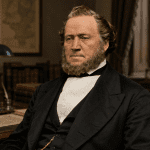
Host Camrey Fox continues her visit with shorthand expert LaJean Carruth. LaJean compares Brigham to Enoch rather than Moses. She points out that many of the transcripts have never been translated before, and they give us new insights into his character and personality. Host John Wilson continues his discussion with Sam Weston about the assassination of Joseph Smith, and whether Brigham was behind it.
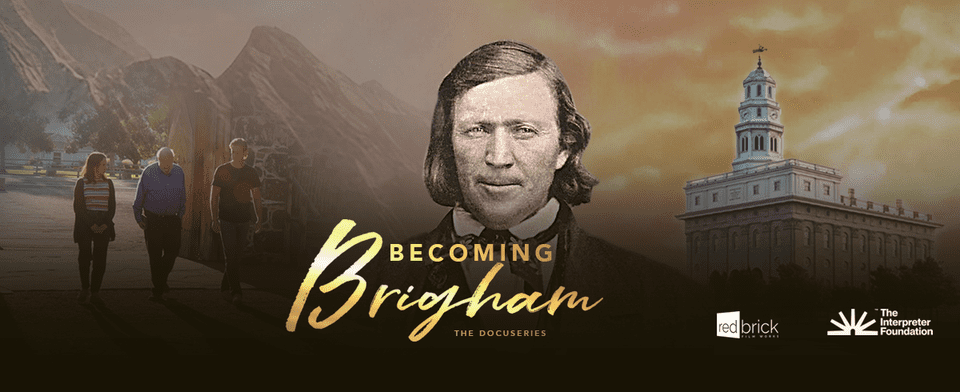
“Enoch and the Temple” — Moses 6 and 7

In Moses 6 and 7, Enoch is raised “high and lifted up even in the bosom of the Father” to be “clothed upon with glory.” Explore the great additional detail apocalyptic literature gives us about Enoch’s temple endowment.
Like Us, They Could Not See A Far Off—Come Follow Me Podcast: Genesis 5; Moses 6

Maurine
It was a beautiful fall day in 1894. The Manti Temple looked glorious as the morning light almost gave it a heavenly glow. My handsome, six-foot-four-inch, twenty-five-year-old Grandfather, Peter Daniel Jensen was there to meet and marry his beautiful twenty-year-old bride, Sarah Jane Rees. Family was gathered and it was indeed a day of joy and happiness. Grandpa was known to be a consistent journal keeper. How would he describe this glorious day in his sacred journal? I have seen what he wrote for Wednesday, September 26, 1894. It simply read:
“Today I married Sarah Jane Rees.”
Adam and Eve also kept a Book of Remembrance and fortunately, they recorded so much more! Let’s talk about that today.
Scot
Welcome to Meridian Magazine’s Come Follow Me Podcast. We are Scot and Maurine Proctor and we are delighted to be with you again this week as we study Genesis Chapter 5 and Moses Chapter 6 together. When you read the Genesis account you might think this is just a boring genealogy with not much more information than Peter Daniel Jensen’s journal entry. If you were to think that, you would be wrong. Let’s do some exploring together as we look at our brave and majestic First Parents, Adam and Eve and their family, the first family of sons and daughters of God on earth.
I believe if we were given the chance to see our parents, Adam and Eve, again, we would be overwhelmed with our connection to them, the love that we would feel from them, their personal knowledge of us and their majesty and glory.
Now, if you just lay out all the birth and death dates on a simple chart, you see that by the time Adam comes to Adam-ondi-Ahman for the great gathering, it is three years before his death and, according to the Joseph Smith Translation manuscript, he would live to be 1,000 years old—so, he was 997 years old. AND, nine generations of these venerable patriarchs (and likely their wives) were alive at this time! That is pretty exciting—I wish we could have been there at that unprecedented gathering at Adam-ondi-Ahman, just so we could do a little family history work! Wouldn’t that have been top notch?
Maurine
So, what are some things we know about Eve, our first Mother? I have to interject here that some years ago I asked Vivian Adams, who is Bruce R. McConkie’s daughter, to write a piece for Meridian on Eve. She accepted the assignment and the article is not to be missed. We quote from Vivian here:
“And Adam called his wife’s name Eve; because she was the mother of all living. (Genesis 3:20)
“Eve’s name was not only personal, but a title and pronouncement of an overarching, all-embracing, wondrous doctrine: that of the initiation of life, worlds without number. The name, we learn from the Hebrew Havah, means life or life-giver. While this designation points toward the initiation of life on earth, it is meant, in the most holy sense, to point to that ongoing system which will eventuate in the creation of life and generation throughout the universe and beyond. Eve is the personification of the entirety of life’s purpose, and the fact that life stems from only such a covenant mother. The name-title is sacred, as is the word mother which in the Hebrew means bond of the family and adds to our understanding of the eternal plan as it centers in women…
Nothing comes into existence temporally or eternally until the appointed woman, wife, and mother begins the process. Even animal life and plant life do not come into earth’s sentient sphere until Eve evokes it in the joyful fall over which angels rejoiced and which opened the world. It is for this reason that the Prophet Joseph Smith explained that when the Genesis term ruach, or the breath of life “applies to Eve, it should be translated lives.”
“Eve achieved pre-mortal preeminence specifically because she had so conformed to the character, attributes, and principles surrounding eternal motherhood. On any given Sabbath we are wont to sing Eliza R. Snow’s immortal words, “In the heav’ns are parents single? No, the thought makes reason stare! Truth is reason; truth eternal Tells me I’ve a mother there.” We exult in that Mother, knowing that she presides in holiness and truth as the consort of the Eternal Father. That full measure of creation indelibly marked Eve’s soul.” (Adams, Vivian McConkie, Mother Eve and the Mission of Life, Meridian Magazine, Tuesday, January 11, 2022)
Scot
That is beautiful and I do love the fact that when Joseph F. Smith, Vivian’s great grandfather, saw the great vision of the redemption of the dead, he saw Eve and he referred to her as “our glorious Mother Eve” (see Doctrine and Covenants 138:39). There doesn’t seem to be a better description of her and I’m sure when we see her again someday, as we have mentioned, we will be overwhelmed and humbled by her majesty, her glory and her love for us. And this is just our earthly Mother Eve.
Vivian also wrote this:
“Our Glorious Mother Eve,” beginning woman, wife, and mother—the last created being to enter Eden’s paradisiacal temple, the Hebrew gan Eden, the Garden of Delight, —and the first to willingly leave it.” (Adams, Vivian McConkie, Mother Eve and the Mission of Life, Meridian Magazine, Tuesday, January 11, 2022)
Now, we find out as we are leading Church History tours that most people are confused in their mind about where the Garden of Eden was located. Most think it was at Adam-ondi-Ahman, but this is not correct.
Maurine
Exactly, we hear this all the time.
Professor Bruce Van Orden, wrote:
“We must remember that the whole earth was paradisiacal before the Fall. The Garden of Eden was a center place. After the Fall, there was no Garden of Eden or paradisiacal status on earth. Yet relative to the locale of the site of the Garden of Eden, the Prophet Joseph Smith learned through revelation (Doctrine and Covenants 57) that Jackson County was the location of a Zion to be and the New Jerusalem to come. The Prophet first visited Jackson County, Missouri, in the summer of 1831. The Prophet visited Jackson County again in April and May 1832. On one of the occasions, or perhaps both, the Prophet Joseph apparently instructed his close associates, and perhaps even a general Church gathering, that the ancient Garden of Eden was also located in Jackson County.
“Brigham Young stated, “Joseph the Prophet told me that the garden of Eden was in Jackson [County] Missouri.” (Journal of Wilford Woodruff, vol. 5, 15 Mar. 1857, Archives Division, Church Historical Dept., Salt Lake City.) Heber C. Kimball said: “From the Lord, Joseph learned that Adam had dwelt on the land of America, and that the Garden of Eden was located where Jackson County now is.” (Andrew Jenson, Historical Record, 9 vols., Salt Lake City: Andrew Jenson, 1888, 7:439; see also Orson F. Whitney, Life of Heber C. Kimball, Salt Lake City: Bookcraft, 1967, p. 219.) Other early leaders have given the same information.
Scot
President Joseph Fielding Smith said: “In accord with the revelations given to the Prophet Joseph Smith, we teach that the Garden of Eden was on the American continent located where the City of Zion, or the New Jerusalem, will be built. When Adam and Eve were driven out of the Garden, they eventually dwelt at a place called Adam-ondi-Ahman, situated in what is now Daviess County, Missouri. … We are committed to the fact that Adam dwelt on [the] American continent.” (Doctrines of Salvation, 3 vols., comp. Bruce R. McConkie, Salt Lake City:Bookcraft, 1956, 3:74. Compare Answers to Gospel Questions, 5 vols., Salt Lake City: Deseret Book Co., 1957–75, 2:93–95, 4:19–24; and Alvin R. Dyer, in Conference Report, Oct. 1968, pp. 108–9.) (Ensign, January 1994, What do we know about the location of the Garden of Eden?, Bruce A. Van Orden)
So, what are some basic things that we know about Adam?
His name is mentioned 56 times in the scriptures. He plays a role unlike any other man who ever came to earth. Brother Robert Millet writes:
“Few persons in all eternity have been more directly involved in the plan of salvation—the creation, the fall, and the ultimate redemption of the children of God—than the man Adam. His ministry among the sons and daughters of earth stretches from the distant past of premortality to the distant future of resurrection, judgment, and beyond.
“As Michael, the archangel, Adam led the forces of God against the armies of Lucifer in the War in Heaven. Under the direction of Elohim and Jehovah, he assisted in the creation of the earth. After taking physical bodies, Adam and Eve brought mortality into being through partaking of the fruit of the tree of knowledge of good and evil. With the fall of our first parents came blood and posterity and probation and death, as well as the need for redemption through a Savior, a “last Adam.” (1 Corinthians 15:45.) To Adam the gospel was first preached, and upon him the priesthood was first bestowed. From Adam and Eve the message of the gospel of salvation went forth to all the world. Following his death, which occurred almost a millennium after he entered mortality, Adam’s watch-care over his posterity continued. Revelations have come and angels have ministered under his direction. Priesthood has been conferred and keys delivered at his behest.” (Millet, Robert L., The Man Adam, Ensign, January 1994)
Maurine
We believe that it was mighty Michael who came to the Garden of Gethsemane to comfort the Lord Jesus Christ in His Divine agony there. (See Luke 22:43) Adam is the first post-mortal being mentioned by name in the great vision of the redemption of the dead. Here he is called Father Adam, the Ancient of Days and father of all. This same Michael, or Adam, came to protect the Prophet Joseph and Oliver Cowdery from being deceived by Lucifer on the banks of the Susquehanna River and certainly cast him out. (See Doctrine and Covenants 128: 20). Michael or Adam, the earthly father of us all, will someday appear at Adam-ondi-Ahman and there preside briefly over the greatest gathering in the history of the world. He will gather his righteous posterity from all generations of time and there receive all the keys and stewardships back from them and then, in a manner unseen in the history of the earth, present them to the One who will appear and who does preside, the Savior of the world, even Jesus Christ, the Great Jehovah.
Scot
Now, briefly back to the location of the Garden of Eden and how people are often confused. After the Fall of the earth, which had itself been in that paradisiacal state, if even the remnant or vestige of the Garden of Eden, perhaps the Tree of Life with Cherubim and the flaming sword was located in Jackson County, our first parents left that area and ended up, as President Joseph Fielding Smith taught, about 70 miles north, northeast from there, near present-day Gallatin, Missouri in the place we call Adam-ondi-Ahman. And this is where Adam and Eve dwelt. This is where they had an altar and offered sacrifices unto the Lord. This is sacred and holy ground. And what was that Tree of Life, what kind of tree? We really don’t know, but in the Middle Eastern Hebrew traditions, it is almost always an olive tree—a tree that gives life and light and food and strength to the people. A tree that can weather all storms that grows and grows and even if it appears to die, it just will not die. I remember when they brought a 600-year old (perhaps even a thousand-year-old) Olive Tree with a long-line off a helicopter to the BYU Jerusalem Center from the Galilee. As they carefully plopped it in the ground with its entire root system, it wasn’t long before every leaf went dry and the tree just flat-out died…at least everyone thought it was dead. Truman Madsen told us he was just heartsick as he watched this venerable tree not respond to all their efforts to revive it. But, within a period of time, a little shoot started out from the main trunk, and then another, and then another. Before long, the tree was “alive again” and it is a glorious, beautiful tree today. That’s the kind of tree that certainly well represents the symbology of The Tree of Life.
Maurine
So, in these early days of starting the family of man, we have two witnesses of the reality and existence of God the Eternal Father and His Son, Jesus Christ: Adam and Eve! They had walked and talked with Elohim and Jehovah for, we don’t know how long, and they knew them extremely well and had been carefully taught by them. Can you imagine if the main teacher for your life was God Himself and Jesus Christ? … Perhaps that’s the pattern that should be in all of our lives.
Adam stood as the priesthood head of the first dispensation of the earth and Eve was there as a second witness by his side.
In every dispensation there is a witness called, in this case two. And that witness has seen God face to face and has been instructed by Him. And that person then bears his witness of God to others who, in most cases, have to exercise their faith in that prophet’s witness. “But this generation shall have my word through you,” the Lord told the Prophet Joseph in March of 1829. It’s the same pattern. We’ll talk about other heads of dispensations throughout this year.
Scot
And those of us who are parents are, in like manner, to stand as witnesses of God at all times and in all things and in all places” (See Mosiah 18:9) to our children and our posterity. Think of what it would be like if all of us would actually do that, to be witnesses of God the Father and Christ to our posterity all the time. It was through Adam and Eve that their children obtained witnesses of the Father and the Son. And in Adam’s day, “God [also] revealed himself unto Seth, and he rebelled not (like unto his brother Cain), but offered an acceptable sacrifice, like unto his brother Abel…
4 And then began these men to call upon the name of the Lord, and the Lord blessed them.
[Now, listen carefully to this:]
5 And a book of remembrance was kept, in the which was recorded, in the language of Adam, for it was given unto as many as called upon God to write by the spirit of inspiration;
6 And by them their children were taught to read and write, having a language which was pure and undefiled. (Moses 6:3-6)
I like so much this whole idea of keeping a book of remembrance where the testimonies and witnesses of the parents are kept to build faith and, in this case, where the children of Adam and Eve were first taught to read and to write. Imagine this pure and undefiled language, sometimes referred to as the Adamic Language or the Adamic Tongue.
Maurine
“The scriptures state that this language, written and spoken by Adam and his children, was “pure and undefiled” (Moses 6:5-6). Brigham Young taught that it continued from Adam to Babel, at which time the Lord “caused the people to forget their own mother tongue; scatter[ing] them abroad upon the face of the whole earth,” except possibly for Jared and his family in the Book of Mormon (JD 3:100; cf. Gen. 11:1-9; Mosiah 28:17).
“This statement reflects the widely held [Latter-day Saint] belief that the founding members of the Jaredite civilization preserved the Adamic language at their immigration to the new world (Ether 1:33-43;3:24-28). Thus, the description by the brother of Jared of his apocalyptic vision was rendered linguistically inaccessible without divine interpretive help, since “the language which ye shall write I [God] have confounded” (Ether 3:21-28).” (Encyclopedia of Mormonism, Adamic Language, p. 18)
Remember when the Brother of Jared went to the mount with sixteen stones to have them touched by the finger of the Lord? He came down from the mountain with eighteen stones, two of which were designated by the voice of the Lord to be hidden up with the sacred record of Mahonri Moriancumer so that the written account of his vision could be translated from this original, powerful language. (See Ether 3:22-28) These latter two stones would be the same Urim and Thummim that Joseph Smith used to translate the gold plates by the gift and power of God to bring forth the Book of Mormon. (See Doctrine and Covenants 17:1)
Scot
This is all very exciting indeed, isn’t it? And, Maurine, as I’ve been studying for this week’s podcast and also studying the words of our living prophets today, they are coming from the very same source! Listen to this from the Book of Moses:
51 And he called upon our father Adam by his own voice, saying: I am God; I made the world, and men before they were in the flesh.
52 And he also said unto him: If thou wilt turn unto me, and hearken unto my voice, and believe, and repent of all thy transgressions, and be baptized, even in water, in the name of mine Only Begotten Son, who is full of grace and truth, which is Jesus Christ, the only name which shall be given under heaven, whereby salvation shall come unto the children of men, ye shall receive the gift of the Holy Ghost, asking all things in his name, and whatsoever ye shall ask, it shall be given you. (Moses 6:51-52)
This sounds like it’s coming right out of the modern-day missionary discussions! In our day we say, “4 We believe that the first principles and ordinances of the Gospel are: first, Faith in the Lord Jesus Christ; second, Repentance; third, Baptism by immersion for the remission of sins; fourth, Laying on of hands for the gift of the Holy Ghost.
And so, the Gospel of Jesus Christ, the Doctrine of Christ, the first principles and ordinances of the Gospel have been taught from the beginning of time, in fact, Adam and Eve were given the commandment “to teach these things freely unto [their] children.” (Moses 6:58)
Maurine
That’s right. For the Christian world to think that Jesus came to the earth and set up His gospel for the very first time, well, they just have not seen the fulness of the records and they just don’t know that this gospel was preached from the very beginning to Adam and Eve!
57 Wherefore teach it unto your children, [the Lord continues] that all men, everywhere, must repent, or they can in nowise inherit the kingdom of God, for no unclean thing can dwell there, or dwell in his presence; for, in the language of Adam, Man of Holiness is his name, and the name of his Only Begotten is the Son of Man, even Jesus Christ, a righteous Judge, who shall come in the meridian of time.
There we get some insight into the language of Adam. Elohim, the Eternal Father of us all, in the language of Adam is called: Man of Holiness. In that same language, Jesus Christ is called the Son of Man (which is short for the Son of Man of Holiness). And we shall see that the great city that Enoch, the fourth-great grandson of Adam built, is called City of Holiness. Can you see why it is so significant that on every temple is inscribed the words: Holiness to the Lord, The House of the Lord. In our world of almost complete UN-holiness, its good to know that there indeed are holy things and we can be a part of them.
Scot
I have to interject here, Maurine, and tell our listeners about that experience we had at the City of David and at the Temple Mount Dig in Jerusalem. First of all, we take our tours every year to the Temple Mount Dig—a place where they let students, classes, families and tour groups come in, and in a little less than an hour, you are trained how to be an archaeologist and you then actually go through Temple Mount materials, buckets filled with dirt, rocks and other amazing things. You dump each bucket out on a screen and then you carefully spray everything with water and then you go through each remaining item. Our tour participants have found tiles from the First Temple period at the time of Nephi, coins from the time of Christ, a crucifixion nail one year and lots of pottery shards and interesting things. One day we were there and asked one of the archaeologists this question, “What is the coolest thing you have ever found personally here in this dig?” He seemed to not want to answer, he just went on and helped someone else. He came over when we had our next bucket of material to be inspected. I asked him again, “Really, I would like to know what the coolest thing is that you personally have ever found here.” He still didn’t answer.
On the third attempt, he reluctantly and humbly motioned for Maurine and me to follow him. We walked the length of the sorting area and headed to the office area. He really didn’t say much—he just pointed to a newspaper article that was taped up on the wall. It showed a picture of a small bulla, an ancient clay seal, and a picture of him as the one credited for finding it. We were so excited, that seal said on it, in the Aramaic, deka leyeh, meaning Pure for God. Apparently, this stamp or seal was used to mark vessels that were ready to enter the holy temple in Jerusalem. And no vessel of oil or object could enter the temple unless it was marked with this seal which was put into hot wax, “Pure for God.” We were thrilled.
Maurine
But that’s not the end of the story. On another trip to Israel we were with Dr. D. Kelly Ogden and he looked at that same Aramaic seal and said out loud, deka leyeh. That can also be translated at holiness to the Lord. That got us very excited. The Jews at the City of David archaeological site have a gift store with these Pure for God necklaces. They are beautiful. And we thought they would be wonderful to find a way to sell them on Meridian. We were talking to Matania, the manager there one day and telling him about our interest in this necklace. He knew that we were Latter-day Saints, but he didn’t know a lot about our beliefs, our practices or even our temples. We told him we knew our people would love these necklaces. “Why?” he asked. “Because the temple means everything to us and it takes a lot to get into our temples as members of the Church. We have to be worthy to enter in. We have to be “deka leyeh” pure for God.”
Scot
To drive this home for him, I pulled out my Temple Recommend and showed him and said, “We can only obtain one of these if we can live our lives a certain way. We have to keep the commandments. We have to be morally clean. We have to believe with all our hearts in God. We have to live our health code and pay a full tithing. Through all of this we are, we might say, “recommended to God” or better yet, “pure for God.” All of a sudden, everything came clear to Matania. His eyes grew wide and bright and he said, “Ahhhh, I see. I understand.” And I think the reason I love that story is not only because of the intercultural, interreligious understanding that we as members of The Church of Jesus Christ had with this wonderful Jewish man, whom we love, but because there are holy things in the world. There really are. God is holy. Man of Holiness is His Name. Son of Man is Holy—even Jesus Christ, who is the Son of Man of Holiness. Our homes, like unto the City of Holiness, can become holy and have the Spirit of the Lord dwell therein at all times. This is our greatest desire for our home and we know it is for yours.
Maurine
There’s so much more to say about Adam and Eve but we have to talk about Enoch. His story is remarkable and little known or unknown altogether in the Christian world.
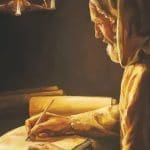
Now, Enoch is, as we have said, the fourth great grandson of Adam. He is referred to often in the apocryphal works as “the teacher of righteousness.” He had an insatiable desire to learn and to record everything. He was such a star gazer, he is thought of in ancient texts, as the one who named all the constellations and learned the most about the heavens. He sought to make binding covenants with God and he was also known as “the weeping angel,” because he felt so much compassion for the children of men and for the God who created them. Enoch was ordained a high priest at the age of 25 (see Doctrine and Covenants 107:48), a young age even in our time, but especially in an age when people were living to be nearly a thousand years old!
Scot
When Enoch was 65 years old, what we might call retirement age in our day, he was given his special calling, and listen to this:
26 … the Spirit of God descended out of heaven, and abode upon him.
27 And he heard a voice from heaven, saying: Enoch, my son, prophesy unto this people, and say unto them—Repent, for thus saith the Lord: I am angry with this people, and my fierce anger is kindled against them; for their hearts have waxed hard, and their ears are dull of hearing, and their eyes cannot see afar off;
That’s such a curious description of the people. Enoch became known as the seer and he was specifically called to cry repentance to a people who could not “see afar off,” which is exactly the opposite of a seer.
Do we see that among the people in our day, in our world? Do we live in a time when people cannot “see afar off?” In other words, have people lost their vision? Have they forgotten what is holy? Have they forgotten the past and are they so concerned about the present they cannot even bear to look upon the future?
Maurine
In Proverbs we learn: “Where there is no vision, the people perish.” (Proverbs 29:18)
And I relate so well to Enoch’s response to his mission call from the Lord:
31 And when Enoch had heard these words, he bowed himself to the earth, before the Lord, and spake before the Lord, saying: Why is it that I have found favor in thy sight, and am but a lad, and all the people hate me; for I am slow of speech; wherefore am I thy servant?
It’s fascinating that at age 65 Enoch would refer to himself as “but a lad.” However, his venerable four-greats Grandfather Adam, at Enoch’s birth, was indeed 622 years old. Seth was 492. Enos was 387. Cainan was 297. His own grandfather, Mahalaleel was 227 and his father, Jared, was 162. Maybe that’s why he felt like a lad.
But the Lord encouraged him:
32 And the Lord said unto Enoch: Go forth and do as I have commanded thee, and no man shall pierce thee. Open thy mouth, and it shall be filled, and I will give thee utterance, for all flesh is in my hands, and I will do as seemeth me good.
33 Say unto this people: Choose ye this day, to serve the Lord God who made you.
34 Behold my Spirit is upon you, wherefore all thy words will I justify; and the mountains shall flee before you, and the rivers shall turn from their course; and thou shalt abide in me, and I in you; therefore walk with me.
Scot
Maurine, that’s always been one of my favorite commandments in scripture: “and thou shalt abide in me, and I in you; therefore walk with me.” And it reminds me of the Lord’s words in John, chapter 15, verse 5, one of our memorized scriptures:
I am the vine, ye are the branches: He that abideth in me, and I in him, the same bringeth forth much fruit: for without me ye can do nothing.
And Enoch indeed kept that commandment. And he did walk with Jesus Christ, we learn in Section 107 of the Doctrine and Covenants: “…and he walked with him, and was before his face continually; and he walked with God three hundred and sixty-five years…” (Doctrine and Covenants 107:49)
Now, what kind of immense privilege is that? It appears from all the literature and words spoken about this verse that this was literal, that Jesus Christ Himself was walking with them for all that time. We don’t know how many others were walking with Him, and we don’t know what the population of Enoch’s people were.
But beginning at Enoch’s age of 65, he walked with God—and something happened during that time—those 365 years—because, Enoch became so righteous, and so did his people in the City of Holiness, or Zion, they were taken up from the earth. And this translation of the City of Holiness or, as we more commonly call it, The City of Enoch, took place 55 years after the great gathering at Adam-ondi-Ahman.
Maurine
35 And the Lord spake unto Enoch, and said unto him: Anoint thine eyes with clay, and wash them, and thou shalt see. And he did so.
36 And he beheld the spirits that God had created; and he beheld also things which were not visible to the natural eye; and from thenceforth came the saying abroad in the land: A seer hath the Lord raised up unto his people.
That’s also a fascinating line that Enoch was able to see “things which were not visible to the natural eye.” How much of our existence on this planet falls into that category? We cannot see afar off, we cannot see most of what really is, we see through a glass darkly.
Listen to a brief description of Enoch’s first mission:
37 And it came to pass that Enoch went forth in the land, among the people, standing upon the hills and the high places, and cried with a loud voice, testifying against their works; and all men were offended because of him.
Scot
38 And they came forth to hear him, upon the high places, saying unto the tent-keepers: Tarry ye here and keep the tents, while we go yonder to behold the seer, for he prophesieth, and there is a strange thing in the land; a wild man hath come among us.
39 And it came to pass when they heard him, no man laid hands on him; for fear came on all them that heard him; for he walked with God.
40 And there came a man unto him, whose name was Mahijah, and said unto him: Tell us plainly who thou art, and from whence thou comest?
Now, we stop here because we have another significant article right now on Meridian by our dear friend, Jeffrey Bradshaw, all about this man Mahijah called: Mahijah, The Unlikely Co-Star of the Enoch Story. It’s fascinating.
We’re going to talk a lot more about Enoch next time.
Maurine
But one more thing we have to say this week is from verses 46 and 47 of Moses chapter 6. This is one of the missionary tools he is using on his mission:
46 For a book of remembrance we have written among us, according to the pattern given by the finger of God; and it is given in our own language.
47 And as Enoch spake forth the words of God, the people trembled, and could not stand in his presence.
This whole idea of the language and the words of God that He gave to Enoch is a principle with great power. We’ll explore that next week.
Scot
That’s all for today. We love studying together with you, our dear listeners. Next week we’ll be just studying Moses Chapter 7. We are grateful to Jenny Oaks Baker for the music that accompanies this podcast and to our producer, Michaela Proctor Hutchins. Blessings to you. We are sending our love. See you next time.
“Come, Thou Fount of Every Blessing” Performed by Jenny Oaks Baker. Used with permission © 2003 Shadow Mountain Records
Why does Genesis say that Enoch “Walked with God” and that “God took him”?

The following was originally pubslihed in Scripture Central. To read more from them, CLICK HERE.
The Know
The Book of Genesis contains many genealogies, most of which mention how old a person was when they had a child, and then how old they were when they died. But sometimes these genealogies break from the norm and provide additional details. In Genesis 5 the passage concerning Enoch begins as follows: “and Jared lived a hundred sixty-two years, and became the father of Enoch, and Jared lived after he became the father of Enoch eight hundred years, and had sons and daughters, and all the days of Jared were nine hundred sixty and two years, and he died. Enoch lived sixty-five years and became the father of Methuselah” (Gen. 5:18–21). But then, suddenly, Enoch’s genealogy mentions something odd as it adds: “And Enoch walked with God after he became the father of Methuselah three hundred years, and had sons and daughters, and all the days of Enoch were three hundred sixty-five years, and Enoch walked with God and he was not, for God took him” (Genesis 5:22–24). These two additional details raise some questions. For example, why does Enoch particularly receive this additional attention? Also, what does it mean that Enoch “walked with God” or “was not” because “God took him”? Although Enoch is never mentioned again in the Old Testament, he is mentioned in the New Testament (Hebrews 11:5), and beyond that, many Enochic texts and traditions appear in ancient and medieval sources, as well as in the Pearl of Great Price (see generally Moses 5:42, 6:21-8:1), that provide fascinating insights into these questions.1
Four main apocryphal books focus on Enoch particularly, namely 1 Enoch, the Book of Giants, 2 Enoch, and 3 Enoch.2 Given that the earliest of these Enoch-related texts comes from the Dead Sea Scrolls, it may be easy to assume that the Enoch traditions developed many years after Genesis 5 was written to expand the few lines about Enoch recorded there. However, given the large corpus of material concerning Enoch in the ancient world, and the many overlaps they share, it is possible that they are all reflecting a strong oral or even written tradition of Enoch that goes much farther back into antiquity. As Enoch scholar Loren T. Stuckenbruck said, “There is no reason to assume that any of the extant materials to 1 Enoch, including the fragments recovered from the Qumran caves, preserve for us anything approaching an ‘original.’”3 In other words, the Qumran texts and even the few lines in the Bible may simply be preserving parts of a much earlier tradition that has been passed down, rather than such a large tradition growing out of a few simple lines in Genesis. Although the origin of the Book of Moses is a complicated issue, it is possible that these later Enoch traditions derive from a text like the Enoch material in the Book of Moses that existed in ancient times.4
The oldest surviving apocryphal text about Enoch, 1 Enoch, was likely written over time between roughly 250 and 100 BC, probably in Aramaic.5 1 Enoch was among the texts discovered with the Dead Sea Scrolls and is part of the canon in the Ethiopian orthodox church, most of it only surviving in the ancient Ethiopian language Ge’ez.6 These texts explain the meaning of “god took him” in an interesting way. In these texts, Enoch physically goes up to heaven and stays with God, never tasting death.
The first section of 1 Enoch, called The Book of the Watchers, begins by explaining that because of his righteousness, Enoch’s eyes were opened, and he is given visions by God about the future as well as about God’s judgement of humanity. It also tells the story of a group of fallen angels, known as “Watchers” who have intercourse with women who in turn give birth to evil, half-angel giants. These giants wreak havoc on humans and animals and the great flood is called down upon the earth to kill them. This does not permanently solve the problem, however, as their spirits are then unleashed to do evil deeds on the earth until the end of time.7
The Book of the Similitudes, the second section of 1 Enoch, recounts more of Enoch’s visions and the angels who help him understand them. Enoch sees a divine being called the Son of Man who will participate in the final judgement which will condemn the wicked and justify the righteous. The third section of 1 Enoch, the Book of Astronomical Writings, contains visions of things that will happen both in heaven and on earth. It argues for a 364-day solar calendar instead of the lunar calendar (an issue which was surprisingly important during the time the book was written).8 Enoch then tells his son Methuselah about a tour of the stars which he was given by an angel named Uriel.9
Enoch continues to tell Methuselah about his visions in the fourth section of 1 Enoch, the Book of Dream Visions. One vision describes the sky falling, and the second is an allegory telling the history of humankind from beginning to end.
Another section, the Book of the Epistle of Enoch is a letter Enoch writes for people living in later times. It emphasizes the point that righteousness will be rewarded and that God will punish the wicked, trying to convince the reader to prepare for the final judgement. In this text Enoch never dies, but goes to heaven without tasting death.10
A book which is related to 1 Enoch is called the Book of Giants from the Dead Sea Scrolls. It tells the story of the “Watchers” having intercourse with human women who give birth to giants, as 1 Enoch does. These beings devastate humanity, as in 1 Enoch, but in this text they reveal the mysteries of heaven to humanity, information they were not supposed to expose. When Enoch hears about this, he tells God about it, and God tells him to preach to people to counteract the negative impact of the Watchers on humanity. God even gives divine dreams to some of the giants who then try to get their companions to repent. Troubled by the dreams, they send a giant named Mahway to Enoch, and Enoch preaches to Mahway and the Watchers continue to rebel against God.11
2 Enoch is another ancient text about Enoch, likely written sometime between 100 BC and 100 AD. Although originally written in Greek, or perhaps Aramaic, the complete text only survives in a medieval Eastern European language called Church Slavonic.12 2 Enoch builds on the earlier traditions about Enoch.
2 Enoch begins with Enoch being given a tour of heaven by two angels. In this text, heaven is divided into ten sections or levels, and Enoch gets a tour of each one. The angel Gabriel takes him to the tenth heaven where he sees God face to face and speaks with him. Enoch is then anointed by Michael and looks like an angel after this. It then recounts the story of an angel who attempts to put himself above God but is cast down for his rebellion. The angels who follow him are the ones who tempt Eve.13
Enoch is then taught all knowledge by an angel and then by God himself, finding out the full history of the earth from the creation through the flood. Enoch then teaches his sons important ethical and moral lessons such as love for all creatures, after which he is taken into heaven permanently. Finally, after Enoch leaves for heaven, the people ask Enoch’s son, Methuselah as well as Methuselah’s grandson to be a priest. It then recounts the miraculous virgin birth of Melchizedek and his priestly role.14
3 Enoch is yet another Enoch text, its version was written likely from sometime between 500 and 700 AD in Hebrew. It recounts the vision of Rabbi Ishmael ben Elisha, who ascends to heaven and sees the divine chariot that God rides on. He then sees Enoch, also known as Metatron. It then explains a few things about angels, as well as giving some information about the last judgement and the heavenly court. It then goes over God’s chariot throne in more detail. Enoch reveals secrets to Rabbi Ishmael, including the names of God, as well as the names of Enoch.15
The Why
These many sources collectively may help to explain the unusual words in Genesis 5 that Enoch “walked with God,” and that “God took him.” All these traditions seem to understand that the phrases “walking with God” and “God took Enoch” refer to the revelatory experiences that Enoch was given as he was taken up into heaven and shown significant things about God and the reality of God’s divine plan. This is similar to the Christian tradition which claims, “By faith Enoch was translated (metatethḕ) that he should not see death” (Hebrews 11:5 KJV). That Greek word in Hebrews 11 for “translated” is the same word (metethḕken) used in the Septuagint (the Greek Old Testament) version of Genesis to indicate that God “took him” (Genesis 5:24 KJV).16 The combined sense of all these passages is that Enoch was taken up into heaven and changed from a mortal state into a state wherein he would not experience death. This supposition is supported by texts like 2 Kings 2:11, in which Ellijah was “carried up by a whirlwind into heaven,” or Deuteronomy 34:5–6, in which Moses is buried by the Lord, understood by some to mean that he ascended without tasting death.17 Moses 7:69 in the Pearl of Great Price supports this idea: ”And Enoch … dwelt in the midst of Zion; and it came to pass that Zion was not, for God received it up into his own bosom.”
Because this understanding was widespread, it is possible that all these texts could preserve or reflect an older understanding of the phrase “walking with God” to mean something more than just physical walking but spiritually revelatory.18 The traditions about Enoch all present the possibility that, when Enoch is said to have been walking with God in the heavens, and that “God took him,” his heavenly condition eventually became permanent.
“Walking with God” can also have the metaphorical meaning of having a close relationship with God or doing things that God desires—i.e., being “in-step” with Him. Here the Septuagint or Greek version of the Old Testament renders this phrase in Genesis as Enoch was “well-pleasing to God” (euḕrestḕse tōi theōi). Noah, Abraham, and Isaac are also described as walking with God (Genesis 6:9; 17:1; 24:40; 48:15), where that phrase appears in connection with their making a covenant with God. Hence, walking with God may refer to the formal creation of a relationship with God through making and keeping sacred covenant bonds and obligations.
Even though the Bible only spends a few verses on Enoch, the many traditions about Enoch preserved in other sources help modern readers to make sense of why a simple ancient biblical genealogy went out of its way to include these additional details concerning him. The many books and traditions which later arose about Enoch show that even a seemingly-insignificant biblical character such as Enoch can be seen as being more important than casual readers might assume. Indeed, early Christians looked to Enoch as a prophet whose life and teachings were important (Hebrews 11:5; see also Jude 1:14-15); and likewise for Latter-day Saints, the Book of Moses (6:21-8:1) rightly gives important insights into his life and work that also help shed light on the divine roles of Jesus Christ and his salvific mission.
Book of Moses Evidence: Enoch’s Divine Power of Speech

As part of his prophetic calling, Enoch was told by the Lord to prophesy unto the people.1 In response, Enoch protested, declaring, “all the people hate me; for I am slow of speech; wherefore am I thy servant?” (Moses 6:31).2 The Lord then provided these comforting words:
Go forth and do as I have commanded thee, and no man shall pierce thee. Open thy mouth, and it shall be filled, and I will give thee utterance, for all flesh is in my hands, and I will do as seemeth me good. Say unto this people: Choose ye this day, to serve the Lord God who made you. Behold my Spirit is upon you, wherefore all thy words will I justify; and the mountains shall flee before you, and the rivers shall turn from their course; and thou shalt abide in me, and I in you; therefore walk with me. (Moses 6:32–34)
The next chapter records the fulfillment of this promise: “And the mountains fled, even according to his command; and the rivers of water were turned out of their course; and the roar of the lions was heard out of the wilderness; and all nations feared greatly, so powerful was the word of Enoch, and so great was the power of the language which God had given him” (Moses 7:13).
The notion that God filled Enoch’s mouth with words to speak, as well as the bestowal of divine authority upon those words, is not anywhere stated or hinted at in the Bible.3 Yet it is found in several extrabiblical sources. For instance, after Enoch beheld a vision in 1 Enoch, he began to preach unto the people declaring, “I was now speaking with a tongue of flesh, and with my breath, which the Mighty One has put into the mouth of men, that they might converse with it; … so he has created and given to me the power of reproving the Watchers, the offspring of heaven.”4
While this language is relevant, it is also somewhat generic, as it presents God giving mankind the general ability to converse, making Enoch’s power to reprove the Watchers somewhat less unique. A comparatively stronger parallel can be found in 2 Enoch: “I have been sent today to you from the lips of the Lord, to speak to you whatever has been and whatever is now and whatever will be until the day of judgment. Listen, my children, for it is not from my own lips that I am reporting to you today, but from the lips of the Lord I have been sent to you.”5 Enoch later declared, “And now, my children, place the thought on your hearts, and give heed to the sayings of your father which I am making known to you from the lips of the Lord.”6
These passages emphasize that Enoch was a faithful emissary of the Lord, speaking the words of Lord on his behalf. Similarly, a Jewish text, known as Sefer ha-Yashar, relates that “divine inspiration would fill Enoch, and he would teach all present the wisdom of the Lord and His ways.”7 This correlates well with the specific description in Moses 6:32 that Enoch’s “mouth … shall be filled.”
Enoch’s authority to speak in God’s name is also present in 3 Enoch, where Enoch is depicted in his glorified state as the angel Metatron. The Lord declared, “Any angel and any prince who has anything to say in my presence should go before [Metatron] and speak to him. Whatever he says to you in my name you must observe and do.”8 This idea is echoed in the story of another Enoch figure known as Rabbi Joshua. Concerning this man, the lord told an angelic being, “Go and do anything that R. Joshua asks of you.”9 The inability of angelic beings to go against Enoch’s words mirrors the way that the elements of the earth itself were bound to follow his commands in the Book of Moses.
“Open Thy Mouth”
When speaking to Enoch, the Lord’s specific instruction to “open thy mouth” must also be carefully considered (Moses 6:32). Perhaps related to this directive is an ancient ceremony known as the “Opening of the Mouth,” which was prominently practiced among the Egyptians and other societies. It involved washing and anointing various body parts with water (often mixed with natron) and oil in order to restore or preserve their proper functions, which can be compared to the washing and anointing rituals in Latter-day Saint temples.10 Building on the research of Eberhard Otto, Hugh Nibley explains,
But though, among the eighty-odd versions [of the Opening of the Mouth ritual] studied by Otto, no two are exactly alike, it is apparent that all have a common nature and background, the basic structure being preserved intact down through the ages. The peculiar formula by which the survival of the age-old ordinance can be readily and easily recognized turns up in every age, now in one ritual context and now in another, but always with the same purpose of restoring the function of the various bodily organs.”11
Interestingly, the ritual was performed on statues as well as human bodies. As explained by Marcin Gamrat, “The ceremonies were used in different contexts, and performed in different places; however, the purpose was fundamentally the same: to endow the object with life energy so it could communicate with the human world.”12
Nibley further explains that the “rite is called the Opening of the Mouth because that must come first, that being the organ by which one may breathe, receive nourishment, and speak …. So the mouth comes first; but to rise above mere vegetation, life must become conscious and aware, so that the opening of the eyes immediately follows.”13 This sequence is rather striking because in the Book of Moses the Lord’s injunction for Enoch to open his mouth was closely followed by an anointing ordinance intended to open his eyes to the spiritual realm (Moses 6:35–36).14
Conclusion
Nothing in the Bible specifically mentions that God enhanced Enoch’s ability to speak. The idea is discussed in a general way in 1 Enoch, which was potentially available to Joseph Smith.15 Yet arguably stronger and more complete parallels can be found in texts which weren’t known to Western scholars or available in English in 1830, especially 2 Enoch. The way that the opening of Enoch’s eyes and mouth echoes ancient rituals from Egypt and Mesopotamia is also quite remarkable. Overall, this element of the Book of Moses resonates with several ancient sources, supporting the text’s antiquity and revelatory production.
Endnotes
1. See Scripture Central, “Book of Moses Evidence: Enoch’s Prophetic Commission,” Evidence 485 (March 12, 2025).
2. See Scripture Central, “Book of Moses Evidence: Slow of Speech,” Evidence 496 (May 28, 2025).
3. For a comparison of Enoch with other biblical figures, see Jeffrey M. Bradshaw, Enoch and the Gathering of Zion: The Witness of Ancient Texts for Modern Scripture (Interpreter Foundation, with Scripture Central and Eborn Books, 2021), 43–44.
4. 1 Enoch 14:2. Translation by Richard Laurence, The Book of Enoch The Prophet (Oxford, 1821), 15; emphasis changed from the original. Note that Laurence’s chapter divisions and pagination differ from those contained in more modern editions of 1 Enoch. Laurence’s translation is used here because it represents the form of 1 Enoch that would potentially have been accessible to Joseph Smith. For a more recent translation, see George W. E. Nickelsburg and James C. VanderKam, 1 Enoch: The Hermeneia Translation (Fortress Press, 2012), 33: “created and destined me to reprimand the watchers, the sons of heaven” (1 Enoch 14:3).
5. 2 Enoch 39:5. Translation by F. I. Anderson, “2 (Slavonic Apocalypse of) Enoch,” in The Old Testament Pseudepigrapha, vol. 1, ed. James H. Charlesworth (Doubleday, 1983), 162; some editing marks in the original silently omitted.
6. 2 Enoch 47:1. Translation by Anderson, “2 (Slavonic Apocalypse of) Enoch,” 174.
7. Sefer ha-Yashar (ed. Dan); as cited in John C. Reeves and Annette Yoshiko Reed, Enoch from Antiquity to the Middle Ages: Sources from Judaism, Christianity, and Islam (Oxford University Press, 2018), 203.
8. 3 Enoch 10:4–5. Translation by Philip Alexander, “3 (Hebrew Apocalypse of) Enoch,” in The Old Testament Pseudepigrapha, 264.
9. Maʿaseh R. Joshua b. Levi; as cited in Reeves and Reed, Enoch from Antiquity to the Middle Ages, 117.
10. See Jeffrey M. Bradshaw, Freemasonry and the Origins of Latter-day Saint Temple Ordinances (The Interpreter Foundation and Eborn Books, 2022), 114–119. For an analysis of ascension themes throughout the Book of Moses, see Jeffrey M. Bradshaw, “The Book of Moses as a Temple Text,” Interpreter: A Journal of Latter-Day Saint Faith and Scholarship 49 (2021): 63–112.
11. Hugh Nibley, The Message of the Joseph Smith Papyri: An Egyptian Endowment (Deseret Book; Neal A. Maxwell Institute for Religious Scholarship, 2005), 166.
12. Marcin Gamrat, “The Opening of the Mouth Ritual in Ancient Egypt and Mesopotamia: A Brief Comparison,” in The Land of Fertility III, ed. Lukasz Miszk and Maciej Waclawik (Cambridge Scholars Publishing, 2019), 75.
13. Nibley, The Message of the Joseph Smith Papyri, 179.
14. See Scripture Central, “Book of Moses Evidence: Enoch’s Anointing,” Evidence 502 (July 9, 2025).
15. See Jeffrey M. Bradshaw and Ryan Dahle, “Could Joseph Smith Have Drawn on Ancient Manuscripts When He Translated the Story of Enoch?: Recent Updates on a Persistent Question,” Interpreter: A Journal of Latter-day Saint Faith and Scholarship 33 (2019): 305–374, esp. 308–311; For reasons to be cautious in assuming it was implausible for Joseph Smith to have learned anything about 1 Enoch, see Colby Townsend, “Revisiting Joseph Smith and the Availability of the Book of Enoch,” Dialogue 53, no. 3 (2020): 41–71.