




Elder Cook to BYU Students: Follow the Prophets to Navigate the World of AI
To read more from Larry Richman, Visit Here.
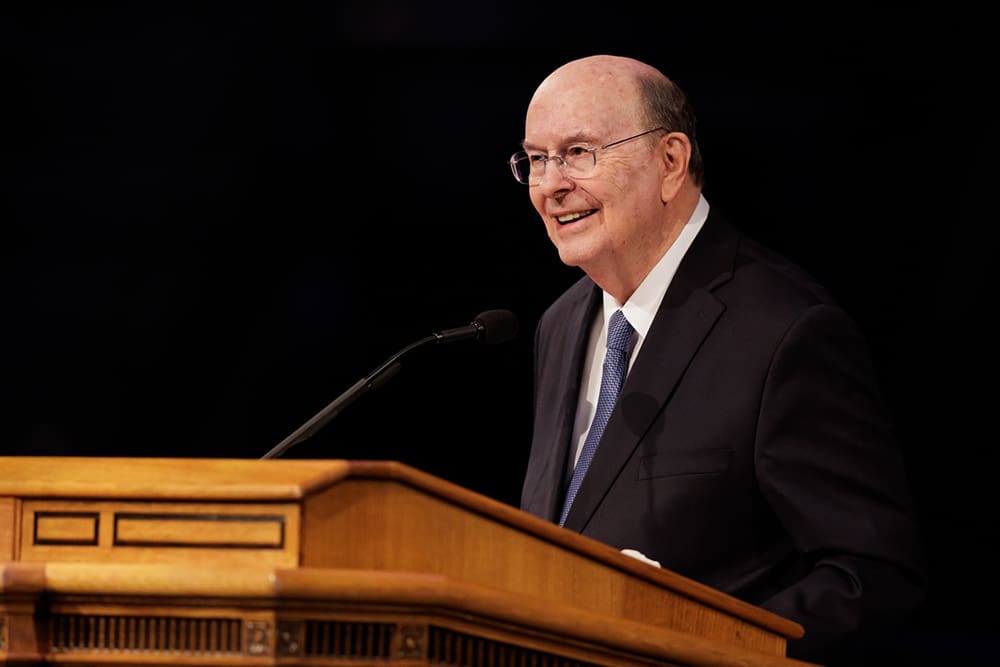
Elder Quentin L. Cook challenged Brigham Young University students this week to increase their spirituality to better navigate the world of artificial intelligence.
In his devotional address, Elder Cook said, “choose truth when deception is easy. Slow down enough to listen to the Spirit and allow Him to direct you. We must all learn to use technology as a servant, not a master. The future of the Church and our very civilization depend on members and individuals who have deep faith, moral courage, and the ability to navigate an increasingly complex world.”
Elder Cook gave his counsel in the context of the accelerating shift now underway in society. He noted that BYU’s 150‑year history has spanned the agricultural, industrial, and information ages — and that today we are moving into the artificial intelligence age. This new era is marked not just by advanced computing power but by systems and algorithms capable of influencing attention, belief, and behavior. He said that these conditions heighten the need for discipleship rooted in spiritual clarity and moral agency.
He explained that technology can help advance the Lord’s work when used under the influence of the Spirit, but when used incorrectly, it can magnify confusion or compromise spiritual sensitivity.
Watch Elder Cook’s talk in the video below:
Elder Matthew S. Holland tells BYU students how he is coping with the loss of his parents
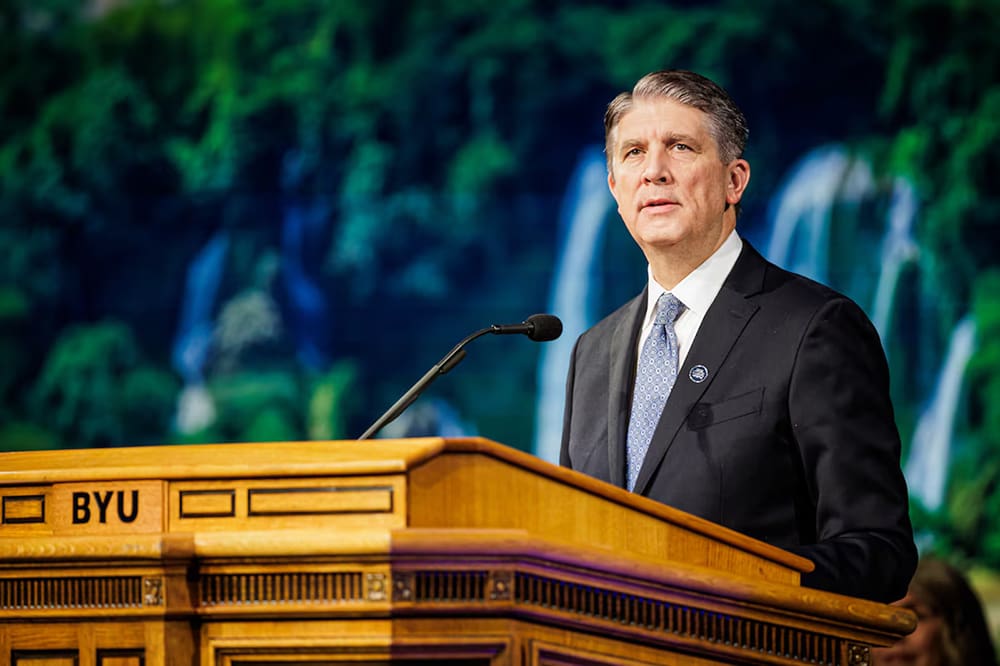
The following was excerpted from Deseret News. To read the full article, CLICK HERE. Photo Credit by Ellie Alder/BYU Photo
Elder Matthew S. Holland grew up in the old president’s home on the BYU campus while his father, President Jeffrey R. Holland, led the school in the 1980s with Sister Pat Holland at his side.
He returned to BYU on Tuesday to deliver a devotional that grew deeply emotional as the General Authority Seventy described the grief he felt after the death of his father three weeks ago, which followed the loss of his mother in 2023.
He called President Holland his best friend on Earth besides his wife and children.
“Losing him leaves an enormous hole for me,” Elder Holland said. “As long as I can remember, he brought laughter, confidence and wisdom to my life like no other. So, I wasn’t really prepared the other day when I turned on my phone and realized I needed to remove his contact from my favorites list.”
That realization struck him last week, and Elder Holland said it broke him.
Who is Gérald Caussé, Our New Apostle?
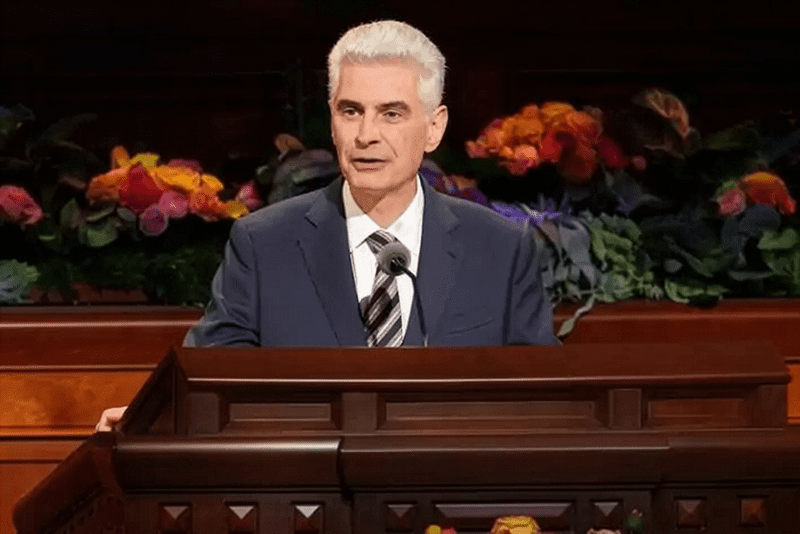
The following was originally published at Public Square Magazine. To visit their website, CLICK HERE.
Gérald Caussé, the French-born Presiding Bishop of The Church of Jesus Christ of Latter-day Saints, was announced Thursday, November 6, 2025, as the Church’s newest apostle. He fills the vacancy in the Quorum of the Twelve Apostles that followed the passing of President Russell M. Nelson, a transition that prompted the reorganization of senior leadership of the Church.
Years before his name was known globally, Caussé told a simple story about ministering that sums up his approach to discipleship. In a 2023 university devotional, he described being assigned as a ministering brother to a man who had just been rebaptized and was navigating divorce, financial strain, and deep discouragement. Caussé did not offer a programmatic solution; instead, he visited, listened, prayed, and saw—saw who the man could become in Christ. Over time, consistent fellowship and the man’s own faith in the Savior brought steady change. Caussé used the experience to teach a principle he has repeated often: effective ministry begins when we look at others as the Lord sees them and act in faith on their divine potential.
Gérald Jean Caussé was born May 20, 1963, in Bordeaux, France. He married Valérie Lucienne Babin in 1986; they are the parents of five children. He holds a master’s degree in business from ESSEC Business School near Paris. Before entering full-time Church service, he built a career in the retail and food distribution sector, including leadership roles at the Carrefour Group and as a general manager and board member at Pomona, a leading French food distributor.
His Church service has spanned local and global assignments: elders quorum president, bishop’s counselor, stake president in Paris, Area Seventy, and then General Authority Seventy beginning in 2008. In 2012 he was called as first counselor in the Presiding Bishopric and, in 2015, became the 15th Presiding Bishop in the Church’s history—the first for whom English is a second language and among the few presiding bishops born outside the United States. From that office he oversaw the Church’s worldwide temporal and humanitarian operations, including welfare, bishops’ storehouses, and humanitarian partnerships.
Caussé is also an accomplished pianist. With Italian composer and conductor Nicolas Giusti he released two albums of sacred piano duets—Joyful (2019) and Noël (2020)—a creative sidelight that hints at how often he uses art and music to teach about the Savior.
In his recent ministry, Caussé has emphasized a number of important themes.
Keeping a sense of wonder. In general conference he has urged Latter-day Saints to resist spiritual complacency and “marvel at the wonders of the gospel,” encouraging daily scripture study, prayer, and a fresh awareness of the Savior’s hand. The theme runs through one of his best-known messages, “Is It Still Wonderful to You?” where he linked spiritual awe to spiritual strength.
The Church is about people. In another conference address, he said plainly that the Church’s strength “comes from the daily actions of millions of [the Lord’s] disciples” who care for one another. Programs and buildings matter only insofar as they lift people. That people-first lens has shaped the way he talks about local priesthood quorums, Relief Society, and ward councils—and, notably, the way he has led as Presiding Bishop.
Temporal service as spiritual discipleship. Under Caussé’s stewardship, the Church has increasingly reported on its global humanitarian work. The 2024 Caring for Those in Need summary detailed US$1.45 billion in welfare and humanitarian assistance, 3,836 projects, and efforts spanning 192 countries and territories—a scale he frames as a natural outgrowth of the two great commandments. In public addresses this year, he has described service not only as a Christian duty but as a unifying force that blesses families, communities, and even businesses.
Whole discipleship—body and spirit. In a BYU devotional during the pandemic, Caussé taught that happiness grows when we harmonize the spiritual and temporal dimensions of life—in other words, when covenants, character, and healthy rhythms of living reinforce each other. That integrated view is characteristic of a leader who has spent years bridging spiritual purposes with temporal stewardship.
Faith with forward vision. Speaking to missionaries in 2024, he taught that “a vision toward the future is an act of faith,” outlining three kinds of trust: faith in oneself as an instrument in God’s hands, faith in the divine potential of the people we meet, and faith in Jesus Christ and His Atonement. That framework echoes the ministering story above and anchors his frequent invitations to see others as the Savior does.
Stewardship and pioneer values for a global church. Caussé has linked Latter-day Saint pioneer heritage to contemporary responsibilities: caring for the earth, serving neighbors, promoting education, and being peacemakers. These values, he argues, help make communities “better places for all” and align with the global expansion of the Church’s humanitarian and self-reliance efforts.
For journalists and observers, Caussé’s call illustrates several dynamics shaping Latter-day Saint leadership in the mid-21st century. First, it underscores an increasingly international and multilingual senior leadership pool—a reflection of the Church’s growth and its emphasis on taking the name of Jesus Christ to “every nation, kindred, tongue, and people.” Second, it brings to the Quorum a leader whose portfolio has blended the temporal and the spiritual at a global scale. He has been a primary public voice for the Church’s humanitarian transparency in recent years, explaining how fast-offering assistance, bishops’ storehouses, and international partnerships work in practice.
Third, his recurring themes—wonder in the gospel, seeing others’ divine potential, disciplined service, and forward-looking faith—are congruent with the Quorum’s apostolic mandate to bear testimony of Jesus Christ and to strengthen Saints wherever they live. His European background and bridge-building ministry suggest he will continue to speak comfortably to both lifelong members and seekers, in language that connects doctrine to daily life. And his inclination to teach with art and music will likely continue to surface in settings both formal and informal.
As Latter-day Saints around the world sustain a new apostle, Caussé’s record hints at how he will serve: by keeping the focus on the Savior, seeing people one by one, and inviting the Church to move forward in faith—with eyes open to the wonders of the gospel and hands ready to serve.
To visit Public Square Magazine’s website, CLICK HERE.
Former Relief Society General President Elaine L. Jack Dies at Age 97

The following is excerpted from the Church News. To read the full article, CLICK HERE.
President Elaine L. Jack, who served as the 12th general president of the Relief Society of The Church of Jesus Christ of Latter-day Saints from 1990 to 1997, died Tuesday, June 10, 2025. She was 97.
In an interview when she was first sustained as a general officer in 1987, Sister Jack recalled being a young girl and standing on a dirt road near her home in Cardston, Alberta, Canada. Gazing at the snow-capped peaks of the Rocky Mountains in the distance, she wondered, “Will I ever travel to the other side of those mountains?” (Church News, June 13, 1987, p. 5).
As the wife of a surgeon, and then as a counselor in the Young Women general presidency starting in 1987 and as Relief Society general president starting in 1990, Sister Jack lived and served in many states and traveled extensively throughout the world, experiencing and appreciating a diversity of cultures.
She recognized that the Church is “full of diverse, interesting, faithful women,” she said. But she also recognized the tremendous unity that comes through the gospel of Jesus Christ.
“Relief Society is glorious because we join as sisters who come unto Christ. In all our roles, as sisters, wives, mothers, daughters, friends, roommates, teachers, leaders and on and on, we strive to come to the Savior. I know how rich our Relief Society sisterhood can be because of what each of us brings to it. Think about how unified we feel and yet how individual we are” (“Charity: How We Treat Each Other,” BYU devotional, March 10, 1992).
Latter-day Saint women everywhere — from the Philippines to Japan, from England to New Zealand, and from Paris to St. Petersburg — are part of a grand whole, she taught.
“We need each other to make our sisterhood complete. When we reach out to clasp the hands of our sisters, we reach to every continent, for we are of every nation. We are bonded as we try to understand what the Lord has to say to us, what He will make of us. We speak in different tongues, yet we are a family who can still be of one heart. We work, play, give birth, nurture, dream dreams; we cry, pray, laugh, sometimes clap for joy and find that mortality teaches us our need for our Savior, Jesus Christ,” Sister Jack said (Relief Society Sesquicentennial Satellite Broadcast, “Charity Never Faileth,” March 14, 1992).
To read the full article, CLICK HERE.
Divine Connection: An Answer to Prayer, 650 Miles Away

“I can’t hear Him anymore, Joe!” Lottie’s voice broke as the phone connection wavered. “I’ve prayed and I’ve tried, and I just can’t hear Him!”
My heart sank. I had been calling Lottie for years, ever since returning home from my mission. The 82-year-old widow lived in the mountains of Arizona, alone in her home apart from her non-verbal son with Down syndrome. She put in 16-hour days caring for him seven days a week, 365 days a year. She cooked, she cleaned, she gardened, and she cared for him almost entirely on her own.
“Have you been able to reach out to anyone nearby?” I asked, thinking of some of her friends that I had met.
“They’re too busy,” Lottie snapped, not in anger, but in desperation. “I can’t rely on them. They’ve got their own problems to worry about.”
I sighed, trying to think of another tact. I had been calling her nearly every Sunday afternoon since returning home from my mission in 2020. Our weekly phone calls had occasionally veered into negative discussions, but rarely had she shown a lack of faith brought on by sheer exhaustion and despair. I wished that I could have been there, but she lived nearly 650 miles south of me, a 12-hour drive for a poor college student with classes the next morning.
Her son cut our conversation short, pulling her attention away from our discussion. He had been losing weight, forcing her to watch him constantly to ensure that he would eat the food that she had prepared for him. Thinking of his smiling face brought a smile to my own, one that left as we ended our phone call. I wished that I had known what better to say to support her in her never-ending trial.
Her words remained in the back of my mind as we approached a devotional given by Elder Dieter F. Uchtdorf of the Quorum of the Twelve Apostles of The Church of Jesus Christ of Latter-day Saints. I arrived half an hour before the meeting began, though the BYU Marriot Center was nearly at capacity already.
I went to the devotional alone, the better to record my thoughts without being distracted by my friends. During the devotional, I had my phone out, recording phrases that Elder Uchtdorf shared with us, inspired by the Spirit as I wrote down his words. “Our Father in Heaven hears you, He knows you, and will NEVER give up on you, so don’t ever give up on Him.”
My ears perked up at his powerful testimony. Lottie needed to hear this. As the devotional concluded, I hurried from the building, passing other chatting college students reveling in the Spirit that permeated the air. As I began the short walk home, I called her on the phone. After pushing past several chatting young adults, I told her that I had something I needed to share with her.
“I just finished listening to Elder Uchtdorf,” I said.
“Who?”
“One of the Twelve Apostles,” I explained. “I wanted to share something he said.”
“Oh, alright,” she said, her voice tired. “Let’s hear it.”
I searched for the exact phrase I had written down. “Our Father in Heaven hears you, He knows you, and will NEVER give up on you, so don’t ever give up on Him.”
As soon as I finished, she burst into tears. “Joe, that was EXACTLY what I needed to hear,” she managed. “That was an answer to my prayers.”
I began to tear up as I continued reading my notes from the meeting. Each phrase, recorded by a 26-year-old, as given by an Apostle of the Lord, was exactly what she needed to hear. We continued to speak as I walked home, reveling in the Spirit of the Lord that testified of truth.
To think that the prayers of an 82-year-old widow would be answered through the Spirit in time to give her the courage to keep living, to keep striving, and to keep pushing forward. I do not take any credit. Like the apostle Paul of old, Elder Uchtdorf planted, I watered, but God gave the increase (1 Cor 3:6-8). God answered her prayers, and I played a tiny role in helping her receive her answer.
Our daily lives can be like that. When we are searching for answers to our prayers, we may not always get the answers in the way we expect. However, those that are willing to continue searching, and hold out faithful to the end, will find their answers, according to God’s will and timing. The trick is to be open to the Spirit, to be willing to answer the prayers of our loved ones through our actions, our words, and our care towards them. Just as God cares for each of us, we can do the same.
The Atonement of Jesus Christ, Judgment Day and You

“I hope you sense that Jesus Christ was then and is now our Friend, our Guide, our Great Physician, our Counselor and above all, our Savior, Redeemer and Advocate with the Father,” taught Elder Jörg Klebingat in the Marriott Center.
In his Tuesday morning devotional, Elder Klebingat spoke on the importance of utilizing the Atonement so we can confidently stand before God on Judgment Day.
Elder Klebingat, a General Authority Seventy for The Church of Jesus Christ of Latter-day Saints, taught that although the covenant path will not be easy, especially during these last days, it will be worth it. Each of us chose to come to earth and experience mortality, trusting that our Savior would make it possible to return one day.
“Thus, we know that as some of the most noble and faithful among Heavenly Father’s spirit children, we were chosen to come here with Him in these last days, strongest soldiers to the front so to speak,” Elder Klebingat said. “Having already stood firmly with our Savior once, including during the war in heaven, we are now called to enlist once more, one last time, in this final battle.”
Mortal weaknesses accompany all of us in this life. Each of us must choose “the pain of discipline, which weighs ounces, or the pain of regret which weighs tons.” Gratefully, that Jesus Christ is waiting with open arms for us to come to Him in repentance, Elder Klebingat taught.
“Ongoing repentance is meant to be a joyful experience as we access the Savior’s Atonement and therefore the remission of sins.” Elder Klebingat said.
That Atonement is a priceless gift that was bought with the life of Jesus Christ. Elder Klebingat taught that this gift is one that should be taken seriously and used often.
“My dear friends, the Savior’s Atonement must not be cheap, instead, it should mean everything to us.” Elder Klebingat stated.
Jesus Christ is the key to our salvation and our advocate with Heavenly Father on Judgment Day. Elder Klebingat expressed the importance of a personal, intimate relationship with our Savior and emphasized the life-changing effects of repentance.
“I testify that in His hospital, He is the Great Physician, Chief Surgeon and Healer,” Elder Klebingat said. “I testify that He specializes in healing the weakest of the weak and in bringing relief to those who least expect it.”
David French at BYU: Concerns Over Political Timing Before the 2024 Election

To read more from Jeff, visit ArisefromtheDust.com.
Cover image via YouTube screen grab.
Last Tuesday, my wife and I watched the BYU TV broadcast of a devotional featuring Elder Patrick Kearon, an Apostle of The Church of Jesus Christ of Latter-day Saints, and his wife, Jennifer. Both were inspiring, intelligent, and thoroughly interesting speakers who positively influenced the many thousands of students attending this event. Naturally, their remarks had no political overtones, free of jabs at any political candidate, as parents of students might expect from both speakers and teachers. These weekly Tuesday gatherings at the large Marriott Center, called “devotionals” when there is a Church-related speaker and “forums” when someone notable outside the Church is invited to speak, are an important part of BYU culture and education.
During that Tuesday devotional, I was surprised when BYU President Shane Reese announced that the speaker next Tuesday for the first forum of the semester (one of only three forums on BYU’s fall schedule) would be a man well known for his outspoken political views related to the contentious presidential election before us. The speaker is David French of The New York Times, a writer whose recent work has been dominated by criticism not just of Donald Trump but also his supporters. A list of his latest columns for the Times shows that from Sept. 8 to Sept. 19, five columns in a row involved Trump and the MAGA movement, and most of the rest of the listed columns are anti-Trump or pro-Harris. My concern is not over his choices, but over Brigham Young University’s choice to select him as the speaker just weeks before the election. How can this be seen as anything but a political statement?
Despite publicly identifying as a “conservative” (or, per the headline of a Jan. 2024 interview, a “Never-Trump Conservative”) and “evangelical,” he has proclaimed that his “pro-life” views compel him to vote for Kamala Harris (see “David French on the Pro-Life Case for Kamala Harris,” a podcast from Aug. 19, 2024). Even if he politely refrains from discussing his politics at BYU, even if he only talks about the joys of crocheting or gardening, why would this controversial man be chosen as a rare forum speaker at a major event where all students are encouraged to attend? Doing this right before the election makes it impossible to overlook the potential political implications. Of the thousands of luminaries that could have been chosen to enlighten out students, why select a man who is mostly known for his opposition to one of two contending candidates? This seems unfair and unwise.
On Sept. 15, just two days after a second assassination attempt on the life of Donald Trump — something that mainstream media outlets told us was his fault for his violent rhetoric — French wrote a column for The New York Times warning that Trump’s opposition to prolonging the bloody war in Ukraine made him a danger — a danger that apparently needed to be stopped:
Trump’s reluctance to say the plain truth — that a Ukrainian victory is in America’s national interest — demonstrates that he is still a prisoner to his own grievances, and there is no one left who can stop him from doing his worst. (David French, “Why Trump Won’t Say He Wants Ukraine to Win,” New York Times, Sept. 15, 2024)
In my opinion, the extreme language of Trump haters talking about the need to punch him in the face, take him behind the barn, or doing whatever it takes to stop the “existential threat” to “our democracy” itself from a man often compared to Hitler, might be just the kind of thing that can drive an unstable or easily manipulated person into doing what we have seen twice now: attempting to assassinate a former president running again for office. French wrote about Trump shortly after the second assassination attempt, without mentioning the attempted violence, without condemning it, without calling for an end of the use violence to stop Trump. Instead, he worried that “there is no one left who can stop him.” He’s not calling for violence of course, but his words might be easily misunderstood. The same article also points to the need to “stop” Putin. Is it possible that someone might read those words and somehow conclude that Trump needs to be stopped just like Putin needs to be stopped, with violent force? The issue here is not whether prolonged war in Ukraine is desirable, but whether someone seemingly unable to condemn political violence against a despised opponent is the right voice that our students need to hear.
The answer we can expect from some academics is that we need “diversity” in thought, and French represents a fresh, diverse voice. Those who have been reading and listening to the mainstream media for the past few years will recognize that there is very little fresh or original in speaking out against French’s favorite target. That’s not to say that such criticism is incorrect, but it has been incessant. Is there really a need for more of the unified voice of mainstream journalists denouncing one particular candidate as an existential threat who needs to be stopped?
The choice of David French for BYU’s upcoming forum was surely made long before the new administration under President Reese, but the decision is unfortunate nonetheless. One can only wonder why it was made in the first place. Why choose a politically outspoken columnist as a forum speaker right before the elections?
BYU Devotional: Don’t Quit or Fear, Have Faith

The BYU community gathered in the Marriott Center to hear the first devotional of the semester, traditionally given by the university’s president and his wife. President Kevin J Worthen and Sister Peggy S. Worthen encouraged students to believe that they can succeed this semester and in other future endeavors.
Sister Peggy S. Worthen
Sister Worthen encouraged students to not give up when classes are difficult, saying that gaining an education is worth the sacrifice.
“There will be times when you may become discouraged while striving to obtain your education,” she said. “When those times come, please remember that what you are doing is praiseworthy. You are seeking to improve yourselves as well as the kingdom of God.”
Sister Worthen said she learned this by taking intermediate algebra through Independent Study while she was working toward her English degree. Family members and friends tutored her, but she failed the final test by only one point. Discouraged and frustrated, she looked for other options to avoid needing the class to graduate, but after a friend nudged her, she decided to retake the test. The second time around, she passed.
“Now when I think about my ordeal with algebra, I am grateful I had the experience — even though it was, at times, very unpleasant and difficult,” she said. “It was definitely a time of growth for me.”
President Kevin J Worthen
President Worthen urged students to fear not, a commandment he said is often overlooked. When we can avoid fear, he said, we will be more productive and joyful.
He defined fear not as the emotion that protects us from danger, or the reverence for God, but as an irrational fear or fear of the unknown. He said this kind of fear is often defined using the acronym False Evidence Appearing Real.
“It is this kind of fear that is debilitating, sometimes paralyzing and almost always soul- and energy-sapping,” he said.
President Worthen acknowledged there are many types of fears students feel at the beginning of a semester, noting that the adversary uses despair, hopelessness and fear against us.
“When any of these false thoughts appear to be real to you, when such satanic lies cause you to lose hope in the future, and maybe even the present — please remember that God has repeatedly commanded us to ‘fear not.’”
Choose faith in Christ
LDS leaders and scripture have taught that faith is the cure of fear. Faith is defined as “the substance of things hoped for, the evidence of things not seen . . . . which are true.”
President Worthen urged students to increase their faith in Jesus Christ through daily prayer and scripture study.
“These simple acts of daily scripture study and prayer — especially with the intent to know the Savior better — will do more than almost anything else to strengthen your faith in Him, which, in turn, will decrease the amount of irrational fear in your life, no matter the particular cause of that fear,” he said.
Serve others more to decrease your fear
Since faith is a principle of action, acting to serve others turns your focus away from your worries, said President Worthen.
“When you find yourself overcome by fear, I urge you to look for others who need your help. Focus on what you can do for them, on what they need,” he said. “If you do this, I promise your fears will decrease because your love for God and His children will increase.”
Recognize you make a choice of fear or faith
Faith is a choice, and President Worthen said that when we recognize the moment to choose between faith and fear, it will help us to choose faith.
“He will also bless us in the interim, in the short run and the long run, if our choices are directed by our faith in Him, rather than our fears about ourselves,” he said.
Remember you already chose faith in Christ
President Worthen reminded students of the war of concepts in heaven in the pre-earth life. This war was won by believers who had faith in Jesus Christ even before the Atonement was performed by him.
“Fear not. Whatever the circumstances you find yourself in, know, with assurance, that you can succeed,” he said. “You are more capable, more talented and more faith-filled than you realize. More importantly, you are more loved by God than you realize.”
To see the full devotional go to BYUtv.
FEATURES