









“Whatever causes us to be dependent on someone else for decisions or resources we could provide for ourselves weakens us spiritually and retards our growth toward what the gospel plan intends us to be.” Dallin H. Oaks “Repentance and Change,” Ensign or Liahona, Nov. 2003
“Self-reliance is the ability, commitment, and effort to provide the spiritual and temporal necessities of life for self and family. As members become self-reliant, they are also better able to serve and care for others.” Handbook 2: 6.1.
Self-reliance empowers individuals to care for themselves, make wise decisions, and remain resilient in times of uncertainty. Individuals and families who obtain items needed for challenging times can develop skills and confidence to meet their own needs. The self-reliant become less dependent on circumstances, government, or church systems, and even the internet, all of which may fail or be unavailable. Self-reliance fosters responsibility, preparedness, and adaptability, enabling individuals and families to face challenges with strength rather than fear. It builds dignity and purpose, as they recognize their ability to care for themselves and others, and enables them to recover more quickly when challenges arise.
This week let’s talk about food storage and complete a few forms. As we build our binders we need to create a system in order to understand exactly what will be needed to be ready for any challenge. This week you’ll create charts to help you identify your needs.
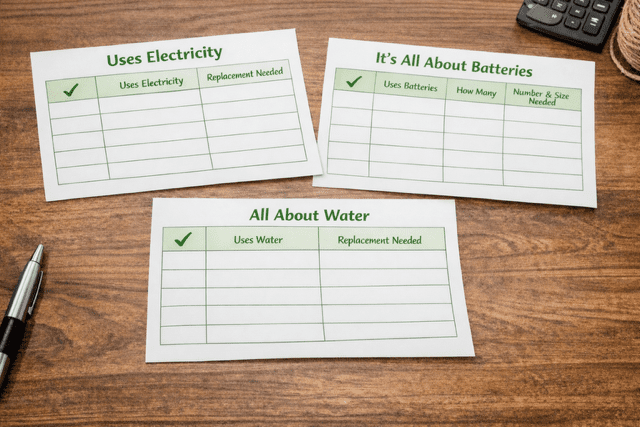
Electricity
What items in your home use electricity? What would you need to purchase or make to replace those items?
Create a chart with three columns similar to the one in the picture. The first column is for checking off tasks completed. The next two columns should have the following headings: Uses Electricity and Replacement Needed.
Fill out the chart. As an example: a clothes dryer uses electricity and rope and clothes pins will be needed to replace it. Place your chart where it can be added to by family members. When your chart is complete, you will have a list of items you should be storing.
Place this chart in your binder and check off items as they are collected or purchased.
Batteries
Do you really understand how many of the items you depend on require batteries? Consider items around the house and in your kits. Create a chart with four columns similar to the one in the picture. The first column is for checking off tasks completed. The next three columns should have the following headings: Uses Batteries, How Many, and Number & Size Needed.
Fill in the chart and total the number of batteries you will need to keep items working. For example: you may list “battery-operated clocks” in the Uses Batteries column and the number “3” in the How Many column. If each clock needs 2 AA batteries, you will add “6 AA batteries” to the Number & Size Needed column.
Post your chart where all family members can add items as they are remembered. When your chart is finished place in your binder and check off batteries as they are purchased.
Water
Create a chart with three columns similar to the one in the picture. The first column is for checking off tasks completed. The next two columns should have the following headings: Uses Water and Replacement Needed.
List all the ways you use water each day and what you need to make or purchase to replace water. For example: a dishwasher uses water and you will need to have paper plates, cups, bowls, utensils, and trash bags for disposal on hand. For some items, you will need stored water as a replacement.
Again, place the chart where others can add to it and then place it in your binder and check items off as they are stored.
Food Storage
Food storage helps individuals and families be prepared for unexpected challenges such as natural disasters, power outages, job loss, illness, or supply shortages. Having food on hand reduces stress and fear during emergencies and allows people to focus on caring for their loved ones rather than worrying about immediate needs. Storing food also enables better budgeting by allowing families to buy food when it is on sale and more affordable to use over time. Most importantly, it provides security and peace of mind, knowing that even when circumstances are uncertain, basic needs can still be met.
Food Groups
Eating foods from all food groups is important providing the body with a balanced mix of nutrients for energy, growth, strengthening muscles, and overall health. When all food groups are eaten regularly, the body is better able to function properly, maintain a healthy weight, reduce the risk of chronic disease and provide the energy needed when dealing with a disaster of any kind. One of the biggest mistakes people make when storing food is not including all the food groups.
Fruits and Vegetables: Colorful fruits and vegetables provide the wide range of vitamins, minerals, fiber, and chemicals your body uses to maintain energy levels, protect against the effects of aging, reduce the risk of cancer and heart disease, maintain good vision, build strong bones, keep the heart healthy, maintain a healthy immune system, and improve memory function.
Protein: No other nutrient plays as many different roles as protein does in keeping you healthy. Protein is important for the growth and repair of your muscles, bones, skin, tendons, ligaments, hair, eyes, metabolism, and digestion. Protein helps create the antibodies your immune system needs to fight disease. If you are injured, ill, or stressed you may need more protein.
The most complete proteins are meat, poultry, fish, eggs, and dairy foods. Beans, peas, and nuts provide protein, but they are incomplete proteins. To achieve a more complete protein serving, you must combine them with grain, fruits, and vegetables.
Grains: When we speak of grain we are really talking about carbohydrates. Carbohydrates are the body’s main source of fuel and are easily used by the body for energy. Carbohydrates are needed for the central nervous system, kidneys, brain, and muscles to function properly.
Whole grains like whole wheat, wheat flour, bulgur, oatmeal, cornmeal, rice (white, brown ,and wild), buckwheat, popcorn, rye flour, barley, pasta, pretzels, couscous, amaranth, millet, quinoa, sorghum, and triticale are all good sources of carbohydrates. You can also count muffin, corn bread, and pancake mixes. For a three-month supply, you should store only the grains you use or are learning to use.
Dairy: Diets rich in milk and other dairy products help build and maintain bone mass, reduce the risk of osteoporosis, build teeth, and help maintain a healthy blood pressure.
Over the next two weeks discover what your family should compile to have a great food storage designed just for you. Remember no friend nor family member, no internet commenter nor podcast host knows your family’s needs and preferences like you do. I recently saw a plan on the internet that would have required me to store four gallons of oil for a year’s supply. I don’t use four gallons of oil in three years!
As a family, make a list of your favorite meals as well as a list of foods you do not like. For example, I love pickled beets, but my husband hates them. Do I store them? Yes, but only what I would reasonably eat. Once you know the favorites and the foods only one person loves, you will begin to see what you need to store and the amounts you should store of each food.
You may ask why you do this when some people recommend choosing seven favorite meals and storing those ingredients. Can you imagine how awful that would have been for months of the same seven meals during COVID? Variety truly is important when storing food. There is more to consider like treats but we will work on that later.
Once you’ve filled out those charts and made a foods list, you’ll be ready for the next step which is coming in a couple weeks!