












When followed by another word, especially a preposition, the word “keep” often suggests variations on a consistent theme of moving forward or pressing ahead, as in “keep it up,” “keep going,” “keep at it,” and “keep on keeping on.” That small word largely implies maintaining an established momentum and avoiding stopping or giving up. That type of steady, relentless, determined pushing ahead is often difficult but an essential opportunity to promote forward motion.
In a small, sparsely illustrated children’s book entitled, “The Carrot Seed,” the author Ruth Krauss offers a timeless story of a young boy who unceremoniously chooses to plant a seed. Remarkably, the straight-forward book has endured since its first publication in 1945. In its simplicity and resonance, the metaphorical tale remains still deep in its importance and broad in its application.
The storyline is uncomplicated. A small boy plants a seed. In turn, his mother, his father, and his plain-speaking big brother all insist, “It won’t come up.” Undeterred by their negativity, the boy pulls weeds and sprinkles the ground with water. In spite of his best efforts, nothing happens, and his family members reassert their negativity. The small boy persists. And then one day, on the penultimate page of the short text, the book says, “It came up.” And on the final, eleventh page, with the boy wheeling his prize carrot away overflowing a very large wheelbarrow, we read, “Just as the little boy knew it would.”
The enduring children’s book has nothing about its text or illustration that is particularly fancy, but everything about its timely, broadly applicable theme that is forever precious. The boy was undeterred by discouraging circumstances and voices or by periods of waiting. Rather, motivated by hope and fueled by consistency, the small boy stayed the course and eventually reaped the reward. He established basic habits and “kept on keeping on.” The result was sure and delicious.
Some years ago, I served as a “ma” on a pioneer trek for the youth in our ward. My husband was unable to attend, so I was asked to serve as the mother figure for a mock family of seven young people without another adult to assist with the immediate leadership of those trekking teens. Because I was new to the ward, I didn’t know those kids intimately. I worried that my lack of experience and acquaintance with them might compromise my ability to provide them the leadership they deserved, but my newness proved to be an asset.
Among the teens in our trek family was a spirited and very bright young woman with lots on her mind. I’ll call that irresistible young modern pioneer Molly. Her parents had strongly encouraged her, mostly against her will, to participate in the trek. Since Molly really didn’t want to be there, and certainly didn’t want to engage in chatter with the others in our group, she positioned herself immediately at the front of the handcart, determined to pull it the whole way across the desert plain. I think she felt that she would rather drill down on her misery than pretend otherwise.
Fortuitously, I assumed a spot at Molly’s side to assist with the pulling. For three days, Molly and I pulled side by side. And as we pulled, she talked. I was a newcomer with no detailed knowledge of the perceived offenses and annoyances that had left her bottled up and angry. I simply listened and asked occasional questions. I felt drawn to that promising, angry girl and eager to be an uncomplicated friend while she sought to make sense of the turmoil inside herself.
As we pressed on, the strength of her negative emotion dissipated. Her conversation grew less angry and more reflective. And all the while, she kept going, one forward footstep after another. By the time we entered the valley and were welcomed home by the enthusiastic cheers of family and friends, Molly had been reborn. She had stayed the course, literally and figuratively. She had kept going, kept it up, kept pace, and kept at it, and she reaped a delicious reward. Shortly after our return from that trek, Molly spoke with the bishop about readying herself to serve a mission. She did serve that mission, later married in the temple, and is now raising a mightily contributing family. Molly kept pace and kept at it.
I don’t know exactly what happened to Molly across those miles and through that conversation, but I feel sure that the blessed result of it all had much to do with her valiant, hopeful exercise of agency as she kept on keeping on, despite the tempest that raged within her.
The words “keep” and “keeping” are used to describe a whole gamut of worthy causes, both in secular and religious vernacular. We talk of “keeping secrets,” “keeping promises,” “keeping out of trouble,” “keeping the law,” “keeping my brother” (as in “my brother’s keeper”), “keeping the commandments,” and “keeping covenants.” All that “keeping” requires both deliberate exercise of agency and consistent staying power. “Keeping” is simple but not easy.
I grew up in a home with very little formal religious observance. My father was a member of the Presbyterian church and my mother, though a member of The Church of Jesus Christ of Latter-day Saints, never attended church during the years I lived at home. As a fortunate beneficiary of the example of Latter-day Saint members and the conspicuous evidence of a Good God in the neighborhood where I lived and the very air I breathed, I was drawn to religious practices. I both felt inclined and was able to simply walk down the street to attend church alone from the time I was very young.
Additionally, I was generously welcomed into the homes of the families of scores of truly wonderful friends whose kind examples provided me a compelling visual of the habits I would adopt and the way I would choose to live my life. I knew very little about the organizational formalities of the Church, but I knew how to speak to Heavenly Father in prayer. He felt real and immediate to me. I had never heard of ward council meetings or seen ceremonial clothing, but I fully trusted that my Father in Heaven knew and loved me and would help, protect, and guide me. Perhaps that young certainty was immature and presumptuous, but it successfully fueled my independence and joyful keeping on. That same hope and confidence, although additionally tutored by years of lived experience, fuel and propel me forward still.
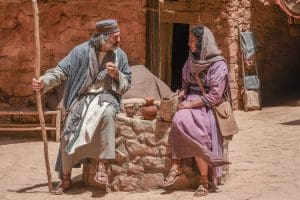
After having fed five thousand followers and walked on the sea, Jesus taught early listeners that he was the “Bread of Life,” the very Son of God. Many of those who heard, responded by saying, “This is an hard saying; who can hear it?” (John 6:60). Jesus, discerning the murmuring of his disciples turned to them and asked, “Doth this offend you?” (John 6:61). We learn that subsequently, “Many of his disciples went back, and walked no more with him” (John 6:66). Jesus then poignantly asked His Twelve Apostles, “Will you also go away?” (John 6:67). Even they were at risk of not keeping up and keeping on.
Those early followers’ response speaks powerfully to me. “Lord, to whom shall we go? Thou hast the words of eternal life.” (John 6:68). The longer I observe others and persist myself, the more deeply I feel that there is no other way as promising, as joyful, as productive, as dependable or sure as is keeping at it and keeping on with the path I chose all those decades ago. Having come so far, learned the things I have learned, experienced the things I have experienced, developed the relationships I have developed, felt the things I have felt, “to whom would I go?” There would be so painfully much to be lost in going anywhere but forward. Keeping on keeping on.
The famous Robert Frost poem, “Stopping by the Woods on a Snowy Evening,” is a rhymed narrative about a traveler who stops in the woods to observe the provocative beauty of a winter night. The final stanza reads:
“The woods are lovely, dark, and deep,
But I have promises to keep,
And miles to go before I sleep,
And miles to go before I sleep.”
That traveler paused, but he kept on keeping on. He knew that he “had promises to keep.” And so do we. We are keepers of promises, covenants, and each other. And we have blessed miles to go before we sleep.






KathleenAugust 15, 2024
Beautiful!
LauraAugust 14, 2024
Thank you for this thoughtful reflection, Kathy. The gospel path is sure, and most definitely worth keeping on!