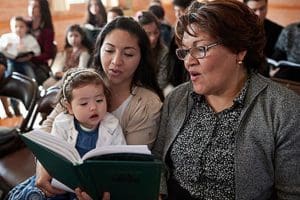







Editor’s Note: Meridian is pleased to offer some sneak peeks into Richard Eyre’s new grandparenting book The Grandparenting Bluebook which will be released in March. This is the third article of four that give us advance samples from the book. (See article 1 here and article 2 here) Today’s excerpts are from the “Life Secrets” part of the book and are actually written by Richard and some of his grandkids.
Author’s Note: I’m excited to share some further excerpts from this new book, and I have to say that what I am sharing today is from my own personal favorite part of the book—because I wrote it with my grandkids! The book is available at a discount on Amazon, but for Meridian readers, please get my larger author’s discount, at https://familius.com/book/the-grandparenting-blueprint/ where you can use coupon code EYREFRIEND.
This book was motivated by the thought that the life principles that I have shared with my own grandkids over the years may have some value beyond our own family, but since we had always called them “secrets,” I had to ask them if it would be okay if I shared them. When they agreed, I asked them to write part of the book by sharing some little personal experiences they’d had with some of those secrets.
Some were lukewarm about that, until I told them about “royalties” and mentioned that everyone who helps write the book gets some of the royalties.
Needless to say, what they wrote became my favorite parts of the book. So let me share some excerpts from some of the “younger secrets.” In the final excerpt article next week, I will focus on some samples of secrets for older grandkids.
Part Two: The Secrets
(12 Principles of a Joyful life)
With the basics in hand (or at least in mind) we are ready to approach, develop, and teach the legacy-secrets that we hope will help shape our grandchildren’s lives.
This takes some work, but it is the best kind of work we do, and the source of the greatest joy that is available to us, and to our grandkids.
Introduction to the Secrets
Once I had asked myself the question “What are the twelve most important things I know—the dozen key things I want my grandkids to know?” I couldn’t stop thinking about it. The question itself kept expanding; it was as though someone else was asking me and would not stop until I gave a satisfactory answer.
- What emotional or spiritual legacy do you want to leave with your grandkids?
- What do you want them to remember about you—what truths do you want them to identify with you?
- What principles or practices will protect them as they grow toward adulthood?
- If you had a magic wand, what qualities would you bequeath upon your grandchildren?
- What do you really think are the keys to their happiness?
I had begun to see grandparenting as a golden opportunity. I had total access to these remarkable young kids, and the love between us was palpable, yet I didn’t have the responsibility or obligation of discipline, of correction, or even of teaching, clothing, feeding and housing. I was free to just be with them, to appreciate them, to praise them, to encourage them, to accept and admire them without judging or monitoring them. It seemed that if I could get their attention, I could teach them whatever I wanted.
And that begged the questions: What did I want to teach them? And how would I get their attention?
As is often the case, the big answer was easier than the small one. As a writer, I understood that. I often had a topic that I was interested in and could talk about easily and at length, but when I tried to write about it, I had to tighten up my thinking—I had to winnow it down to its essence, to fill in any gaps, and make it internally consistent.
And that was what I wanted to with what I want to teach my grandkids. I had to take everything I wanted to give them, explain to them, warn them of, show them, alert them to, and reduce it down to a small list of principles that would resonate and stay with them, principles that were so short that they could memorize them, well-formed little ideas that we could discuss and find examples of, and that could be implanted deeply enough in their minds that they would be in their consciousness when they needed them. And the principles had to be worded intriguingly—like secrets.
What I wanted to create was not so much a list of what I believed—of my convictions and faith—I could do that in longer letters to them. Rather, what I was thinking about now were the “operating principles” for living a good and happy everyday life—the things I thought they needed to know to find their truest selves, make good choices, have solid priorities, and make the most of their lives. It was the self-help (and God-help) concepts that I felt had worked for me and would work for them, but in a form that they could understand as kids, and that would expand within them as they grew.
My thoughts eventually evolved into the 12 Grandfather’s Secrets that they have memorized, discussed, and implemented over the last decade and a half. And I’m so happy to have each of these beloved grandkids help me tell the story— they now range from 8 (the earliest age they have access to the first two secrets) to 27.
I don’t think you, as your own unique kind of grandparent, with your own unique grandkids, should adopt my secrets. You should develop your own from your own beliefs, your own life experience, and your own insights and inspiration for your own grandkids.
But I hope my secrets will serve as prompters and prototypes, and that my process of creating them will be a pattern that you can consult as you create yours.
Excerpts from one of the “Age Eight Secrets”
Secret 2: LEADING
“Most kids are waiting for someone to lead them, but they just don’t know it yet.”
In most peer groups, there seem to be one or two kids who make all the choices, sometimes for the good but often for the bad. The kid says “let’s do this” and everyone does it, not so much because they like the idea but because everyone is doing it and the “leader” suggested it.
We all want to raise our kids (and to condition our grandkids) to think for themselves rather than “following the leader,” and sometimes all it takes is an understanding of the notion that “most kids are waiting for someone to lead them” that gives our kids the courage and incentive to be the leader rather than the follower.
As grandparents, we can tell them these stories and give them these examples, and we can gradually build within them a reputation of being a leader—a reputation that can stay with them for a lifetime.
Stories
Kids, let me tell you three short, true stories, one about your aunt Saydi and one about your uncle Tal. See if you can see Secret 2 coming out in these three little true stories:
When your Aunt Saydi was in junior high school, there was a girl who had the locker next to her who didn’t fit in. She didn’t seem to know how to do her hair and her hygiene was not good. She was either shunned or made fun of by most everyone else.
She missed school a lot, and when she was there, she looked worried and scared. Saydi started asking her little questions in the moments when they were both at their lockers, and found out that her name was Katie and that she had come at the first of the school year to live with her grandma because her dad was in prison and her mom was working three jobs and couldn’t take care of her. One day she looked even more upset than usual and told Saydi that she hated her grandma, hated her life, and hated school because everyone had their cliques and groups and there was no room for her. Saydi thought about that for a couple of days, and then she decided to do something about it.
She organized five or six of her friends to do something to welcome Katie, even though the school year was half over. She told them about her life and that what she really needed was a few friends. The group got her some nice little gifts and came early to school the next day and waited together by Katie’s locker. When she came in, they circled around her and said they were sorry they had not welcomed her to school earlier. They gave her their small gifts and introduced themselves and said they would try to invite her and go with her to school stuff. Oh, and “Would she sit with them at school lunch today?” As the year went on, they helped Katie with her hair and her teeth, and brought her with them to dances and assemblies.
By the end of the year Katie had become one of Saydi’s good friends.
In high school, your Uncle Tal was the star of the basketball team and the president of the boys’ student body, but at lunch each day, instead of sitting with the rest of the team or with his friends, he tried to find kids who were sitting alone and sat down and asked them some questions about themselves. I was proud of Tal for this, and grateful for his leadership in looking out for others when it would have been easier to just stay in his comfort zone. And I knew that a lot of lonely or misplaced kids appreciated it even more than I did.
But the full extent of his commitment to lead in this way didn’t hit me until the first day of Tal’s college life when I took him to campus and we were having lunch together before he checked in. I was busy giving him advice and going over his schedule when I noticed his attention was elsewhere. Suddenly he said, “Excuse me, Dad. You finish eating, and I’ll join you later.” He got up, and I watched him walk over with his lunch and sit down by a somewhat lost-looking fellow student who was sitting alone. It was Tal’s first day, but he saw someone who looked more confused than he was, so he went over to make the other guy feel more comfortable.
I’ve never enjoyed eating alone as much as I did that day.
What do you like about the story about Aunt Saydi? What impressed you about Uncle Tal in the story about him?
Discussion and Case Studies
Use the same kind of questions outlined on Secret 1. It’s important to see what your grandkids think and find out their first impressions before jumping into the case studies. Try to “ask and listen” and to see how much they can grasp of the concept of each secret just by hearing it and thinking about it.
Then use the case studies to get them thinking about meaning and implementation. Many kids, after putting themselves into the case studies, will bring up some similar personal experience they have had, and that is exactly what you want.
Case Studies, Discussion Questions, and Memorizing sections come next, followed by grandkids comments. Here are a couple samples:
Dean, 9
In school during gym class at the beginning of the year, I was not that good of a leader. For example, when my gym teacher said to me to come over and sit on the bleachers, my friends didn’t do it and I stayed with them. The gym teacher got a little mad. I kept hanging with the crowd a little bit longer, but one day during gym the teacher said come sit down. I said to my friends, “Let’s go sit down,” and we all did it. I could tell that my gym teacher was happy.
Later in the school year I got a lot better at leading. Now I am a lot better leader.
Another time my friends were trying to fight each other at recess and I said “I don’t think you should do that.” They actually said “Oh yeah, this is kind of dumb.” Now I know always to try to lead and be a leader because some kids just need someone to follow.
Zara, 11
My name is Zara, and I am 11 years old. During 5th grade, my friend got this book which came with two matching necklaces. I felt touched when she said I could have one necklace and she would have the other one. “They can be our friendship necklaces,” she said. I was in a good mood because of that.
Then she said, “Have you ever seen Mean Girls?”
I said “No.”
She told me that in Mean Girls, there was a book that was called a burn book. She said it was a book about the people you don’t like and you write trash about them. And she said she had a burn book and we could write in it together. So, we kept writing in it. One of the girls we were writing trash about was named Lilly.
One day we were writing in the bathroom and Lilly came in and snatched the book out of our hands and locked herself in a stall and read the chapter about her. She came out of the stall crying.
I felt awful. I am not proud of what we did.
Later our teacher lectured me and my friend. Even though I was in trouble, I was happy that the teacher was the leader and made us see how bad a thing we had done.
It all made me think of the Grandfather’s Secret that most kids are waiting for someone to lead them, but they just don’t know it yet. I guess I was waiting for my friend to lead me, and she led me in a very bad direction. I promised myself never to follow that friend blindly again, and to try to be the leader myself instead. And I did apologize to Lilly, and I hope she has forgiven me.
Excerpts from one of the “Age Ten Secrets”
Secret 4:POPULARITY
“Good popularity comes from being nice to everyone—and it lasts. Bad popularity comes from only being nice to certain people—and it doesn’t.”
Story
When I was in elementary school, just like you are now, I learned the word “popular” and boy, did I want it! In the first week of junior high school, we had homeroom elections, and I asked a kid I hardly knew named Ronnie Brown if he would nominate me for president and I would nominate him for vice president. He did, and we both won, so I thought maybe I was popular. And I tried to hang out with other kids that I thought were popular.
There was one kid named Curtis who was definitely not popular. He didn’t wear the cool brand of clothes, and he didn’t do a lot of school activities. But he sat by me in one of my classes and he just seemed nice. And he asked me quiet questions once in a while about what I liked to do. I liked him, but he wasn’t popular.
It took me a while to realize it (and to admit it to myself) but I really liked being around Curtis more than being with the in-crowd. With them I always felt like I was being judged—sometimes admired, sometimes shunned, pressured to be cool. With Curtis, I could just be myself. I remember one night when I was going to go over to Curtis’s house to do homework and sleep over, when I got invited to a kind-of exclusive party. Curtis didn’t get invited and I was calling him to tell him I couldn’t come over—then it sort of dawned on me all of a sudden that I really didn’t want to go to the social-climber party, and I really did want to hang with Curtis. That little epiphany opened my eyes to some other things. A lot of my popular friends were pretty rude to kids who they thought weren’t on their level—while Curtis, though a little shy, was nice to everyone. The “populars” liked to talk about themselves—while Curtis was curious about me. The populars were always looking for somewhere cool to go—while Curtis just did what he enjoyed. The populars were always putting on an act, trying to impress—while Curtis seemed comfortable just being himself.
That was when I first realized that there were two kinds of popularity, good and bad. And by the time I started high school, I had learned that the good one lasted and the bad one didn’t. By the time we were seniors and starting college, it seemed like the clique-ish kids had faded, and the genuine, be-yourself and be-nice kids had ascended.
There is one other part to this story, and it is a girl named Marilyn. She was (I thought) the prettiest girl in our class. Everyone liked her and she liked everyone—and I do mean everyone. There were two special needs kids in our class, Eddy and Marsha, and they were essentially social outcasts. They looked a little strange, dressed a little strange, and Eddy could barely talk. Martha had Down Syndrome. No one ever talked to them except teachers…and Marilyn. She always said hi and made sure both of them were feeling okay. I noticed that the only time Eddy or Martha were smiling was when Marilyn was talking to them. Marilyn was the best example I had ever seen of Good Popularity.
Lots and lots of time passed, and just a couple of years ago I went to my 50th high school reunion. I was a little late and when I walked in one of the first things I noticed was that Eddy and Martha were there—they were seated by themselves, except that Marilyn was there with them, and they were talking and smiling. By now I understood: you see, good popularity does last—at least for 50 years!
Discussion and Case Studies
Why do you think I enjoyed being with Curtis so much?
What did that help me decide about good and bad popularity?
Why do kids want to be popular? Why doesn’t bad popularity last? Why does good popularity last?
Can you think of someone you know who has bad popularity? Is there one of your friends who you think has a lot of good popularity?
Discussion and Case Studies and Memorization follow here, and then comments and inputs from my grandkids. Here are a couple of them:
Mila, 10
Hi, I’m ten years old and this happened to me about a year ago: I went to a new school and there was this popular girl and she wanted to be friends with me. I didn’t feel like I wanted to be friends with her because I felt like everyone should have her same amount of attention.
Think about it: If the popular kids get all the attention doesn’t that mean a lot of kids get left out? So, my choice was to not be friends with her and I wanted to give the kids who didn’t get much attention more attention.
I mean, really, when you get the chance to be friends with the most popular girl? What would you do if you got asked? Be. Honest!
But this little voice whispered into my ear that I should give the other kids more attention.
Poem, 13
When I turned 10 and got GF Secret 4, I thought of something that happened to me five years earlier: I was 5 years old, and my family moved from our home in Hawaii to Spain for a year. While we were there I had to go to kindergarten and I did not know any Spanish or anything about this new place. I remember being so scared on the first day of school not knowing anyone or where anything was. When my mom left me, I was on the verge of tears, and as I was about to cry, I remember a girl from my class named Maria, she was one of the prettiest and popular girls in the whole kindergarten and there she was standing right in front of me. She asked me in poor English if I was okay and then Maria showed me around the classroom. Then when lunchtime came around, she grabbed me by the arm and introduced me to my classmates and new friends. We sat down and she talked to almost every kid in the kindergarten and tried to help me understand the Spanish that they were speaking to each other. In class the next day Maria showed all of my new friends and me how to draw a bike, and I still draw my bikes like that. Maria has shown me not only how to draw a bike but how to have good popularity. She showed me to be kind to anyone and everyone even if they are new and different and don’t know your language. Maria was a friend to everyone, and I remember the way she made me feel included—I remember this whenever I see a sad kid who is not in my regular friend group.
Be on the lookout for one more excerpt article next week!
Thanks for reading. I’m excited to share one more set of excerpts with you next week here in Meridian—this time from some of the secrets for older grandchildren. These grandkids, young and old, are our delight, and they are also our legacy.
Richard Eyre is a New York Times #1 Bestselling Author and a former Mission President in London.