







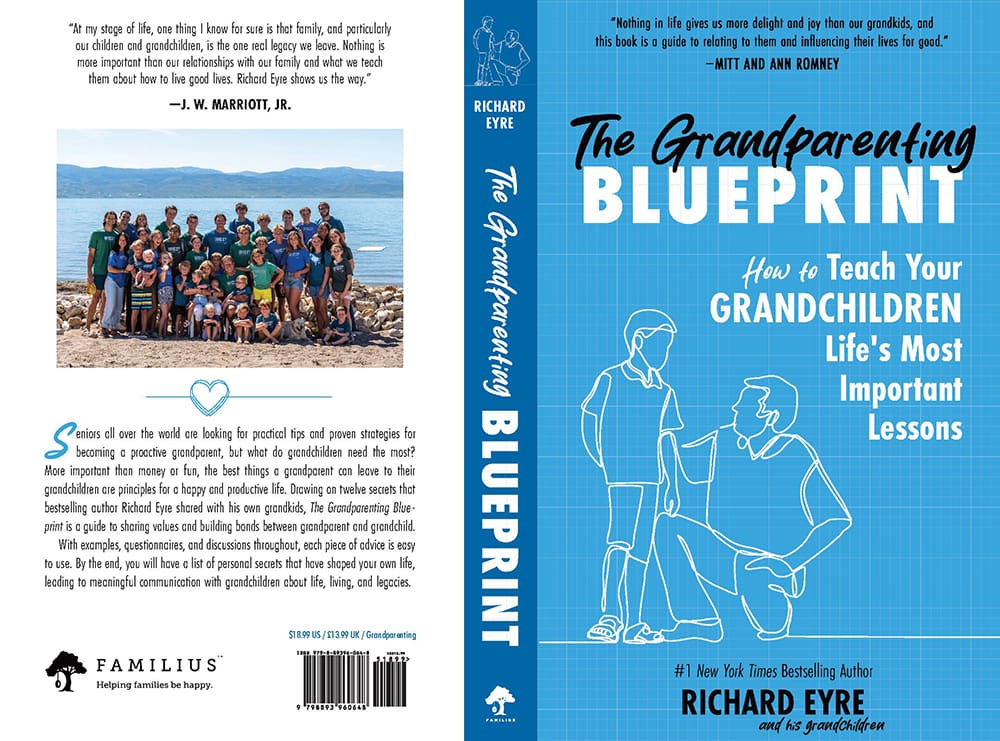


Editor’s Note: Meridian is pleased to offer some advanced peeks into Richard’s new grandparenting book which will be released in March. Today’s excerpts will introduce the book, and three additional articles will sample some of the grandparenting advice from three of the book’s main sections. In the final article, you will find a link that will give Meridian readers a chance to get the book early and at a discount.
Author’s Note: Both Linda and I are honored to be long time Meridian contributors, and it is a privilege to do a little early sharing from this new book. Enjoy! (Because that is what grandparenting is all about!)
When I first began writing this book, I had a question in my mind—a question for myself and for all grandparents. The question was: “Why not focus more attention on the most delightful part of our lives?”
We have been writing and speaking to grandparents for a long time, and I have concluded that the answer is “We don’t really know how.” We don’t know enough about how to be the kind of proactive, involved grandparents that we would like to be. Not that there is only one kind of good grandparent—each of our families are different and unique, and we have to find our own way. But aren’t there some principles and “best practices” that will work for all grandparents?
I believed that there were, and it was that belief that led to this book.
In this first of four little articles, let me just share the idea of the book by sharing its cover, its preface, and its introduction:
Back Cover and Endorsements
Surveys show that a majority of grandparents consider their grandchildren to be the most delightful part of their lives. Yet grandparenting, and doing it well, and without stepping on parents’ toes, can follow a difficult and tricky path
You will find this book to be a trustworthy guide. Richard and Linda Eyre, after nearly 40 years of writing and speaking to parents throughout the world, have now turned their attention to where their own life is—forming deep relationships with grandkids; finding balance between family, faith, ongoing work, retirement, estate planning, and travel; and partnering with and parenting adult children. The goal is living the fullest and richest possible autumn-of-life season, and at the heart of it all is grandparenting!
“Anything I have done or accomplished in this life pales in comparison to the joy I have with our children, the spouses they chose to marry, and our grandchildren. This is our legacy. I highly recommend this book to anyone who wants to know the “secrets” to effective and joyful grandparenting.”
–Nolan Archibald, Retired CEO of The Black & Decker Corporation.
Our friends the Eyres continue to create solid advice for families—in this case grandparents. Nothing in life gives us more delight and joy than our grandkids and this book is a guide to relating to them and influencing their lives for good.
My only regret in reading Rick’s new book is that I didn’t have it years ago. Not really knowing our grandparents in order to model our own grandparenting, we made many mistakes and omissions. This is a practical guide that can be shaped for one’s own family and priorities.
—Mitt and Ann Romney
Many people assume that my life is fun because it’s all about basketball, but I’m here to tell you that far and away the most fun part of my life is my grandkids.
–Danny Ainge, former Boston Celtic and current CEO of the Utah Jazz
At my stage of life, one thing I know for sure is that family, and particularly our grandchildren, is the one real legacy we leave. Nothing is more important than our relationships with our grandkids and what we teach them about how to live good lives. My friend Richard Eyre shows us the way.
–J. W. Marriott Jr, Chairman Emeritus, Marriott International
What I like most about this book is that Richard keeps it basic and practical. When he gives us an idea, it is one he has tried, and developed, and practiced—and one that he feels really worked with his own grandchildren. And even when he suggests something that I don’t feel would work with my grandkids, it usually triggers my mind to think of something similar that would work! Richard says he is writing to grandpas, but if you ask me, everything he says is equally relevant to us grandmas—so I am reading it first and then giving it to my husband!
–Jana Arnoldy, CEO organization
Other Quotes on Grandparenting
“Grandchildren are God’s way of compensating us for growing older.” — Mary H. Waldrip
“They say genes skip generations. Maybe that’s why grandparents find their grandchildren so likeable.” Joan McIntosh
“My grandkids believe I’m the oldest thing in the world. And after two or three hours with them, I believe it, too.” — Gene Perret
“ I have a warm feeling after playing with my grandchildren. It’s the liniment working.”–Anonymous
“Perfect love sometimes does not come until the first grandchild. — Old Welsh Proverb
“Grandparents sort of sprinkle stardust over the lives of little children.”—Alex Haley
Preface
One of the problems of being a grandpa is that your wife is probably a lot better grandparent than you are. That has certainly been the case in our family. Linda seems to have a gift for discerning the hearts of our grandkids—for knowing what they need and knowing how to give it. And it seems like she is always doing things for them and with them. She even has “Grammie Camps” with them every summer.
As the grandpa, I was feeling like a slug!
One day as I was thinking about how I could step it up a little, I asked myself what I most wanted to give to my grandchildren. The answer wasn’t financial help or more fun or travel. The answer was that I wanted to try to share with them the principles that I felt could help to make their lives happy and productive. The best things I could give them, I reasoned, were the best things I had learned.
So, one quiet Sunday afternoon, I wrote a short list of three or four “Grandfather’s Principles.” The next week I read a couple of them to some of my older grandkids in hopes of engaging them in a little discussion.
It fell flat. Their looks seemed to say, “When will this lecture be over?”
I tried changing my pitch to “Grandfather’s Beliefs” and “Grandfather’s Tips,” but those didn’t work any better.
But I kept working on my list, expanding it and refining it, and then one summer, at our family reunion while I was with some of our elementary age grandkids, I repurposed my list as “Grandfather’s Secrets,” and boom, I suddenly had their interest and their attention. I even had their curiosity!
Things got better from there. I polished my list of principles/beliefs/tips/secrets until I had a dozen of them that were simple and basic but that genuinely reflected what I thought was truly important and what I felt were the top-12 little “life guides” that I wanted to share.
Nowadays, when our grandkids turn 8 (the “age of accountability” we call it) they receive the first two secrets. When they are 10, they get two more; two at 12, two at 14, two at 16, and the final two in the year they have turned 18. Recently I added a bonus “marriaging secret” that I share when they get married (as four have done so far).
I give rewards and recognition to kids for learning them, for memorizing them. We talk about when and how they have applied them or how they might apply them when they are older. I text back and forth about them with grandkids who are old enough to have a phone. At reunions we have group discussions where they share examples of using them in everyday life. The secrets seem to find their way into ordinary conversations. Older grandkids sometimes tutor younger ones on what certain secrets mean and how they work.
Individually, whenever I have a somewhat private moment with a grandchild or two, I ask them to give me an example of how they applied one of the secrets in the past or how they imagine they might apply one in the future. For the ones who live farther away, I text “case studies”—hypothetical situations they may find themselves in when one of the secrets might come into play, and I ask them to text back about what they would do.
I learned a lot about myself from developing these secrets, and I’m still learning important things about my grandkids as I try to teach them.
From one Grandfather to another—A challenge:
I challenge you, while reading this book, to develop your own set of “secrets.” They will not be the same as mine. Far better, you will come up with the secrets that have shaped your life. You will have personal stories about them, and those stories will lead to questions and discussions—and to meaningful communication with your grandchildren about important ideas. Your secrets will become your legacy in the minds of your grandchildren.
This book will help you put all that together.
As you ponder, and as you think about your grandkids’ needs (which should be reflected in your secrets) maybe some of my secrets can be a motivation, or a guide, or an idea-starter, or just something to think about as you develop your own. Maybe some of your secrets will be very similar to some of mine.
And, final word of preface: You should know that I asked my grandkids if I could “tell our secrets.” I sat down with them for a little discussion at our last family reunion and posed the question—should we share these secrets, and put them in a book?
Some had some reservations, after all, these are secrets! But as we discussed it together, they all felt that yes, we should share them—with the emphasis on the we! They wanted to be co-authors—to share how they have used the secrets in their own lives—and, said a couple of the older ones, to share the book’s royalties!
Turns out that that little discussion was the real key to making this book interesting. I can explain the secrets and why I chose them and how I wrote them and how they were transmitted to my grandkids. But only these grandkids, in their own voices, can tell you how they worked for them, what they did with them, and how their choices, character, and lives were influenced by them.
So, their stories, their reports, their experiences populate the pages of this book. And these are unedited—they are their voices in their 8-year-old or 12-year-old or 18-year-old language. You will enjoy them, but probably not as much as I did!
Introduction
The Nature of this Book
You will find that this is a personal book. It is just one grandpa writing to another—the writing grandpa talking to the reading grandpa. Thus, much of it is written in the first person, especially the introductions or stories or opening parts of sections, and I’ll use words like “we” and “let’s” and “you and I”. We’re thinking about and talking about our grandkids, you and I. We know this is not an easy job, and we know there are a lot of ways to fail and a lot of blunders and counterproductive moves we can make. So, let’s be personal, and let’s be real. We both want to do it the best we can, and we both believe that our grandkids are special—remarkable even. We brag a lot about them and we want to do everything for them. But oh, how we want to do it right, and how we want to do it in harmony and in teamwork with our children-the-parents.
In order to be personal and real, I will need to reveal a lot about myself. You will see that I am spiritual and religious as well as practical and analytical. I can’t hide any of it. But you will also see that I am not trying to influence who you are other than trying to help both of us be better grandparents—each in our own way. So please, right from the beginning, try to see me not as the ideal or the example, but rather as one example sharing ideas not for you to copy but to stimulate your own, and to encourage you to do your thing in your way, with your grandkids.
Fellow grandpas, let’s unite, let’s learn from each other, and let’s you and I focus more on the most delightful part of our lives.
Let me modify that last sentence just a little, and say “fellow grandparents” rather than just “grandpas.” Because this book, despite its title, is written for all grandparents—grandmas as well as grandpas. It’s just that I’m the latter, and I kind-of think the former needs less help than the latter. But if you’re the former, enjoy; and then give it to your latter!
Prerequisites to the Secrets—The basics of “part one” that need to precede the secrets of “part two”
Jumping right into creating and writing your own set of secrets would be positive and admirable, BUT every grandparent ought to want to put his house in order before filling it with furniture. We want our relationships to be right with our grandkids (and with their parents) before we start spouting secrets that we want them to embrace.
When a grandpa (or grandma) does the basics to develop those relationships and to deserve both the trust and the interest we need from our grandkids, the secrets will be perceived as confidence rather than control, love rather than lectures, guidance rather than our goals for them.
So, before we get to the secrets, let’s begin this book by talking a little about what we know as the basics of Grandparenting. We will start by thinking a little about the art and the skill of this role, and review some of the fundamentals. Because being aware of what grandparenting really is, and feeling motivated to learn how to negotiate it will put each of us in position to create and teach our own secrets.
And after you read Part One: The Basics, you will be much more ready for Part Two: The Secrets
Both parts will be personal. I want to simply tell you what has worked for me and Linda. I’ll leave out the many things that didn’t work so well, because we all have plenty of those…so let’s not dwell on them.
The Roles all Grandparents can Play
In speaking to grandparents throughout the world, we’ve come to realize that focusing on what we are (the roles we can play as grandparents) is more effective and leads to more results than focusing only on what we can do. And we’ve also learned that a simple acronym can be the key to staying “on it” and remembering the kind of grandparent we want to be.
And since I like acronyms that also have double or triple meanings as words, I love this one:
“T.E.A.M.”
Every grandparent who is willing to put in the thought and the effort can be on this T.E.A.M.
First meaning:
We need to be in teamwork with our children-the-parents, realizing and acknowledging that they are in charge and that we want to support and consult and supplement when they want it. Good communication and even regular meetings or Zoom calls between generations one and two provide the best support and outcome on behalf of generation three.
Second meaning:
You don’t have to re-discover the wheel on every approach to or idea for grandparenting. Resource and strategy teamwork with other grandparents can make the role less lonely and better prepared. Reading this book is a form of that, as is getting together occasionally with other grandparents you respect to share problems and challenges and look together for solutions.
Third meaning: (the acronym):
T stands for Trunk, because we really are the trunk that connects our branches to our roots. Research shows that the more kids know about their ancestors, the more identity and resilience they will develop. And we will cover this “trunking” in Part One.
E stands for Ear, and it is our listening skills that can not only lead us to accurate assessments of needs and to conveyance of confidence, but that can give us the true joy of knowing these beloved grandkids from the inside out.
A stands for Assembler, because if we don’t pull our families together to learn from and serve each other, to bond cousins, and to celebrate our familial relationships, who will?
M stands for Match, because as we observe three-generation families, we see a lot of “spoiling” going on—grandparents giving grandkids too much and giving it in ways that confer entitlement rather than motivation. Irrespective of their financial situation or capacity, grandparents who give “matches” where a grandchild has to work to come up with his share, do much better at giving incentive and avoiding entitlement.
We will get to these and many other simple but effective ways to be an effective, balanced, proactive grandparent in Part One, before we progress into the Secrets of Part Two.
Next Article
Join me here next week for some excerpts on this T.E.A.M. approach to grandparenting.






Bob SpielFebruary 26, 2026
You blessed my life as a teenager with "I Challenge You, I Promise You." Excited to see how your wisdom can bless my life again...now at the grandpa stage of life. Thank you!