










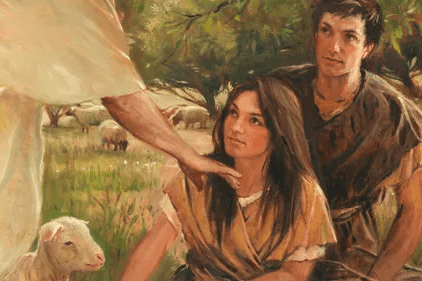


There is a story that appears so many times in our canon that when I come across it, I have been tempted to skip over it, thinking, “Yeah, yeah, I know. I’ve heard it a million times.” When I finally stopped skipping over this story and truly started studying it, I came to understand why it is critical enough to repeat until we “get it”.
The fact that the story of Adam and Eve occurs five times in the Book of Mormon is evidence of the importance of this story. One would think that writing on gold plates would be hard enough—what with finding the gold, creating the plates, and carving the words—that Mormon wouldn’t keep writing down the same story. But he does.
The first time we read the story in the Book of Mormon occurs when Lehi is teaching his son Jacob. We read it again when Ammon teaches King Lamoni, when Aaron teaches King Lamoni’s father, when Alma teaches Zeezrom, and again when he teaches his son, Corianton.
Not only does the story of Adam and Eve appear five times in the Book of Mormon, it also appears in the Book of Abraham, the Book of Moses, the Book of Genesis, and in the temple. Consider the time it takes to make covenants in the temple. The covenant of baptism takes less than one minute per person, as does the confirmation. The initiatory takes a few minutes, perhaps five. When I was endowed, the endowment took three hours. It was then shortened to under two hours and now takes only an hour and 10 minutes. With each abridgement, Adam and Eve’s experience remains intact.
The truths taught in the story of Adam and Eve are essential to understanding our Father’s plan and can enlighten both those who are considering making covenants as well as those who have strayed from the covenant path.
Truth #1 The earth was “made” by God, not by happenstance
Believing that God created the earth is the first truth that we must accept before the rest of the truths we learn from Adam and Eve make sense.
Ammon knew how important it was to believe that God created the earth. When Ammon begins to teach King Lamoni, he asks, “Believest thou that this Great Spirit, who is God, created all things which are in heaven and in the earth? (Alma 18:28).
While it might seem obvious that God created the earth, not everybody believes this. Some believe the earth was created at random, a series of fortunate coincidences. Korihor, the anti-Christ, taught such false doctrine. Alma corrects him, “And now what evidence have ye that there is no God, or that Christ cometh not? I say unto you that ye have none, save it be your word only. But behold I have all things as a testimony that these things are true; and ye also have all things as a testimony unto you that they are true…” (Alma 30:40-41).
Truth #2 God Invited us to Come to Earth
Once we acknowledge that God created the earth, we can more readily accept the fact that we are here on this planet at His invitation.
We are instructed to consider ourselves as if we were Adam and Eve when we visit the temple. Like Adam and Eve, we were all invited to come to the earth God created. We learn in the Doctrine and Covenants (sections 93 and 101) that we all had the agency to accept or decline this invitation.
Truth #3 There is such a thing as Good and Evil
On the Creator’s earth, there was a difference between good and evil. There was actually a tree on this earth called “the tree of good and evil.” The tree is not called an “aspen” tree or a “cottonwood” tree. It is called the tree of good and evil.
The fact that there is a tree on God’s earth called “The tree of Good and Evil,” suggests that “anything goes” is not a sound philosophy. Although, many today argue as Korihor did: “And many more such things did he say unto them, telling them that there could be no atonement made for the sins of men but every man fared in this life according to the management of the creature; therefore every man prospered according to his genius, and that every man conquered according to his strength; and whatsoever a man did was no crime.” (Alma 30:17 [italics added]).
Adam and Eve’s story teaches us that in God’s world, good and evil do exist. God decides what is good and what is evil. We can’t rationalize sin by calling “good evil” or “evil good” (Moroni 7:14).
Truth #4 God Makes the Rules for Living on His Earth
In God’s world, God makes the rules. Like Adam and Eve, we are invited to obey God’s rules. The rule for Adam and Eve is, “don’t eat of that tree.” “But of the tree of the knowledge of good and evil, thou shalt not eat of it…” (Genesis 2:17).
As much as we enjoy living in the world God created, not everybody is thrilled with God’s rules. We enjoy the beauty of the earth—the vast rivers and small streams. We play gleefully on this earth God created. We ski in the mountains, and surf in the oceans, and kayak and mountain bike, and camp, but don’t necessarily want to abide by God’s rules.
If you are a fantasy novelist, you can build a world with whatever rules you like. However, in this world that God created, God gets to make the rules.
Truth #5 God gave us Agency
We not only had agency to choose to come to earth, as mentioned in truth #2, but we also learn from Adam and Eve that we have agency here on earth. We can choose whether we will obey God’s rules or not. “But of the tree of the knowledge of good and evil, thou shalt not eat of it, nevertheless, thou mayest choose for thyself, for it is given unto thee;” (Moses 3:17). This portion of this sentence in italics is revealed in the book of Moses, and also in the temple, but does not exist in Genesis. Therefore, many people do not appreciate the gift of agency.
Knowing that we have agency resolves the predestination debate, wherein some believe that no matter what you do in this life, your fate in the next life is already decided. People with this belief can justify sin by claiming you are “damned if you do and damned if you don’t.” They may claim there is no point in choosing good if it doesn’t bless you now or in the next life. Knowing we have agency and are accountable for our choices drastically affects our decision-making.
Truth #6 God Determines the Consequences of Obedience and Disobedience
Although we are free to choose to obey the rules, we are not free to choose the consequences of those choices. The fact that there are consequences for our choices is what concerned Alma’s son, Corianton. “And now my son, I perceive there is somewhat more which doth worry your mind which ye cannot understand—which is concerning the justice of God in the punishment of the sinner…” (Alma 42:1) Alma recognized the story of Adam and Eve would help Corianton understand how God’s consequences are just.
The consequence for disobedience for Adam and Eve was death, “But of the tree of the knowledge of good and evil, thou shalt not eat of it: for in the day that thou eatest thereof thou shalt surely die.” (Genesis 2:17).
Death for Adam and Eve means the same thing as death for each of us. Death was and is a separation, both physical and spiritual. Adam and Eve were physically removed from the presence of God. They were kicked out of the garden where they had walked and talked with God, thus being physically separated from God. They also became separated from God spiritually. They were no longer at-one with God—their behavior was not aligned with His will.
Truth #7 God Provided a Solution for the Sinner
The story of Adam and Eve is a story for sinners. In the Book of Mormon, four of the five renditions of Adam and Eve’s story are given to people who are suffering from sin.
King Lamoni pleads, “O Lord, have mercy; according to thy abundant mercy…”
The father of King Lamoni declares, “I will give up all my sins to know thee.”
Zeezrom has just attempted to use deception and lies to trick Alma and Amulek into denying the existence of a Supreme Being
Corianton has been seduced by the harlot, Isabella.
It is no coincidence that the way to help sinners be “at-one” with God is to teach them the story of Adam and Eve. Fortunately, the story of Adam and Eve doesn’t end with our first parents breaking God’s rules and suffering the consequences. The happy ending is the best part of the story.
The story continues with God inviting Adam and Eve to come out of hiding. They learn they cannot “cover-up” their sins with a bunch of flimsy fig leaves. God offers them clothing made of animal skins, clothing that completely covers them, clothing that is warm, soft, durable, safe, and secure. The animal skins are a symbol of the sacrifice of God’s Only Begotten Son, who paid the price, the “cover charge,” if you will, for their sin. Adam and Eve can again be at-one with God. The invitation extended to Adam and Eve to allow The Savior to “cover” their sins is the same invitation that can unify each of us with The Father, spiritually in this life, and one day, physically. It is an honor to receive this invitation, and those who comprehend this will jump at the chance to accept it.
JeaNette Goates Smith is a Licensed Marriage and Family Therapist and the author of four non-fiction books on family relationships. More information can be found on her website, www.smithfamilytherapy.org







KathleenNovember 21, 2025
Great points. I might add the importance of understanding the fall. Those who don't, see no need for a Savior and redemption.
Douglas NadybalNovember 20, 2025
It is a bit of a stretch to say that we came to earth on God's "invitation". I was recently invited to a party, but chose not to go. There was no penalty for not going other than I missed a good time. I was not cast into outer darkness, nor was my progression stopped. If you chose not to come to earth, you by default, aligned yourself with Satan's plan. We all clearly had a decision to make, with the option to stay put was off the table. I'd call it more of a relocation than an invite.