







Story and photos by Meridian Magazine Hawaii correspondent Mike Foley.
LAIE, Hawaii — Brigham Young University–Hawaii is offering maturing Latter-day Saints a free seminar — LDS Life Launch-2: Exploring the Path for Life’s 2nd Half, on Friday and Saturday, March 25–26, 2011 — to assist them in creatively planning a jump-start on their retirement years.
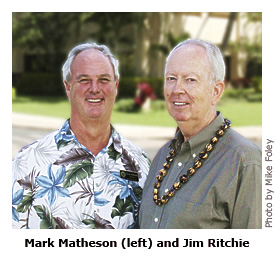
“This participatory seminar is for Latter-day Saint couples from the ages of 40–70 who want to map out a blueprint for the second half of their lives,” says Jim Ritchie, director of the BYUH Willes Center for International Entrepreneurship, which has put the program together. “Seminar participants will explore their options for creative, self-initiated service, expand their repertoire of social entrepreneurship skills, and interact and network with other like-minded LDS couples.”
Willes Center entrepreneur-in-residence and seminar director Dr. Mark Matheson, a successful financial stock analyst for the past 25 years, says he’s seen “that the Lord has really blessed a lot of Latter-day Saints to be prosperous in their 30s and 40s. So what do they do in their 50s and 60s? I think the old notion of our parents, to retire at age 65, has really got to be turned on its head in the next few years for some people.”
“We have an opportunity here to teach maturing LDS couples together about what they might accomplish in the second half of their lives, beyond the first-half milestones of baptism, priesthood, mission, temple marriage, career and family.”
“We need to better prepare the rising generation about what retirement is going to be like. Maybe they could be doing the things they love, along with their work, starting in their 30s, 40s and 50s; and not put it all off until after they’re 65 and finished with financial work. Let’s start them doing good for the Kingdom now instead of over-working financially.”
He asks several qualifying questions: Should you keep earning dollars, or should you stop now if you have sufficient to do more good in the world? Is that really even possible if, for example, you still have children at home?
“It is possible. Miracles can happen. For example, the Lord can make it happen that you have a winning stock and make your pot of gold, and then you can spend the rest of your life in more creative service,” Dr. Matheson responds. “At the seminar you’re going to learn from two couples who gave up the rat race in their 30s, and have been creatively serving ever since.”
“I’m trying to help change the view a lot of mature Latter-day Saints have that they’re just going to wait for their mission call at age 65 or later. Why can’t you creatively find what you’re passionate about in life now, and do that in addition to what maybe you’ll be called to do as a fulltime missionary one day?” he asks. “Create and find your own path of service that resonates with your soul, and do it as early as you can. Don’t be fearful that you can’t do it until after you turn 65.”
Dr. Matheson explains that’s why the seminar features “four of the best LDS social entrepreneurs that I could find, to give an overview of what creative Latter-day Saints have done,” including:
- Becky Douglas and her Rising Start Outreach. “Her main focus is India, with the leprosy issue over there, among other things,” Dr. Matheson says.
- Cindy and Blair Packard with Care for Life in Mozambique, one of the poorest nations on earth. “Cindy was an LDS midwife who saw the need for some basic birthing materials to help babies survive after birth. She found that some people in Mozambique were having to cut the umbilical cords with rocks, so she started putting together birthing kits, and now she’s doing innovative things with families and villages…to help them be self-sufficient.”
- Stephen and Bette Gibson, who started the Academy for Creating Enterprise in the Philippines to help young returned missionaries there develop entrepreneurial skills to become self-sufficient.
- Dr. Jerry Simons and his Hope Projects Foundation, which is involved in humanitarian projects for the peoples of the high Andes in South America.
Other presenters and features of the seminar include:
- BYU–Hawaii President Steven C. Wheelwright and his wife, Margaret.
- Laura and Mark Willes, CEO of Deseret Management Corporation, on giving.
- Jim and Carolyn Ritchie, who started their creative Church service at age 35.
- Jeri and Dr. Doug Brinley who’s “revised his classic, as the news media put it, ‘LDS sex manual’. He’s here on a CES mission and we’re going to talk about senior intimacy issues,” Dr. Matheson notes.
- Dr. James B. Mayfield on worldwide opportunities.
- Panel discussions on planning a creative path of service, living abroad, using the Internet to broaden your impact, working together as husband and wife, finding your own causes, and dealing with separation anxiety.
- And more.
The LDS Life Launch-2 seminar will attract a “core mass” of attendants already on campus for BYU–Hawaii’s annual Empower Your Dreams entrepreneurship event (go to https://leadership.byuh.edu for more information) earlier that week.
“This is not a come-and-listen-to-lectures seminar, Dr. Matheson points out. “This is a come and find out how people are living this kind of life right now. For example, you’ll learn how to deal with being away from grandkids while you’re following your passion. About half the people I’ve talked to say God takes care of their grandkids better while they’re away, and the grandkids love that grandma and grandpa are off doing something to change the world.”
Dr. Matheson explains this type of service also provides a “dual track” to senior missionary work. “This could be a preparatory step — a good bridge to dip your toes in the water without the pressure of a fulltime mission. Even couples in their 60s could do some of the best work in their lives in the years ahead of them — if they have a vision. That’s the key.”
“If you get thinking, my best years are behind me, you’re probably going to coast,” he adds. “But if you have a vision, you’re going to do some amazing things that you’ve dreamed up, rather than sit home, play golf and have a peaceful retirement.”
“You’re not waiting for the envelope from Church headquarters to tell you where you’re going to serve. We’re trying to reach out early to incubate some of you to start serving earlier than that, by finding your own creative path 20 years before you might otherwise serve.”
Dr. Matheson, who earned a Ph.D. degree in organizational leadership and a Harvard MBA, is doing what he advocates. For example, for years he tried to start up an “envoys of education program” using talented Latter-day Saints “as unpaid ambassadors for a year in schools around the world. They wouldn’t be proselyting missionaries, but they could make some big inroads. Many of them could also teach in languages other than English. I see it as a cross between the [BYU Provo Kennedy Center] China Teachers Program and the U.S. Fulbright Scholarship program. The China language program is wonderful: Why don’t we see if we can do that around the world?”
Dr. Matheson recalls one Sunday as he was studying his scriptures about a year ago, after failing to build sufficient interest in his “envoys” idea, he prayed, “Heavenly Father, I’ve been trying to do it my way for years.
I’ll do it your way. Do you have anything for me?”
“Two hours later, by a miracle, I talked to Jim Ritchie and found out about this opportunity at BYU–Hawaii. I’ve been serving here as a volunteer for the past school year, teaching a social entrepreneurship class about using business skills to help change the world. I absolutely love it.”
“I’m living what I think is the new reality. I will probably always keep doing my stock market business on the side until I die — it’s in my blood and it’s my passion; but there’s so much else we can be doing as well. I think the Lord wants us to do so much more than just going to work and following the world’s money rat race. He needs us and wants us to be more valuable to Him, if we just stop following the world’s path.”
“People can create something of their own, or they can join themselves to a good, existing enterprise. For example, go and be an area director in central Africa for a year, or do something over the Internet. We’re going to spend one seminar session addressing how we can do good over the Internet and not have to leave our homes.”
“Remember, you don’t have to be the top dog, the CEO. You can just say, I have a little bit to contribute. I’m not wealthy, but I can take a year off and go live in a country where the cost of living is a lot less.”
Dr. Matheson admits “this is not going to appeal to everyone, but we want to resonate with those who are touched by the scripture in Doctrine and Covenants 58:27–28”:
Men should be anxiously engaged in a good cause, and do many things of their own free will, and bring to pass much righteousness; For the power is in them, wherein they are agents unto themselves.
For more information on the LDS Life Launch-2: Exploring the Path for Life’s 2nd Half seminar at BYU–Hawaii on March 25–26, 2011, phone 808-675-4990, email [email protected], or visit the LDSLIFELAUNCH2 pages at leadership.byuh.edu.