






The “Worlds of Joseph Smith Symposium,” at the Library of Congress in Washington, D.C. on May 6-7, featured scholars from many faiths and backgrounds who discussed the Mormon prophet from five perspectives or “worlds.” At each session, a scholar presented a paper to which three others responded.
Session I: Joseph Smith in His Own Time
Presenter: Richard L. Bushman, professor emeritus of history at Columbia University: “Joseph Smith’s Many Histories”
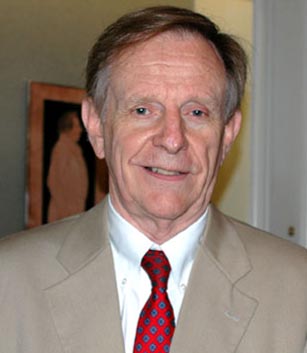
Richard L. Bushman, Professor Emeritus of History, Columbia University
Bushman is a well-known and highly respected American cultural historian, and his full-length biography of the Prophet, Joseph Smith: Rough Stone Rolling, will be published in the fall by Knopf. Joseph Smith’s life and legacy, he believes, are a testament to the position that “a small history will not account for such a large man.” In his discussion, he proposed that Joseph Smith has many histories, what he calls “detachable histories.” He focused on the meaning and significance of these different histories and how such an enlarged view of the prophet helps scholars both understand him and also place him in the history of biblical prophets.
“Every nation, every institution, every person can be extricated from one history and attached to another,” he said, explaining that histories within a cultural context define who we are. To truly find the essence of the prophet and to understand what he accomplished, Bushman believes that researchers need a more encompassing historical portrait of Joseph Smith than the Yankee upbringing of a New York farm boy or the religious milieu of 19th-Century America into which he was born.
According to Bushman, a major problem with many biographies of the Mormon prophet has been their narrow focus. In particular, they place too much emphasis on his American roots, while Bushman believes that Joseph Smith “transcended his time and place,” with both a national and a transnational history he calls “the history of apostasy and restoration.” It was this transnational history, Bushman said, that is the key to comprehending the man and his mission: “Only in the larger field will we see his true dimensions.”
Yet Bushman asserted that detractors and biographers of Joseph Smith inevitably place him in a much smaller context – a product of his immediate environment. Bushman provided an overview of such critics, including I. Woodbridge Riley, Fawn Brodie, and Dan Vogel, whose views on Joseph Smith ranged from considering him a “deformed offspring of Yankee culture” to an epileptic, an imposter, and a product of a dysfunctional family.
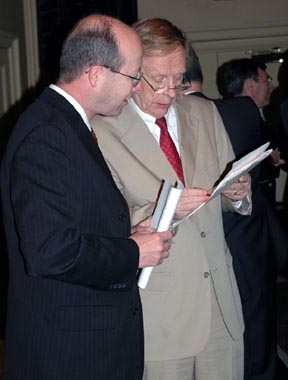
Bushman (on right) with Richard E. Turley, Jr., managing director of the LDS Family and Church History Department and session moderator
Bushman believes that all of these accounts not only “strip the Prophet of grandeur and depth,” but also fail to explain his accomplishments and influence. Instead, Bushman looks forward to biographers and historians who are willing to probe new dimensions of Joseph Smith and to see him in a more transnational light. He suggested that the works of Jan Shipps, John Brooke, and Harold Bloom, though not all favorable to Joseph Smith, at least “enlarge him and give him scope.”
Bushman also said that Joseph Smith had to learn for himself who he was, and it was the Book of Mormon that finally “clarified Joseph’s identity.” From his early money-digging days to the First Vision, the visits of Moroni, the recovery of seer stones, and the translation of the gold plates, Joseph Smith “sailed in uncharted waters,” Bushman argued. Although the young man had no precedent for what he was required to do, as he translated and read for himself about the history of ancient people on the American continent, he began to learn things about himself in such figures as Mosiah the Seer. By the time of a revelation he received on April 6, 1830, he finally began to see himself as a seer, translator, and prophet: Behold, there shall be a record kept among you; and in it thou shalt be called a seer, a translator, a prophet, an apostle of Jesus Christ, an elder of the church through the will of God the Father, and the grace of your Lord Jesus Christ. Doctrine and Covenants 21:1.
As historians continue to debate how to view Joseph Smith or how to analyze the way that Joseph Smith sees himself, Bushman suggested taking the larger view: “As we broaden the historical context, we increase the understanding of the man.”
In the question and answer period that followed his remarks, Bushman also noted that he was willing to let “many flowers bloom,” to allow for many kinds of historical research. He pondered the future of other studies about the prophet and whether there would ever be a way to truly uncover “the real Joseph Smith.”
Respondent: Robert V. Remini, professor emeritus of history and humanities at the University of Illinois at Chicago.
Newly named historian for the U.S. House of Representatives, Remini is a Jacksonian scholar who believes Joseph Smith deserves the recognition of BYU and the Library of Congress because the prophet and his contributions were unique.
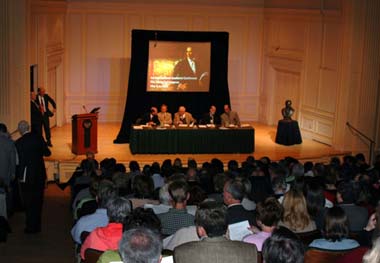
Conference sessions were packed with attendees, many of whom took notes during the lectures.
Lacing his comments with humor, Remini said he knew little about Mormons when he was asked to write a book on Joseph Smith, but he grew to like the man he called “the quintessential American.” He discussed the difficulty that historians face when they must write about something they either don’t believe or have no experience with. “You have to find the rational,” he said, adding that critics, apologists, and others with specific agendas cannot write objective biographies. He said the historian has to look for reasons to explain a person’s beliefs and actions, and then continue asking questions even though the answers may not be readily apparent.
In contrast to Bushman, Remini believes that Joseph Smith must be viewed as the very product of his American and Yankee environment. “I don’t think anybody is divorced from the environment in which he lives,” he said, pointing out that Joseph Smith was born in the middle of the Great Awakening and into a unique family that included a strong, religious mother and a father who had dreams.
He suggested that because Americans are uncomfortable with things that are strange or different, people “either revered or wanted to attack” Joseph Smith. Yet Remini said that internationally, Joseph Smith seemed to have much more appeal because of his very Americanism and the 19th-Century “experiment in freedom” of Jacksonian democracy. Remini also believes that, as a document, the Book of Mormon was part of an American tradition of “contracts,” like the Mayflower Compact, the Declaration of Independence, the Constitution, and the Bill of Rights. In his view, this written history of an ancient people and their theology set Mormonism apart and helped it survive for 200 years even though other new religions failed.
On the other hand, Remini agrees with Bushman that the examination of Joseph Smith is far from complete; he encourages more work on the Prophet’s early years. “Historians have got to keep looking – to help explain the extraordinary success of The Church of Jesus Christ of Latter-day Saints,” he said.
Respondent: Richard T. Hughes, professor of history at Pepperdine University
From the perspective of a professor at an institution with historic ties to the teachings the principles of the reformed Baptist preacher Alexander Campbell, Hughes discussed the commonalities and differences between Joseph Smith and Campbell – leaders of the two great restoration movements of the 19th-Century frontier – and how the “cosmic rhythm of restoration and millennium” featured in the thinking of these early Americans.
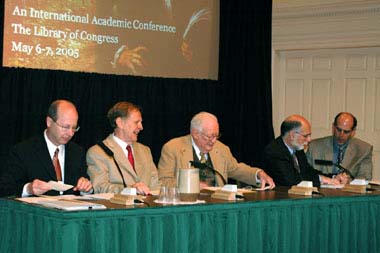
The panel discussion was lively and informative.
Hughes explained that the idea of trying to rediscover and implement the teachings and practices of the primitive church “flourished in ante-bellum America in ways that it has seldom flourished at any other place or any other time in the past 2,000 years.” But he also pointed out that the restoration idea was not new: it has reemerged over the centuries. In Joseph Smith’s day, however, Hughes said that every restoration movement also believed it was “helping to usher in the millennium.” Campbell, for example, edited a journal called The Millennial Harbinger, about “the restoration of the ancient order of things.” Yet Campbell differed from Joseph Smith in the way he believed the restoration would actually take place. Because Campbell believed that God spoke to man rationally, through the Bible, and not through visions or continuing revelation, he viewed Joseph Smith as a fraud.
Hughes also identified other restorationist movements like the Shakers and John Humphrey Noyes’ Oneida Community. All these groups, the Mormons included, he said, sought a restoration of an ancient order. Like Remini, he believes that the political and social underpinnings of the new American nation contributed to the popularity of these movements: people were reevaluating who they were, where they came from, and what were “self-evident” truths in the nature of man and the cosmos. Rediscovering and returning to original truths, they believed, would ultimately lead to the millennium.
Hughes paralleled this thinking to the significance of symbols in the Great Seal of the United States, which includes a Latin phrase beneath an unfinished pyramid that translates, “A new order of the ages.”
What set Joseph Smith and his movement apart, according to Hughes, was that Mormon theology encompassed the restoration of all things, with Mormons searching for lost truths in both the Old and New Testaments and though such unconventional means as modern revelation. The result, said Hughes, is that Joseph Smith emerges as a complicated man “with one foot in American culture, and the other in biblical culture,” and he agreed with Bushman that “any attempt to understand Joseph exclusively in terms of his American setting is bound to fail.”
Respondent: Grant Underwood, professor of history at Brigham Young University
Underwood reiterated the caution that all histories are subjective and the creation of the authors, thus making it difficult to construct an accurate picture of any historical figure. He suggested ways that Joseph Smith could be linked to other histories, thereby putting him in a broader context.
After the death of the apostles, Underwood said that church leaders taught that truth could only be known through the writings of the apostles and not through personal revelation from God. But in the period before Joseph Smith, many cultures and faiths from Methodists to African slaves believed in visions as a means of personal communication with God. Underwood suggested that Joseph Smith’s history is more complete with an appreciation of such “visionary cultures,” as well as of millenarianism, a view of the world founded on the conviction that its adherents were the “chosen people of God living in the final days of history.” The beginnings of Mormonism were infused with this apocalyptic theme, although it gradually subsided.
Underwood also mentioned the debate between magic and religion and how Joseph Smith’s “youthful seeric prowess in locating lost objects or discovering treasure was, in time, overshadowed by his more transcendent ability to bring forth God’s word .” Seeking to apply Bushman’s picture of Joseph Smith enlarged through transnational comparison, Underwood then described certain Tibetan Buddhist traditions that seem to indicate a precedent for a foreordained translator of ancient writings. Most significantly, Underwood believes that Joseph Smith “linked himself to the ancient apostles,” which had the effect of affirming his contention that he was a prophet of God.