






Sometimes the memory of a childhood disappointment can become blissful as we come to see it in a new light.
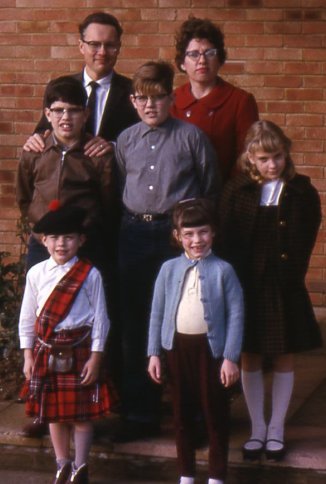
In 1962 I was an introverted eleven-year-old living overseas. My father had been called on a two year mission to present daily organ recitals at the Hyde Park Chapel of the Church of Jesus Christ of Latter-day Saints in London, England. Dad, Mom, and we five children had just two weeks notice to pack and make the move from Provo, Utah, to a new home in the London suburb of Epsom. One of the first priorities after arrival was to find music teachers, for my younger brother played cello and I, violin.
For me it was a strange new world, yet interesting and exciting. Cars drove on the wrong side of the road. At the store one asked for “sweets” instead of “candy.” The monetary system seemed most peculiar with its pounds, shillings and pence.
Fortunately I was not alone in facing these changes; I had three American friends whose families were also in England on church assignments. “Kent,” “Curt,” “Eric,” and I started school together that fall and discovered even more differences between England and America. Boys and girls were segregated; the doors between the two sides of our school were locked. Outdoors, our playgrounds were divided by a fence.
Each school day began with a Church of England devotional where we sang hymns and the headmaster read a prayer. My schoolmates’ enthusiastic singing rubbed off on me and for the first time I became really excited about singing. What a delight it was to mingle my voice with those beautiful English accents. There was also a choir; however auditions had been held prior to our enrollment. Still, the music teacher decided it would only be fair to “give the Yanks a go,” and he gave us an impromptu audition in front of the class.
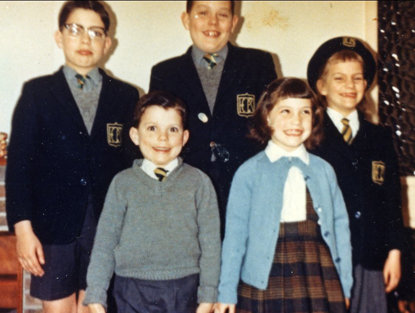
Although it was a comfort to have my three American friends with me at the new school, we were also quite competitive. As I approached the audition I couldn’t help but think, “Ha! With my musical background this will be a cinch. I’ll outdo the others and be a shoe-in for the choir.”
Kent was asked to sing first; he did his best to follow along as the teacher played a scale on the piano. His voice wasn’t bad but he sang out of tune. No competition there. Next came Curt. Curt had no clue—the piano and he were a discordant duet. When my turn came I was anxious to show them! I sang precisely on key and turned confidently for teacher approval. “Can you sing louder?” he asked, “I can barely hear you.” I was sure I sang louder the second time but he still seemed unimpressed. What was with this guy? Couldn’t he recognize obvious musical talent?
Eric went last. No problem. He was an athlete—there couldn’t be a musical bone in his… uh-oh… what was this? Eric opened his mouth and angelic sounds came out—pure, true… and strong! Eric was a natural. He was enthusiastically chosen for the choir. The rest of us lost out.
In the ensuing weeks the pain of that rejection was magnified as strains of the choir’s preparations for the Christmas program drifted through the halls. As November turned to December, anticipation of Christmas increased and we schoolboys became more unruly. Our teacher, Mr. Anthony, responded by making more frequent allusion to his faithful friend “Professor Tickle.” The Professor was a hefty cane that hung prominently from a coat hook in the corner. Mr. Anthony never did find it necessary to use him—the mere threat seemed to suffice.
Christmas among English schoolboys was much like in America except that it was strange to hear “Happy Christmas” instead of “Merry.” And “Father Christmas” seemed more distant and formal than Santa. On the day of the Christmas program we were treated to a special lunch with Christmas pudding for dessert. We weren’t as interested in eating it, though, as in dissecting it to search for hidden sixpences.
In the land of Dickens and Scrooge the program that night seemed infused with more Christmas magic than I can remember feeling at any other time and place. The sound of an English boys’ choir is divine and the choir of Epsom County Primary School was no exception. But there, right in the middle, stood a tall and beaming Eric. Oh cruel, unjust world!
While losing out to Eric had left me feeling less excited about the program than I might have been, my disappointment was diminished somewhat by the fact that I had been given a special assignment. My English friend, Michael, and I were to turn off the two bare bulb lights above the stage at the end of the nativity play—a nativity that was enacted entirely by boys, all the way down to a hooded Mary singing, “Lullay, Thou Little Tiny Child” to “her” baby Jesus.
As Michael and my big moment approached I arose and raised my hand to the light switch. But what was this? Michael’s light had gone out already. No! Michael, you dope! You were supposed to wait longer to turn off your light! I frowned over at him in dismay. Oh well, at least I had waited until the proper time. Standing next to the wall to the left of the audience, with great care and at what I judged to be precisely the right moment, I flipped my switch to the off position. Maybe it had actually worked better, I thought—switching off the two lights stepwise. Michael and I were so fortunate to have been chosen to make this important contribution to the play.
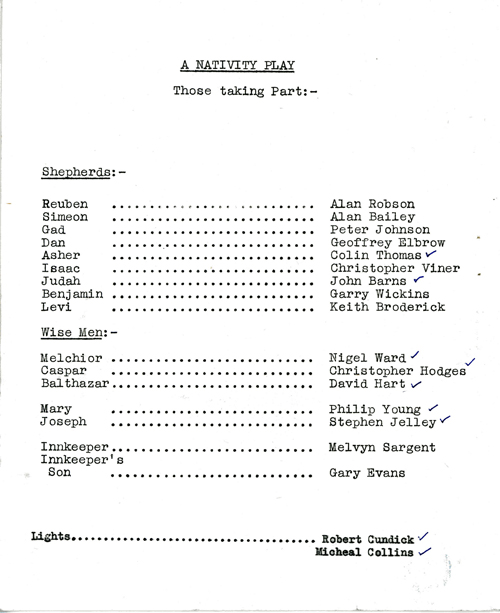
I still have a program from that night. At the bottom it reads “Lights by Robb Cundick and Michael Collins.” So, despite not being chosen for the choir, I did receive recognition for my participation in the program. Well… actually I typed the part about Michael and me on my own copy of the program later on. It seems so silly now—grasping at straws to soften my disappointment and feel important. Such were the thoughts and feelings of childhood.
But in our Heavenly Father’s wisdom we are sometimes given a second chance. And so it happened that the events of the ensuing years at last came together to purge all of the pain from that memory. Though my interest in singing waned for many years, I later rediscovered it and enjoyed participating in church choirs. One thing led to another and in 1990—after a period of vocal training—I auditioned for and was accepted into the Mormon Tabernacle Choir. This time the director was apparently able to hear my voice!
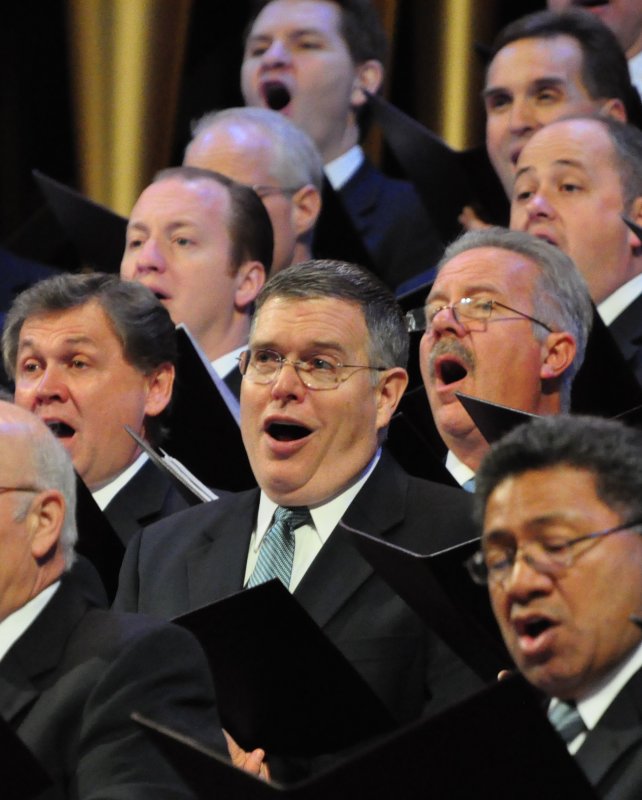
For the past twenty years I have thrilled to sing in one of the greatest choirs in the world. This will be my last, as twenty years is the maximum length of service and I will retire in May. As each of these twenty Christmases has come around I have marveled at my good fortune and thanked my Heavenly Father for the special joy of singing about the birth of our Savior in this glorious choir.
But the feeling is even sweeter when I look back on the Christmas I didn’t get to sing.