




Art of the Old Testament during the Period of the Judges
By Bonnie Oswald, BFA, MA
Israel entered Canaan at a time when there were a bewildering number of different people living in the area. It is hard to keep them straight. Many had a rich artistic tradition, particularly the Phoenicians, Egyptians, and the Philistines.
Some 200 years of Israel’s history occurs during the period of the Judges, from the time of Israel’s entry into Canaan until the time of King Saul. But the Israelites did not enter a land that was peopled by a single nationality. The people we know as the Canaanites actually were composed of a great many different groups:
- Phoenicians (a northern Canaanite people),
- Amorites (a fierce semitic nomadic tribal group)
- Jebusites (Canaanites living in the town David would conquer and make his capital as
Jerusalem) - Hivites (probably a sub group of Hittites or Amorites)
- Hittites (descendants of Heth)
- Canaanites (descendants of Canaan, the fourth son of Ham)
- Edomites (descendants of Esau), and
- others who were known by the name of their local leader or ancestor.
Also there were Moabites (descendants of Lot and his eldest daughter), and Ammonites (also descended from Lot). Amalakites and Midianites (descendants of Abraham and Keturah, and Ishmaelites (descendants of Abraham and Hagar. The Philistines were part of the sea peoples from the Greek Isles. It was a confusing land, with other Mesopotamians and Egyptians also traveling through or living in the land of Canaan.
Art from these peoples was of differing quality. There were groups that seemed to have no artistic traditions, but imported art from the Egyptians. Beautiful pottery, jewelry and figures are found in
archaeological digs in the area, much imported from Egypt. The artistic influence of Egypt was strong.
Fertility figures or idols are commonly found in Canaan, and statues of Baal. Female fertility figures were nude, often holding their breasts, with groin areas clearly shown. Some of these figures were crudely executed, some obviously made in molds indicating that they were for mass production and wide distribution. Some are found in early Israelite areas, indicating reasons for Jehovah’s displeasure.
This figure of a nude woman is probably a Canaanite fertility goddess. It is a clay figurine, 2nd to 1st Millennium B.C. It was crudely made in a mold showing evidence of the seam in the mold at the sides of the figure. / Israel Museum, Jerusalem
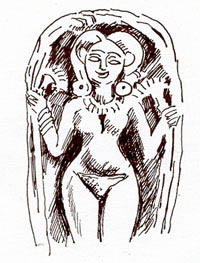
Terra cotta plaque of a fertility goddess, possibly Astarte, holding lotus blossoms, with Hathor hairstyle. Canaanite with Egyptian influence. /Israel Museum, Jerusalem
Places of Canaanite worship – or high places – have been found. Usually there is a large stone base or platform with standing stones and other stones with incised markings. This one has a stele with hands raised, and a figure of a man or priest, and a carved orthostat lion. Usually small fertility figures, bowls for libations and incense stands are also found nearby.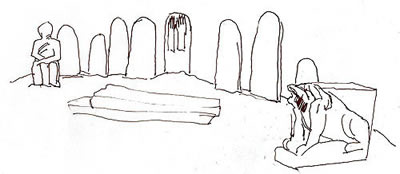
Drawing of the Shrine of the Stelae, Canaanite temple. These objects, found in a small temple, include a beardless male with a shaved head, holding a cup in his right hand, 15 3/4″ tall. 7 standing stones from 15 5/8″ tall to 8 5/8″ tall, a stele with hands raised to a crescent and disk, and an offering altar. Also a lion orthostat that probably flanked an entrance. From Hazor. /Israel Museum, Jerusalem.
Carved ivory boxes and decorations are often found, particularly in the Phoenician areas. Many are Egyptian imports. Most are beautifully carved, and we will see more as we study Ahab and his “ivory house.”
Carved ivory box from Meggido, 14th-12th Century BC. Lid missing, Lions and winged beasts or sphinxes./ Oriental Institute, Chicago
Philistine art is lovely, particularly the pottery which reflects its roots in the Greek Isles. It is often indistinguishable from Greek early pottery, and import pottery from Greece is also found in Canaan. Philistine pottery is terra cotta and adorned with lines, birds and other animals. Many pieces, used as mugs or pitchers, have a strainer spout, which was used to strain out barley husks, showing the fondness they had for beer.
Fired (baked) pottery is an invaluable tool for the archaeologist. Even if it is broken, once fired, the shards (pottery pieces) to not disintegrate or decay, and can be identified and dated by the design or composition. The clay can identify the place of origin, and glazes and decoration identity the maker. The broken pieces of pottery were so durable that they were commonly used to write messages on – an early form of stationery.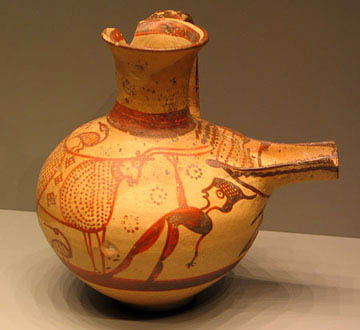
Jug with Man and Bull. Mycenaean, 1250-1225 B.C., terra cotta. The image of man and bull occurs often in Minoan and Mycenaean art, and is similar to Philistine pottery. On this pitcher a man grasps a bull by the horn, and a sphinx holds a pomegranate branch. A strainer is built into the spout. A well-known sport in the Mycenaean area was known as “bull dancing.” An athlete would stand in front of a charging bull, and when the bull was near enough, the gymnast would grasp the horns, do a handstand flip onto the back of the bull, and do another flip off the back, and stand behind the bull. One wonders at the mortality rate in this sort of sport. Getty Villa, Malibu California
One of the most interesting archaeological finds in the Philistine area (along the coast of southern Israel) is a Philistine temple at Tel Qasile.In fact, recently another was found as well. The architecture is different from that of Egyptian, Canaanite, or Israelite edifices. It was discovered in a trench dig. Early archaeologists started at the top of a ruin or mound and removed layers down to bedrock. More recently archaeologists dig a trench into the area of investigation. This technique uncovers layers but leaves most of the site untouched. Thus, future scientists, with more refined methods and advanced technology, will have access to untouched ground. There is an element of luck as to what one will find using this method, and it was fortunate that at Tel Qasile a temple was found. This temple, though small, has two central columns that support the roof. The columns are less than seven feet apart. A large, immensely strong man could pull or push them down. The roof was probably used for seating, as well as seats around the interior of the temple. In such a temple, Samson could have killed many people. The temple at Gaza was undoubtedly larger. Later Philistine temples are influenced by the buildings of surrounding cultures and do not have the two central columns. But those found from the period of the Judges do have them.
Artist’s rough rendering of the Tel Qasile Philistine temple, showing the two central columns.
Also found at Tel Qasile in the temple area is an incense stand showing a man holding two columns.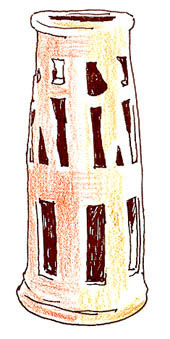
Incense stand, clay, from Tel Qasile. /Israel Museum, Jerusalem
There are some lovely examples of Canaanite art found for this period. Most of this art was imported from Egypt or made by Phoenicians.
Fish, Tell el-Ajjul. Alabaster vessel, 5 1/2″ length, mid second Millennium B.C. Excavations from the British School of Archaeology. Israel Museum, Jerusalem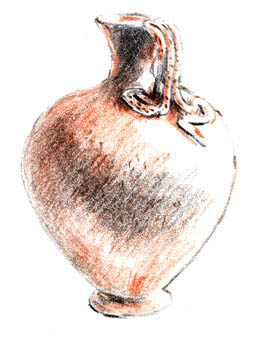
Snake jug, provenance unknown, mid second millennium B.C. Pottery 12 5/8″ tall. Snakes sinuously twined to form handle. Covered with a heavy while slip and burnished. /Israel Museum, Jerusalem
Another beautiful object found in Israel from this time period is the horned altar. When the Israelites settled in Canaan, six Levite cities were designated as cities of refuge. These were scattered throughout the country, on both sides of the Jordan River. They were to be accessible to those who sought a place of refuge, particularly if they had been involved in an accidental killing and needed a place of asylum from retribution until a judgment could be made as to what should be their fate.
The honed altar itself is also mentioned in the Old Testament as a place of refuge. One could grasp the horns for safety. Until recently it was unknown what these would look like or whether they had actual animal horns attached.. The Old Testament tells Israel that they are to be formed from uncut stone, but a number of beautiful ones have been found that were carved from a single stone, in Israelite areas.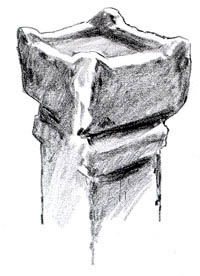
Limestone altar, Iron Age, Megiddo, from Israelite area. 26.5″ tall and 22.5″ wide. /Oriental Institute, Chicago
Large horned altars were used for sacrifice of animals. Several large altars have been found that would hold an animal. Also in some cases blood was to be sprinkled on the horns as an offering for sin. Some altars were smaller and would have been used for grain, wine or incense offerings. Most other cultures in the area also used altars, often horned altars.
2006 Meridian Magazine. All Rights Reserved.