












 Hardly a person exists in the civilized world who has not heard of C.S. Lewis. He’s a beloved children’s author and a well-respected apologist for the Christian religion, and he has been quoted more times from the pulpit in general conference than any other person alive who is not a member of the religion.
I remember reading “The Lion, the Witch, and the Wardrobe” as a child and coming to the scene where Aslan is slain by the Witch and then takes up his life again. All of a sudden, I realized that Aslan is a type of Jesus Christ in the story-I didn’t know that when I picked the book up. I was thrilled to think that someone could write a book, teach the concepts of the gospel, and do it in a way that was entertaining and not in-your-face with spirituality. At that point I already knew I wanted to be a writer, and this realization was key in shaping my early ideas of what I wanted to do with my career.
Later on, I read “The Screwtape Letters” and once again found myself bowled over. Lewis had taken the plan of the adversary, crystallized it into its simplest form, and presented it in such a way that anyone can understand. As I read it, I found myself saying, “Yes! That’s it exactly!” over and over. Once again, Lewis’s message was absolutely plain and easy to understand.
I share these two experiences of mine with Lewis’s writings as a preamble to this book review because I want to create for you the foundation upon which I approached this book-I am not only a fan of C.S. Lewis’s writings, but I admire him greatly as a man. To me, he is the perfect example of a person who has gained a testimony of Jesus Christ and has used his talents to share that testimony with others.
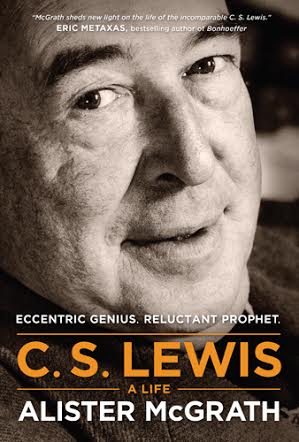
“C.S. Lews: A Life” by Alister McGrath is a beautifully produced book that contains pictures of Lewis throughout his life and a timeline so the reader can clearly visualize the events as they unfold. I always appreciate things like that when I’m reading nonfiction.
It may come as a surprise to those who have always considered Lewis to be British, but he was actually born in Ireland in 1898. He was greatly inspired in his life and writing by the countryside of Ireland and spoke fondly of it his whole life. He grew up surrounded by shelves and shelves of books, as every child should in my opinion. He was an imaginative boy, prone to daydreaming, who didn’t have many friends. He wanted to find beauty in the world and to bring that beauty into his life. He embarked upon what he called “a quest for Joy,” which I found remarkably coincidental considering that he later married a woman by that name.
When Lewis was just shy of ten years old, his mother became very ill with abdominal cancer and eventually passed away. This was a rough period of time for Lewis and his older brother, Warnie. They formed a closer relationship through their shared grief, which was crucial to their emotional survival, as their father had ceased being able to care for them. Shortly after this, Lewis was sent to England to live at Warnie’s boarding school-Wynyard.
Lewis attended three boarding schools over the course of his education and hated all of them passionately. He later said that even the trenches of World War I were not as bad as boarding school. He developed an instant hatred for England that took years to overcome. As I read this portion of the biography, I had to wonder if his mother’s death hadn’t clouded his judgment-being sent away from home right after something like that would definitely impact a person. However, in the case of Wynyard, it would seem that the dislike was justified-the man who established the school was later put away for insanity and the school was closed down.
The next portion of the biography tells of Lewis’s other schools, which I won’t detail here. Suffice it to say, he was a sad, lonely boy who never found the kind of friendship or intellectual stimulation he badly needed to feed his growing mind. He set his sights on Oxford as his next lofty educational goal, but before he had the chance to fulfill that ambition, he was conscripted to go to war.
Lewis’s time fighting in World War I, was a time he chose not to dwell upon. He had a choice to make, a choice as to whether or not to let it impact the rest of his life. He chose to think of it as an episode in his past rather than a life-changing experience, and so in his writings, we don’t see a lot about that period of time. He considered this choice “a treaty with reality.” It was his way of coping with what he had seen. This biography does share some of those wartime experiences, which I found fascinating as a reader and gave me further insights into the man.
After that time, he was able to pursue his dream of studying at Oxford, the place that would be his home for the next thirty-five years as he moved up the ranks from student to don. He had begun submitting his writings to various publishers only to receive rejections, and during this time he had also begun a complex and confusing relationship with a woman by the name of Mrs. Moore.
Lewis’s father passed away in 1929, unattended in death by either of his sons. He had made decisions that had estranged him from his boys and it was an uncomfortable relationship at best. Lewis later stated regret at not being there when his father passed, but at the time, his feelings wouldn’t allow it.
With both parents now deceased, Warnie and Lewis decided to reconnect and they moved in together on property purchased in Mrs. Moore’s name. She lived there with them as well and they formed a sort of family unit along with her daughter Maureen.
<p style="margin-bottom: 0.
<hr class=’system-pagebreak’ />0001pt; line-height: normal; text-align: left;”>Lewis’s writings in his early career were markedly atheistic, but things were shifting in his life. Chapter six in this biography details how he made the transition into full Christianity. His was not just a partial conversion-he turned the remainder of his life over to the study of the gospel and speaking about it and writing about it. This chapter was very compelling to me as it explored the real concept that you can’t write real characters and leave God out of the equation-the only way to create a lifelike character is to include that divinity within them. This line of thought heavily influenced the study that would consume Lewis’s later life. He called himself the “most dejected and reluctant convert in all England.”
It was this conversion that led to his writing and eventual publication of the works that would bring him into the literary circles he sought. “Mere Christianity” is one of the most famous books on the subject ever written. And of course, we can’t go further without additional mention of the Narnia series, which allowed Lewis the ability to share the basic fundamentals of the gospel with children-and readers of all ages, actually.
I won’t encapsulate every portion of the book because I’d rather you purchase it and read it for yourself. I’ll tell you that the last sections of it deal with his marriage to Joy Davidson and his continued fame after his passing. The biographer does not gloss over character flaws in Lewis, and yet does not flog him for them either. Each event throughout the book is presented in a balanced fashion, stating the facts with only a minor amount of author interpolation. The reader is left with greater insight into Lewis, a desire to know more, and for myself, a greater yearning to strengthen my own stance as an apologist and to use the gifts I’ve been given in the way they were intended.
***
C.S. Lewis-A Life by Alistar McGrath, published by Tyndale, 379 pages, hardback $24.99



TimMay 19, 2014
Angela is correct. And besides, the British Isles includes not just the island of Great Britain, but Ireland also. Having said that, though, the English, Scots, Welsh and Irish all regard themselves as from their own country rather than British. I am English. That may mean that technically I am British, but I never think of myself that way.
PaulaMay 16, 2014
What an excellent review of this book and the man (C.S. Lewis). Anthony Hopkins & Debra Winger starred in a lovely and well-written movie about Lewis called "Shadowlands". This reminds me I want to see that movie again (AND read this book)!