










Click here to “like” Meridian on Facebook.
Sign up to receive email updates by clicking here.
“Think not when you gather to Zion your troubles and trials are through, that nothing but comfort and pleasure are waiting in Zion for you.” Eliza R. Snow wrote this insightful poem based on her early church experiences in Missouri, Illinois, and Utah. After their expulsion from Missouri, members of The Church of Jesus Christ of Latter-day Saints sought refuge in Nauvoo, Illinois.
Between 1839 and 1846, the Saints founded communities on both sides of the Mississippi River, with Nauvoo being the headquarters of the church. In their quest to establish Zion, the early Saints matured socially and spiritually from the sacrifices, trials, and challenges they experienced in Nauvoo.
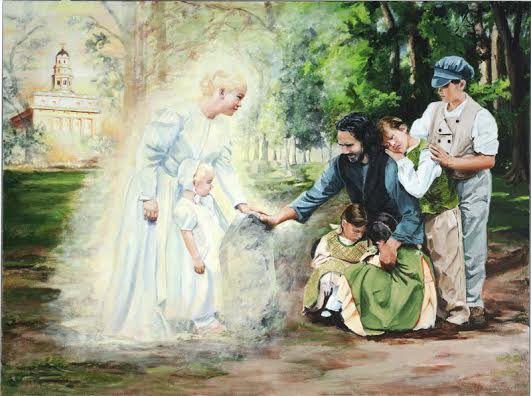 “Peace in the Turmoil” Patty Bingham
Death and Burial in Nauvoo
In 1840s America, the average life expectancy was about 40 years. Most families in Nauvoo were young, and sickness and death were an integral part of the Nauvoo experience. Almost half of the recorded deaths were children under the age of 10. William D. Huntington, Nauvoo’s sexton during the Mormon period, kept a “Record of Deaths in the City of Nauvoo ” which listed an individual’s name, date, age, and cause of death. Personal journals and newspaper obituaries also provided information about those who were laid to rest in Nauvoo.
Even though the early Saints drained the mosquito-infested flatland, malaria-known then as “the shakes” or “ague and fever”-was the most common cause of death in Nauvoo. Consumption (tuberculosis), measles, and whooping cough along with infectious and epidemic diseases impacted Nauvoo along with other areas of the nation. Some of the early Saints died from malnutrition and exposure as a result of Missouri persecution and inadequate shelter and/or personal belongings.
Before the Saints moved to Commerce in 1839, several burial sites already existed in the community, including Indian burial mounds, private lots of pre-Mormon settlers, and a town cemetery on Durphy Street (now Highway 96) between White and Hotchkiss streets. Before the LDS cemetery on Parley Street opened in 1842, the Saints buried loved ones in the graveyard on Durphy Street. They also buried family members-particularly infants and children-on private family lots around the city. The Smiths, for example, dug family graves on the Homestead property.
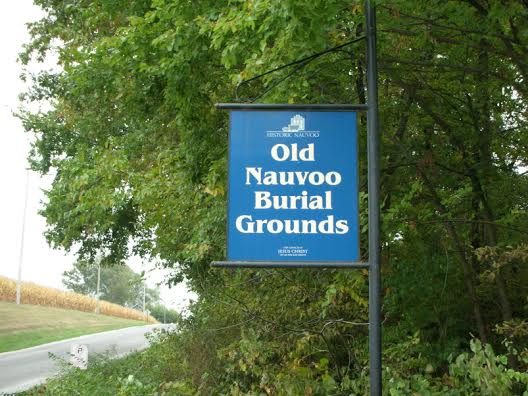 Old Nauvoo Burial Grounds sign today
History of Old Nauvoo Burial Grounds
On May 1, 1841, Joseph Smith “moved that a new burying ground be procured outside the city limits . . . and ten acres were ordered to be purchased” (HC 4:353) two miles east of Durphy Street on the south side of Parley Street. On June 4, 1842, the Wasp advertised that “the burying ground southeast of the city has been laid out in family burying lots. A number of which will be offered for sale.” This graveyard eventually became known as the Old Pioneer Cemetery or Pioneer Saints’ Cemetery. Between 1842 and 1846, many Saints in Nauvoo were buried here; others who died earlier were moved to this burial ground after it opened.
 Old Nauvoo Burial Grounds today
At times burial sites in the pioneer cemetery were difficult to find. On July 7, 1845, Hosea Stout wrote that he went “to the burying ground to seek for the grave of little Lydia my daughter,” born 20 December 1841 and died 13 November 1842. It appears he could not locate her grave.
The Saints continued to bury their dead in this graveyard as they prepared to leave Nauvoo in 1846. Some even returned with a family member who died early on the trail. Catherine Spencer died near Keosauqua, Iowa, a month after crossing the Mississippi River. Orson Spencer took his wife’s body back to Nauvoo and buried her next to their infant daughter Chloe who died the year before.
In October, soon after the Saints left Nauvoo, Colonel Thomas Kane visited this cemetery. “On the outskirts of the town was the city graveyard,” he wrote. “Some of the mounds were not long sodded; some of the stones were newly set, their dates recent” (Kane, The Mormons, p. 5). These families left loved ones knowing they may never visit their resting place again.
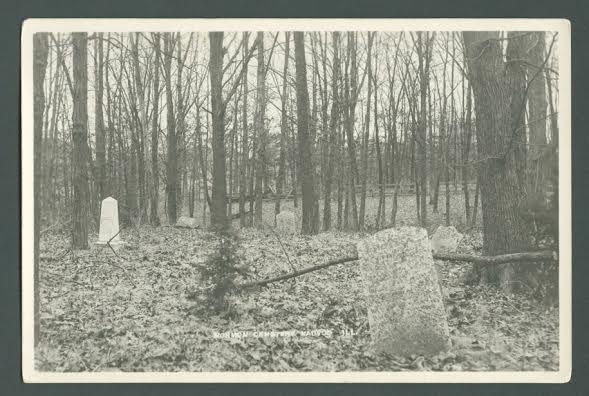 Pioneer cemetery, 1915 (LDS Church History Library)
After the Mormon exodus from Nauvoo, the RLDS Church (now Community of Christ) acquired the cemetery property, possibly in the early 1860s, and continued to use it as a burial ground. With its inaccessible location, the cemetery deteriorated. Monuments weathered and became undecipherable, or they crumbled or were stolen. Through decades of neglect, headstones lay half-buried under decaying foliage. In the early 1960s, the RLDS Church built a dirt road that curved over the brow of the small hill into the graveyard. By the time Nauvoo Restoration, Inc. (NRI), acquired the property, it was covered with brush, vegetation, fallen trees and leaves, poison ivy and oak-and snakes. Only those courageous visitors determined to learn more about their pioneer ancestors entered this site-once they discovered where it was located.
In 1989, NRI received the property from the RLDS Church in a land trade and began clearing and restoring the graveyard for the sesquicentennial of the founding of Nauvoo. President Gordon B. Hinckley dedicated the “Old Nauvoo Burial Grounds” on October 7, 1989. The renovation included a small parking lot and a kiosk with a list of “names of some of those who died while living at Nauvoo between 1839 and 1846.” Any visible gravestones were set upright.
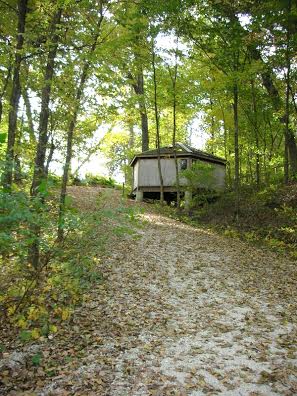 Kiosk with path/dirt road
Approximately 1,800 people were buried in Nauvoo.
The kiosk wall at the cemetery entrance reports that “many of them were children and each of them had a story worth telling. We don’t know all of their stories but we do know that they are loved and the Savior knows and loves each one.”
Visitors who walk into this sacred place are drawn to the bronze statue of a family laying a child to rest in a grave. Around the statue’s base are quotes from John 11:25-26 and Joseph Smith who said: “The place where a man is buried is sacred to me.”
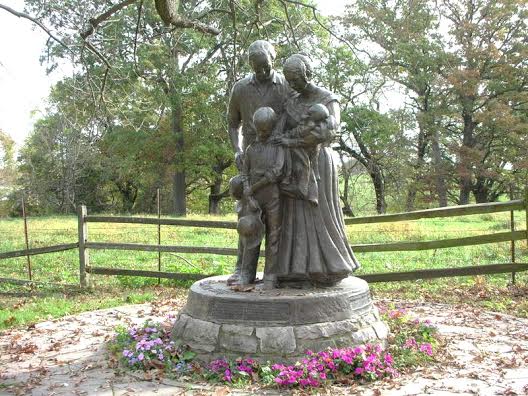 Bronze statue in cemetery
Final Resting Place
Among the original headstones in the Old Nauvoo Burial Grounds is Rhoda Eleanor King’s. Rhoda and her twin brother Enoch were born October 3, 1839, in Mantua, Ohio. They had four older siblings between the ages of four and fifteen. After the family settled in Nauvoo, Rhoda died on July 15, 1840, two years before the LDS cemetery opened. Consequently, she must have been buried in another spot and reinterred in this graveyard. Rhoda’s tombstone contains these words: “Rhoda E., daughter of Tho. & Rebeca E. King, died July 15, 1840, aged 9 mo. & 12 days.” Her parents crossed the plains and settled in Kaysville, Utah, leaving their baby 1,300 miles away.
 Tombstone of Rhoda Eleanor King
A young couple who died in Nauvoo apparently left no living posterity. In 1844, Sophronia Ball died during childbirth-four months after the Prophet Joseph Smith’s martyrdom-and her newborn infant also died. Six months later, husband Jonah Ball died of consumption. Based on available resources, eight-month-old Theresa Ball was a daughter who died nine months before Sophronia. Each has a story worth telling, but sexton William Huntington only recorded the following information:
|
Date |
Name |
Years |
Months |
Days |
Cause |
|
1844 8 Jan |
Theresa M Ball |
|
8 |
4 |
Inflammation of Brain |
|
1844 25 Oct |
Sophronia Ball & Infant |
31 |
|
|
Childbirth |
|
1845 5 April |
Jonah R Ball |
41 |
8 |
1 |
Consumption |
It appears that Jonah and Sophronia married in Vermont in 1832. Did they have other children before moving to Nauvoo? This family’s story needs to be told.
Scovil Plot
Other original headstones still standing in the Old Nauvoo Burial Grounds are Joel Franklin Scovil’s partial gravestone and the one for his mother Lury and her infant twins. The original markers stand behind two other tombstones added years later.
 Scovil new and original tombstones
Lucius and Lury Scovil married in Ohio and moved to Missouri until driven out by mobs. They built a home and bakery in Nauvoo and raised a half-dozen children. On May 10, 1844, fourteen-year-old Joel Franklin Scovil, their oldest child, died of consumption. After the funeral, Lury’s cousin Eliza R. Snow published a poem about Joel in the local newspaper. Excerpts from the poem are:
I sat beside his coffin, but for him
I had no tears to shed. How could I weep?
His years, indeed, had been but few, but then
He was a saint, and he has gone to join
The spirits of the just. . . .
then I look’d upon
His mourning parents, and I thought of their
Bereavement! Tis their only son-he is
Their first-born. . .
Be faithful then ye parents! Keep the faith . . .
And you shall soon embrace your child, array’d
In robes of royalty-with glory crown’d
In your own mansion of celestial light.
(Times and Seasons, May 15, 1844, Vol. 5, p. 543)
The year after their son’s death, Lucius Scovil asked temple stonecutter Charles Lambert to carve a tombstone for Joel’s grave. Charles and Mary Lambert had just prayed for divine help for food, as the family was starving. Lucius Scovil gave Charles four and one-half bushels of wheat as payment for the stone. Charles Lambert gratefully took the grain to the mill and ground it into flour for his family. He carved the stone and placed it on Joel’s grave with the inscription: “In memory of Joel F. son of L. N. Scovil, died May 10th, 1844, age 14 Y 12 D.” Joel’s headstone is a reminder of a direct answer to prayer.
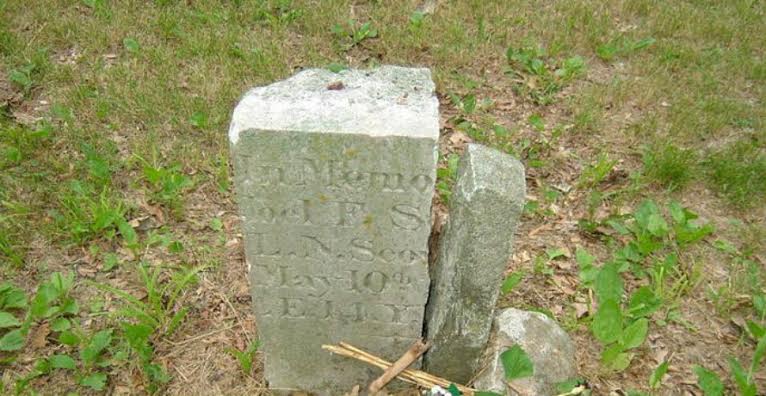 Joel Scovil’s tombstone today
On January 27, 1846, Lucius’ wife Lury Scovil died from complications thirteen days after giving birth to twins Martha and Mary. The infants died the day before their mother and were buried with her. A headstone with these words identifies the grave: “In memory of Lury, wife of L.N. Scovil, died Jan. 27, 1846, age 38 Y 10 M. Martha & Mary Infants.”
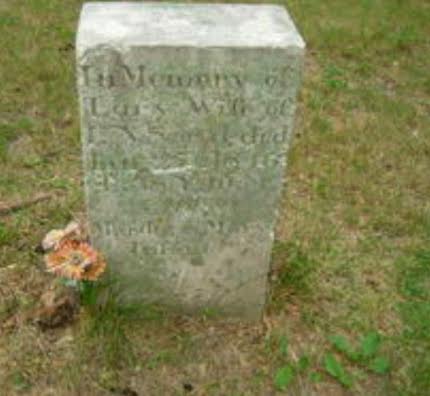 Lury Scovil’s tombstone today
Holbrook Graves
After the Saints were forced out of Missouri, Joseph Holbrook went to Illinois to find a place to live. His wife Nancy remained in Missouri, where she gave birth to Nancy Jane in a makeshift shelter. Nancy endeavored to keep her newborn warm and her three other children fed. In 1840, the Holbrooks settled in Ramus, Illinois. That same year David, born prematurely, was stillborn. The next year William Morris was also stillborn.
Joseph and Nancy buried both babies in Ramus and then moved to Nauvoo in 1842. Weak from the trials of Missouri and three children born in three years, Nancy died, leaving four children between the ages of three and ten, and was buried in the pioneer cemetery. Joseph remarried in January. The next September, four-year-old Nancy Jane died from measles and was laid next to her mother. Joseph said he “put up good grave stones at their graves” with the inscription: “Sacred to the memory of Nancy consort of Joseph Holbrook who died July 16, 1842, aged 37 Y, 11 M, 2 D. Also Nancy J daughter of the above who died Sept. 7, 1843, aged 4 Y, 7 M, 10 D”
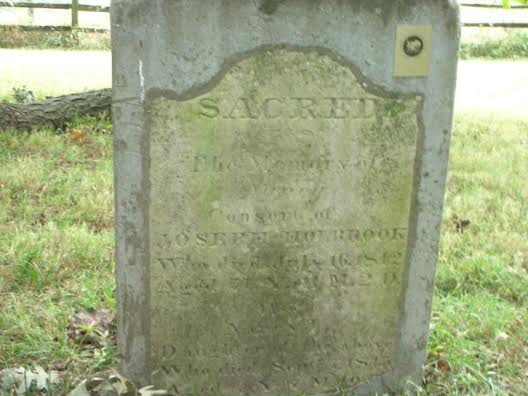 Nancy and Nancy Jane Holbrook’s tombstone
Pilkington Family
After the Mormon exodus from Nauvoo, local residents continued to use the Old Pioneer Cemetery. In 1842, Adam Pilkington traveled to Nauvoo from Lancashire, England. Hs wife Jane and their four children Mary, Elizabeth, Margaret, and Amos left England in October of 1843 to join Adam.
Adam Pilkington helped construct the Nauvoo Temple, and his family then chose to remain in the area after the Saints left. They resided in Sonora Township adjacent to Nauvoo, where two daughters were born in 1848 and 1850. In 1849, fifteen-year-old Mary Pilkington was killed by lightning, and her body was laid to rest in the pioneer cemetery. In 1856, Adam died, leaving Jane with Elizabeth and Margaret (young adults), Amos (sixteen), Alice (seven), and Mary Ann (five). Adam, too, was buried in this cemetery.
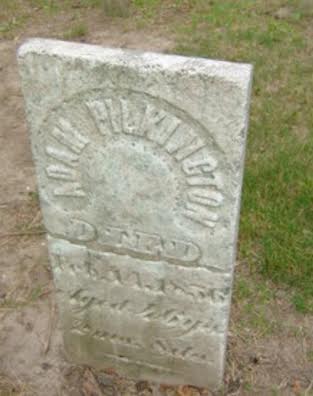 Adam Pilkington’s tombstone
Several Pilkington children later joined the RLDS Church, with Elizabeth being baptized in 1863 by David Hyrum Smith. Elizabeth had previously helped the wife of Joseph Smith III care for his grandmother Lucy Mack Smith on the Smith farm near the Pilkington residence.
According to Pilkington friends, “Everyone of that family made good citizens and exerted a strong influence for right living.” Margaret, Alice, Mary, and Betty (Elizabeth) were “shining examples of industry,” and their friendship lasted as long as they lived (Roots Web’s WorldConnect: My TreemendousFamily).
Adam Pilkington’s wife Jane passed away in 1880, seven weeks before her daughter Elizabeth and newborn baby died in childbirth. All were laid to rest in the pioneer cemetery, with Jane next to daughter Mary who was struck by lightning. Jane and Mary share the same tombstone. Although the top is broken off where Jane’s name was engraved, the inscription states: “Wife of Adam Pilkington died Mar. 22, 1880, aged 68 Ys, 10 Ms, 6 Ds. Mary dau. of A & J Pilkington died Aug. 12, 1849, aged 15 Ys, 3 Ms, 25 Ds. DEAR MOTHER AND SISTER, THOU HAST LEFT US HERE, THY LOSS WE DEEPLY FEEL, BUT TIS GOD THAT HATH BEHEST US HE CAN ALL OUR SORROWS HEAL.”
 Jane and Mary Pilkington’s tombstone
“The place where a man is buried is sacred to me,” Joseph Smith said. Many of those buried in the Old Nauvoo Burial Grounds may not have identifiable graves, but each has a story to tell and the Savior knows and loves them. As visitors enter this holy place today, they can feel what Joseph Smith said: “How consoling to the mourners when they are called to part with a husband, wife, father, mother, child, or dear relative, to know that, although the earthly tabernacle is laid down and dissolved, they shall rise again” (TPJS, 347), for “the Lamb of God hath brought to pass the resurrection” (TPJS, 367).
Lydia Stout and Jonah and Sophronia Ball’s gravesites will then be known and their stories told. Until that day, visitors to this hallowed spot can sense the spirit of Nauvoo and possibly rub shoulders with their own ancestors who have passed on and need to be remembered.
Rosemary Palmer is Nauvoo, Illinois, correspondent for Meridian Magazine.






Mark Deppe, descendant of Thomas Winward buried in Nauvoo.November 29, 2021
Wonderful pictures and family history content. How could I get a copy of this original article?
Paul RippFebruary 6, 2018
Beautiful Place and enjoyed the article I am a Non Active Member of the Church and a Paranormal Investigator and have got answers when asked questions Here at Certain Graves. Will go back sometime and try to find more answers using my Equipment. Have the ability to get yes and no answers. Facebook