







By Bryan Gentry
Click to Buy
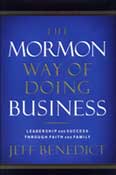 After many years of doing business in “the Mormon Way,” Jeff Benedict finally got to write a book about it.
Benedict’s book The Mormon Way of Doing Business, released in January by Warner Books, examines the business practices of eight members of The Church of Jesus Christ of Latter-day Saints who have reached the top of the corporate ladder. The book explores how these men are influenced by lessons from their missions and how they live by their faith while building and leading their businesses.
“This book is about doing it different,” Benedict said, speaking at Southern Virginia University on Feb. 28. He explained his book to some of SVU’s faculty, staff and students.
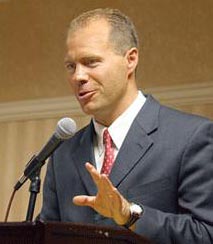 Jeff Benedict, shown here as he spoke at Southern Virginia University on Feb. 28.
Benedict said that the executives in the book “live their religion very clearly.” The book reveals them as family men who come home for dinner and attend their children’s sporting events, as church men who give dozens of hours each week to callings, and as men of integrity who abide by their values in business.
Missions, Service and Tithing
The Mormon method of doing business in a different way is evident from the first paragraph of Chapter One, “On a Mission.” The chapter opens with a description of David Neeleman, CEO of JetBlue Airways, humbly working as a flight attendant on one of his company’s flights. His presence and his work are great for employee relations and customer service.
Then the chapter reveals how Neeleman’s mission influenced him to develop this kind of business practice. Serving in the slums of Brazil, Neeleman learned the importance of working for those less fortunate. He learned to love people in spite of their economic difficulties. And he learned to work.
Because of those lessons, Neeleman parks next to his employees instead of riding in a limo to the office door. He works alongside his employees on the plane, and he donates his salary to a fund for employees who hit hard times. And he talks one-on-one with customers to make them the most important part of his business.
The chapter reports other mission lessons. Kevin Rollins learned discipline and hard work on his mission in Alberta, Canada, which later helped him improve Dell’s performance where he was CEO. Dave Checketts, former CEO of Madison Square Gardens, received a card from his mission president telling him to “Expect a Miracle.” That motto reshaped his mission in East Los Angeles, but it also helped him shoot for miracles in his business career.
The differences continue. These professionals fly across the country to get home in time for their children’s games. They leave their work at work so they can spend time with family. Many of the executives in the book have served in time-consuming church callings. Several have been bishops, and others have been clerks or executive secretaries. They pay tithing. They seek not for power or wealth, but to succeed. They don’t give up.
As author, Benedict spent two years getting to know these executives and interviewing them and their families. He saw first-hand how they conduct business differently than anyone else in the world.
But Benedict admits that he never would have had the chance to write this book if he had not done business “the Mormon Way” himself for his entire publishing career.
“Doing it Different”
“I’m a big believer that very small decisions that you make … have a huge impact on what you’re going to be doing, and whether you are going to be happy as parents and church members, 20 years from now,” Benedict told SVU students during his visit to their campus. “It’s those decisions, if you make them the right way, that will pay off in spades.”
Benedict began his work with Warner Books a decade ago when he wrote Pros and Cons: The Criminals Who Play in the NFL . On this first assignment, his editors learned about his values and his desire to live them even when writing and selling books.
Benedict pored over court records from many proceedings as he wrote that book, and he had to quote from them. He ran into a problem because the witnesses called to the stand in these trials had used a lot of foul language. Particularly, he ran into the “f” word often, and he knew he didn’t want it in his book. Since he was a non-fiction writer, he had an obligation to report faithfully.
But he was also a Latter-day Saint, who wanted to live faithfully, too.
Benedict chose to represent that foul word with its first letter, followed by dashes. Then, a copy editor looked over the manuscript and marked that the word should be spelled out at each occurrence. Benedict brought it up when he sat down with the editors to finalize the manuscript.
“I don’t like the word, and I don’t think we need to use the word,” Benedict told his editors. They were astonished. Their previous books had never used dashes. It was editorial policy to just print the word. Benedict stuck by his decision, and the question went up the ladder to the top editor. Finally, Benedict got permission to leave the dashes in the book.
As the book went out on the market, Benedict had to tour and give many interviews to promote it. “They want you to go on every show you can,” Benedict said. “The kind of books I write, I need to be on air to raise awareness for the book.”
Many people who interviewed Benedict about Pros and Cons asked him, “Why’d you use dashes?” Each time, he had the opportunity to share his value of clean language.
Benedict knew that at some point he would probably be asked to have interviews on Sunday. He made it clear from the start that he wasn’t available on the Sabbath. He told his publishers that he would be available for them from 6 a.m. on Monday to midnight Saturday night, but that he would spend every Sunday with his family.
“I have never in my career had to do a Sunday interview,” Benedict said.
While still promoting that first book, Benedict made a third choice based on his religious standards. He got a call from Warner Books one day with exciting news.
“Jeff, we sold an excerpt,” his editor said.
This was Benedict’s dream come true. Having a portion of his book printed in a magazine would give him exposure to thousands of potential customers and readers who would never hear of his book otherwise. It could spark a great jump in sales.
But then the editor continued: “It’s in Playboy .”
Benedict’s heart sank.
At the time, he taught early morning seminary to a class full of teenage boys. He had worked hard to set a good example for them and encourage them to live the gospel. For many of those young men, Benedict was their only father figure and priesthood role model. He thought about the consequences of having his name and his words printed and promoted in a pornographic magazine. He would be a hypocrite. And, worse, he felt he would lose all the progress he’d made with the boys at seminary if they knew he allowed himself to profit from the sale of pornography.
Benedict explained the situation to his editor and pleaded to get out of the deal. The editor said that the excerpt sale was necessary – the magazine would bring Benedict’s words to thousands of adult men, a key, hard-to-reach market. He also said the decision was out of Benedict’s hands. The contract was between Playboy and Warner Books, and Benedict could not stop it.
After hanging up the phone, Benedict thought more about the consequences. He went to his room, knelt and prayed. He prayed that somehow, his excerpt would not print. An odd thing for a new writer to pray for less publicity. But not odd at all for a Mormon who places beliefs above business.
Weeks later, the editor called back with “bad” news that was music to Benedict’s ears: Playboy magazine had backed out of the deal. The excerpt would not print.
Benedict told his editor at that time that any pornographic magazine was off-limits for excerpts from any book he would ever write for Warner.
An Unexpected Offer
It’s been about ten years since Benedict decided to use dashes in his book, to not work Sundays and to keep his words out of pornographic magazines.
He shared those decisions with SVU students and then said, “I tell you those three stories because I want to tell you, that but for those three decisions made ten years ago, this book never would have been written.”
In 2004, after covering the Kobe Bryant rape trial for Sports Illustrated and the Los Angeles Times , Benedict had a rare period of time with no writing assignment. During that lag time, he received a call from his former editor at Warner Books. The editor, who also has a Sunday morning radio show, invited Benedict to come on the show.
Benedict thanked him for the offer, but reminded him that he doesn’t do Sunday interviews. “This led to a conversation about Mormons and business practices,” Benedict said. He shared with his editor some of the names of Latter-day Saints who are successful in the business world.
“Some of the top companies in New York and some of the top companies in the country, as far as brand name, are run by Mormons,” Benedict told the editor. He also mentioned that the dean of Harvard business school and some of its top faculty members, are LDS.
The next day, the editor e-mailed Benedict to say, “I’m going into the board meeting, and I’m going to pitch the book.”
“What book?” Benedict thought.
Later, he learned that the editor loved the idea of a book about Mormons and how their faith influences their success in business. The editor pitched the book idea, and the board asked Benedict to write The Mormon Way of Doing Business .
Benedict was shocked by the offer – most authors have to come up with ideas themselves and then struggle to convince a publisher to back the project.
When Benedict’s agent heard about the offer, which was for much less pay than Benedict’s previous books, the agent said, “We can get more money,” and offered to negotiate.
But Benedict’s editor explained that asking for more money could cause the whole project to be cancelled. He asked his agent not to negotiate.
“I would do this book for a dime,” Benedict said. “This is an opportunity that I know could possibly never come again … This is a book about my faith, and I would take the price.”
Sharing the Faith
Benedict’s book opens with an author’s note that begins, “I am a Mormon.”
That was something Benedict felt was necessary to disclose, so that readers would know he shares the faith of the business executives featured in the book.
That declaration of faith also exemplifies the new book’s power to share the gospel.
Benedict now gets to talk about the Church when he gives interviews or tells anyone about the book. Not only that, but every reader gets to know the Church better through the pages of The Mormon Way of Doing Business. The chapters do not present the first discussion, but they do teach about the day-to-day aspects of Latter-day Saint living. While coming to understand the faith and lives of Mormon business leaders, readers learn about the details of missionary service; the Church organization, including stake presidencies and bishops; the definition, expectation and blessings of tithing; and more.
The book is already being used to increase understanding of the Church. Benedict said that some of the businessmen featured in the book have purchased copies to be given for free to church members who attend universities with low LDS populations. These Latter-day Saint students then give copies of the book to friends of other faiths.
Not only does The Mormon Way of Doing Business tell a lot about the Church, but it does so in Benedict’s compelling style and intriguing power of narrative.
“This is a great way for me to do something I love to do and to relate it to the Church,” Benedict said.
But none of this would have happened, Benedict said, if, ten years ago, he had not chosen roads that kept him in the faith, but a little out of the norm in the publishing world. He showed his editors all along that he was not an average writer, rather a Latter-day Saint writer.
“This book is about doing it different,” Benedict said. By “different,” he means being faithful to principles, putting family and faith first; in general, living the gospel while building a business.
The eight business executives highlighted in The Mormon Way of Doing Business show that doing it “different” is doing it right and succeeding well. Benedict’s life shows that, too.
In addition to The Mormon Way of Doing Business, Jeff Benedict has written several books about professional sports and crime. More information on his books, and a sample chapter of his latest, can be found at www.jeffbenedict.com .