






A couple of times a year a book will cross my path that absolutely affects me to the core, one whose author is so adept at twisting and turning words that I simply stand in awe as the phrases on the page create never before imagined pictures in my head. Books such as these deserve a column all their own, as I attempt to describe to you not just the story, but why it moved me deeply enough to exhort you to read it, too. Markus Zusak’s The Book Thief is just such a book.
Thoughts on a Thief
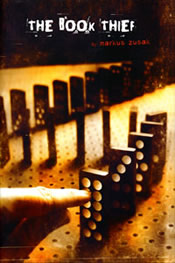
Here I go again- one more Nazi era book for you from me. One Goodreads.com (link) reviewer noted The Book Thief was, “Yet another World War II book, yet another Holocaust book,” while another lamented, “It’s about the Holocaust, and I think we’ve all heard enough about that.” These ladies may fuss (though they both eventually enjoyed the book), but sick as it may seem, I silently rejoice.
I’ve pondered the question in past columns, as I’ve exposed my own fascination with the World War II era, but I’ll consider it again and ask you to do the same: Why has so much ink been spent exploring the state of the world during the 1930s and 40s? What is it about that time that inspires so many writers to write and so many readers to read, even today? Surely, Stalin and Lenin were monsters, cut from the same cloth as the wretched Fhrer. Some fifty million souls are said to have died by their hands alone. And China’s Mao is estimated to have killed more than twice the number murdered by the Nazis, yet, is there a cottage industry of non-fiction writing spawned from the atrocities committed by these butchers? I think not. (If you know of any, please recommend!)
The clearest, most direct answer I can formulate for this interest comes from the opening line of Charles Dickens’ classic A Tale of Two Cities, “It was the best of times, it was the worst of times.” 1 What was on display across the war-wrapped world in the 30s and 40s was, indeed, humanity at its very best, and at its apocalyptic worst. Men, women, and even children showed extreme courage and valor in the face of living nightmares, contributions small and large were rapidly tabulated among our fellow earth bound travelers. Whether it was a brave Dutch family keeping a single Jew from harm, an American family sacrificing sons for the army, or something much grander, like thousands of Polish citizens giving their lives in order to reclaim their homeland from the Nazis, millions of people bound together in spirit to fight against evil and take a stand.
Markus Zusak’s offering to the genre of World War II fiction is a welcome one in my mind for several reasons. First, The Book Thief gives a refreshing perspective to this amply covered topic, both in narrative style and in character development. Second, the author has a personal claim in this narrative, as his parents grew up in Germany under the barbarian-in-chief, Adolf Hitler, and he grew-up hearing their stories. Because of this, his observations on the time immediately carry more weight for me than fictional stories constructed purely out of historical records. Finally, Zusak is a writer to be reckoned with. He has a remarkable way of creating poetry out of prose. In fact, I think he could write copy for an organic cereal company and make consumers weep while reading the silly box! He is that good.
Point 1: A Refreshing Perspective
Tracing the life of Liesel Meminger, a nine year old German girl with dark blond hair and dangerous brown eyes, Zusak weaves a story of immense sadness, intermingled with snatches of childhood joy and even “normalcy.” When the story opens, young Liesel, whose mother and younger brother have been snatched away by the coming war, finds herself taken in by strangers, an orphan without knowledge or understanding of her new status. The year is 1939, the town is Molching, a suburb of Munich.
Like so many children of that time, Liesel is pale and bony, malnourished due to poverty and extreme rationing by the government. Despite her age, she is barely able to read and write. Her loud and often cruel foster mother, Rosa Hubermann, mocks everyone around her and spares no sympathy for Liesel. Her foster father, Hans, or Papa, however, takes the youngster under his wing, making Liesel’s years in the household bearable.
The “Book Thief,” as Liesel is called by our prescient narrator, gains her nickname when he observes her retrieving a small, darkly covered book out of the snow in the cemetery after her brother’s funeral. Entitled The Gravedigger’s Handbook, this small text was the first written object that created within Liesel the desire to read. As our guide is none other than Death himself, the odd little book also provides a witty opening for the dark narrator to take his place among the characters of Zusak’s novel.
A victim of haunting nightmares, Liesel awakens night by night, screaming herself into consciousness. It is the quiet, unassuming Papa who sits with her each time, soothing away the horrific images; it is also Papa who discovers the purloined book and discerns that she cannot read. So, secretly Hans patiently and painstakingly imparts of his fourth grade education, teaching Liesel to read in what becomes known as their “Midnight School.” Rosa would never have considered doing such a thing, softness is just not her strong suit, but by stepping in to console and empower Liesel’s young mind with words, Hans quickly gains her love and trust “primarily through the brute strength of his [his] gentleness.” 2
While other authors may have used the same narrative device, I can hardly imagine (and don’t remember) any of them creating a life-revoking personality with quite so much…liveliness! Indeed, Zusak’s Death is not of the hood and scythe/ Grim Reaper variety, though he does find this image quite funny. No, Liesel’s strange admirer is a curious sort with a wry sense of humor. Instead of mocking those souls he must remove from this earthly existence, this Death is sympathetic. Truth be told, he finds humankind rather interesting, especially those like Liesel and Hans, whom he considers “survivors.” When he gets the opportunity between jobs, as it were, our narrator rather enjoys watching their lives, knowing eventually he will get to meet these special, rugged spirits face to face.
Of Death’s narration I will comment two things: 1) he communicates his observations rather like a screen writer, and 2) he knows people. Zusak’s Death delights in “setting the scene” for readers and often gives background information on even the most minor characters, which creates a greater intimacy with the township of Molching than other writers might have chosen to create. Indeed, where many authors would likely leave minor characters in the background to exist as only thin sketches, Zusak allows his narrator to illuminate bits of a character’s life which may help readers to better understand them as individuals, and even empathize with some of the less savory ones.
As one who would appreciate my GPS system one hundred times more if it gave directions by saying something like, “Drive a little ways until you see (x), then turn left. You will see (y) with a tall oak tree next door, turn right. Drive about half a mile until you see a white building with blue trim, and don’t forget to look at the house next door, it’s quite lovely!” I find Death’s descriptors helpful, humorous, and intriguing.
The style serves to enhance The Book Thief’s uniqueness, though some reviewers have found it distracting.
Point 2: Personal Stories
Imagine growing up in the heart of Nazi Germany. I would assume being expected to hate and scorn anyone not “Aryan,” and being required to march in the Hitler Youth, shouting praises to a man whose existence only ever hurt those she loved, could not have lent itself to a happy, carefree youth for Liesel. But as children do, she still managed, nevertheless, to carve a small sliver of childhood out of the chaos and pain.
Melding reality with a touch of innocent fantasy is one of the things I most admired about the construction of The Book Thief. Considering what must have been a surrealistic time to be alive, the addition of small fantastical elements to the writing reinforces the fact that this story was ultimately about children, not just the Holocaust. Interestingly, the realism of Zusak’s work is supplied in large part by the experiences of his parents, Elizabeth and Helmut Zusak, who grew up in Germany during Hitler’s rein.
One experience detailed in the book which comes directly from his mother’s life, entails Liesel and her best friend, Rudy, watching a death march to nearby Dachau Concentration Camp through the middle of their town. The whole of the community stops to watch as these wisps of humanity are forced to parade through their lives, bringing them all, including the children, face to face with the evil of Hitler’s war. While others may have recoiled internally at the site before them and wanted to reach out a helping hand, only one resident actually did. An old man by the name of Hans Hubermann, Lisel’s beloved Papa, braved the whipping he would have anticipated in order to give a small crust of bread to a starving soul. Elizabeth Zusak saw that episode play out in real life, though in her story, the old man was a teenaged boy.
In the back of my copy of The Book Thief there is an interview with Markus Zusak, wherein he explains what I believe must have been the overarching theme of his parents’ stories to him: humanity finds a way.
I…hope that readers of any age will see another side Nazi Germany, where certain people did hide their Jewish friends to save their lives (at the risk of their own). I wanted them to see people who were unwilling to fly the Nazi flag, and boys and girls who thought Hitler’s Youth was boring and ridiculous. If nothing else, there’s another side that lives beneath the propaganda reels… 2
As we look at world events today, events that in far too many ways echo the wretchedness of World War II, I often think of those that must be fighting up stream in much the same way Liesel and the Hubermanns and their counterparts in reality did so long ago; and that is always a story worth reading.
Point 3: Keeping it Pithy
One seat, two men, a short argument, and me.
It kills me sometimes, how people die. 3
Can’t get much more piquant than that, now can we? Death has hundreds of lines just like this one peppered throughout The Book Thief. Brief zingers that seem to just sum things up–with a twist, of course– are what makes the heaviness of Zusak’s subject matter more bearable than it might otherwise be.
As noted in the first section, I find Markus Zusak to be a fascinating writer. In fact, I followed up my early winter reading of The Book Thief with another work of his, I Am the Messenger, and only had my belief in his genius confirmed (now, if he could write with markedly less foul language, I’d be overjoyed!).
It could easily be said, and some on Goodreads did point out, Zusak’s use of figurative language gets a bit overwrought or heavy handed at times. However, just as I’m about to agree with that observation, the author throws out another turn of phrase that just hits me square in the chest, taking away my breath, and leaving the image of his creation seared into my mind.
While I could attempt to rather clumsily describe more of his writing skill, I’d much rather let you read Zusak’s own words so you can see for yourself what I mean.
It felt as though the whole globe was dressed in snow. Like it had pulled it on, the way you pull on a sweater. Next to the train line, footprints were sunken to their shins. Trees wore blankets of ice. 4
Papa’s bread and jam would be half eaten on his plate, curled into the shape of bite marks, and the music would look Liesel in the face. I know it sounds strange, but that’s how it felt to her. Papa’s right hand strolled the tooth-colored keys. His left hit the buttons…The accordion’s scratched yet shiny black exterior came back and forth as his arms squeezed the dusty bellows, making it suck in the air and throw it back out. In the kitchen on those mornings, Papa made the accordion live. I guess it makes sense, when you really think about it. How do you tell if something’s alive? You check for breathing. 5
People on the street stood and watched, some with straight-armed salutes, others with hands that burned from applause. Some kept faces that were contorted by pride and rally like Frau Diller, and then there were the scatterings of odd men out, like Alex Steiner, who stood like a human-shaped block of wood, clapping slow and dutiful. And beautiful. Submission. On the footpath, Liesel stood with her papa and Rudy. Hans Hubermann wore a face with the shades pulled down. 6
Some facts about Stalingrad: 1. In 1942 and early ’43, in that city, the sky was bleached bed sheet white each morning. 2. All day long, as I carried souls across it, that sheet was splashed with blood, until it was full and bulging to the earth. 3. In the evening, it would be wrung out and bleached again, ready for the next dawn. 4. And that was when the fighting was only during the day. 7
Goodness, I have so many to show you! Show you because that exactly what Zusak does with his writing. I have been touched by many authors’ words, but very rarely does one create a full Blu-Ray DVD version of his literary vision in nothing but black ink on a white page.
Closing Comments and Reader Warnings
The Book Thief is one of those books I will sadly have to warn more sensitive readers away from. Despite being set in war time, it is not filled with particularly violent or gory details, nor is there any abject violence upon women. There is, however, within its five hundred fifty pages, the descriptions of rough and difficult lives, of children being raised in harsh times by often coarse, ill-educated people, of humans grasping onto what is left of the humane in the world, and sometimes failing to hold on. They lose control of their tongues quite a bit, and though Zusak mercifully spares his Young Adult target audience (and their parents) the smacks of the “F” word, even Death observes at one point, “No one can blaspheme like the Germans.” Indeed, the language in The Book Thief pushes me right to the limit of my ability to “skip and scan” past such detractors, but the effort is well worth it.
Reading Group Guides (link)
End Notes
1. Charles Dickens, A Tale of Two Cities, (Bantam Dell: New York, 2003)
2. Markus Zusak, The Book Thief, (Alfred A. Knopf: New York, 2005) 36.
3. In His Own Words: A Conversation with Markus Zusak, The Book Thief supplemental.
Alfred A. Knopf, New York. 2005.
4. Markus Zusak, The Book Thief, (Alfred a Knopf: New York, 2005) 454.
5. Ibid, 6
6. Ibid, 38
7. Ibid, 62
8. Ibid, 106