




by Robb Cundick
Pictures by Debra Gehris
Editor’s Note: In this delightful report of the Mormon Tabernacle Choir’s 75th anniversary trip, you’ll travel with the choir to the Sacred Grove and a performance with the Boston Pops. This article stands alone, but if you want to double your fun, click here for part one.
In part one, I described the tender experience of singing in the Kirtland Temple, which stirred sweet memories of the temple dedication last year at Nauvoo. Sunday, June 29, we had yet a third opportunity to visit a place where extraordinary events in Church history took place. And in Church history there is no more revered site than the Sacred Grove and Hill Cumorah at Palmyra, New York.
Having lived in New York for several years, I had visited Palmyra a number of times but I was in for a surprise as there have been many changes. I had found it best to visit the Sacred Grove at a time less crowded than summer in order to enjoy the kind of stillness that invites the Spirit. Traveling with 10 busloads of people, my expectations for a reverent walk in this special place were not high. How gratifying, then, to discover that the trails in the grove have been greatly expanded. I walked with Choir General Manager Scott Barrick and it didn’t take us long to be immersed in the reverence of tall trees and vivid greenery. The trail even took us through a meadow of wildflowers. It isn’t often you can think of a day’s events and say, “I walked through the Sacred Grove and to the top of the Hill Cumorah this morning.” And to share such experiences with fellow choir members strengthened the bonds between us. Moreover, there was added meaning because the Choir’s very object is to carry forth the spirit of the work begun in these sacred locales.
|
click to enlarge
 |
|
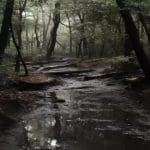
The stillness of the Sacred Grove.
|
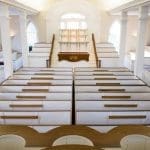
Elder Spencer J. Condie of the First Quorum of Seventy (who was on special assignment to travel with the Choir) spoke at our sacrament meeting that afternoon. We held the service in Fayette, New York where the Church was organized. There, surrounded by miles of farmland, stands an elegant 18th century New England-style chapel. Located alongside is a replica of the small Peter Whitmer home where that first meeting took place. Elder Condie’s subject was “authentic experiences.” He discussed the principles that help people to recognize that the spirit radiating from the Choir is authentic. Quoting Alma 5:14, which asks “Have you received [the Lord’s] image in your countenance?” he told of a woman who found she was as moved by Choir members’ faces as by their music. Elder Condie counseled that in order to emanate the Spirit, we in the choir – like John the Baptist – must “decrease that he [the Savior] might increase.” So it is that those with solo voices must learn to blend and not stick out – decreasing their own prominence in order to increase the Choir’s ability to carry forth the Savior’s work.
|
click to enlarge |
|
Debra Gehris, photographer for these article, poses with a missionary
atthe Whitmer farm (I guess she didn’t snap this one, though!). |

On to Newark
We were fortunate to have such a poignant Sabbath morning because the remainder of the day proved to be grueling. The bus ride to the Newark, New Jersey Airport Marriott was scheduled for a 9 p.m. arrival. However, Newark is just across the Hudson River from New York City, and travel towards the metropolitan area on a Sunday evening is unpredictable at best. Construction and a rollover accident made for delays that held us up until well after midnight.
We were able to laugh about it the next day, but the final test of our patience came when we sighted the hotel but were frustrated in our attempts to reach it. Signs took us to a bridge with clearance too low for the buses. We drove around loops, made U turns, and tried to follow cell phone-relayed instructions from a hotel employee who turned out to be as confused as we were. Our bus had been first in this late-night circus parade, but – true to scripture – we ended up last.
It is hard to imagine the hotel had ever experienced such pandemonium at 1:30 in the morning. Forget the elevator – there was a line just to get to the stairs. But as always, people were patient with one another and we made it to our rooms in a reasonably orderly fashion, grateful that this was one of the few mornings breakfast wasn’t until 9 a.m. A couple of days later, I overheard two new Choir members talking about what an eye opener their first tour has been. It does take a tour or two to adjust to such episodes, which are probably best described as “ordered chaos.”
Monday, June 30th, we had some free time. For me it was good to catch up on my writing and enjoy a quiet day before entering the most intense period of the tour. Some used the break for a quick trip to New York City to see “Ground Zero” or other landmarks. The concert that evening was at the New Jersey Center for the Performing Arts. We traveled during rush hour but arrived quickly thanks to an aggressive, road-blocking, red-light-running police escort. The bus drivers had a great time setting traffic rules aside. It was good to see them enjoy the experience because the demands of our schedule are hard on them, too.
The hall was beautiful: new and very large – seating almost 2,800 people. With four tiers above me, I had to crane my neck just to see those at the top. Among them was a sight that always cheers us – a group of missionaries in their white shirts and ties. Despite the hall’s size, acoustics were excellent with no amplification required. The audience was once again enthusiastic. As NJ.com later put it, “A nearly sold out crowd at NJPAC in normally sleepy June and an aura of devotional fervor among the fans attested to the extra-musical appeal the Mormon singers have.” (Hmm… “extra-musical appeal” …It is good to see a recognition that there is something beyond our music that appeals to people, even if the writer couldn’t quite put her finger on it.) Unfortunately, there was no time to stop and visit afterwards. We were hustled back to the hotels, caught a short night’s sleep, and then were off to Albany.
Hopping Around
Given the resources required to take nearly four hundred singers and instrumentalists on such a journey, it is important to take advantage of every opportunity that presents itself. The population centers of the Northeast offer so many possibilities for performances, but when you’re trying to schedule halls and fit into the performance calendars of summer music festivals, you have to take the dates that are available. If you didn’t know the method behind the madness, you might think someone planned this trip by putting a grasshopper on a map and marking an “X” wherever he hopped!
As I said, Newark (our June 30 concert) was just across the Hudson from New York City where we would sing on Wednesday night, July 2.
But Tuesday, July 1, we needed to be in upstate New York at Saratoga. Then after returning south to New York City on the 2nd, we went north again for a July 3rd dress rehearsal and the concert with the Boston Pops on the 4th …then south to Washington, D.C. (Wolf Trap) for the 5th, north again to Philadelphia for the 7th and north yet once more to Tanglewood in western Massachusetts on the 11th.
The MTC Live at Saratoga
Saratoga was another beautiful outdoor venue with a large, two-tiered amphitheater. A lawn area at the rear accommodated families who came early to picnic. Here was another place we would sing to thousands (somewhere around 7,500 turned out). The Choir performed here in 1967on the same tour as Chautauqua. Again as was the case in Chautauqua, some members of the audience had also been present 36 years ago.
The heat on stage wasn’t too bad but there seemed to be more bugs than ever. It’s a dangerous combination – singers with wide-open mouths and bugs on random flight paths …Yuck! Enough said! But despite such small annoyances, Saratoga was another rousing success. The Schenectady Daily Gazette described it this way: “The Mormon Tabernacle Choir’s well attended performance at Saratoga Performing Arts Center on Tuesday night was stirring from first note to last. …The sound of the huge chorus was thrilling, robust and wonderfully balanced throughout, with phrasing smooth as that of a fine string quartet.” Albany’s Times Union added, “The thick, rich sound was simply stunning. If perhaps you have seen the MTC on television, the truth is, you really haven’t heard anything until you’ve actually sat within a hundred feet of these angelic voices.”
|
click to enlarge
 |
|
The schedule said wear the silver bow tie …but we don’t have one! So
Randy Honecker and Darren Major (seated) did their best. |
Avery Fisher Hall
Early next morning we headed to New York City. Traffic wasn’t a problem until we reached town, but here, even though a police escort met us, roads were so clogged that they weren’t much help. We were late for lunch, had time for a short rest, and then it was already time for dinner. It seemed like we’d just stepped off at the hotel when it was time to reload for Lincoln Center’s Avery Fisher Hall, one of the nation’s most prestigious concert halls.
The Center is across the street from the Manhattan Ward/Visitors Center building, which is being remodeled to house the Manhattan Temple. With the open house and dedication coming up, the Church decided to use this concert to foster goodwill among community and religious leaders as well as diplomats from throughout the world. The complimentary tickets were by invitation only. After the short pre-concert rehearsal and sound check, we were introduced to actress Cicely Tyson. She smiled, said what an honor it was to meet us and posed for a picture. New York Governor George Pataki came to a pre-concert reception. Though he had only planned to stay for the opening number on the concert, he was so captivated that he stayed for the entire first half (much to the chagrin of his staff, who were trying to hurry him to his next engagement).
|
click to enlarge
 |
|
(l. to r.) Mack Wilberg, Craig Jessop, Charles Osgood and Lloyd Newell at Avery Fisher Hall.
|
Brother Jessop came out brimming with energy. His conducting motions and facial expressions seemed to say, “Look around you – you’re singing in Avery Fisher Hall! Let’s make a joyful sound that will be remembered here for years to come! ” We responded, but oh, did it take extra effort on this third straight night of singing. And this audience seemed harder to please, for some reason. But they did warm to us, especially after “Betelehemu,” our rousing Nigerian carol which includes 4 conga drums, a huge percussion section, hand clapping and rhythmic swaying by the Choir. I later told Craig I was glad he had programmed, “Come, Come, Ye Saints” towards the end. Though our situation was far different from the pioneers crossing the plains, singing the words “No toil or labor fear,” “Why should we think to earn a great reward if we now shun the fight?” and “Gird up your loins, fresh courage take!” helped us bear up just as our energy began to sag.
This concert also had a couple of additions to the program. Radio personality Charles Osgood has been a good friend of the Choir since appearing on our Christmas concert a few years ago. For our most recent album, Spirit of America, we recorded a musical setting of the Pledge of Allegiance he composed the day after the September 11 terrorist attacks. Joining us as our special guest for this concert, Mr. Osgood prepared one of his trademark poems, which he read as we hummed in the background. He then turned to listen and watch as we performed his song. As we concluded, he was visibly moved with his face becoming flushed with emotion.
The second event was a great honor for the choir. Joyce Tudryn, President of the International Radio and Television Society, presented us with their Gold Medal award to honor the 75th year of “Music and the Spoken Word.” This accolade compares in significance to an Emmy. Past recipients have included Bob Hope, Walter Cronkite, Oprah Winfrey, and Leslie Moonves, president of CBS Television. Elder Condie read an acceptance letter from President Hinckley. In typical fashion, Elder Condie disarmed the crowd by starting with a quip often quoted by President Hinckley: “When you’re ninety-three, you avoid buying green bananas!”
Singin’ in the Rain
The Choir was invited to appear the next morning on “The Today Show,” but 100 singers were needed in Boston at the same time to rehearse with the Boston Pops Esplanade Orchestra (more on the reason for that later). The only solution was to divide us into two groups. 100 singers under the leadership of Mack Wilberg left immediately on what turned out to be an all-night bus ride to Boston. The rest of us arose early the next day, sang briefly for hotel staff and guests in the lobby of the Marriott Marquis (our elegant but brief quarters on Times Square) and walked a few blocks to Rockefeller Plaza, the location of NBC Studios.
|
click to enlarge
 |
|
Getting ready for the Today Show (before it started to rain).
|
Sometimes it is the most trying experiences that turn out to be the most memorable. The Bush Inaugural Parade (where we froze for hours on a float); El Escorial in Spain (where we were squeezed so tightly on narrow steps that there was no room to bring down our music, so we held it up the entire concert); the Musikverein in Vienna (where the temperature continued to climb as we roasted under hot television lights) are all experiences that are still talked about years later.
And now we can add singing in drizzling rain at Rockefeller Plaza in New York City.
The rain wasn’t much at first, but it grew insistent and before long we were holding paper plates or anything else we could find to cover our heads. While waiting to go on the air, we playfully vocalized, “I’m Singin’ in the Rain.” We should learn never to joke in front of TV cameras, because the producers picked up on that and decided to replace, “God Bless America” with the lighter tune. There was just a slight problem with that: after one phrase most of us hadn’t a clue as to the rest of the words. Soprano Lou Ann Crisler came to our rescue. She knew the words and is a master at thinking up pantomimes for words. She stood behind Craig and put on an animated show, pointing to the sky, making smiley faces, clasping hands, rocking back and forth – whatever it took to spoon feed us the words. A couple of times through and we started to sound like we knew it. I wish we had video of her. It was a performance of which Primary Choristers everywhere would be proud!
We did sing “America the Beautiful” at the close of the show, so the entire performance wasn’t “off the cuff.” Back at the hotel they scrounged up plastic bags in which to place our wet clothes before the next long bus ride.
Independence Day in Boston
New York traffic took full advantage of its last opportunity to frustrate our plans. We were due at Boston’s Copley Place Marriott by mid-afternoon. But the scheduled free time to find dinner on our own wasn’t to be. We arrived at 6:30 p.m., tore up to our rooms to change, returned to the buses and headed for the Charles River Esplanade, arriving over an hour late for the July 3rd dress rehearsal. Fortunately the crucial camera dry run before a live audience wasn’t until 8:30; and it went well enough that we hope Boston Pops officials weren’t too annoyed with us.
Now it’s time to tell about the singers who came the day before, and who have come to be known as the “Boston 100.” The July 4th Esplanade concert has used choirs before but there isn’t enough room for singers in the sound shell where the orchestra plays. And so it has been determined that the best way to optimize the sound is to mike the choir from within a tent, where they follow the conductor via television monitors. But you don’t take the Mormon Tabernacle Choir all the way to Boston just to hide them in a tent; and so 250 of us stood in front of the orchestra and sang softly enough that we could hear and be in sync with the 100 singers in the tent who actually provided the sound. Craig and Mack took turns conducting. They would watch the baton of Keith Lockhart (who was leading the orchestra behind us) and relay the beat to us. Is that complicated enough? But it seemed to work just fine.
The next day, July 4th, was a great day to have free time in Boston. Dave Jackman and I used it to walk part of the Freedom Trail and see places of significance to the founding of our country. We ran into Choir members everywhere and compared notes. One group happened to be on a tour boat in Boston Harbor just as the USS Constitution came out to fire its annual cannon salute. No matter what you do, there always seems to be someone who found something even better!
|
click to enlarge
 |
|
Sopranos Rebecca Nelson and Peggy Cann look patriotic as they tour Boston
on Independence Day. |
But no Choir member got the short end of the stick on this day, for we were all invited to a party of 700,000 at the Charles River Esplanade; and we were among the guests of honor! Boston Police put on the most impressive escort ever. Several motorcycles leapfrogged one another in blocking every side road. Though the hotel was only a few blocks away, one bridge with low clearance made it necessary to take a circuitous route. We waved to onlookers and tried our best to look like celebrities, but …you know …it felt a bit ridiculous – because we’re pretty ordinary folks. Only as a body of does the Choir carry great significance.
I was concerned that the 100 singers in the tent might feel left out and so I ventured inside to see how they were faring. I found them sitting in air-conditioned comfort while we endured the heat and humidity outside. My sister-in-law, Betsy Cundick, who along with my brother Tom was among them, said they were having a great time and didn’t feel cheated at all. Even so, we outside felt very grateful to them because it did seem a sacrifice.
|
click to enlarge
 |
|
Here’s what you saw if you tuned into the July 4th Boston Pops broadcast
on CBS. |
|
click to enlarge
 |
|
…and here’s what you heard!
|
The crowd was in a raucous mood, having one mammoth party. They cheered when we came on and several nearby joked with us. Some said, “Hey, cheer up! You don’t look like you’re having fun!” In our suits and long dresses I’m sure we did seem rather stiff, especially surrounded by throngs dressed in bare summer fare. We needed to let these folks know Mormons are people they can relate to. Craig Jessop had just the idea, “Let’s do the wave!” So, during a commercial break we launched the wave; first left to right and then back right to left. The Boston Globe later named it one of the best things not seen on camera. The crowd let out a big cheer! Afterwards, someone (perhaps a Church member?) yelled, “Who says Mormons don’t have any fun?!”
The Boston Globe story the next day was headlined, “Solid lineup made for the best Pops Fourth in years.” Only the last hour of the 2 hour program was televised nationally and half of that was fireworks, but we were pleased with this rare opportunity to appear on network television. And the entire show played to a huge audience in the New England area. We also got a chance to wave and say hello to fellow Church member Mitt Romney, Governor of Massachusetts, who was at the dress rehearsal.
I’ll bet you thought I’d mention how much we liked the fireworks …sorry – we saw only one or two as we hurried off to the buses. This busy week was not yet finished. The next night was our concert at Wolf Trap and since the buses wouldn’t be able to make it there fast enough, we headed off to catch a midnight train for Washington, D.C.
But I’ll leave that for part 3!
.