







 By Robb Cundick
Sometimes in the course of our lives we come across events that draw interesting parallels to the past. A few weeks ago I received an email from a sister named Nel McCourt, who lives in the state of Washington. She had read some of my articles about the Mormon Tabernacle Choir and wanted to make me aware of a friend of hers, Lulu Christensen Salmon McDaniels. In 1932, Lulu Christensen (as she was known then) sang what was thought to be the very first solo with the Mormon Tabernacle Choir in General Conference. I corresponded with Nel, asking questions and intending to eventually write an article about Lulu. Then, something happened that suddenly put her story in a new and more immediate context. Two weeks ago I learned that this coming Sunday, the infrequent event of a soloist at General Conference will once again take place. Liriel Domiciano, a delightful young Latter-day Saint woman from Brazil, has been extended a special invitation from President Hinckley to sing a hymn with the Choir.
 |
|
Lulu in costume for her debut performance at the Castle Gate community center in 1922.
|
You may find it interesting, as have I, to contemplate the changes that have come between the times that Lulu and Liriel have stepped before the Church to share their beautiful voices. Lulu was from Price, Utah. Located over a hundred miles southeast from Salt Lake City, it may well have been considered somewhat of an outlying area of the Church in 1932. In the present, while Brazil is thousands of miles from Salt Lake, its 800,000 plus members make it unthinkable to apply an adjective such as “outlying.” Lulu’s solo was sung in the Tabernacle and carried on radio to an audience that could only imagine the scene. Liriel will stand before over 20,000 members in the Conference Center; and both sound and images of the session will be transmitted throughout the world to millions, the discourse being translated into many languages.
I have had the great pleasure of interviewing both Lulu and Liriel; the former via telephone from her home on Whidbey Island, Washington, and the latter face to face, but through a translator in the lobby of the Joseph Smith Memorial Building. Let me share with you their inspiring stories and how they came to sing before the Saints. In this article I will focus on Lulu Christensen; I’ll cover Liriel in part 2.
An Invitation to Sing on the Radio
Lulu Christensen was born in Ephraim, Utah, in 1914. When she was eight years old her family was living in Castle Gate, a mining town near Price. The town was owned by the Utah Coal Company, which sponsored a program in the community center. When another girl who was to sing a solo became ill, Lulu volunteered to step in at the last minute; “I already knew the part,” she told me, “because I memorized everything I heard.” Lulu’s debut in the community program was a great success and from that point on she became known for her beautiful singing voice.
 |
|
Lulu performing for the KSL radio audience. Her stage name was Joyce Palmer
|
In 1930, Salt Lake radio station KSL was looking to increase its base of listeners throughout the state of Utah, so it came up with the idea to have someone from each county come to Salt Lake City and do a promotional piece on the air. Fifteen-year-old Lulu was now attending high school in Price and her reputation for beautiful singing brought an invitation from the mayor to be the representative for Carbon County. She traveled to Salt Lake City by train and was met by two sorority sisters from the University of Utah, who acted as her escorts for the day. They showed her around town, took her to KSL, treated her to lunch and then put her back on the train that evening.
At KSL, Lulu sang a song that had been written especially for the occasion by a couple from her community; it told all about Carbon County. “It was lengthy,” she said, “but a cute number.” Meanwhile, the producers at KSL were so enchanted by her voice that they said, “When you turn 18 years old, we want you to come back to Salt Lake and we will guarantee you a job on the radio.”
Lulu returned to Price and soon found work at the telephone office, saving all she could for her anticipated move to Salt Lake. Her mother had attended Snow College with Anthony C. Lund, the then current conductor of the Mormon Tabernacle Choir. As Lulu’s eighteenth birthday approached, her mother wrote to Brother Lund to ask if he would give her daughter voice lessons. Brother Lund consented, and so it was that shortly after her move to Salt Lake, Lulu began taking lessons from Tony Lund (as she called him). Once again, her voice was recognized as being remarkable. Brother Lund said, “The Lord has given you a voice that is so rare and I’m not going to do anything to change it. I’m just going to teach you how to breathe.” He also told her she belonged in the Mormon Tabernacle Choir and invited her to join.
And so, Lulu began singing in the Choir. Her voice was unusually low – so remarkably so that she was assigned to the tenor section. She still has her identification card designating her as Tenor 51. At first she was placed between two gentlemen, but in order to avoid comment on the oddity of a woman sitting amongst the men, she was soon moved to the edge of the section where it would appear she was part of the contraltos. I asked Lulu if it was common at that time for women to sing with the men; she replied that the only other person she knows of who ever did this was Jesse Evans, who later became wife to the Prophet Joseph Fielding Smith.
Scheduled for a Solo
As her first General Conference approached, Lulu was surprised by Brother Lund when he said, “I have you scheduled for a solo.” “I can’t do that,” Lulu replied. When asked why, she said, “I’m afraid of all those people!” Brother Lund retorted, “There isn’t one person in that Tabernacle – even when it’s chuck full – that is going to harm you in any way. If I didn’t think you could do it, I wouldn’t have asked you.” He then proceeded to give her a piece of advice that was to help her throughout her singing career. “I’m going to tell you a secret. You pick out a pillar that’s holding up the balcony at the very end of the Tabernacle; and you sing to that and don’t take your eyes off from it.
You sing to that pillar with all your heart and everyone in the Tabernacle will think you’re singing to them.”
 |
|
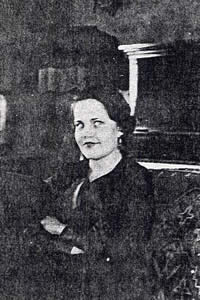
This picture was taken just after Lulu’s solo performance at General Conference in 1932; she was 18 years old.
|
Lulu gathered her courage and sang her solo, “O My Father,” in October Conference of 1932. There was only one microphone and it was for broadcasting – there was no amplification in the Tabernacle itself, so the Choir had to sing very softly so that she could be heard. She focused on the pillar as Brother Lund had instructed, “That pillar [became] my pillar, to keep me from getting emotional.” With a quiver in her voice, she told me, “I have never felt so humble and so thrilled in all my life.” Afterwards, President Heber J. Grant stepped up, took both of her hands in his, looked her straight in the eyes and said, “You will sing again in General Conference in April. I have never heard a more beautiful voice sing a hymn.” “Of course,” she added, “I was a little girl and he was puffing me up, I guess; giving me confidence.”
I asked her to tell me more about what President Grant was like. “He was an absolutely wonderful man,” she said, “Reserved – always reserved – but meeting him face to face like that, there was a warmth that I still feel. I will never forget it.”
Lulu sang “O My Father” a second time in April and the experience was not quite so daunting the second time. Her solos inspired many people. “Out of that,” she says, “came many letters to KSL from all over, requesting to know more about the Mormon Church and the girl that sang.” “Now I’m not telling you this stuff to be puffed up,” she hastens to add, “It’s really true, because I have no reason to be puffed up; not at all. And besides, I’m not that way.”
As promised, when she moved from Price she received employment at KSL. Her job was to be “on call.” The station was on the air between 6 AM and 9 PM. Whenever they had airtime that had not been sold, Lulu came down with an accompanist to sing popular songs and light classics. Sometimes they broadcast from the old 7th Ward building or above Daynes Music on Main Street. She was given the stage name of Joyce Palmer. Soon, she married Jack Salmon (who, incidentally, was a classmate to President Hinckley at LDS High School). They started their family; and when their second child came along she found it increasingly difficult to keep up with the demands of singing both at the station and in the Mormon Tabernacle Choir. “I had to make money,” she told me, “[in the] Depression you took every bit that you could get.” So, reluctantly, she resigned from the Choir after two and a half years.
Other Stories
Lulu has many interesting stories to tell about her life and times. She related how Tony Lund, along with a well-known soloist named Albert Southwick, and President Heber J. Grant sang a song at her wedding reception. “President Grant sang, too?” I asked, “What was his voice like?” “Well …he was determined to sing and he carried the tune! I’m not going to say any more than that because I was too excited to be a critic about things like that. And I was just absolutely thrilled when Tony stood up and sang.”
She also told of the first experiment at KSL with a “remote broadcast.” Lulu sat in the studio wearing headphones and her accompanist, Gene Halliday, was at a theater organ 40 miles north in Ogden. “I sang in Salt Lake and he accompanied me in Ogden. …He would say (they gave me the name of Joyce) and he said, Joyce, is this the key that you will do’ …such-and-such a number, say, The Old Spinning Wheel’ …and I’d say, No, that’s too high or too low,’ and he’d give me another key. And all this is going over the air, and we had five sponsors and lasted six months. And it was fun!” The program aired on Sunday afternoons with Richard L. Evans as announcer. He later became the voice of the Mormon Tabernacle Choir’s “Music and the Spoken Word” and was ordained an apostle in 1953.
Lulu’s Testimony
One might think that a girl who was raised in the Church and who went on to join the Mormon Tabernacle Choir and sing a solo in Conference would have “arrived,” so to speak, in terms of her testimony. But Lulu doesn’t feel that way. Her grandfather went on three missions for the Church. This became a source of embitterment to her father, who resented his father’s frequent absences from the family. While he and her mother always made sure that Lulu and her siblings went to Church, he himself did not attend.
Besides the need for fathers to be to be away on missions, there were other things that were different in those days. When she left Carbon County, Lulu didn’t feel that she knew very much about the Church. Even when she went to the temple for her marriage, her bishop never interviewed her. “I was never asked to pray; I was never given a calling. I was never asked to be a visiting teacher. I was never asked to be a teacher; and my Patriarchal Blessing said that I would be a teacher in Zion.” Then, fifty years ago her husband was diagnosed with heart problems and advised by doctors to move to sea level. So, Lulu, Jack, and their four children packed up and moved to Washington’s Whidbey Island. Here they found themselves members of a small branch of about forty members. As Lulu tells it:
 |
|
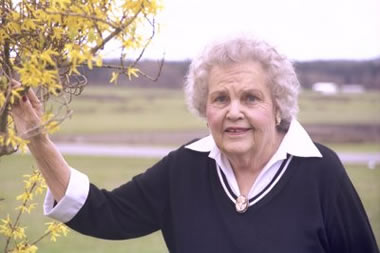
At 90 years of age, Lulu is still a vibrant and fun personality. She continues to share her musical talent to brighten the lives of others. This picture was taken in front of her farm on Whidbey Island.
|
“Everybody had to pitch in and do and take …and teach. And so I was Relief Society President – without any training. And I was a Laurel teacher; I led the music in all the meetings, besides taking care of my family. And my testimony …associating with people and getting their feelings …and thru prayer …nothing, nothing in this world can ever shake my testimony. And here on Whidbey Island is where I got it. I wasn’t needed in Salt Lake, and here I was needed. …My husband and I, we just pitched in and we did everything we could; and everything we could for people. And we paid an honest tithing. And I felt like we were one of the tentacles’ of the Church.
And if we made ourselves strong, that would make the body of the Church strong. That’s the way I thought of it. Everyone that was there, they all took their jobs [seriously] …and when the building needed to be painted, we painted it … and a little thirteen-year-old girl played our hymns. And it was like I imagined the Church was at the very, very beginning.”
The sea air and the more relaxed pace of Whidbey Island helped Jack to live for nine more years. Six years after his death, Lulu was remarried to Robert McDaniels, a wonderful man who was not a member. Lulu was concerned about marrying a non-member and asked her bishop for advice. He told her to go ahead and everything would be fine. Unbeknownst to Lulu, Robert had been taking the missionary lessons and planned to surprise her. The bishop was in on the plan and Robert was baptized six weeks after he and Lulu were married. He passed away two years ago after having served faithfully as a Bishop and in many other leadership positions.
Lulu turned 90 at the beginning of March. She is still active and vigorous, and continues to sing. Until just recently, she sang with a band. She had been singing with them for 14 years but finally resigned because there was a trumpet player who insisted on intentionally drowning her out. “They ask me to come back all the time but I won’t,” she says, “it was too hard to tolerate!”
 |
|
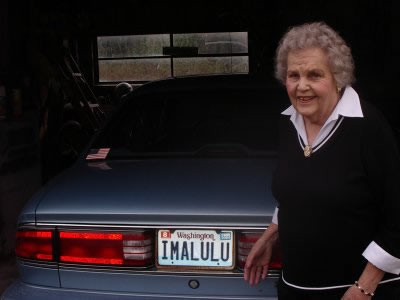
Not one to take herself too seriously, Lulu shows an example of her fun sense of humor.
|
In contemplating her story I find am struck by the fact that neither the spotlight of singing in Conference nor the fame of singing on the radio are what seem to mean the most to her. “I was striving just like everyone else during the Depression and I just got a couple of wonderful breaks,” she says. She is not at all enamored with the celebrity she received. “I don’t take any credit. They just tied a nice soft string around my neck and drug’ me along so I could be a part of it. It was no effort on my part; it was just that everyone was so kind.” When we closed our conversation, she said, “I don’t want to leave you with the feeling that I’m puffed up, because [I’m] absolutely not. I feel very humble towards the gift that was given to me and I have shared it in many, many ways. And not for money; I have done it to make other people happy.” Serving others in her ward and community is what means the most to Lulu McDaniels.
Nel McCourt, who first emailed me about her says, “I just love Lulu, I have known her for three years but she is the most up-beat person I have ever met …she still performs for us in the ward every Christmas and any other time I ask her to.” My special thanks to Nel for all her help in providing background and pictures. I also want to thank Doug Dobbins, a member of Lulu’s ward who scanned in additional old photographs and took the pictures of Lulu as she is today.
Oh …and there’s one more thing that I mustn’t forget. Remember at the beginning where I talked about interesting parallels to the past? Lulu’s number in the Mormon Tabernacle Choir was Tenor 51. Guess who is Tenor 51 now? Strange to say, it happens to be me!