





By Robb Cundick
On Monday afternoon, July 15, 1929, the Mormon Tabernacle Choir gathered in the Salt Lake Tabernacle to launch what was to become the longest-running network radio program in broadcasting history. While there was undoubtedly much excitement at the prospect of singing to the nation, it seems unlikely that any of the participants could have predicted what a national and even worldwide institution the Choir and its broadcast would become.
 |
|
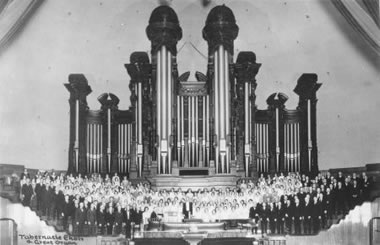
Here is what the Tabernacle Choir looked like in 1929.
|
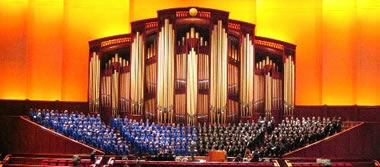
This year marks yet another milestone in that enduring legacy, which began on radio, spread to television in the 1960’s, and now is available anywhere in the world via Internet streaming. July 18th, 2004, will mark the 75th anniversary broadcast of Music and the Spoken Word. To allow as many as possible to join the celebration, the broadcast will originate from the Conference Center. There will also be a gala concert in the same venue the night before. CBS Radio Commentator Charles Osgood will be guest artist for both. [As of this writing, some (free) tickets for the July 17th concert remain, and many are still available for the Sunday morning broadcast. The latter will be followed by a mini-concert featuring much of the music from the night before.Click here for ticket information.]
 |
|
And this is the scene that will greet visitors to the 75th Anniversary |
A remarkable run of events has lead up to this exciting month and has kept anticipation high. It began a year go with our 75th Anniversary Tour of the Northeastern United States. While in New York City, we received the International Radio and Television Society‘s Gold Medal Award in recognition of our 75th anniversary year of broadcasting.
 |
|
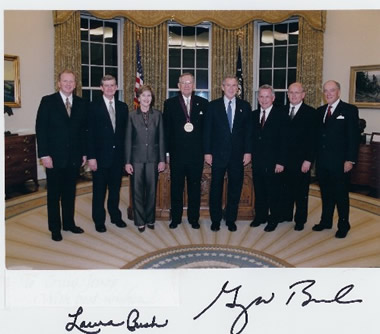
Six members of the staff traveled to Washington, DC in November to represent |
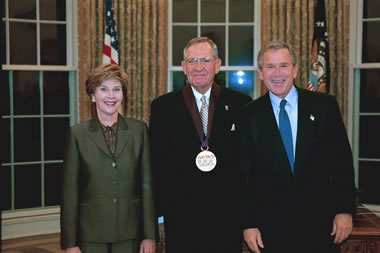
Two other prestigious awards were to follow, with President Bush presenting the National Medal of Arts in an Oval Office ceremony in November, and the induction of the Choir and Music and the Spoken Word into the National Association of Broadcasters Hall of Fame at their April Convention in Las Vegas. We have also been honored here at home, receiving a Utah “Best of State“ award, the Heritage Award from This Is the Place Heritage Park and several Pearl Awards for LDS faith-based music.
 |
|
Choir President Mac Christensen poses with President and Mrs. Bush following |
An exhibit featuring displays about the history of the broadcast is currently running at the Church Museum of History and Art. Included are such interesting artifacts as batons used by each of the Choir‘s conductors, Alexander Schreiner‘s famed red-lined cape, Choir dresses and soloist gowns from the past; awards, medals, and several historic recordings of The Spoken Word. The exhibit will continue through October 17.
 |
|
Lee Groberg thanks the Choir and Orchestra at Temple Square following a |
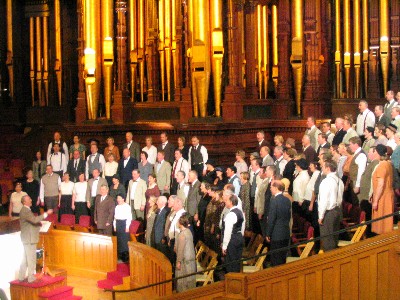
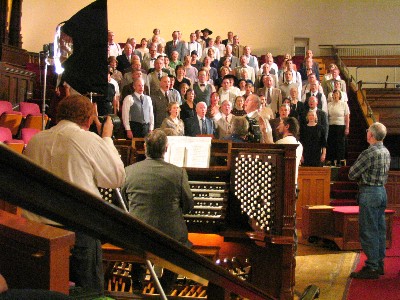
And what could be more appropriate to celebrate 75 years than the production of a documentary? Lee Groberg, producer/director of several documentaries on the Church, has turned his focus upon the Choir. His previous works include An American Prophet: The Story of Joseph Smith, Trail of Hope: The Story of the Mormon Trail, and Sacred Stone: The Temple on the Mississippi. For the past two years, he and writer Heidi Swinton have become familiar faces at Choir rehearsals, concerts and tours near and far. One of the highlights occurred last November when a reenactment of portions of the 1929 Broadcast was filmed, complete with 1929 clothing and hairstyles.
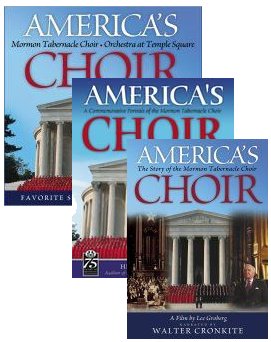 Exciting new releases for the 75 year anniversary of Music and the Spoken Word: Lee Groberg’s documentary, Heidi Swinton’s book, and the soundtrack album from the documentary. Exciting new releases for the 75 year anniversary of Music and the Spoken Word: Lee Groberg’s documentary, Heidi Swinton’s book, and the soundtrack album from the documentary. |
|
|
America?s Choir: The Story of the Mormon Tabernacle Choir has just been released on DVD/VHS and is slated for nationwide broadcast on PBS Television the evening of Thanksgiving Day. Narrated by Walter Cronkite, it tells the story of the Choir from its pioneer origins to the present day. Concert performances of many favorite selections are shown, as well as interviews with celebrities as diverse as rock music artist Sting, actresses Angela Lansbury and Roma Downey, composer John Williams, radio commentator Charles Osgood, Welsh Baritone Bryn Terfel, and the popular British a cappella group, The King‘s Singers. All have performed with the Choir in recent years and are effusive in their praise. Mr. Cronkite, himself, tells of his experience with the Choir in the 2002 Christmas Concert when he took up the baton to conduct Handel?s Hallelujah Chorus.? ?Guest artists who perform with the Choir leave changed. “I was one of them”, he says, “it was what I called A thrill in a thrill-filled life.“
 |
|
For the reenactment, Choir members got the full treatment, with 1929 |
And every bit as compelling as the documentary is Heidi Swinton‘s accompanying book, America‘s Choir: A Commemorative Portrait of the Mormon Tabernacle Choir. I have read it cover to cover and thoroughly enjoyed its moving story, gorgeous color photography, and numerous enlightening sidelights and vignettes. Heidi is a gifted writer, and as with Lee Groberg, we are very fortunate to have had her spend so much time experiencing the Choir and telling its story.
 |
|
The reenactment was held on a work day, so not all of the Choir could come. |
Personal Impressions
Earlier this year I was asked to write an article about our 75th year of broadcasting for the Tabernacle Choir and Orchestra at Temple Squares‘ in-house newspaper, Keeping Tab; and so not yet having the benefit of Heidi‘s book I set about doing a good deal of research on my own.
 |
|
Filming the reenactment. |
As I was searching for materials I came across a reproduction of the front page of the Deseret News, dated just a few days before that first broadcast. Much of the page was devoted to the upcoming event. At the top was a large picture of the Choir standing beneath the familiar organ pipes. Except for the twenties clothing and a cluster of ancient-looking loudspeakers hanging above, it looked much like a modern day portrait. “Entire U.S. Will Hear Them”, read the caption. The bylines below proclaimed, “Tabernacle Choir Rehearses Tonight for Big Broadcast“ and, “Famed Organ Also Will Go on 30 Station Hookup Beginning Next Monday Afternoon.“ I chuckled when I saw the article to the left, “Federal Agents Get 2 Big Stills at Idaho Falls.“ What could better place the event squarely in its historical setting?
 |
|
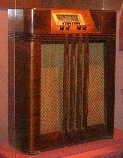
The first broadcast in 1929 was heard on radios like this beautiful old |