












To read more from Daniel, visit his blog: Sic Et Non.
Cover image via Gospel Media Library.
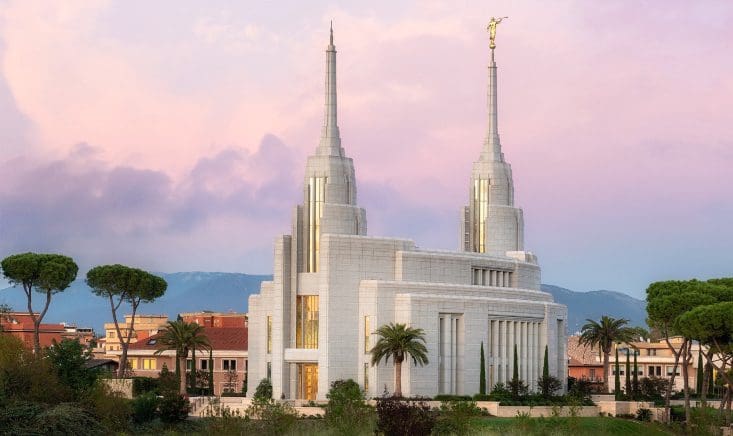
Not infrequently, I encounter complaints that Latter-day Saint temples are too lavish, that such grandiose buildings can have no genuine connection with the poor, wandering preacher known as Jesus of Nazareth. “Foxes have holes and birds of the air have nests,” he himself said, “but the Son of Man has no place to lay his head” (Matthew 8:20). “Go, sell everything you have and give to the poor,” he advised one young man, “and you will have treasure in heaven. Then come, follow me” (Mark 10:21).
There is, of course, no well-defined, objective line of demarcation separating ostentatious extravagance from what is reasonably “high-end.” Surely there is a point where a desire for quality passes over into excess. But is anything really too good or too beautiful for God?
I myself judge the many temples that I’ve seen to be beautiful, elegant, and serene, certainly, but not immoderate or excessive. Among other things, they are intended to provide at least a faint foretaste of heaven, and, to me, they have definitely done exactly that. (Some of my earliest intimations of faith came in connection with temples.)
An increasing proportion of Latter-day Saints live in what has sometimes been called the “Third World.” For many of them, I expect, the temples of the Church may well be the most beautiful buildings they are ever permitted to enter—and, yes, a harbinger of the blessings awaiting the faithful in the world to come. As a pampered and privileged resident of perhaps the wealthiest nation in human history, I’m happy if my tithes can help in even a small way to provide that experience for them, and I’m strongly disinclined to deprive them of it.
Others may disagree, of course. But we should be very humble about assuming that our own personal religious tastes are the standard by which the religious tastes of others must be measured and condemned. I can’t help being reminded, in this context, of Parson Thwackum, a character in Henry Fielding’s classic 1749 novel The History of Tom Jones, a Foundling: “When I mention religion,” declares Parson Thwackum, “I mean the Christian religion; and not only the Christian religion, but the Protestant religion; and not only the Protestant religion, but the Church of England.”
So, what does the Bible actually say about employing costly materials in a bid to honor God by constructing religious shrines? I’ll give you the spoiler right up front: It doesn’t condemn doing so.
Consider, as an example, the Israelites’ “Tabernacle in the Wilderness,” which was constructed in obedience to divine command by Bezaleel and Aholiab, the finest craftsmen to be found among the children of Israel (Exodus 31:3-6) According to the Lord’s instructions as recorded in Exodus 26-30, the Tabernacle, which was a relatively large portable temple, featured screens or curtains of blue, purple, scarlet, and “fine-twined” white linen hanging from a framework of gilded wooden bars passing through golden rings and silver sockets. Its furnishings were of brass or bronze, or overlaid with gold, or even, in some cases, made of “pure gold” (e.g., the “vessels,” the candelabra or menorah, and the sculpted cherubim described at Exodus 25:18-22, 31-40). Ministering in the tabernacle, Aaron the high priest not only wore costly vestments but wore a plate of “pure gold” on his forehead, on which was inscribed “Holiness to the Lord” (Exodus 28:36-38). The whole priestly liturgy of the Tabernacle represented considerable financial sacrifice for a group of recently freed slaves who were now nomadic exiles in the Sinai Desert.
So, did the Lord reject the Tabernacle? Hardly. He commanded it. Moreover, he said that he would speak to Israel from between, precisely, the two pure golden cherubim in the Holy of Holies (Exodus 25:22). And when the Tabernacle was complete, he manifested his acceptance of it by filling it with his glory, and it was accompanied thereafter by a cloud during the day and a pillar of fire by night, representing his presence (Exodus 40-34-38).
When Solomon set about to build Israel’s first permanent temple, it wasn’t only Israelites who worked on it. The Hebrew Bible tells us in 1 Kings and 2 Chronicles that Solomon imported a foreign overseer from the city-state of Tyre along with cypress and cedarwood and stonemasons—for which he paid lavishly in wine, oil, and wheat, and for which, eventually, he deeded twenty towns of the northwestern Galilee over to Hiram, the Tyrian king.
Did God reject the temple of Solomon? Apparently not. According to 1 Kings 8:11, at its dedication “the priests could not stand to minister because of the cloud: for the glory of the Lord had filled the house of the Lord.”
Now, of course, some Christians will dismiss the testimony of the Old Testament. The Tabernacle and Solomon’s Temple were pre-Christian buildings, they will say, and are therefore not relevant to the new Christian era. However, this maneuver won’t work for Latter-day Saints, for the simple reason that they believe the Jehovah of the Hebrew Bible to have been none other than Jesus. Even for mainstream trinitarian Christians, though, dismissing Old Testament precedents seems questionable. After all, isn’t the Son of God the second person of the Trinity? One God in three Persons? Without rejecting the Old Testament, which Jesus emphatically did not, it isn’t clear how modern Christians can dismiss the evidence that it offers for building expensive sanctuaries to honor God.
But we’ll move forward now into the New Testament. Nearly a thousand years after Solomon, Herod the Great rebuilt the ancient temple of Jerusalem on an even grander scale. Vast numbers of sacrificial animals, notably including unblemished lambs, were slaughtered in it on a daily basis, sacrificed along with the first-fruits of the field and costly blends of incense. Was this sheer wasteful extravagance? Couldn’t this money and these resources have been more usefully deployed? Shouldn’t they have been given to the poor?
How did Jesus feel about the temple during his mortal ministry? We can only go by what the New Testament tells us—and it doesn’t seem to tell us that the Savior rejected the temple of his day.
For one thing, Jesus’ family venerated Herod’s temple. The gospel of Luke (2:22-40) says that they “presented” their newborn son to God there. And Jesus himself carried on with their veneration for it. When he was ten years old, his parents temporarily lost him at the conclusion of the Passover Festival, but they found him in the temple. “Wist ye not that I must be about my Father’s business?” he asked them (Luke 2:41-52). Or, as several modern translations legitimately render the same passage, “Did you not know that I must be in my Father’s house?”
“Train up a child in the way he should go,” says Proverbs 22:6, “and when he is old, he will not depart from it.” Of course, Jesus probably didn’t require earthly training from Mary and Joseph in order to live righteously—he had a long track record of righteous living before he was born—but he certainly never departed from their reverence for the temple.
The accounts of his driving the money changers from the temple (which are given in all four of the canonical gospels, at Matthew 21:12-17, Mark 11:15-19, Luke 19:45-48. and John 2:11-17) clearly demonstrate this. “My house shall be called the house of prayer,” he thundered, “but ye have made it a den of thieves” (Matthew 21:13). “Make not my Father’s house an house of merchandise,” he said. “And his disciples remembered that it was written, The zeal of thine house hath eaten me up.” (They were recalling Psalm 69:9.)
So perhaps Christian veneration of the temple ended with the crucifixion, resurrection, and ascension of Jesus? Plainly not. His apostles continued thereafter to preach, teach, work miracles, and praise God in the temple precincts (see, for example, Luke 24:53; Acts 2:46; 3:1; 5:42). It’s quite true that the vision given to John the Revelator of the “new Jerusalem” at the end of time shows no temple in the city. But that’s because the city has itself become a temple, adorned with gold and precious stones and, precisely like the Holy of Holies of Solomon’s temple, a perfect cube in shape.
Obviously, the Savior wants us to care for the poor and the afflicted. And, in fact, his restored Church devotes substantial resources to doing precisely that. But the Bible, including the specifically Christian portion of it, absolutely does not insist that churches should erect only bare and purely functional buildings. The ordinances of the temple could, it’s true, be performed in Quonset huts or, for that matter, in the upper room of a small commercial building or on a mountain top—as, in fact, actually occurred early in this very dispensation. But those were temporary accommodations. The first vicarious baptisms for the dead were performed in the Mississippi River at Nauvoo, but the Saints were very soon informed that this was only a stop-gap measure and that, if the practice was to continue, they must build a temple (see Doctrine and Covenants 124:25-44).
A seemingly unrelated event in the life of Christ may be helpful in considering this topic, of how Christians should expend their resources: All four of the New Testament gospels recount the story—or, perhaps, the stories—in which, while Jesus was being hosted by a prominent person, a woman entered and anointed his feet and/or his head with expensive perfume. Comparable accounts occur in Matthew 26:6-13 and Luke 7:36-50 but, for this column, I’ll quote the account given in Mark 14:3-9 and, afterwards, that supplied by John:
“While he was in Bethany, reclining at the table in the home of Simon the Leper, a woman came with an alabaster jar of very expensive perfume, made of pure nard. She broke the jar and poured the perfume on his head. Some of those present were saying indignantly to one another, “Why this waste of perfume? It could have been sold for more than a year’s wages and the money given to the poor.” And they rebuked her harshly. “Leave her alone,” said Jesus. “Why are you bothering her? She has done a beautiful thing to me. The poor you will always have with you, and you can help them any time you want. But you will not always have me. She did what she could. She poured perfume on my body beforehand to prepare for my burial. Truly I tell you, wherever the gospel is preached throughout the world, what she has done will also be told, in memory of her.””
The gospel of John is typically quite distinct from that of the other three gospels, which are often termed “synoptic” (from Greek words for “together” and “seeing”) because of their similarities. In this case, though, John 12:1-8 also tells the story that is told in the synoptic gospels. But it includes interesting details that they do not include—among those details, significantly, the identity of the principal critic:
“Six days before the Passover, Jesus came to Bethany, where Lazarus lived, whom Jesus had raised from the dead. Here a dinner was given in Jesus’ honor. Martha served, while Lazarus was among those reclining at the table with him. Then Mary took about a pint of pure nard, an expensive perfume; she poured it on Jesus’ feet and wiped his feet with her hair. And the house was filled with the fragrance of the perfume. But one of his disciples, Judas Iscariot, who was later to betray him, objected, “Why wasn’t this perfume sold and the money given to the poor? It was worth a year’s wages.” He did not say this because he cared about the poor but because he was a thief; as keeper of the money bag, he used to help himself to what was put into it. “Leave her alone,” Jesus replied. “It was intended that she should save this perfume for the day of my burial. You will always have the poor among you, but you will not always have me.””





Jacob CrapoAugust 23, 2023
D H: Exactly right. Building temples brings an incredible opportunity for the construction workers in an area. I remember on worker on the Dallas temple (if I remember that right) who was a Baptist and said that the temple was his Masterpiece, the project he is most proud of. I think one thing that we can’t forget is the potential to change lives. A man I taught on my mission once said “The Freemasons make good men great but the Mormons make good men Saints.” That happens lately in the temple, and those Saints make promises to live better lives and build a better world.
Rosalie Erekson StoneAugust 19, 2023
When my husband and I saw the magnificent carved woodwork in the temple in Cochabamba, Bolivia, my first thoughts were similar to those you described when you wrote, "the temples of the Church may well be the most beautiful buildings [the local members] are ever permitted to enter—and, yes, a harbinger of the blessings awaiting the faithful in the world to come."