








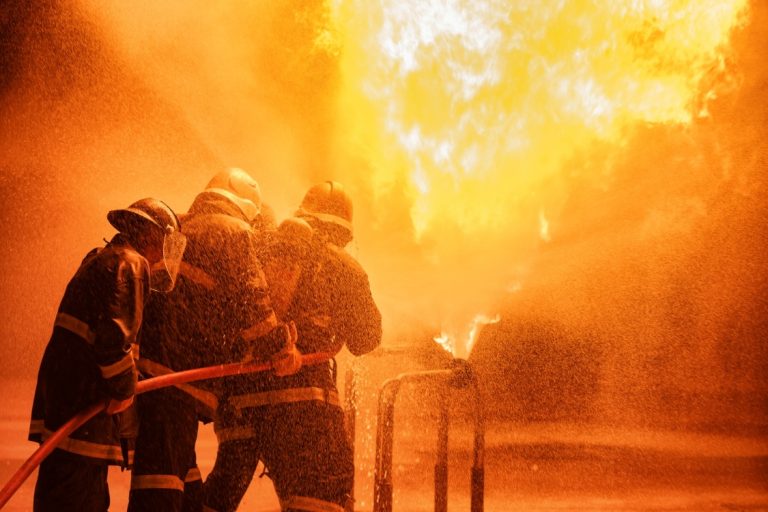


In the summer of 1979, The New York Times reported on more than 19 serious fires in six different states. Seven of the blazes were located in Idaho, including one around Ship Island in the Salmon National Forest. The Ship Island Fire, ignited by lightning on July 17, 1979, was located on dangerous terrain, forcing the fire response to focus on containment rather than immediately extinguishing the blaze.
On June 21, approximately 30 firefighters were airlifted into the location to stop the fire from spreading further. Five days later, the fire was still blazing, despite efforts to contain it. Kyle Pattee, fire management officer on the Ashton Ranger District, Targhee National Forest, had been called in to help with Salmon National Forest Fire. As a veteran firefighter with more than 300 fires under his belt, Pattee would be sure to handle the situation professionally.
On July 26, Pattee and a line scout were trapped when a spot fire began near the helipad where they had been taking charge of the situation. The spot fire, begun when embers drifted to their location and took hold, forced Pattee and the scout to take cover in portable fire shelters less than 20 feet from the blaze. Both Pattee and the line scout performed the drill “in a very professional and competent manner.” The line scout was forced to move his own shelter multiple times as the fire bore down around them. Unfortunately, Pattee’s fire shelter became too hot for his ungloved hands to manage, and he died from heat and smoke inhalation.
Several miles away in Challis, Idaho, then firefighter Tom Harbour arrived back at the firefighting dispatch office late at night. His day had been full of firefighting from the air, as he fought to contain a blaze approximately 40 miles away from Ship Island. “Acres of heavily wooded, heavily vegetated areas just exploding in flames in seconds,” Harbour described. “The heat and the sounds are just… you can’t explain to anybody who hasn’t been there.”
As he entered the dispatch office, a friend of his told him about the death of Pattee that had occurred while Harbour was in the air. Harbour turned from the lighted building, walking away alone into the dark, devastated. “I knew Kyle. He was about my same age… And he was a really good fireman. And he was dead.”
The impact of Pattee’s death, along with hundreds of other Line of Duty Deaths (LODD) that Harbour saw, changed his focus in firefighting. Rather than simply protecting the locations and people impacted by the fires, Harbour broadened his focus to protecting the firefighters under his care and across the field. “If there’s a triumph in my career, I hope it’s that I’ve helped somehow prevent one Line of Duty Death,” Harbour said. More than 55 years later, his dedication to LODD prevention speaks for itself.
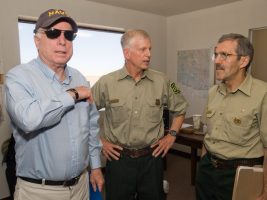 Throughout Harbour’s career as a firefighter, he worked as a Burn Boss, an Incident Commander, and an Area Commander for both prescribed wildfires and managing naturally caused wildfires. During his time serving, he presented more than 300 folded flags to the families of lost firefighters. “I’m quite confident that I’ve presented more flags to more firefighter families…” Harbour said. “I hope and pray nobody will ever be in a place where they will have to kneel down in front of the family as many times as I have.”
His experiences in the field gave him the knowledge to found HarbourFire, LLC, a consulting firm that offers expertise and advice regarding policies and organizational issues related to wildland fire management. Organizations can reach out to HarbourFire to learn about wildland firefighting, wildland aviation firefighting, public policies, and the National Incident Management System. He testified to Congress about his efforts, and was called to serve as the National Fire and Aviation Management Director from 2004 to 2015, the longest serving National Fire Chief to date.
His career eventually led him to The National Fallen Firefighters Foundation (NFFF) to work with them to reduce LODD,
Standard operating procedures (SOP) are reviewed on a regular basis, ensuring safety for the firefighters involved. Harbour now serves on the Board of Directors and Advisory Committee of the NFFF, where the experiences gained working on “10s of thousands of incidents” give him a unique perspective on how to help prevent those tragedies.
The largest factor the NFFF found in preventing LODD is fire prevention. Fire departments work with advocacy groups to spread awareness of simple things that can be done to avoid fires. These include installing home sprinkler systems, ensuring that buildings are up to fire code, and educating the public on how to manage smaller fires before they become life-threatening blazes. Education campaigns on ensuring campfires are maintained and vehicles are safely parked reduce the risk of wildfires.
While some tragedies occur in the field, many come for the firefighters long after the blazes have been extinguished. The trauma that heroic firefighters face is staggering. 90% of all firefighters report facing at least one traumatic experience in their career, along with higher occupational injuries and fatalities compared to other positions. Many of these heroes face fatigue, post-traumatic stress disorder, anxiety, and depression symptoms. “When you have that constant pressure and burden of danger and stress and death and fatigue, it takes its toll,” Harbour said.
Many firefighters would turn to alcohol, sex, or drugs in an attempt to cope with their trauma, leading many to develop heavy drinking or binge drinking habits. The culture of drinking as a firefighter is well-established across the world. Harbour described traveling to Russia and Greece, where alcohol flowed freely at firefighting conventions that he attended. It was a way for firefighters to bond over their common experiences and had become more than a simple pastime. Harbour said that when he chose not to drink alcohol, “that’s almost like slapping somebody in the face.” But for Harbour, it was more than an attempt to avoid negative habits. For him, it was part of his religion as a member of the Church of Jesus Christ of Latter-day Saints.
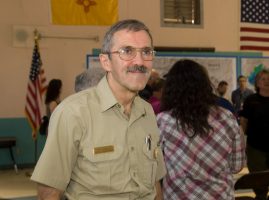 Harbour’s family had been looking for the right church of them all throughout his teenage years. As a young man, he was baptized into a number of different churches. He later changed his mind and abandoned religion and God, becoming an atheist. As he entered his 20s, he began to explore religion again, studying the teachings of the restored gospel of Jesus Christ and the Church of Jesus Christ of Latter-day Saints.
“I knew that Christ and Heavenly Father loved me. I knew that the Holy Ghost spoke to me, and I knew the words of scripture were in the Book of Mormon,” Harbour said. He would open his copy of the Book of Mormon late at night and read with a tiny flashlight, determined to follow the teachings within. He built his faith on a solid foundation, determined to be a righteous father, a good husband, a good son and son-in-law, and to do well in his career.
Harbour joined the Church in 1975, five years after beginning his career as a firefighter in central California. A year later, he married Laree Harbour and moved to Idaho. They raised four children together, which at times was challenging when he would be called away to fight a fire. Before cell phones were common, that was the only notice and warning that he would be gone for days, weeks, or even months at a time. “Our children grew up with mom getting up in the morning and [her] saying,
‘Dad had to go last night, in the middle of the night.’
‘When will he be back?’
‘As soon as he can be.’”
Often, Harbour would be on call during Church meetings or during the Sacrament on Sundays. He and other firefighters with him learned to silence their phones during those meetings, because they would need to leave at a moment’s notice. “I hope it made a difference that I never got up in the middle of the sacrament,” Harbour said. “I got up as soon as the sacrament was over, but I always tried to be careful of having the sacrament.”
With the stresses of work, the culture of drinking, and the long trips away from home, few members of the Church remain active. “They have high divorce rates,” Harbour said, and struggle to keep the commandments. He later said that he was quite confident that if he did not have the Church in his life to help guide him to making positive decisions, along with the support of his family, he would have struggled with many of the same things his brothers and sisters on the force did. “I was very blessed,” he repeated.
More than 55 years from the start of his career at the “very very bottom of the organization,” Harbour recognizes that he would never have gotten to where he is now without the help of Providential hands. “I always tried to ask, what could I take from the Savior and His teachings and apply it to my work?” Harbour said. “If I was skilled enough to pull a principle from a prophet and adapt it to my world, it always worked.”
His friends on the force would notice Harbour’s efforts to follow his religion. Even though few of them were members of the Church, they were still willing to support him. “They would build me up,” Harbour said. He was confident that they supported him because of his own confidence and belief in the Savior. “I was able to be resilient, and that resiliency came primarily from the Savior and our temple covenants.”
Harbour has long since retired from active service, yet continues to mentor the rising generation. Even with all the fires he fought and tragedies he witnessed, Harbour never let the flames of adversity consume his faith. His story stands as a testament to how faith in Jesus Christ can preserve the soul—even when surrounded by heat, loss, and chaos. “If there’s a young firefighter [who is a member of the Church] out there, I hope they know, ‘You can do this.’” For Harbour, it was never just about fighting fires—it was about protecting lives, upholding values, and keeping covenants.




BenAugust 6, 2025
Tom Harbour, and his wife Laree, are perhaps the most remarkable people I have ever met. They are always serving other before themselves.