



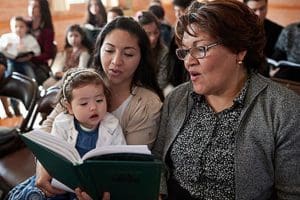





Cover image via Gospel Media Library.
“[F]ather’s blessings, patriarchal blessings, and other blessings are a remarkable privilege . . These individualized priesthood blessings are a powerful witness of the love of the Lord Jesus Christ in seeking to bring exaltation to each of us. They are our personal revelation from God.” (James E. Faust, Priesthood Blessings, Ensign November 1995)
My Cousin Paula
“Our patriarchal blessing will be an anchor to our souls, and if we are worthy, neither death nor the devil can deprive us of the blessings pronounced. They are blessings we can enjoy now and forever.” ¹
The word cancer has affected most people’s lives whether they or someone close to them has been diagnosed. Our family is no different. The “C” word has left its mark on many family members. Yet, when I heard my cousin Paula was diagnosed with terminal cancer, I was shocked.
Paula was truly a lovely lady whose sweet spirit radiated from her entire being. I recall the last time I saw Paula she was very pregnant with her fifth and last child. I remember massaging her shoulders hoping to offer a bit of relief and comfort. Some cousins are part of your everyday life, while others you seldom see. Since Paula and I lived nearly two thousand miles apart, we fell into the “seldom see” category. Traveling to Vernal, Utah from the Washington, DC area in the 1960’s and 1970’s was only done when we gathered for family reunions. Yet despite the distance and being less than a year apart in age, we enjoyed playing together during those cherished visits.
After Paula married, she continued to live in Utah while my husband and I, stayed in Maryland. Many years would pass without seeing each other, but Paula always had a place in my heart. So, when my sister Cheri called to tell me Paula had cancer, I hung up, then immediately called Paula. When she answered I got straight to the point and asked Paula what happened.
Paula was 37 years old and had five children, when cancer entered her life. Her youngest was just two years old. Paula explained that she was feeling exceptionally tired, yet excused it since she had a toddler and four other children to manage. It was when she began having trouble swallowing, that she went to the doctor. He thought it was likely a hiatal hernia and recommended a simple procedure. During the surgery, the doctor made the discovery.
“The doctor told me I was riddled with cancer and that nothing could be done,” Paula stated quite matter-a-factly. My reply of, “Is there anything I can do?” was followed by a contemplated response. “Well, my patriarchal blessing says I will be the keeper of the genealogy, but I don’t know anything about our family history. Do you know who does?” That was an easy question for me to answer since my mother and I were the earthly keepers. Paula then explained what she needed and why. “I would like to make booklets for each of my children.” I followed by giving her a quick explanation of what I would do to help make that possible. Then I remarked, “Well, we know what you will be doing on the other side!”
Through this entire conversation there were no tears or sadness or reminiscent memories. Paula was as delightful and direct as she always had been. Paula’s sweet nature was still there shining brightly. This would be our final conversation as she passed away just a few months later.
My Cousin Cari
“Little children who die will have this opportunity in the future. President Joseph Fielding Smith (1876–1972) explained: ‘The Lord will grant unto these children the privilege of all the sealing blessings which pertain to exaltation. … When they grow, after the resurrection, to the full maturity of the spirit, they will be entitled to all the blessings which they would have been entitled to had they been privileged to tarry here and receive them.’” ²
I never met my cousin Cari. The first time I was in her presence, her little body laid in the small, white casket at the front of the chapel. Cari was only two when she suddenly left this existence. Being late to her funeral service, I stood in the back of the room and recall focusing on my Aunt Pricilla, Cari’s mother. Pricilla’s eyes never left the casket, not even during the prayer. At the wake Priscilla said to me, “I couldn’t leave my baby in Africa; I had to bring her home.”
My Uncle Warren (my father’s brother) and Aunt Priscilla lived with half of their eight children in Johannesburg, South Africa; the other four were going to school in the United States. Warren worked in the rural, African Savanna for US Steel as a lead geologist in the field. Being out in the backcountry of Africa exposed him to contracting Malaria. This caused a need to take medication in hopes of preventing this serious illness.
When I saw Uncle Warren at the wake, he told me his story of Cari’s death: “Two weeks before Cari died I was told by the Lord that one of my children would be taken home. I was not told which child but was assured their earthly mission was complete.
“I took the medication to prevent Malaria since I traveled in the African Savanna,” Uncle Warren continued. “I always opened the container, took the pill, sealed the container shut and put it in my pocket. I have no memory of leaving the pill container open on the night table by my bed.”
Uncle Warren paused for a long moment. “The bright, orange pills would have been enticing to a two-year-old. They looked much like candy.”
My heart ached as I listened to the sorrow in my Aunt and Uncle’s voices. A few years later, I traveled to South Africa to visit them. This time, when they spoke of Cari, their words were laced with laughter, their memories softened by time. Through their stories, I caught glimpses of Cari as a bright and vivid toddler, yet at times, still felt a gentle ache of longing beneath the joy.
Cari, who died at age two, never received her patriarchal blessing, yet, from what her father told me, Cari’s earthly mission was complete.
Uncle Vearle
“[T]he recipient of the blessing should not assume that everything mentioned in it will be fulfilled in this life. A patriarchal blessing is eternal, and its promises may extend into the eternities.” ³
Samoa is a scared place for the McBride family. My Uncle Vearle’s Grandfather, Jesse Bert McBride began the Samoan mission tradition, when he stepped upon Samoan shores to preach the Gospel of Jesus Christ in the mid 1800’s. Jesse Bert’s son Don Carlos, who was Vearle’s father, would follow in his father’s footsteps by serving two missions on the islands of Samoa. Both of them had powerful, miraculous experiences while serving these wonderful people. (see A Mission Testimony of Jesse Burt McBride; Don Carlos McBride’s Second Mission to Samoa; Some of Grandfather Don Carlos McBride’s Spiritual Experiences As Related by his son, Vearl G. McBride)
When Vearle received his patriarchal blessing stating he would teach the people “upon the isles of the sea,” it seemed only natural to think he too, would serve a mission in Samoa. But, it was not meant to be, at least not in the capacity of a formal mission. What Vearle did do was to teach his Panoramic Reading method in several places across the globe including the islands of Samoa.
Vearle’s patriarchal blessing also mentioned his children would serve in Samoa and would see great destruction. Two of Uncle Vearle’s children, Maurice and Darla, both served two missions in Samoa. While serving upon these beautiful, tranquil islands, neither Maurice or Darla saw any destruction until Darla’s second mission in 2009.
On the 29th of September 2009, the Samoan Islands shook as two massive earthquakes—both measuring 7.8 in magnitude—struck. Together, they packed the power of a magnitude 8.0 quake and became known as a “doublet earthquake” because they happened so close together.
These violent shifts in the earth triggered a powerful tsunami. The impact was devastating, causing serious damage and loss of life as the sea level rose on the Samoan coast. The Tsunami waves reached about 46 feet (14 meters).
This event took place just a few months before Vearle passed through the veil of this life.
My Parents’ Patriarchal Blessings
“If the blessing does not mention an important event, such as a full-time mission or marriage, the person should not assume that he or she will not receive that opportunity.” ⁴
One of my cherished memories occurred while relaxing on the sofa in my parent’s living room surrounded by my parents and a few of my siblings. My father prepared to read his patriarchal blessing, which having been lost to him for many years was requested and replaced by the Church (Request My Blessing). I remember feeling the anticipation in the air.
As common with my father he began by describing in dramatic detail, the scene and timing surrounding the administration of receiving his blessing.
“The world was tilting toward war—fast. You could feel it in the headlines and in the hush of late-night radios. It was 1941, and danger was inching toward our shores like a rising tide,” he said, pausing as we leaned in, the weight of history settling between us. “I was just nineteen. Too young, officially, for a mission—twenty-one was the standard. But my bishop pulled me aside one afternoon. He looked me straight in the eye and said, ‘I feel if you don’t serve a mission now, you never will.’ That was all I needed.” My father paused again, then concluded, “I officially entered the mission field on December 7th, 1941.”
My siblings and I were not lost on the date our father entered the mission field. Pearl Harbor. The day America was thrust into the chaos of the Second World War.
My father went on. “Before I left, I asked for my patriarchal blessing. As I listened, I figured if we became entangled in the war, I wasn’t coming back. It didn’t mention anything about marriage or a family. He paused, then gave a small, knowing smile. “Turns out, I couldn’t have been more wrong.”
This is when my mother chimed in. At that moment she told us that her patriarchal blessing also never mentioned marriage or family. Obviously, they did marry and produced nine children, 37 grandchildren and many great-grandchildren. After this revelation about our parents’ blessings, my siblings and I joked that our family was patched together; we were the left overs, the misfits knitted together to form this interestingly odd family!
My Patriarchal Blessing
If one is worthy, all promises will be fulfilled in the Lord’s due time. Those promises and blessings that are not realized in this life will be fulfilled in the next. ⁵
When I received my own patriarchal blessing, I was just shy of my thirtieth birthday. I recall listening intently as Patriarch John Baker pronounced wonderful, desired blessing with the hope of attaining them through my faithfulness. As he spoke, I felt a powerful sense of love from the Lord—not just for me, but for my husband, our children, and even my ancestors.
As I reflect on the deeply personal guidance, the many promises and blessings spoken, I am filled with wonder at how intimately the Lord knows me—my needs, my hopes, and my eternal potential. Whether or not the things spoken of in my patriarchal blessing are fulfilled in this life or the next, I am certain they will come to pass if I stay firmly on the covenant path.
My patriarchal blessing helped increase my faith and trust in my Heavenly Father and my Savior. It also increased my love for Them—and it still does.⁶
Conclusion
The stories of Paula, Cari, Uncle Vearle, my parents—and even my own—each paint a unique picture of how patriarchal blessings unfold in real life. Sometimes, we see their fulfillment in clear and immediate ways. Other times, we’re left wondering, watching as the Lord’s timing unfolds in unexpected or eternal patterns. What unites them all is this: each blessing is a testimony of the Lord’s personal awareness of our lives.
Paula’s desire to fulfill her role as the “keeper of the genealogy” became part of her final earthly mission and has likely carried on into the eternities. Cari’s short but meaningful life was affirmed by a father’s spiritual witness that her mission was complete. Uncle Vearle’s patriarchal promise extended beyond his own lifetime, reaching into the lives of his children and through the tremors of a literal earthquake. My parents’ blessings, which seemed to omit the most obvious of life’s milestones, were not lacking—but rather layered with eternal meaning beyond the ink on the page. And mine continues to unfold in quiet, personal ways that remind me God knows me deeply.
Patriarchal blessings are not roadmaps with exact mile markers—they are heavenly declarations of potential, purpose, and divine identity. They are treasures from a loving Father who sees our whole soul, not just our current season. Some promises may be fulfilled in this life. Others are held in trust for the next.
In the meantime, we walk in faith, trusting that the Lord remembers every word—and that in His due time, all things will be fulfilled.
“Your patriarchal blessing is but a prelude to receive even greater blessings from your Father. Paul wrote, ‘Eye hath not seen, nor ear heard, neither have entered into the heart of man, the things which God hath prepared for them that love him.’ (1 Corinthians 2:9). All that the Father has is hard to imagine, but your patriarchal blessing isn’t just about what you will get. It is about what you can become through the grace of God and Christ.⁷
NOTES
“Every worthy, baptized member is entitled to and should receive a patriarchal blessing, which provides inspired direction from the Lord. Patriarchal blessings include a declaration of a person’s lineage in the house of Israel and contain personal counsel from the Lord. As a person studies his or her patriarchal blessing and follows the counsel it contains, it will provide guidance, comfort, and protection.” ⁸
- Faust, James E..Priesthood Blessings. https://www.churchofjesuschrist.org/study/eng/general-conference/1995/10/priesthood-blessings. Accessed 7 June 2025.
- Mathews, Mark A. Mathews. The Salvation of Little Children Who Die: What We Do and Don’t Know. https://www.churchofjesuschrist.org/study/eng/liahona/2021/07/the-salvation-of-little-children-who-die-what-we-do-and-dont-know. Accessed 7 June 2025.
- Patriarchal Blessings. https://www.churchofjesuschrist.org/study/eng/manual/gospel-topics/patriarchal-blessings. Accessed 7 June 2025.
- Glenna McBride Hansen (his niece). 1950. A Mission Testimony of Jesse Burt McBride. Viewed May 2025
- Dictated by John and Minnie Hinck to Elaine McBride Pratt: Re-typed from Elaine Pratt’s document in 2007 by Cris McBride. Don Carlos McBride’s Second Mission to Samoa. Viewed May 2025
- Contributed by Tanya McBride Skeen. Some of Grandfather Don Carlos McBride’s Spiritual Experiences As Related by his son, Vearl G. McBride. 2003. Accessed 8 June 2025.
- Patriarchal Blessings. https://www.churchofjesuschrist.org/study/eng/manual/gospel-topics/patriarchal-blessings. Accessed 7 June 2025.
- Patriarchal Blessings. https://www.churchofjesuschrist.org/study/eng/manual/gospel-topics/patriarchal-blessings. Accessed 7 June 2025.
- Bennett, Randall K..Your Patriarchal Blessing—Inspired Direction from Heavenly Father. https://www.churchofjesuschrist.org/study/eng/general-conference/2023/04/25bennett. Accessed 7 June 2025.
- Wilcox, Brad: “Three Things You Need to Know about Patriarchal Blessings”. LDS Living, 2 Aug. 2021, https://www.ldsliving.com/Brother-Brad-Wilcox-three-things-you-need-to-know-about-patriarchal-blessings/s/94543.)
- Patriarchal Blessings. https://www.churchofjesuschrist.org/study/eng/manual/gospel-topics/patriarchal-blessings. Accessed 7 June 2025.




Rochelle HaleJune 13, 2025
As a recent convert, I received my Patriarchal blessing at about age 16 1/2. It was a beautiful blessing given by our beloved stake patriarch and member of our ward family. Over the next few years, I would read it and mentally check off the things I had accomplished or the blessings I had received. However, another reading would indicate to me that I had a long way to go. It was kind of like the magic you find when reading the Book of Mormon again and again; there is always something new to learn or do.