












To read more from Daniel, visit his blog: Sic Et Non.
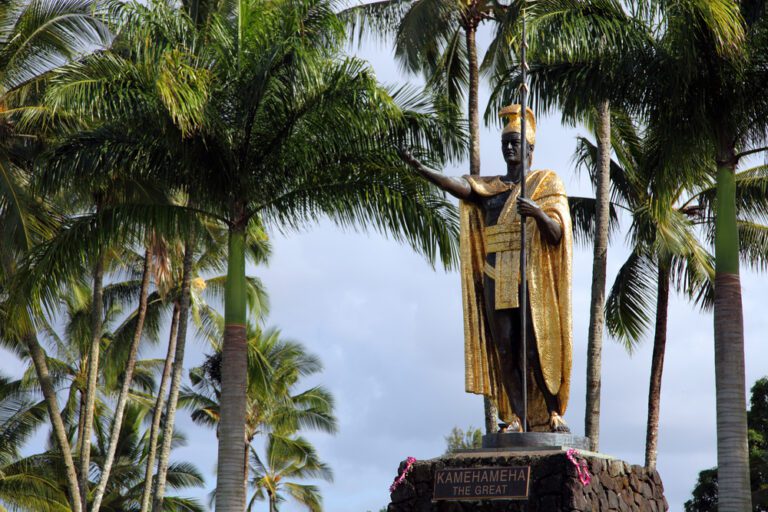
Cover image: Statue of Kamehameha the Great.
During a recent visit to the Hawaiian island of Oahu, we drove up to the Nuʻuanu Pali, a mountain pass that offers a spectacular vista across the other side of the island from Honolulu. We’ve been there many times before; the highway that goes over the pass is, among other things, a major way to reach Laie, the picturesque North Shore town where sit the Polynesian Cultural Center, the Hawaii campus of Brigham Young University, and the beautiful temple dedicated by President Heber J. Grant in 1919.
Nuʻuanu Pali was also the site of the Battle of Nuʻuanu, one of the bloodiest military encounters in Hawaiian history. Having already conquered his home island of Hawaii and seized the neighboring islands of Maui and Molokai, Kamehameha I (aka “Kamehameha the Great”) next invaded the island of Oahu. The pivotal battle for the island occurred in May 1795 in Nuʻuanu Valley, where Oahu’s defenders were driven back up into the mountains, trapped above the cliff, and then forced by Kamehamehaʻs invaders to plummet to their deaths. Approximately 400 warriors perished in the battle.
Not for the first time, I wondered while standing there why we call Kamehameha “the Great,” and why his name and his statues still show up all over Hawaii. Yes, he unified Hawaii under a single ruler. Himself. But for what? Simply because he wanted to own all of the islands? Why? Did he have innovative ideas for helping people? Was he trying to serve them? Didn’t he lack enough poi to eat? Was his grass-hut palace on the Big Island too small? How many people needed to die for him to gratify his ambition?
During his lengthy reign over the Hawaiian Islands, which he had unified for the very first time, Kamehameha may have made some changes for the better. He may have done some good. But Kamehameha was also a man who, on one occasion, ordered one of his priests to pound water out of dry earth and then hanged that priest. Why? Because the task that the priest had been ordered to accomplish was completely impossible.
And here’s yet another story about how Kamehameha I gained complete control of the Big Island, preparatory to his unification of the Hawaiian Islands as a whole:
By 1782, he had taken over western and northern Hawaii island (i.e., the Kona and Kohala districts). During the next eight years, however, he fought several inconclusive further battles, trying to increase his realm. And then, after returning from his conquest of Maui in 1790, he was attacked by his cousin Keoua Kuahuula, who still controlled the eastern side of the island, in the area of modern Hilo. Thereupon, presumably frustrated, Kamehameha returned to the seaside village of Kawaihae, where he had spent some time earlier. There, a respected “kahuna,” or priest, suggested the building of a “luakini heiau,” a sacrificial temple, as a means of gaining the favor of the war god Kukailimoku.
The massive temple was completed in the summer of 1791. So, in a seeming gesture of friendship and reconciliation, Kamehameha invited his erstwhile rival Keoua Kuahuula to come for a visit to the new temple, offering the false promise of a peace treaty that would put an end to the strife between them. However, when Keoua Kuahuula stepped ashore, he and his entourage were captured and killed. And, with the offering of their bodies, the new temple was officially dedicated. Thus, with his base secured on his home island, Kamehameha could proceed once more with the subjugation of the other islands.
So why, again, do we call such men “great”? To repurpose words from Joel 2:3, “the land is as the garden of Eden before them, and behind them a desolate wilderness.”
I suspect that there’s a different standard in heaven for greatness. And there should probably be a different standard on earth, as well. As the Savior taught, “He that is greatest among you shall be your servant. And whosoever shall exalt himself shall be abased; and he that shall humble himself shall be exalted.” (Matthew 23:11-12)
At the end of April, I traveled to the ancient city of Samarkand, in the independent Central Asian republic of Uzbekistan, where I participated in a Muslim-Christian conference. However, before the conference actually began, a number of us spent part of a day at the Gur-i Amir. This is the mausoleum of the famous Turkic conqueror Timur, who is also often known as “Timur-i Leng” and, in the West, as “Tamerlane.” (Shakespeare’s rival and contemporary Christopher Marlowe wrote a play about him, “Tamburlaine the Great” that is occasionally performed still today.)
Timur, who died in February 1405, founded the relatively short-lived but enormous Timurid Empire, which covered not only today’s Uzbekistan and much of the rest of Central Asia, but the modern areas of Iran, Iraq, and Afghanistan, the southern Caucasus, and portions of contemporary Turkey, Pakistan, and northern India. I soon noticed that Timur was being treated by local guides and signage as a hero. For example, a larger than life-sized statue of an enthroned Timur is located in a park within easy walking distance of the hotel where our conference was based.
My own view, however, is that Timur is yet another of those who are called “Great” but whose claim on the title seems very questionable. And I’m not the only doubter. While we were under the dome of the Gur-i Amir listening to our guide praise Timur, one of the Iranian scholars with whom we were meeting leaned over to me and whispered, “He was a horrible person, you know.” I couldn’t agree more. It’s beyond question that Timur was a brilliant and consistently victorious general, but he was brutal and cruel even by the standards of highly successful ancient and medieval warlords. Perhaps, I suspect, pathologically so.
I apologize for the rather graphic nature of what follows, but I deem it necessary to make my point: Timur appeared to take great and seemingly psychopathic pleasure in torturing and killing people. One of his trademark acts after capturing cities that had resisted his attentions was to build large piles or towers of severed heads; one source that I recall reading in graduate school reported that, with the passage of time, the severed heads would decay and that, at night, they began to give off an eerie greenish glow.
Once, when the important city of Isfahan—a center of Persian art and literature that I visited some years ago—revolted against his oppressively high taxes, Timur ordered its citizens massacred; the death toll is estimated to have been between 100,000 and 200,000. An eyewitness counted more than 28 towers constructed of about 1,500 heads each, in the case of Isfahan alone.
And here’s a charming story that I also recall reading while I was in graduate school: A mid-sized city found itself in the path of one of Timur’s military campaigns and, hearing about the mass slaughters that had occurred in towns that had resisted him, decided to open its gates and surrender rather than to suffer the same fate. In fact, it went even further: When the conqueror approached, the residents of the city sent a large number of its young girls out to meet him, clad in white and strewing flowers before him. Evidently, though, he wasn’t in a good mood that day. (Perhaps he had a headache. Maybe his rheumatism was acting up, or he was suffering from a bad hangnail.) So he ordered his cavalry to trample the young girls to death.
But enough of these charming anecdotes. Let’s take a larger bird’s eye view. It’s probably not surprising that the late “great” Comrade Joseph Stalin, who himself ordered the murder of scores of millions of his own citizens, admired Timur and was intrigued by him. And, as Stalin is reputed to have quipped, an individual death is a tragedy, but a million deaths are merely a statistic. Even in this regard, though, Timur’s numbers are appalling: One source suggests that he was responsible for the deaths of approximately twenty million people—which, in the fourteenth century, would have represented roughly five percent of the world’s total population.
I’m skeptical of many of these “great” men. I find it more and more difficult to admire anybody who, as the eighteenth-century English poet Thomas Gray put it, “wade[d] through slaughter to a throne and shut the gates of mercy on mankind.”
What about Napoleon, for example? In the early nineteenth century, of course, the population of Europe was much smaller than it is today. But the estimates that I’ve seen still suggest that between 2.5 and 3.5 million soldiers died during the Napoleonic Wars, with civilian deaths estimated at between 750,000 and 3 million. In other words, the death toll during the Napoleonic Wars was at least 3.25 million people and possibly as many as 6.5 million. And, again, for what, exactly? Did Napoleon need a larger bed? Did his murderous conquests enable him to consume more food than he already did? To wear more shirts? Did almost seven million people need to die so that he could build a nicer home? Did he improve the lives of the survivors? Not discernibly. And yet I know that he is venerated by many in France. Does he deserve such veneration?
I wrote this column in England. Often, when I’m in London, I visit the tombs of the monarchs in Westminster Abbey. The history represented there is dazzling, perhaps especially for anybody who knows Shakespeare’s histories—which are littered with rebellions, exploitation, betrayals, murder, and sheer moral wreckage. Henry III oppressed English Jews and attempted to conquer France. His son Edward I expelled the Jews from England and invaded Scotland and Wales. Richard II was deposed and probably starved to death by Henry IV. Mary, Queen of Scots, was imprisoned for nearly two full decades by her cousin Elizabeth I (“the Great”) and finally beheaded. (In the Abbey, her body lies just thirty feet from Elizabeth’s.) Henry VII overthrew and killed Richard III and then gave us, as his heir, the notorious Henry VIII. And one final example: During her roughly five years as monarch of England, Mary I burned more than two hundred religious dissenters at the stake, which explains the title of “Bloody Mary” by which she is often called.
I’ve come to think much more highly, instead, of such rulers as the genuinely great Mauryan emperor Ashoka of India — great, certainly, in the later period of his life, after his rather conventional beginning as a bloody conqueror — about whom I wrote for the “Deseret News” back in 2012. (See “Indian Ruler Sowed Seeds of Buddhism”: https://www.deseret.com/2012/5/6/20410909/indian-ruler-sowed-seeds-of-buddhism/). I admire Anwar Sadat of Egypt, who finally decided, after decades of destructive wars between Israel and the Arabs, to try to end their fruitless violence and bloodshed. Ultimately, alas, his dramatic visit to Jerusalem and his involvement in the Camp David Accords cost him his life.
And true greatness can easily be found among non-rulers. Take Maximilian Kolbe, for instance. Nicholas Winton. Raoul Wallenberg. The villagers of Le Chambon. Saint Damien of Molokai. Political power isn’t needed for greatness. Nor is wealth. I’m not being sentimental here when I observe that many of the greatest moral heroes of our time, or indeed of any time, are mothers: They sacrifice their time, their ambitions, and their sleep for their children, without glory, without material rewards, and with little if any public praise.
Our society is too often fascinated with shallow, self-absorbed, self-indulgent, unserious, and morally defective celebrities, directing its admiration toward people who, frankly, don’t deserve it. One magazine annually features a cover announcing a list of “the year’s most interesting people.” And yet our planet’s most genuinely interesting men and women seldom if ever make that list.
The Lord, though, invites us to judge by a different standard: “He hath shewed thee, O man, what is good; and what doth the Lord require of thee, but to do justly, and to love mercy, and to walk humbly with thy God?” (Micah 6:8)







Corey D.June 15, 2025
Great article and thought provoking. I'm a great admirer of Thomas Jefferson and often I think of our present political and social environment and our present leaders and think what a contrast. I have often had the thought, especially when I was still working, if Jesus was a CEO what would that be like ? Thanks again for an interesting article.
HelenCJune 9, 2025
Dr. Dan, as your Very Favorite Brit I’ve had to do some hard thinking about Elizabeth I, especially in her later years, and I would like to apply Anna Leonowens quote to her but there were definitely times when she didn’t try as hard as she could have. For example, her treatment of the sailors who were released after her Navy’s success over Spain, then left to beg or starve on the streets of England. Her father, Henry VIII, was similar but, I think, more culpable in wrong-doing. I wonder what kind of people both would have been had they not worn the crown? Not a job I would ever want, that’s for sure!