








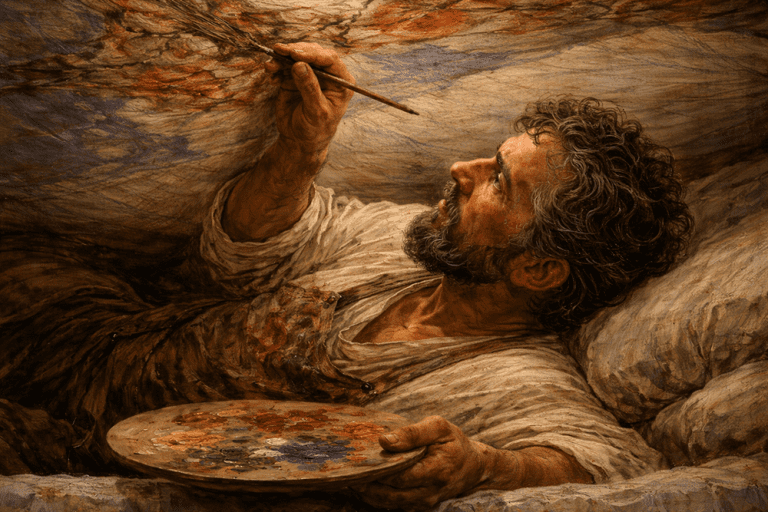


Michelangelo Buonarroti considered himself a sculptor, not a painter, when he reluctantly accepted a commission from Pope Julius II to paint the ceiling of the Sistine Chapel. From the outset of that daunting project, he faced serious logistical, technical, and physical challenges including his limited experience with large-scale fresco painting. He basically had to master the technique on the job.
He described the artistic complications of painting while lying on his back: “My brush, above me all the time, dribbles paint so my face makes a fine floor for droppings! … I am not a painter.” (1)
The young artist devoted about four years of intense labor to his masterpiece, lying on scaffolding sixty-five feet above the ground, in the heat and humidity of the poorly ventilated chapel. His efforts took a steep physical toll, including eye problems. The awkwardness of craning his neck for prolonged periods caused chronic neck and back pain. Michelangelo’s personal descriptions of the process sound absolutely miserable. I wonder if he considered those years of intense effort and discomfort to be worth the price he paid.
In 2022, my husband and I decided to celebrate our 35th anniversary in Italy, and we invested a great deal of time planning and preparing for the trip. Every guidebook and article we read urged travelers to purchase tickets many months in advance for the more popular attractions. So, we sat down with a laptop one evening and successfully scheduled visits to several art galleries in Florence, then turned our attention to Rome and Vatican City. We were frustrated to find that all of the tours to the Vatican Museums and Sistine Chapel were already sold out on the days we would be there. How could we go to Rome and not see inside these famous places? I had looked forward since my early teens to viewing in person the artistic genius of Michelangelo’s frescoes in the Sistine Chapel.
My husband persisted in his search for tickets until he discovered one ridiculously expensive early morning tour which concluded with breakfast on the Vatican grounds. The price was enough to make us raise our eyebrows and immediately reject the idea of paying that much money. However, after careful consideration, Brad and I agreed that a trip to Rome without seeing the Sistine Chapel would be incomplete. Though we gulped at the price, we went ahead and purchased the tickets.
In Rome, many months later, our excellent Italian guide Suzanne (pronounced Su-ZANN-uh), met us inside the Vatican Museum at 7:00 a.m. and we were surprised to discover that we were the only people in our tour group. Suzanne walked us through portions of the Vatican Museum, pointing out items of interest, but she was very aware of the time and knew the exact moment to take us to the door of the Sistine Chapel when no one else was inside. After experiencing the claustrophobia-inducing crowds of Florence, and the bustling craziness that is much of Rome, here we three stood in absolute silence. We had the Sistine Chapel to ourselves as we raised our eyes toward one of the world’s artistic masterpieces.
I was particularly moved by one of the central panels of the ceiling, The Creation of Adam. Though I had previously seen many photographs of this work, I was unprepared for my deep emotions as I viewed in person the familiar depiction of God reaching out to impart life to Adam, their fingers nearly touching.
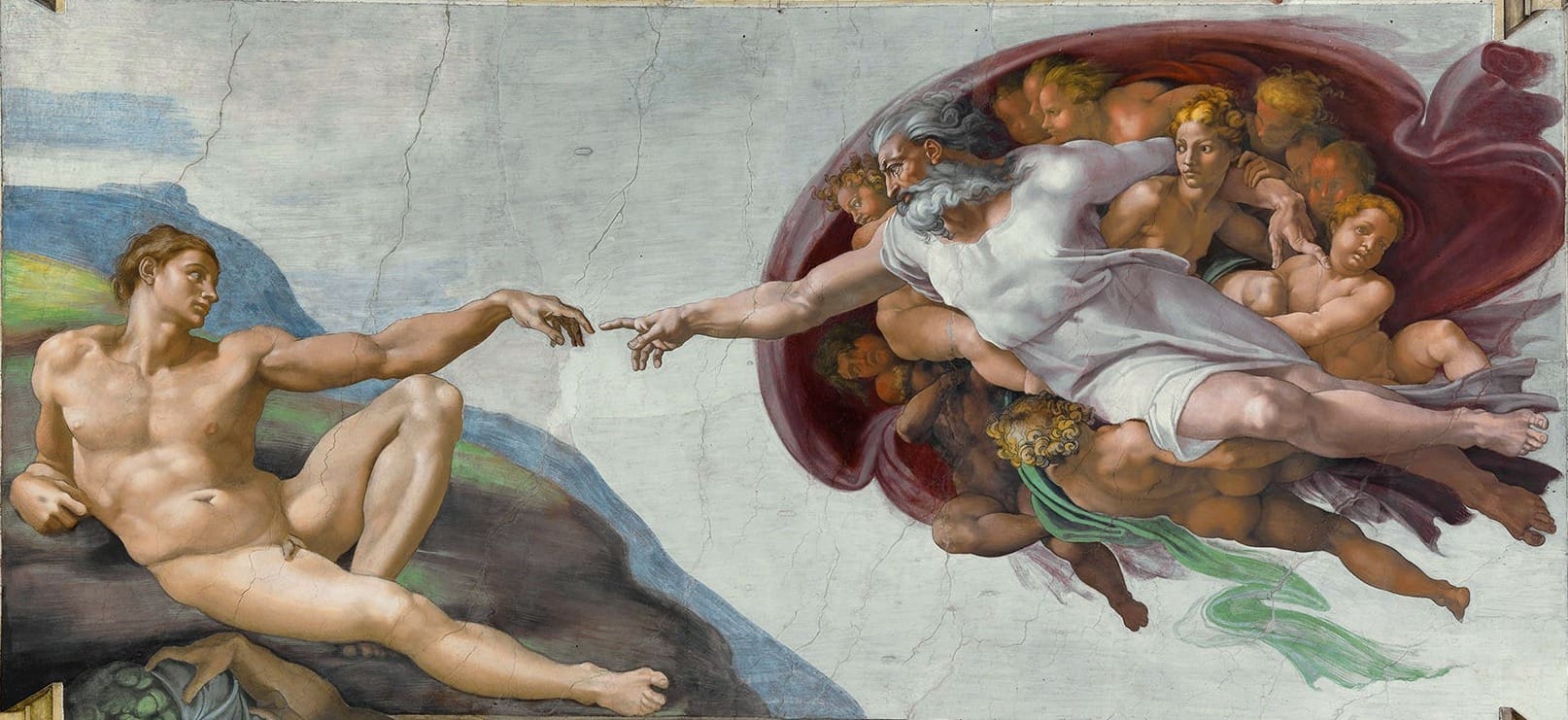
Michelangelo, Public domain, via Wikimedia Commons
When I glanced at Suzanne with tears in my eyes, she smiled and acknowledged softly, “You understand.” I left the chapel that morning thinking, “This was worth every cent we paid.”
Many things in life are not worth the money or time we spend on them: the new shirt that shrinks the first time it’s washed, the tool that breaks after only a few uses. But many things are worth the money, the time, the sacrifice, or the mental, physical, or spiritual exertion they require.
—Home grown tomatoes and corn on the cob are worth the months-long effort of preparing soil, planting, watering, weeding, and harvesting.
—Mastering a new language, developing proficiency on a musical instrument, or becoming a professional athlete may involve tens of thousands of hours of practice. Each of these pursuits require the “price” of serious time and effort.
Over the last several months, I have learned a spiritual lesson while watching someone pay a different kind of price: extreme physical suffering. During my daughter-in-law Emily’s first pregnancy, she experienced Hyperemesis Gravidarum (HG), an extreme form of nausea and vomiting during pregnancy which usually requires medical intervention. It became nearly impossible for Emily to keep any food or liquids down, necessitating IV infusions to prevent dehydration. I was truly scared for her as these severe symptoms lasted through the entire pregnancy. What a relief it was when her baby girl arrived healthy, and Emily’s misery finally abated.
Four months ago, our family was surprised to learn that Emily was expecting another baby. I had not thought she would be willing to endure a second pregnancy since her doctors assured her that it was 99% likely that she would experience HG again. Emily and my son thought long and hard about the consequences, but—ultimately—Emily decided that she wanted a sibling for her daughter badly enough to pay a steep price. And she is paying. This second pregnancy has been brutal.
Each time I look at my beautiful Emily and see the suffering in her face in spite of her efforts to smile, I get a lump in my throat. She had no idea what the first pregnancy would cost her physically, emotionally, or mentally. But she willingly went into this second pregnancy, fulling knowing what the cost would be, because she felt it would be worth the price she would have to pay.
I cannot help but draw parallels to the One who paid the ultimate price for all of God’s children who would ever live on earth. He, too, must have counted the price that would be required of Him when He volunteered, “… Here am I; send me.” The atonement of Jesus Christ was the ultimate expression of sacrificial love.
No mortal can comprehend the full extent of the Savior’s suffering as He wrought His infinite atonement, but His own words give us a glimpse of the depth of His sacrifice for us:
“For behold, I, God, have suffered these things for all, that they might not suffer if they would repent; But if they would not repent they must suffer even as I; Which suffering caused myself, even God, the greatest of all, to tremble because of pain, and to bleed at every pore, and to suffer both body and spirit—and would that I might not drink the bitter cup, and shrink…” (D&C 19:16-19)
From the prophet Isaiah:
“He was wounded for our transgressions; he was bruised for our iniquities. The chastisement of our peace was upon him, and with His stripes we are healed.” (Isaiah 53:5)
Elder Tad R. Callister declared, “The Great Deliverer has rescued us — saved the day, saved eternity. But, oh, what a battle! What wounds! What love! What cost!” (2)
By enduring the unspeakable suffering of His infinite atonement, Jesus Christ showed that it was worth the price He paid. That we are worth the price He paid.
Notes:
- https://www.poetryfoundation.org/poems/57328/michaelangelo-to-giovanni-da-pistoia-when-the-author-was-painting-the-vault-of-the-sistine-chapel
- Tad R. Callister, The Infinite Atonement, p. 138.





Robert JohnsonMarch 21, 2026
God’s Son had pushed the earth apart And laid my finger on His heart! Christ’s death split the veil in two, And let the face of God shine through. —RMJ (Adapted in 2023 from the 1912 poem Renascence by EDNA ST. VINCENT MILLAY and D&C 138, 88 & 93) ATONEMENT AND RESURRECTION Easter asks us a question, is the joy of Sunday worth the pain of Friday? That's what Easter's all about. It's that question. Is the joy of Resurrection Sunday at the Garden Tomb worth the Atoning pain of Friday in Gethsemane and on the cross? Will the joy of our resurrection be worth the painful adversities of life? Jesus and the scriptures and the prophets (and Edna St. Vincent Millay) are going to say, "Yes, yes, it's worth it. —S. Michael Wilcox (Follow Him podcast New Testament Episode 19 part 2 edited by RMJ) It is also my testimony that it won’t be easy but it will be worth it. Our hereafter will depend on what we seek after here.
Robert JohnsonMarch 20, 2026
God’s Son had pushed the earth apart And laid my finger on His heart! Christ’s death split the veil in two, And let the face of God shine through. —RMJ (Adapted in 2023 from the 1912 poem Renascence by EDNA ST. VINCENT MILLAY and D&C 138, 88 & 93) ATONEMENT AND RESURRECTION Easter asks us a question, is the joy of Sunday worth the pain of Friday? That's what Easter's all about. It's that question. Is the joy of Resurrection Sunday at the Garden Tomb worth the Atoning pain of Friday in Gethsemane and on the cross? Will the joy of our resurrection be worth the painful adversities of life? Jesus and the scriptures and the prophets (and Edna St. Vincent Millay) are going to say, "Yes, yes, it's worth it. —S. Michael Wilcox (Follow Him podcast New Testament Episode 19 part 2 edited by RMJ) It is also my testimony that it won’t be easy but it will be worth it. I conclude, where I started, with the theme for today. Our hereafter will depend on what we seek after here. In the name of Jesus Christ, amen.