





Sign up for Meridian’s Free Newsletter, please CLICK HERE
Editor’s Note: The following is the third installment in a series on Margaret Blair Young’s work in the DR-Congo along with her husband and her brother. It explores some of the hard realities they’ve encountered and how they are being addressed not only by the LDS Church but by some remarkable Catholics as well.
I thought I was just making a movie!
The initial plan was to make a film set in the Democratic Republic of Congo. The plot was compelling: A former revolutionary becomes a missionary and is paired with an Anglo. Each has huge issues—including tribalism/racism—to overcome. It was based on true experiences. We got some good seed money to start the film and found some of the best filmmakers to help. But as we traveled to the Congo, we soon realized that the lack of infrastructure would make filming difficult if not impossible. We visited a studio in South Africa and decided to film there. At least, that was the plan.
“Things fall apart,” said Yeats in his poem “The Second Coming.”
Turning and turning in the widening gyre
The falcon cannot hear the falconer;
Things fall apart; the centre cannot hold;
Mere anarchy is loosed upon the world. . .
When Nigerian author Chinua Achebe wrote a book about African traditions and colonialism, he used Keats’ words for his title.
The plans for the film fell apart. The details aren’t relevant. There were a few days when it appeared that the film would simply not get made without a miracle. Nevertheless—and it still amazes me to think back on this–during this time, I was supported by a rare sense of gratitude. In the temple, after my “things fall apart” moment, I was buoyed up by energetic hope, joy, and thanksgiving—beyond what I had experienced heretofore. Perhaps my plans for the film were only one part of a larger plan, and this lively gratitude was for all I had learned up until that point.
I had not yet been to Lodja (DR-C). When I got there on July 29th, 2017, and was taken throughout the city and told of the horrors the war had wrought on the people, I recognized that my screenplay was an American take on a Congolese story and that I didn’t know enough to do the subject justice. I set about to learn more. I overhauled the script. Not only that, but I sent it to my Congolese film team for translation and help. When I first met the priest who would be a significant part of the re-write, I had no way of knowing that he was already an award-winning author, playwright, and poet.
I had no way of knowing that he had studied not only the history of the Congo but its poetry and the intricacies of its languages. In our first meeting, he was fresh from overseeing construction on a university building and wasn’t wearing his priest’s collar, just work clothes. I would not actually learn about his academic history or his writing awards for another two months. Then it was clear that the support our film project required had already been supplied. A way had been prepared. In fact, I recognized that I was not capable of writing a screenplay which would be free of appropriation. I needed somebody who knew the culture at my side.
And there was more.

As we looked at the poverty of Lodja, at the schools which had been war-torn, at the lives which had been traumatized, it became clear that we needed to do much more than make a film. We needed to be about the work of restoration.
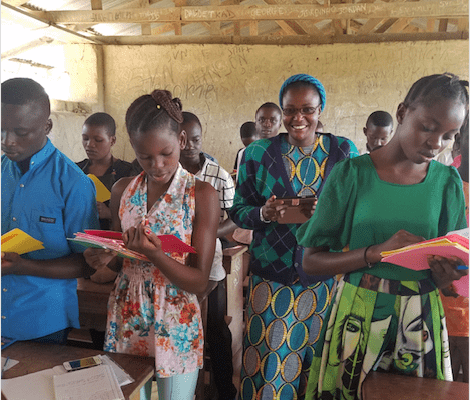
We started with oral histories. War kills hope, and stories of heroism, survival, success renew hope. We started gathering these histories and then taught our students how to create and bind their own books. We let them know that their stories were worth telling; that their little successes were heroic and could inspire others.
When we presented the bound oral histories to our subjects, the responses were delighted screams, shouts of “C’est magnifique!” and some jumping. One man, though, tried to be circumspect. We gave him his beautifully bound oral history and then talked a bit more about his remarkable life. As we talked, he tried to pay attention to our words, but the book drew his eyes. He nodded contemplatively and was visibly restraining himself from reading his new book. After we departed, he called his son. “We are doing well, aren’t we,” he said in Lingala. “I have been a poor man for all of my life. But look where we are now! You have a good job. And there’s a book about me!”
The message of our oral history project to those who participated was simply, “Your life matters.” It was a significant step towards the restoration of hope.
On my second trip to Lodja (November 2017), I brought a solar panel, DVD player, and a power box, and we successfully showed a film. I also brought donated food coloring and made simple paint for the students in the various schools. An LDS ward had donated two-hundred small paint brushes, which the students received with eager shouts. Some wrote their names in color. Others painted pictures. We were opening up possibilities.
We are now planning our next trip. We will make the film, but we will do much more than that. With us will be a pediatrician to assess the medical needs of Lodja and ultimately to meet them; a university president from Utah and two of his assistants; a curriculum designer; a linguist; two elementary school teachers. A total of ten Americans will go to Lodja with the understanding that we are directly involved in the work of redemption. We realize that we will gain more from those we teach than we will give to them. We go with respect for them and for their culture but also tooled to provide access to education in many ways and fields.
For twenty years, I worked with Darius Gray, who remains one of my dearest friends. We told the stories of black pioneers and were always inspired by them. Often in a fireside, Darius would present a sermon which he called “Not a curse but a calling.” In this sermon (which I never repeat in whole, as it is his), he talks about the pre-existence in which we pre-mortals were given assignments. He describes how it might have been when the Lord called him forward and said, “Darius, you will go to a country where racism is a huge problem. You will be born into a line which has included slavery in its past. You will confront segregation and prejudice—and you will be tempted to become bitter and angry. You are expected to maintain your spiritual gift of love and to share that gift—with the particular nuances you will learn in your family—with others. Do you accept this assignment?” At this point, he would look significantly at the audience and then say, “And silly me. I said yes.” He would then turn to me and say, “And the Lord said to Margaret, ‘”You are assigned to a line which has had many privileges, and you will be tempted to become arrogant and dismissive of others, to indulge in prejudice. You are assigned to maintain your spiritual gift of love AND to share your gifts with others—including access to various blessings. Do you accept this assignment?”
From the first time I heard Darius present these compelling words, I have thought about what it means to provide or to open up access to those without it, that all may be benefitted (D&C 46:12). I thought about my father, who went into many lands to learn the languages of others, and who consistently referred to them as “my teachers.” His methods valued the gifts of each student even as he opened up new gates of knowledge for them.
I learned about the many spiritual gifts which Darius brought into our partnership, gifts of joy and of music. I learned about his mother, who would sometimes interrupt her housekeeping by sitting down at the piano and singing an enthusiastic hymn—because she could not resist the song. I was blessed by getting to know his family, most of whom had died long before I met Darius. He also benefitted from my spiritual gifts and talents, and the work we did together bore good fruits.
Who will our teachers be as we go to Lodja? We don’t yet know their names, but we know that God knows them. What gifts will we exchange? We know only our preliminary plans, and see the whole work line upon line. We will understand it only in retrospect.
We know, though, that God knows every dimension of this particular assignment. And that is enough.